
Skip to content
Wall to Wall
A suffocating Korean thriller where the dream of home ownership curdles into paranoia — 84 square meters of concrete pressing in, every unexplained thud from above the sound of a life collapsing.
Wall to Wall

Wall to Wall

84제곱미터

"A life of debt, of endless noise, am I to blame?"

17 July 2025 South Korea 118 min 6.2 (279)

Director: Kim Tae-joon

Cast: Kang Ha-neul, Yeom Hye-ran, Seo Hyun-woo, Kim Hyun-jeong, Jeon Jin-oh

Drama Thriller Debt as a form of imprisonment Inter-floor noise as social warfare The collapse of the middle-class dream Paranoia and the unreliability of perception Atomized community and the death of neighborliness

Overview

In April 2021, at the height of Seoul's runaway property boom, Noh Woo-seong buys an 84-square-meter apartment for 1.1 billion won — the standard-issue Korean dream, sized to the millimeter. He moves in with his fiancée and a mountain of debt, convinced he has bought his way into the future. By August 2024 the same apartment is worth somewhere in the 800-million range, the engagement is over, and Woo-seong is carrying more than 700 million won in loans while working a day job and delivering packages at night.

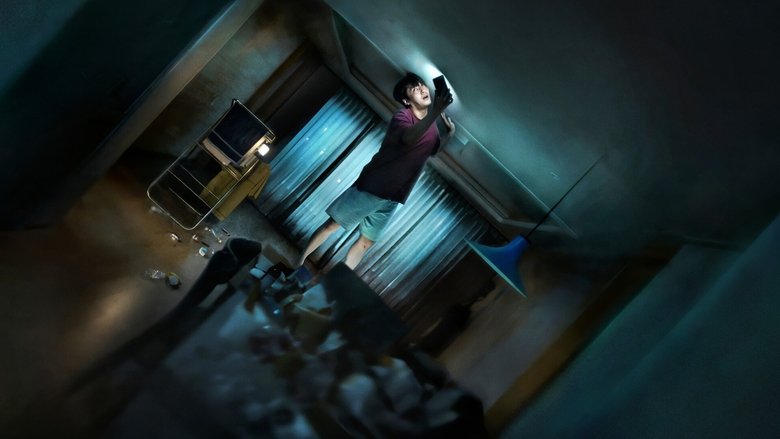
Then there is the noise. Thuds, scrapes, hammering — sourceless sounds that bleed through the ceiling and floor at all hours, that no one else in the building will admit to hearing the way he hears them. Woo-seong's neighbors blame him; he blames them. What begins as a familiar, almost mundane Korean grievance — 층간소음, inter-floor noise — slowly hardens into obsession, and the corridors of a perfectly ordinary apartment tower start to feel like the corridors of a trap.

Written and directed by Kim Tae-joon, the film spends its first hour as a pressure-cooker social drama about debt and shame, then, in its second hour, turns into something markedly stranger and more violent. Kang Ha-neul carries almost the entire running time as a man being slowly hollowed out by his own address, with Yeom Hye-ran and Seo Hyun-woo as neighbors whose interest in his suffering is not quite neighborly.
Core Meaning

Kim Tae-joon takes the most banal conflict in Korean domestic life — the neighbor upstairs who won't stop stomping — and uses it as an X-ray of a whole economy. The noise is never really the point. The point is that Woo-seong has mortgaged his entire adult life to a box of concrete whose value collapsed the moment he signed, and that the only thing he has left to defend is the very thing destroying him.

The film argues that the Korean housing market has turned ordinary people into each other's enemies. Debt makes you unable to leave; being unable to leave makes every sound a persecution; persecution makes you turn on the only people in the same trap. Woo-seong cannot fight the banks, the developers, or the forty consecutive weeks of record-high prices that lured him in, so he fights the ceiling.

Underneath the thriller mechanics is a bleaker suggestion: that the noise of modern humanity, squeezed together, does not stop when the villains are gone. The apartment was never haunted by a person. It was haunted by an arrangement.

Thematic DNA

Debt as a form of imprisonment 30%
Inter-floor noise as social warfare 22%
The collapse of the middle-class dream 20%
Paranoia and the unreliability of perception 16%
Atomized community and the death of neighborliness 12%

Debt as a form of imprisonment

Woo-seong buys at 1.1 billion won in April 2021 and watches the valuation fall into the 800-million range by August 2024, leaving him with over 700 million won in loans. He works days and delivers at night; he even gambles on crypto to claw his way out, and it goes sideways. He cannot sell without ruin and cannot stay without madness — the mortgage, not the walls, is what actually holds him inside the frame.

Inter-floor noise as social warfare

Korea's 층간소음 problem is real and enormous — tens of thousands of formal complaints a year — and the film treats it as the front line of a low-grade civil war. Neighbors accuse, surveil, retaliate and escalate over sounds no one can prove. The building's residents have no shared language for grievance, only doors, intercoms and passive-aggressive notes, so every complaint becomes an act of aggression.

The collapse of the middle-class dream

The Korean title — 84 Square Meters — names the standard apartment unit that stands in for having 'made it'. Woo-seong achieves the exact template of a successful young Korean life and finds it hollow: the fiancée leaves, the savings evaporate, and the asset that was supposed to secure his future becomes the instrument of his ruin.

Paranoia and the unreliability of perception

Because the noise cannot be located, Woo-seong's sanity becomes the contested territory. Neighbors insist he is the problem; he becomes convinced they are conspiring. The film keeps the audience inside his hearing, so that we cannot fully separate genuine persecution from a mind fraying under financial terror.

Atomized community and the death of neighborliness

Hundreds of households stacked vertically, sharing walls, floors and air, and none of them know each other's names. What community does exist forms around grievance — residents' meetings, complaint groups, factions — rather than around care. Proximity without intimacy is the film's definition of the modern apartment block.

Character Analysis

Noh Woo-seong

Kang Ha-neul

Archetype: Everyman turned antihero Key Trait: Stubborn endurance curdling into obsession

Motivation

To hold on to the apartment at any cost, because letting it go would mean admitting that everything he sacrificed — the relationship, the sleep, the 700 million won in loans — bought him nothing.

Character Arc

Begins as an ordinary striver celebrating the purchase of his first home in 2021. Over three years he loses his fiancée, his savings and his sleep, sliding from reasonable complainant to obsessive investigator to a man capable of severing a gas line and walking away from a burning apartment. His arc is not redemption but corrosion — and in the final scene, having survived, he returns to an empty unit, hears the noise again, and laughs.

Eun-hwa

Yeom Hye-ran

Archetype: False ally / manipulator Key Trait: Disarming warmth over a hard calculation

Motivation

Self-preservation and control: protecting what the ledger would expose, and steering a desperate man toward the outcome that serves her.

Character Arc

Presents herself as a fellow resident who understands Woo-seong's torment and can help him find the source of the noise, drawing him into the building's politics. Her real agenda emerges late, and she ends the film attempting to kill Woo-seong using the ledger hidden inside a stack of magazines — only to be stabbed to death in the struggle.

All 3 characters and cast

Symbols & Motifs

84 square meters

Meaning:

The standardized unit of Korean aspiration. A life measured, priced and sold in identical increments — the dream as a mass-produced product.

Context:

It is the film's original title and its entire stage. Nearly everything that matters happens inside, or just outside, this one floor plan, replicated hundreds of times up and down the tower.

The noise from above and below

Meaning:

Ostensibly a nuisance; actually the sound of other people's lives pressing against yours. By the end it reads as the noise of modern humanity, squeezed together — something no individual can silence because no individual causes it.

Context:

It starts as a plot problem to be solved, becomes a weapon, and finally returns in the last scene as something Woo-seong can only laugh at.

The ledger

Meaning:

Written proof — the documentary record of who did what to whom. In a world where everything is denied, the paper trail becomes the most dangerous object in the building.

Context:

Late in the film it is concealed inside magazines and used as a lure; Woo-seong ultimately puts it in the microwave along with his apartment papers, destroying the record of ownership and the record of guilt in the same gesture.

Fire and the severed gas line

Meaning:

Purification by destruction. When the asset cannot be sold, escaped or survived, burning it is the only exit that feels like agency.

Context:

Woo-seong cuts the gas line and triggers an explosion, then walks out imagining the whole tower going up — a fantasy of total erasure the film pointedly refuses to grant him.

Water and the ceiling stain

Meaning:

Leakage between lives: whatever happens above always seeps down. The building cannot keep anyone's business private, no matter how thick the concrete.

Context:

Damage and seepage from neighboring units function as the visible counterpart to the invisible sound, evidence that the boundaries residents defend so violently are not real.

Delivery work and the motorbike

Meaning:

The gig economy as the underside of the property ladder — the same person who owns an apartment must ride through the night to keep it.

Context:

Woo-seong's night shifts intercut with his daytime respectability, showing how a single 84-square-meter box requires two entire lives to sustain.

Philosophical Questions

Can you own a home, or does the home end up owning you?

Woo-seong holds the deed and is nonetheless entirely controlled by the asset: he cannot sell it without ruin, cannot leave it, and organizes two jobs and his whole psyche around servicing it. The film pushes the question toward its bleakest form — ownership as a relationship of obligation running in the opposite direction from the one advertised.

Is it possible to live decently among strangers you are physically fused to?

The apartment tower is a machine for maximum proximity and minimum relationship. Every character's suffering is transmitted through shared concrete to people who have no way to acknowledge it except as an accusation. The film suggests that without some form of mutual obligation, closeness produces only friction.

When the true cause of your suffering is a system, where does your anger go?

Woo-seong cannot confront the banks, the developers or the market cycle that ruined him. He can, however, confront the person on the fourteenth floor. The plot is essentially a study in displaced rage, and the ending — the survivor alone with the same noise — is the film's verdict on whether displacement ever works.

At what point does self-defense become the thing you were defending against?

The climax leaves Woo-seong having cut a gas line, caused an explosion in a residential tower, and survived a mutual slaughter. The film declines to grant him moral cleanliness; it asks whether a man pushed far enough becomes indistinguishable from what pushed him.

What does it mean that the noise never stops?

In the final scene, in an emptied apartment with the antagonists dead, the sound returns. The film reframes it as the irreducible sound of other people existing nearby — the noise of modern humanity, squeezed together — and asks whether the only available response is Woo-seong's laugh.

Alternative Interpretations

The literal reading. Everything is exactly what it appears: a genuine conspiracy among neighbors, a real ledger, real culprits, and a man who is correct all along. Under this reading the film is a straightforward indictment — Woo-seong is persecuted, fights back, and survives, and the closing noise is simply proof that the building's pathology outlives its individual bad actors.

Full ending explanation

Cultural Impact

Wall to Wall arrived as one of Netflix's 2025 Korean originals at a moment when Korean genre cinema's defining export has been the class-rage thriller — the lineage running from Parasite through Squid Game, in which the architecture of Korean life (basements, dormitories, apartment blocks) does the ideological work. Kim Tae-joon's contribution is to narrow the lens from society to a single floor plan, and to pick a grievance so ordinary that Korean audiences recognize it instantly.

Its context is entirely non-fictional. The film is built on the real 2021 Seoul property spike that pushed a generation into what Koreans call 영끌 — 'scraping together every last soul' to buy in before being priced out permanently — and on the equally real epidemic of 층간소음 disputes, which in Korea have escalated to assault and homicide often enough to be a recurring news category. By dramatizing both at once, the film made explicit the connection ordinary coverage keeps separate: people trapped by debt cannot simply move away from a bad neighbor.

Critically the reception was middling-to-warm rather than rapturous. The South China Morning Post gave it three stars out of five, praising it as a clear step up for the director, and multiple reviewers noted that the film works best as a close-quarters pressure chamber in its first half before its second hour veers into more conventional thriller violence. Its IMDb user score settled around 5.9. Its broader impact has been less as a cinematic landmark than as a conversation piece — a film that gave a very specific national anxiety an internationally legible horror shape.

Audience Reception

Praised: Kang Ha-neul's near-solo performance carrying the film's escalating desperation, the claustrophobic single-location tension of the first hour, and above all the premise's relatability — reviewers repeatedly noted how effectively the film dramatizes economic inequality and the impossibility of home ownership for younger generations in expensive cities. Critics also broadly agreed it represents a clear step up from Kim Tae-joon's debut, Unlocked.

Criticized: The tonal break at the midpoint. Multiple reviews observed that the film 'starts out as your typical drama about noise pollution from neighbors' before morphing into something quite different in its second hour, and viewers split sharply on whether that turn is a bold escalation or a betrayal of the grounded social realism that made the setup so effective. The final act's violence and contrivance drew the most complaints, and audience scores reflected the divide — the IMDb user rating settled around 5.9, while the South China Morning Post landed on three out of five.

Contentious points: Whether Woo-seong remains sympathetic after the gas-line explosion in an occupied residential building; whether the closing laugh is earned catharsis or an authorial shrug; and whether the film's social critique survives its genre turn or is consumed by it.

Verdict: A sharply conceived, well-acted pressure chamber whose first half is stronger than its second — valued more for the acuity of its subject than for the elegance of its plotting.

Interesting Facts

  • The Korean title, 84제곱미터 (84 Square Meters), refers to the most popular apartment unit size in South Korea; director Kim Tae-joon chose it specifically to ground the story in a reality most Korean viewers live inside.
  • Roughly 80 percent of South Korea's housing stock is multi-family housing, and more than 80 percent of that is apartments — the statistical basis for the film's claim to universality.
  • According to the Korea Environment Corporation, there were 33,027 consultation cases related to inter-floor noise in Korea in 2024, and more than 110,000 people have joined online support communities for people dealing with the problem. Kim cited this scale of suffering when explaining why he made the film.
  • The film opens with an on-screen statement that apartment prices in Seoul were setting record highs for the fortieth week running — the real-world 2021 property mania that sets the entire plot in motion.
  • Wall to Wall is Kim Tae-joon's second feature and his second Netflix film, following the 2023 thriller Unlocked; James Marsh of the South China Morning Post called it 'a marked improvement' on that debut.
  • The film premiered on Netflix worldwide on July 18, 2025, and runs 118 minutes.
  • Kim discussed the project at a press conference in Seoul in July 2025, framing inter-floor noise as a conflict that nearly every Korean has either suffered or been accused of causing.
  • The narrative is structured around precise dates and numbers — an April 2021 purchase at 1.1 billion won, a slide into the 800-million range by August 2024, over 700 million won in outstanding loans — so that the horror is delivered in the language of a mortgage statement.

Frequently Asked Questions

Explore More About This Movie

Dive deeper into specific aspects of the movie with our detailed analysis pages

Comments (0)

Leave a comment

No comments yet. Be the first to share your thoughts!

Similar Movies