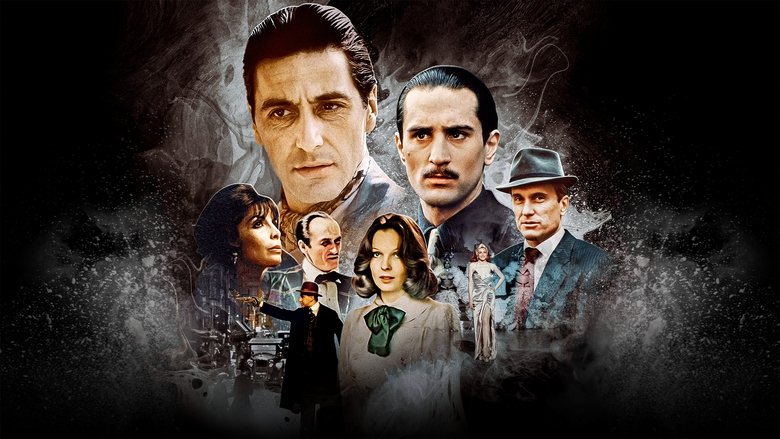
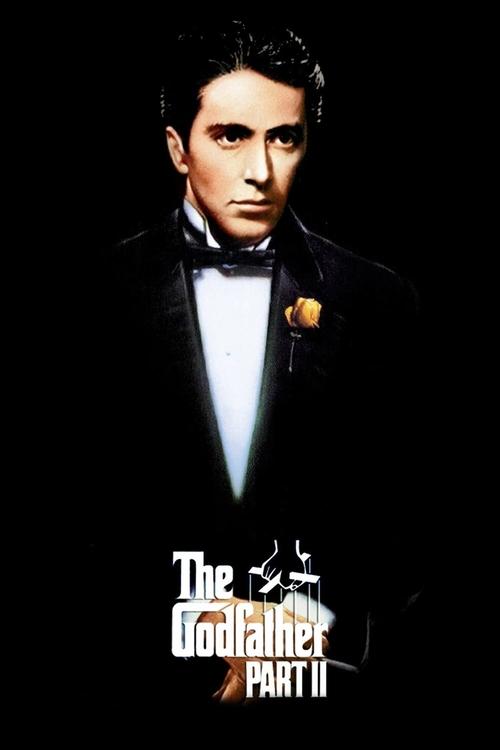
The Godfather Part II
A somber, epic crime drama that charts the corrosive deep-seated rot of power and the tragic unraveling of a family, painted in haunting shadows and golden-hued memories.
The Godfather Part II

The Godfather Part II

"The rise and fall of the Corleone empire."

20 December 1974 United States of America 202 min ⭐ 8.6 (13,226)
Director: Francis Ford Coppola
Cast: Al Pacino, Robert Duvall, Diane Keaton, Robert De Niro, John Cazale
Drama Crime
The Corruption of Power The Immigrant Experience and the American Dream Family and Betrayal The Inescapable Cycle of Violence
Budget: $13,000,000
Box Office: $102,600,000

Overview

"The Godfather Part II" presents a dual narrative that serves as both a sequel and a prequel to the original film. One storyline follows Michael Corleone in the late 1950s as he endeavors to protect and expand the Corleone family's criminal empire, venturing into Las Vegas, Hollywood, and pre-revolution Cuba. This chapter of his life is marked by betrayal from within his own family, assassination attempts, and a deepening descent into moral isolation. Michael's journey is one of consolidating power at the immense cost of his own soul and family relationships.

In a parallel narrative, the film flashes back to the early 20th century to trace the origins of a young Vito Corleone. After his family in Sicily is murdered by a local Mafia chieftain, Vito escapes to New York City. From his humble beginnings as an immigrant in Little Italy, we witness his gradual and calculated rise from a quiet family man to a respected and feared community leader, laying the foundation for the powerful Corleone family. These two interwoven stories create a rich, layered epic that explores the cyclical nature of power, violence, and the elusive, often corrupted, American Dream.
Core Meaning

The core meaning of "The Godfather Part II" is a profound exploration of the corrupting nature of power and the tragic irony of destroying one's family in the name of protecting it. Director Francis Ford Coppola contrasts the rise of Vito Corleone with the moral fall of his son, Michael. Vito, while ruthless, builds his empire on a foundation of community and family, earning respect and loyalty. Michael, in his quest to secure the family's legacy and legitimize its business, becomes a cold and paranoid tyrant, alienating and ultimately destroying those closest to him. The film serves as a cautionary tale about the immense personal cost of ambition, suggesting that the pursuit of absolute power inevitably leads to spiritual and emotional emptiness. It delves into the dark side of the American Dream, portraying a success story built on violence and deceit that ultimately leaves its inheritor victorious but utterly alone.

Thematic DNA

The Corruption of Power 35%
The Immigrant Experience and the American Dream 30%
Family and Betrayal 25%
The Inescapable Cycle of Violence 10%

The Corruption of Power

This theme is central to Michael's story arc. As he consolidates his power as the new Don, he becomes increasingly ruthless, paranoid, and emotionally detached. His actions, particularly ordering the murder of his own brother, Fredo, signify his complete moral decay. The film contrasts Michael's reign with his father's; while Vito used violence to establish his family and protect his community, Michael's use of power becomes a destructive force that shatters his family from within, leaving him isolated and spiritually bankrupt by the film's end.

The Immigrant Experience and the American Dream

Vito Corleone's backstory is a poignant depiction of the immigrant's journey and a critical examination of the American Dream. Arriving in America as a penniless orphan, Vito's rise to power is a perverted version of the classic success story. He achieves wealth and influence not through legitimate means, but through organized crime, responding to a society that initially offers him little opportunity. His story explores how the pursuit of success in America can be built on violence and sacrifice, questioning the very nature of the dream itself.

Family and Betrayal

The concept of family is both the foundation and the ultimate casualty of the Corleone saga. Vito builds his empire on the principle of family loyalty. In stark contrast, Michael's story is fraught with betrayal, most devastatingly from his brother, Fredo. Michael's response to this betrayal—disowning and eventually killing Fredo—is the ultimate violation of the family values his father held dear. This act, along with the disintegration of his marriage to Kay, underscores the film's tragic message: in his effort to protect the family's power, Michael destroys the family itself.

The Inescapable Cycle of Violence

The film suggests that violence is a self-perpetuating cycle. Vito's journey begins with the murder of his family in Sicily, which he later avenges by killing the local Don, Ciccio. This act of vengeance solidifies his path. Decades later, Michael continues this legacy of violence, eliminating his enemies with cold precision. The parallel structure of the film emphasizes this cyclical nature, showing how the sins of the father, however justified in his own mind, are visited upon the son in a more tragic and soul-crushing manner.

Character Analysis

Michael Corleone

Al Pacino

Archetype: Tragic Hero/Anti-hero
Key Trait: Ruthless

Motivation

Michael is driven by a desire to protect and legitimize the Corleone family, a promise he made to his wife, Kay. However, his primary motivation becomes the consolidation of his own power and the elimination of all threats, leading to a state of perpetual paranoia and a belief that extreme measures are necessary for survival.

Character Arc

Michael's arc in this film is a descent into darkness. Having fully embraced his role as Don, he transforms from the reluctant outsider of the first film into a cold, calculating, and ruthless leader. His efforts to protect the family lead him to commit monstrous acts, culminating in the murder of his own brother. By the end, he has achieved immense power but has lost his family and his soul, leaving him a hollow, isolated figure.

Vito Corleone

Robert De Niro

Archetype: The Patriarch/Founder
Key Trait: Astute

Motivation

Vito's initial motivation is survival and providing for his family in a new and often hostile country. As he gains power, his motivation expands to protecting his community from extortionists and establishing a respected and influential family enterprise. His actions are consistently framed by a deep-seated commitment to his family and a traditional code of honor.

Character Arc

The film portrays Vito's rise from a young, traumatized immigrant to a powerful and respected Don. His journey is one of careful calculation, strategic violence, and the cultivation of loyalty through favors and protection. He builds his criminal enterprise as a means to provide for his family and community. His arc concludes with him avenging his family's murder in Sicily, solidifying his status as a formidable and just leader in his world.

Fredo Corleone

John Cazale

Archetype: The Resentful Sibling/The Betrayer
Key Trait: Insecure

Motivation

Fredo is motivated by a desperate need for respect and to prove his worth. He feels he was unfairly passed over as the head of the family and resents being treated as the weak, incompetent brother. This deep-seated insecurity makes him vulnerable to manipulation by Michael's rivals, who promise him a larger role and the respect he craves.

Character Arc

Fredo's arc is a tragic one, fueled by feelings of inadequacy and being overlooked within the family. He is portrayed as weak and not particularly intelligent, a perception that deepens his resentment, especially towards Michael. His desire for respect and to be his own man leads him to betray Michael by colluding with his enemies. This betrayal ultimately leads to his disownment and eventual murder at Michael's command, a devastating conclusion to his struggle for significance.

Tom Hagen

Robert Duvall

Archetype: The Consigliere/The Voice of Reason
Key Trait: Loyal

Motivation

Tom's primary motivation is loyalty to the Corleone family and the preservation of its interests through legal and strategic counsel. He consistently tries to be the voice of reason, advising Michael against rash actions and attempting to de-escalate conflicts. His loyalty is unwavering, even when Michael pushes him away.

Character Arc

Tom Hagen's role as consigliere is tested as Michael becomes more insular and paranoid. While he remains loyal, his influence wanes, and he is often kept at arm's length by Michael, who questions his wartime capabilities. Tom struggles to maintain his position as a trusted advisor in the face of Michael's increasing coldness and isolation, representing a more level-headed, business-oriented approach that clashes with Michael's ruthlessness.

Symbols & Motifs

The Parallel Timelines

Meaning:

The dual narratives of Vito and Michael serve as a powerful symbol of contrast and comparison. Vito's story represents the rise of the family, built on community, tradition, and a certain code of honor. Michael's story symbolizes the family's moral decay and descent into a colder, more corporate form of criminality, where loyalty is secondary to power.

Context:

The film constantly intercuts between Vito's warm, sepia-toned past in early 20th-century New York and Michael's cold, starkly lit present in the late 1950s. This juxtaposition highlights the tragic irony of Michael's journey: as he gains more power, he loses the very humanity and family connection that his father fought to build.

The Kiss of Death

Meaning:

The kiss is a symbol of ultimate betrayal and a death sentence. It is a gesture that feigns affection or forgiveness while sealing the recipient's fate.

Context:

The most significant use of this symbol is when Michael discovers Fredo's betrayal in Cuba. During a New Year's Eve party, Michael grabs Fredo, kisses him forcefully on the lips, and says, "I know it was you, Fredo. You broke my heart. You broke my heart." This moment marks the point of no return for Fredo, signifying that his betrayal is unforgivable and that he is marked for death.

Doors

Meaning:

Doors often symbolize separation, isolation, and the division between Michael's business and family life. A closing door frequently signifies Kay's exclusion from the dark realities of the Corleone family's affairs.

Context:

Similar to the iconic final shot of the first film, doors continue to play a symbolic role. When Kay reveals her abortion to Michael, he explodes in rage and throws her out of the room, shutting the door on their marriage. The final shots of the film emphasize Michael's solitude, often framed by doorways and windows, visually representing his emotional and moral imprisonment.

Memorable Quotes

Keep your friends close, but your enemies closer.

— Michael Corleone

Context:

Michael says this to Tom Hagen while discussing his dealings with Hyman Roth. It explains his strategy of continuing to do business with Roth despite suspecting him of orchestrating the assassination attempt.

Meaning:

This iconic line encapsulates Michael's strategic and cynical philosophy. It advises that one must maintain a vigilant watch over rivals and potential threats by feigning friendship and alliance, in order to anticipate their moves and ultimately defeat them.

I know it was you, Fredo. You broke my heart. You broke my heart.

— Michael Corleone

Context:

Michael confronts Fredo at a New Year's Eve party in Havana after Fredo inadvertently reveals his connection to Johnny Ola and Hyman Roth. Michael delivers the line after giving Fredo the "kiss of death."

Meaning:

This quote signifies the devastating moment Michael confirms his own brother's betrayal. It is a rare expression of personal pain from the otherwise stoic Don, but it is immediately followed by a cold and unforgiving condemnation, effectively sealing Fredo's fate.

If anything in this life is certain, if history has taught us anything, it's that you can kill anyone.

— Michael Corleone

Context:

Michael says this to Tom Hagen in response to Tom's assertion that Hyman Roth is too powerful and well-protected to be assassinated, comparing it to trying to kill the President.

Meaning:

This chilling statement reflects Michael's complete embrace of a nihilistic and ruthless worldview. It dismisses any notion of invincibility and underscores his belief that power ultimately resides in the ability to eliminate any obstacle, no matter how powerful they may seem.

You're nothing to me now. You're not a brother, you're not a friend.

— Michael Corleone

Context:

Michael says this to Fredo after their mother's funeral. He has just "forgiven" Fredo in their mother's presence, but once she is gone, he makes his true feelings known and effectively gives the order for Fredo's execution.

Meaning:

This is the moment Michael completely disowns Fredo. It is a brutal and absolute severing of family ties, demonstrating that for Michael, betrayal is an unforgivable sin that erases all past bonds of love and kinship.

Philosophical Questions

Can one maintain their humanity while pursuing and holding absolute power?

The film explores this question through the character of Michael Corleone. His journey demonstrates that the pursuit of absolute power necessitates ruthless and inhumane actions. In his quest to eliminate all threats and secure his family's empire, he sheds his morality piece by piece, culminating in the murder of his own brother. The film contrasts him with his father, Vito, who managed to balance his criminal activities with a genuine sense of family and community. However, the film ultimately suggests that Michael's path is the inevitable endpoint of such a life, posing the question of whether Vito's balancing act was an exception or merely an earlier stage in the same corrupting process. Michael's final state of isolated, powerful emptiness serves as a stark answer: absolute power ultimately consumes one's humanity.

Is family defined by blood or by loyalty?

This question is at the heart of the Corleone saga. The family preaches the importance of blood ties above all else. Yet, Michael's actions challenge this principle. He trusts his adopted brother and consigliere, Tom Hagen, more than his blood brother Fredo. Ultimately, he chooses to punish Fredo's disloyalty with death, a clear statement that for him, loyalty transcends blood. The film explores the tension and ultimate breakdown of these two conflicting ideas of family, suggesting that in Michael's world, the bonds of loyalty, and the consequences of breaking them, are the supreme law.

Alternative Interpretations

One of the most debated aspects of the film is the ending. The dominant interpretation is that the final shot of Michael, alone and lost in thought, represents his tragic victory—he has secured his power but lost his soul and his family, a stark contrast to his father's legacy. However, an alternative reading suggests that Michael's isolation was not a tragic consequence but an inherent part of his character from the beginning. The final flashback, showing him choosing to enlist in the Marines against his family's wishes and being left alone at the table, can be interpreted as evidence of a pre-existing narcissistic and sociopathic tendency to always choose his own path, regardless of the cost to his family. This view posits that the power of being the Don did not corrupt Michael, but rather enabled the full expression of his true, isolated nature.

Another point of interpretation revolves around Fredo's betrayal. While the film presents him as naive and manipulated, claiming he "didn't know it was a hit," some viewers debate the extent of his naivete versus his deliberate malice. Was he a truly ignorant pawn, or did he, on some level, understand the potential consequences of his actions, driven by a deeper and more sinister resentment than he lets on?

Cultural Impact

"The Godfather Part II" had a profound cultural impact, solidifying the gangster genre as a vehicle for serious artistic and social commentary. It is widely regarded as one of the greatest films ever made and a rare example of a sequel that is considered by many to be superior to its already classic predecessor. The film's innovative dual-timeline narrative structure has been influential, setting a new standard for complex storytelling in cinema. The character of Michael Corleone became an archetype for the tragic anti-hero, his descent into moral darkness resonating through countless subsequent films and television series. Phrases like "Keep your friends close, but your enemies closer" have become ingrained in the cultural lexicon. The film also deepened the exploration of the Italian-American experience and the complexities of the American Dream, making the Corleone saga a touchstone in American popular culture that continues to be analyzed and referenced decades after its release.

Audience Reception

"The Godfather Part II" was met with widespread critical acclaim upon its release and is now considered by many to be a masterpiece of American cinema, with some critics even deeming it superior to the first film. Audiences and critics alike praised its ambitious and complex dual narrative, the masterful direction of Francis Ford Coppola, and the powerful performances, particularly by Al Pacino and Robert De Niro, who won an Oscar for his role. The film's rich thematic depth, exploring the corrupting influence of power and the tragic downfall of its protagonist, was lauded. However, some initial reviews were mixed, with critics like Roger Ebert finding the parallel timelines to be a "structural weakness" that hindered the film's narrative momentum. Some viewers also found the film's tone to be relentlessly bleak and its pace slower compared to its predecessor. Despite these initial reservations, the film's reputation has only grown over time, and it consistently ranks among the greatest films ever made.

Interesting Facts

  • The film was the first sequel to win the Academy Award for Best Picture.
  • Robert De Niro spent four months learning to speak the Sicilian dialect for his role as the young Vito Corleone. He speaks only a few words of English in the entire film.
  • Marlon Brando was supposed to appear in the final flashback scene as Vito Corleone but dropped out due to a dispute with Paramount.
  • Director Francis Ford Coppola initially did not want to direct the sequel and suggested Martin Scorsese, but the studio refused.
  • The character of Hyman Roth is loosely based on real-life mobster Meyer Lansky.
  • Many of the actors playing the senators on the committee investigating the Corleone family were well-known figures in the film industry, including director Roger Corman.
  • An extra, Carmelo Russo, improvised a moment where he greets Vito on the street. Coppola was initially unhappy, but De Niro liked it, and the moment stayed in the film as it showed the community's respect for Vito.
  • The ship that carries the young Vito to America, the Moshulu, is now a restaurant in Philadelphia.

Easter Eggs

During the scenes in Little Italy showing a young Vito Corleone delivering groceries, a man can be seen in the background stealing a pepper from a woman's shopping basket.

This is a subtle, blink-and-you'll-miss-it detail that adds to the texture and authenticity of the bustling, and sometimes desperate, street life of early 20th-century Little Italy. It's a small moment of background action that enriches the environment in which Vito is beginning his rise.

The musical play that Vito and Genco attend in New York, titled "Senza Mamma," was actually written by Francis Ford Coppola's grandfather, Francesco Pennino.

This is a personal tribute from Coppola to his own family history. The play's theme, about a son who travels to America and leaves his mother behind, mirrors Vito's own story, adding a layer of thematic resonance to the scene.

Among the senators investigating Michael Corleone are several notable figures from the film world, including legendary low-budget director Roger Corman and acclaimed sci-fi writer Richard Matheson.

This is an inside joke and a nod to Coppola's peers and influences in the film industry. Their non-actor presence adds a subtle layer of realism and a winking cameo for film buffs.

⚠️ Spoiler Analysis

Click to reveal detailed analysis with spoilers

Frequently Asked Questions

Explore More About This Movie

Dive deeper into specific aspects of the movie with our detailed analysis pages

Comments (0)

Leave a comment

No comments yet. Be the first to share your thoughts!