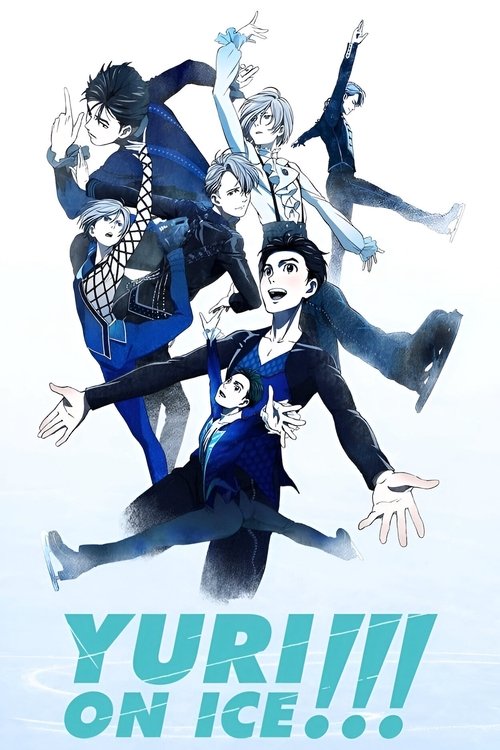
Yuri!!! on Ice
A poignant sports anime that glides with the grace of a triple axel, exploring the fragile heart of a champion and the transformative power of love, all set against a backdrop of shimmering ice.
Yuri!!! on Ice

Yuri!!! on Ice

ユーリ!!! on ICE

"Born to make history. Destined for victory."

06 October 2016 — 22 December 2016 Japan 1 season 12 episode Ended ⭐ 8.5 (633)
Cast: Toshiyuki Toyonaga, Junichi Suwabe, Koki Uchiyama
Drama Animation Comedy
The Nature of Love (Eros and Agape) Anxiety and Self-Doubt vs. Confidence Breaking Conventions and Authenticity The Athlete's Life Cycle

Overview

"Yuri!!! on Ice" follows Yuri Katsuki, a talented but anxiety-ridden Japanese figure skater on the verge of retirement after a humiliating defeat at the Grand Prix Final. His life takes an unexpected turn when a video of him perfectly recreating the routine of his idol, the five-time world champion Victor Nikiforov, goes viral. Intrigued, Victor flies to Japan and declares he will be Yuri's coach. This sudden partnership is complicated by the arrival of Yuri Plisetsky, a fiery 15-year-old Russian prodigy and Victor's former rink mate, who demands Victor fulfill a prior promise to choreograph a program for him.

The series chronicles Yuri Katsuki's journey back into the competitive world of men's figure skating, as he and the younger Yuri Plisetsky compete against each other and skaters from around the globe in the Grand Prix series. Under Victor's unconventional coaching, Yuri K. must confront his deep-seated insecurities and rediscover his passion for the sport. The narrative beautifully intertwines the technical and athletic demands of figure skating with the blossoming, complex relationship between Yuri and Victor, exploring themes of inspiration, self-discovery, and the multifaceted nature of love.
Core Meaning

The core meaning of "Yuri!!! on Ice" revolves around the idea that love, in all its forms, is the ultimate source of inspiration and strength. The creators, Sayo Yamamoto and Mitsurō Kubo, wanted to portray a narrative where personal connection and emotional vulnerability are not weaknesses but the very catalysts for artistic and athletic greatness. The series posits that to truly succeed and find meaning, one must look beyond personal ambition and connect with others, allowing their support and belief to foster self-belief. As Victor states, "We call everything on the ice 'love'." This encapsulates the show's message: the passion for a craft, the bond between a coach and student, familial support, friendship, and romantic affection are all intertwined forces that propel individuals to overcome their limitations and discover their true potential.

Thematic DNA

The Nature of Love (Eros and Agape) 35%
Anxiety and Self-Doubt vs. Confidence 30%
Breaking Conventions and Authenticity 20%
The Athlete's Life Cycle 15%

The Nature of Love (Eros and Agape)

The central theme is explicitly explored through the two programs Victor choreographs: "On Love: Eros" (sensual love) for Yuri Katsuki and "On Love: Agape" (unconditional love) for Yuri Plisetsky. Initially, both skaters struggle to embody a concept of love that seems alien to their personalities. Yuri K., who is shy and reserved, must find his inner confidence and allure to express Eros. Conversely, the aggressive and competitive Yuri P. has to connect with a softer, more selfless emotion for Agape. Throughout the season, their interpretations evolve. Yuri K.'s Eros transforms from a performative act to a genuine expression of his feelings for Victor, while Yuri P. finds his Agape in the love for his grandfather. The series argues that love is not a single concept but a spectrum of emotions that fuels personal growth and artistic expression.

Anxiety and Self-Doubt vs. Confidence

Yuri Katsuki's character arc is a profound exploration of managing anxiety and crippling self-doubt. At the start, his career is defined by his inability to perform under pressure. Victor's arrival provides an external source of confidence, but the journey is about Yuri learning to internalize that belief. Key moments, like his panic before the Cup of China free skate in episode 7, highlight the psychological reality of competitive sports. His free skate program, titled "Yuri on Ice," becomes a musical autobiography of his struggles and his path toward self-acceptance. The series realistically portrays that confidence isn't a permanent state but a continuous process of confronting fear with the support of those who believe in you.

Breaking Conventions and Authenticity

The series challenges conventions in both the world of sports anime and figure skating. It subverts the typical sports genre by placing the emotional and romantic relationship at the center of the athletic journey. The relationship between Yuri and Victor is presented as a central, normalizing force, pushing against traditional depictions of queerness in anime by treating their bond with sincerity and depth. Furthermore, the show delves into the idea of authenticity in performance. Victor encourages Yuri to find his own unique "Eros," rather than simply imitating someone else, leading Yuri to embrace a more feminine-coded sensuality that feels true to him. This highlights the theme that true artistry comes from embracing one's genuine self, regardless of societal expectations.

The Athlete's Life Cycle

"Yuri!!! on Ice" examines the different stages of an athlete's career and the search for new purpose. Victor, at 27, is a living legend who has lost his ability to surprise himself and the world, leading to a creative crisis. Coaching Yuri reignites his passion and gives him a new perspective on life and love outside of his own competition. Yuri Katsuki, at 23, is facing a premature end to his career and must decide if he has the will to continue. Yuri Plisetsky, at 15, is at the very beginning of his senior career, full of raw talent and ambition but lacking emotional depth. The series contrasts these three paths, showing that inspiration and growth are necessary at every stage of a career.

Character Analysis

Yuri Katsuki

Toshiyuki Toyonaga

Archetype: The Underdog
Key Trait: Anxious but Resilient

Motivation

Initially, his motivation is simply to get back on the ice, driven by his lifelong admiration for Victor. This evolves into a desire to prove himself worthy of Victor's coaching and affection. By the end, his motivation becomes a synthesis of his love for Victor, his rediscovered passion for skating, and a newfound self-belief. He wants to win gold not just for Victor, but to prove to himself that he can. His ultimate goal becomes creating a future where he and Victor can remain on the ice together.

Character Arc

Yuri begins the series as a talented but mentally fragile skater, crushed by anxiety and on the brink of giving up. His journey is one of profound self-discovery and confidence-building. Initially, he is entirely dependent on Victor for validation and direction. As the series progresses, he learns to skate for himself and to channel his own experiences and emotions into his art. He evolves from mimicking his idol to wanting to surpass him. His decision in the final episode to continue skating, not out of obligation but out of a newfound desire to compete alongside Victor, shows his transformation into a self-assured athlete who has found his own strength through love.

Victor Nikiforov

Junichi Suwabe

Archetype: The Mentor / The Living Legend
Key Trait: Charismatic and Unpredictable

Motivation

Victor's primary motivation is to find inspiration. He admits he has lost the ability to surprise people, and most importantly, himself. Yuri's viral video presents him with a muse and a new challenge: to unlock Yuri's potential. As his relationship with Yuri deepens, his motivation shifts from a purely artistic quest to a deeply personal one. He wants to see Yuri succeed and is driven by the love he develops, finding a new form of fulfillment in supporting someone else.

Character Arc

Victor starts as a charismatic but enigmatic figure, a skating legend who seems to have achieved everything. However, his decision to coach Yuri reveals a man suffering from creative stagnation and a surprising lack of experience with life and love off the ice. Coaching Yuri forces him to confront his own emotional limitations and learn how to nurture another person's talent and spirit. He transitions from a playful, sometimes thoughtless coach to a deeply committed and emotionally invested partner. By witnessing Yuri's growth, Victor rediscovers his own inspiration, deciding to return to competition with a renewed sense of purpose, not just as a skater but as someone who has finally found a life beyond the rink.

Yuri Plisetsky

Koki Uchiyama

Archetype: The Rival / The Prodigy
Key Trait: Fiery and Ambitious

Motivation

Yurio's motivation is to be recognized as the best in the world and to defeat his idol-turned-rival, Victor. He is fiercely ambitious and feels he is the rightful heir to Russia's skating legacy. This competitive drive is later supplemented by a desire to provide for his grandfather, who raised him. His rivalry with Yuri Katsuki also becomes a key motivator, pushing him to evolve beyond just technical skill and to develop his own unique artistic voice on the ice.

Character Arc

Known as the "Russian Punk," Yuri Plisetsky, or 'Yurio,' begins as an arrogant, aggressive, and supremely talented prodigy. His arc is about discovering the emotional depth required to transition from a junior champion to a true artist in the senior division. Initially driven by a competitive desire to beat his rivals and claim Victor's attention, he is forced to look inward to understand "Agape" (unconditional love). Through his training with ballerina Lilia Baranovskaya and his connection with his grandfather, he learns to channel grace and vulnerability. He develops from a solitary antagonist into a complex rival who forms an unlikely friendship with Otabek Altin and even shows moments of respect and support for Yuri Katsuki, maturing into a more complete and formidable skater.

Symbols & Motifs

Pork Cutlet Bowl (Katsudon)

Meaning:

The pork cutlet bowl, or katsudon, symbolizes comfort, home, and Yuri Katsuki's initial, simple understanding of love and sensuality (Eros). It represents the rewarding feeling of satisfaction and the familiar comforts that ground him. His declaration, "I'm a pork cutlet bowl fatale that enthralls men," is his first attempt at understanding how to be seductive on the ice. The dish is also a source of conflict regarding his weight, symbolizing the constant battle between indulgence and the discipline required of an elite athlete.

Context:

It is introduced early on as Yuri's favorite food, which he indulges in after his defeat, causing him to gain weight. When Victor asks him to define "Eros," Yuri's first thought is of a pork cutlet bowl. Later, Yuri Plisetsky becomes intrigued by it, and his grandfather creates a fusion dish, the Katsudon Pirozhki, symbolizing a bridge between their cultures and a gesture of grandfatherly love.

The Gold Rings

Meaning:

The matching gold rings that Yuri buys for himself and Victor in Barcelona are the most direct symbol of their commitment and bond. While Yuri initially calls them a "good-luck charm," Victor immediately and publicly refers to them as engagement rings. They symbolize their partnership, both professional and personal, and represent a promise to support each other. For the audience, it is the undeniable confirmation of the romantic nature of their relationship.

Context:

In Episode 10, while shopping in Barcelona before the Grand Prix Final, Yuri impulsively buys two gold rings. He gives one to Victor at a church, and Victor puts them on their respective right ring fingers. This event is a pivotal moment in their relationship, solidifying their bond just before the final, high-stakes competition.

The Ice Rink

Meaning:

The ice rink serves as a sacred space, a stage, and a sanctuary. It is a world where emotions that cannot be spoken can be expressed through performance. Victor's final line of the series, "We call everything on the ice 'love,'" reinforces the rink as a place where passion, ambition, struggle, and connection are all laid bare. It is both a battlefield for competition and a private world where characters connect on a deeper level.

Context:

The entire series is set in and around ice rinks across the world, from Yuri's hometown rink in Hasetsu to grand arenas in China, Russia, and Spain. The rink is where Yuri and Victor's partnership is forged, where the two Yuris have their "Hot Springs on Ice" face-off, and where every major emotional and plot development is performed and witnessed.

Memorable Quotes

We call everything on the ice 'love'.

— Victor Nikiforov

Context:

This is said by Victor in Episode 12, as he reflects on the Grand Prix Final and his journey with Yuri. It serves as a concluding thought for the series, tying all the emotional and athletic threads together.

Meaning:

This line, spoken in the finale, encapsulates the show's core philosophy. It broadens the definition of love to include passion for a sport, the relationship between competitors, the bond between an artist and their audience, and the dedication required to achieve greatness. It frames the entire competitive journey as an act of love.

If you don't have any inspiration left, you're as good as dead.

— Yuri Plisetsky

Context:

Yuri Plisetsky says this in Episode 3 during the "Hot Springs on Ice" competition, expressing his frustration and artistic philosophy while struggling to connect with his assigned theme of Agape.

Meaning:

This quote reveals the intense, all-or-nothing mindset of an elite athlete and artist. For Yurio, skating without inspiration is pointless. It highlights his deep, albeit aggressively expressed, passion for the sport and underscores Victor's initial crisis, which led him to coach Yuri in the first place.

Just have more faith than I do that I'll win! You don't have to say anything. Just stay by my side!

— Yuri Katsuki

Context:

Yuri shouts this to Victor in a moment of extreme anxiety before his free skate at the Cup of China in Episode 7, following a tense argument where Victor threatened to resign as coach.

Meaning:

This is a pivotal moment in Yuri's development. It's the first time he doesn't ask Victor for instructions or praise, but instead demands unwavering emotional support. It signifies his shift from a passive student to an active partner in their relationship, understanding that Victor's belief in him is the key to overcoming his own anxiety.

I don't really have a name for this emotion, but I have decided to call it love.

— Yuri Katsuki

Context:

Yuri says this during a press conference in Episode 5 after his first competition, when asked about the theme of his free program, "Yuri on Ice."

Meaning:

This quote signifies Yuri's acceptance of the profound and complex feelings he has developed through his experiences with Victor and his return to skating. It's a candid admission that the connections he's forged have changed him, given him strength, and redefined his world.

Episode Highlights

Easy as Pirozhki!! The Grand Prix Final of Tears

S1E1

This episode masterfully sets the stage for the entire series. It establishes Yuri Katsuki's rock-bottom emotional state after his crushing defeat, his return home, and the viral moment that changes his life forever. The unexpected arrival of Victor Nikiforov at his family's hot spring is an iconic and transformative moment.

Significance:

It introduces all three main characters and the central conflict. It lays the groundwork for the themes of failure, redemption, and inspiration that will drive the narrative. The episode's ending, with Victor's shocking appearance, serves as the powerful inciting incident for the entire story.

I Am Eros, and Eros Is Me?! Face-Off! Hot Springs on Ice

S1E3

The first major skate-off between the two Yuris. Tasked with embodying themes contrary to their personalities—Eros for Yuri K. and Agape for Yuri P.—this episode forces them to grow as artists. It highlights Victor's unconventional coaching methods and solidifies the central rivalries and relationships.

Significance:

This episode establishes the season's primary artistic challenge and character dynamic. The competition decides who Victor will coach, setting the plot for the Grand Prix series in motion and forcing both Yuris to step outside their comfort zones for the first time.

China's On! The Grand Prix Series Opening Event!! The Cup of China, Free Skate

S1E7

A hugely significant episode for Yuri and Victor's relationship. After an argument born from Yuri's intense anxiety, Victor threatens to leave if Yuri fails his free skate. Yuri, in turn, asks Victor to simply have faith in him. His performance is emotionally charged, and the episode culminates in Victor, overwhelmed with pride and relief, kissing Yuri on screen after he lands a surprise quadruple flip.

Significance:

This episode marks a turning point, moving the subtext of Yuri and Victor's relationship into undeniable text. It demonstrates a new level of trust and emotional honesty between them and shows Yuri taking a significant step in overcoming his performance anxiety through his connection with Victor.

Gotta Supercharge it!! Pre-Grand Prix Final Special!

S1E10

Narrated from Victor's perspective, this episode provides crucial backstory and context to his motivations. A flashback reveals that he first met a drunk Yuri Katsuki at the previous year's Grand Prix banquet, where Yuri begged Victor to be his coach. This re-contextualizes the entire series, showing that Victor's arrival in Japan was not a whim but a response to Yuri's initial plea. The episode also features Yuri buying the gold rings.

Significance:

This episode fundamentally shifts the audience's understanding of the series' events. It reveals that Yuri initiated their connection and that Victor has been acting on feelings for Yuri from the very beginning. The exchange of rings solidifies their commitment, making it one of the most pivotal episodes for character and relationship development.

Gotta Super-Super-Supercharge it!!! Grand Prix Final Free Skate

S1E12

The series finale delivers a dramatic and emotional conclusion to the Grand Prix. Yuri, thinking it will be his last performance, alters his program to include a quadruple flip, aiming to surprise Victor. He breaks Victor's free skate world record. Yuri Plisetsky then delivers a flawless performance, breaking the short program record and winning the gold medal by a razor-thin margin. The season ends with Yuri K. deciding not to retire and moving to St. Petersburg to train with Victor, who also announces his return to competition.

Significance:

The episode provides a satisfying conclusion to the season's arcs while leaving the future open. Both Yuris achieve personal and professional victories, and the final scene of Yuri and Victor skating a pair skate exhibition to "Stammi Vicino, Non Te Ne Andare" beautifully symbolizes their new, balanced partnership.

Philosophical Questions

What is the true nature of inspiration?

The series constantly explores whether inspiration is an internal or external force. Victor, a creative genius, finds his wellspring of inspiration has run dry. He seeks it externally in Yuri, believing he can create a masterpiece out of him. Yuri, conversely, has the passion but needs Victor's external belief to unlock his own internal confidence and artistry. The series suggests that inspiration is not a one-way street but a dynamic, symbiotic exchange. True, lasting inspiration comes from the connection between people, where one's passion can reignite another's, creating a cycle of mutual growth and creativity.

Can love be defined, or is it an all-encompassing force?

"Yuri!!! on Ice" deliberately challenges a narrow definition of love. It presents various forms: Yuri's hero worship of Victor, Victor's nurturing mentorship, Yuri P.'s familial love for his grandfather, Phichit's friendly support, and the burgeoning romance between the two leads. The themes of "Eros" and "Agape" are presented as two sides of a coin, with the skaters learning that both sensual and selfless love are necessary for a complete emotional life. By having characters state they are skating their "love" or that everything on the ice is "love," the show posits that love is the fundamental energy behind passion, ambition, and human connection itself.

Alternative Interpretations

While the romantic relationship between Yuri and Victor is widely accepted as the primary reading, some early discussions and critical analyses explored alternative interpretations, often influenced by the conventions of the sports anime genre or debates around queerbaiting. One perspective suggested the relationship could be viewed primarily as an intense platonic bond between an athlete and a mentor, with moments like the rings being "good-luck charms" used to maintain ambiguity. However, the creators have been clear in interviews about their intention to portray love without fear of prejudice, and the overwhelming textual evidence (the kiss, the rings being called engagement rings, the paired skate) has made this interpretation less common over time.

Another interpretation focuses less on the romance and more on the series as a metaphor for creative rebirth. In this view, Victor is not just a lover but a representation of the artistic muse. His relationship with Yuri is a journey of an artist (Yuri) finding his voice and a master (Victor) rediscovering his passion through teaching. The story becomes an allegory for the symbiotic relationship between inspiration and creation, where both parties are essential for the other's growth.

Cultural Impact

"Yuri!!! on Ice" achieved massive international popularity upon its release in 2016, becoming a cultural phenomenon that transcended the typical anime audience. Its most significant impact was its positive and central portrayal of a same-sex relationship. By treating the romance between Yuri and Victor with sincerity and making it integral to the plot, the series was lauded for its groundbreaking LGBTQ+ representation in a mainstream anime, resonating deeply with queer audiences worldwide.

The show also had a notable impact on the professional figure skating world. Many real-life skaters, including Evgenia Medvedeva, Johnny Weir, Adam Rippon, and the late Denis Ten, publicly praised the series for its accuracy, emotional depth, and loving tribute to their sport. The show's music has been used in actual competitions by skaters like Miu Suzaki and Ryuichi Kihara at the PyeongChang 2018 Olympics, a testament to its authenticity and influence. The series brought a new wave of fans to figure skating, bridging the gap between anime fandom and sports enthusiasts. Its success demonstrated a strong market for original, character-driven anime not based on existing manga, and it remains a benchmark for positive queer representation in media.

Audience Reception

"Yuri!!! on Ice" was met with overwhelmingly positive reception from audiences worldwide, quickly developing a massive and passionate fanbase. Viewers praised the series for its beautiful animation of the skating sequences, compelling character development, and engaging story. The central romance between Yuri and Victor was a major point of acclaim, celebrated for its heartfelt and positive depiction, which many fans found to be a refreshing and significant step forward for LGBTQ+ representation in anime.

The main points of criticism were relatively minor but often pointed to inconsistencies in the animation quality in some broadcast episodes, particularly in non-skating scenes or with background characters, which was attributed to tight production schedules. Some viewers also felt the series occasionally bordered on "queerbaiting" in its early episodes by not explicitly labeling the central relationship, though this criticism largely subsided after pivotal moments in episodes 7 and 10 confirmed the romantic nature of the bond for most of the audience. Overall, the series is remembered as a critically and commercially successful hit, beloved for its emotional sincerity and groundbreaking themes.

Interesting Facts

  • The series' creators are director Sayo Yamamoto and manga artist Mitsurō Kubo.
  • The figure skating choreography in the anime was created by real-life Japanese figure skater and choreographer Kenji Miyamoto. He performed all the routines, which were recorded to provide authentic sound effects and serve as reference for the animators.
  • According to a study, the series used more key animators than any other anime in its season, with an average of 48.5 per episode. In early episodes, each character's skating was handled by a different animator to give them a unique style.
  • The project was greenlit around the time of the 2014 Sochi Olympics, when public interest in figure skating was high.
  • Many of the skaters are believed to be inspired by real-life figure skaters. For example, Yuri Plisetsky was modeled after Russian skater Yulia Lipnitskaya, and Victor Nikiforov shares traits with Evgeni Plushenko.
  • Real-life skaters Stéphane Lambiel and Nobunari Oda make cameo appearances as themselves commentating during the Grand Prix Final episodes and voiced their own characters.
  • The planned feature film, "Yuri!!! on Ice the Movie: Ice Adolescence," which would have focused on a young Victor Nikiforov, was officially cancelled in April 2024 after years in production.

Easter Eggs

Victor's poodle, Makkachin, has a tissue box cover that looks just like him.

This is a direct homage to champion figure skater Yuzuru Hanyu, who is famous for carrying a Winnie the Pooh tissue box cover with him to competitions. Mascot tissue boxes are a common sight in the real-life figure skating world.

The drunken banquet scene shown in Episode 10.

This scene, where Yuri pole dances and has a dance-off, was reportedly inspired by real-life shenanigans that often occur at the after-competition banquets. Specifically, it may have been influenced by videos and photos of skaters like Daisuke Takahashi, Yuzuru Hanyu, and Misha Ge celebrating after events.

Phichit Chulanont's character and love for social media.

Phichit, the skater from Thailand, is constantly taking selfies and posting on social media. His character may be partly inspired by Michael Christian Martinez, the first skater from Southeast Asia (the Philippines) to compete in the Olympics, and his social media presence is a nod to how modern athletes connect with their fans.

⚠️ Spoiler Analysis

Click to reveal detailed analysis with spoilers

Frequently Asked Questions

Explore More About This Movie

Dive deeper into specific aspects of the movie with our detailed analysis pages

Comments (0)

Leave a comment

No comments yet. Be the first to share your thoughts!