The Amazing World of Gumball
Overview
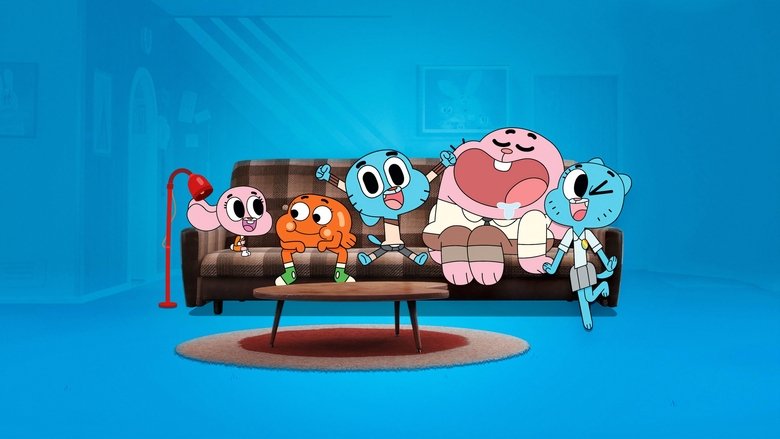
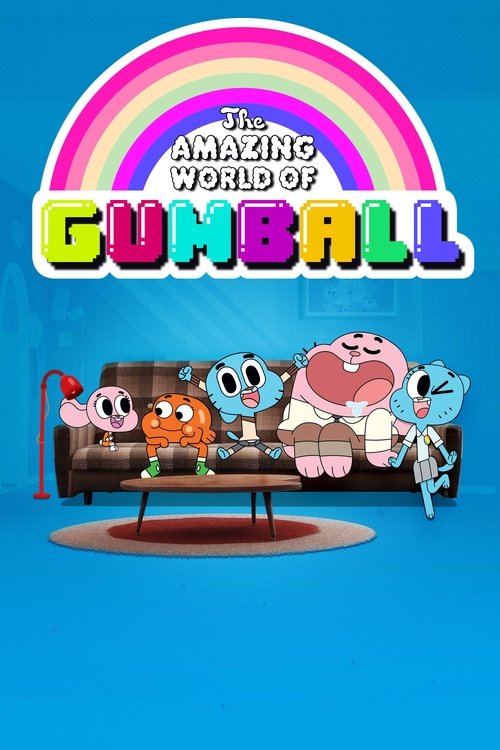
"The Amazing World of Gumball" revolves around the daily life of Gumball Watterson, a 12-year-old blue cat, and his best friend and adoptive brother, Darwin, a goldfish who sprouted legs. They live in the fictional, bizarre city of Elmore, where Gumball's chaotic shenanigans with his family and diverse classmates form the crux of the narrative. The Watterson family includes his hyper-intelligent four-year-old sister, Anais; his workaholic, fiercely protective mother, Nicole; and his lazy, stay-at-home father, Richard.
The series is defined by its lack of a single, overarching plot, instead focusing on episodic, surreal adventures that often parody various genres, internet culture, and societal norms. Each episode sees Gumball and Darwin navigating the complexities of school, family, and friendship, often escalating mundane situations into city-wide catastrophes with their naive yet well-intentioned schemes. The show's unique visual style, which mixes multiple animation techniques and live-action backgrounds, is integral to its humor and storytelling, creating a world where every character, from a talking T-Rex to a piece of toast, has their own distinct design.
Core Meaning
At its heart, "The Amazing World of Gumball" is a satirical yet affectionate celebration of the modern family and the beautiful chaos of childhood. Through its surreal humor and meta-commentary, the series explores the idea that life is messy, unpredictable, and often absurd, but these imperfections are what make it meaningful. It champions the importance of family bonds, unconditional love, and embracing one's own weirdness in a world that doesn't always make sense. The show consistently delivers a message of finding joy in the mundane, learning from (or hilariously failing to learn from) mistakes, and the unwavering support system that a loving, albeit dysfunctional, family provides.
Thematic DNA
The Modern Family Dynamic
The series presents a nuanced and comedic take on the contemporary family structure. Nicole is the overworked, often stressed breadwinner, while Richard is the loving but comically inept stay-at-home dad. This subversion of traditional gender roles is a recurring backdrop for many stories. The family's unwavering love and support for each other, despite their constant bickering and the chaos Gumball and Darwin create, is the show's emotional anchor. Episodes frequently highlight their fierce loyalty, proving that their bond transcends their individual eccentricities and dysfunctions.
Satire and Social Commentary
"Gumball" is renowned for its sharp, witty satire of modern life, internet culture, and societal norms. Episodes frequently parody social media trends, video games, consumerism, and various film and TV genres. The show uses its surreal premise to comment on real-world issues in a digestible and hilarious way, often breaking the fourth wall to poke fun at storytelling conventions and its own existence as a cartoon. This self-awareness allows it to tackle complex ideas with intelligence and humor.
Coming of Age and Identity
Through the eyes of Gumball and Darwin, the series explores the awkward and confusing journey from childhood to adolescence. They grapple with issues like fitting in, first crushes (most notably Gumball's relationship with Penny), navigating friendships, and understanding the adult world. The show portrays their mistakes and misinterpretations with empathy and humor, highlighting the trial-and-error nature of growing up and figuring out who you are.
The Nature of Reality
Later seasons delve into increasingly meta and existential themes, questioning the very fabric of the show's universe. The introduction of 'The Void,' a dimension where the world's mistakes and forgotten things end up, becomes a central plot device. This concept allows the show to explore ideas of irrelevance, cancellation, and the awareness of being a fictional character, culminating in a finale that directly confronts the characters with the end of their own world.
Character Analysis
Gumball Watterson
Logan Grove (Seasons 1-3), Jacob Hopkins (Seasons 3-5), Nicolas Cantu (Seasons 5-6)
Motivation
Gumball's primary motivation is to alleviate boredom and navigate the immediate challenges of his pre-teen life, whether it's winning the affection of Penny, avoiding detention, or simply trying to have fun. His goals are typically short-sighted and self-serving, but often stem from a well-intentioned, albeit flawed, place. As the series progresses, his motivation also includes protecting his family and friends from the increasingly bizarre threats of their universe.
Character Arc
Gumball begins the series as a relentlessly optimistic but naive troublemaker, whose schemes are born from a simple, childlike logic that inevitably spirals out of control. Over the seasons, he develops a greater sense of self-awareness and sarcasm. While he never fully loses his chaotic energy, his motivations mature slightly. He develops a genuine, stable romantic relationship with Penny, learns to occasionally consider the consequences of his actions (though rarely before acting), and becomes increasingly aware of the bizarre, meta-nature of his own world.
Darwin Watterson
Kwesi Boakye (Seasons 1-3), Terrell Ransom Jr. (Seasons 3-5), Donielle T. Hansley Jr. (Seasons 5-6), Christian J. Simon (Season 6)
Motivation
Darwin is motivated by an intense love for his family, especially Gumball, and a desire to maintain harmony and do the right thing. He wants everyone to be happy and often tries to solve conflicts with kindness and honesty. His motivation evolves from simply wanting to please Gumball to actively trying to steer his brother towards more ethical (and less destructive) choices.
Character Arc
Darwin starts as Gumball's overly innocent and sweet-natured sidekick, often serving as the voice of caution. His arc is one of gaining independence and a more defined personality outside of Gumball. As the series progresses, Darwin becomes more assertive and occasionally cynical, sometimes even questioning Gumball's harebrained schemes. His unwavering loyalty remains, but it's tempered with a growing understanding of the world's complexities, and he develops his own interests and relationships, showing he is more than just an appendage to his brother.
Anais Watterson
Kyla Rae Kowalewski
Motivation
Anais's primary motivation is a desire for order, logic, and intellectual stimulation, which is constantly thwarted by her family. She is also driven by a fear of being helpless or dependent. Beneath this, however, lies a deep-seated loneliness and a desire to be understood and accepted, not just for her brain, but as a child who wants to have fun and be loved.
Character Arc
Anais begins as the voice of reason and intellect, a four-year-old genius frustrated by her family's absurdity. Her development involves learning to embrace her childhood and connect with her family on an emotional, rather than purely intellectual, level. Initially, she is somewhat detached and manipulative, using her intelligence to get her way. Over time, she participates more willingly in her brothers' adventures, revealing a deep-seated desire for friendship and a genuine love for her chaotic family, even if she'd rarely admit it. She learns that intellect isn't everything and sometimes has to cede control to chaos.
Nicole Watterson
Teresa Gallagher
Motivation
Nicole's driving motivation is the protection and well-being of her family. She works tirelessly to provide for them and will go to extraordinary, often terrifying, lengths to defend them from any threat. Her competitive nature, instilled by her parents, also motivates her to be the best at everything, from her job to parenting, which is both a source of her strength and her immense stress.
Character Arc
Nicole is introduced as the family's responsible, workaholic, and short-tempered matriarch. Her character arc is one of the show's most developed, revealing the immense pressure she faced from her overachieving parents as a child, which forged her into a fiercely competitive but deeply caring individual. Throughout the series, she learns to balance her intense nature with moments of vulnerability and to accept the imperfections of her family and herself. Her history as a martial arts master is explored, framing her protective instincts as a literal superpower. She evolves from just the 'angry mom' trope into a complex, relatable, and formidable character.
Richard Watterson
Dan Russell
Motivation
Richard is primarily motivated by a desire to avoid all forms of work and responsibility, seeking comfort in food, sleep, and television. However, his deeper motivation is an unconditional love for his wife and children. While he fails at most practical tasks, he is fiercely dedicated to their happiness and will occasionally muster incredible effort if he believes they are truly in need of his help.
Character Arc
Richard starts as a one-dimensional trope: the lazy, gluttonous, and unintelligent father. However, his character is deepened significantly over the series. Flashbacks reveal his own difficult childhood with a neglectful father and an overprotective mother, which explains his aversion to responsibility. His arc is about proving that despite his laziness and incompetence, he possesses a huge heart and profound emotional wisdom. He evolves from being pure comic relief to the emotional core of the family, often providing simple, heartfelt advice that cuts through the chaos.
Symbols & Motifs
The Void
The Void symbolizes irrelevance, mistakes, and forgotten concepts within the show's universe and, metaphorically, in the real world. It represents the discarded ideas, outdated designs, and continuity errors of the series, giving a physical form to the creative process's 'cutting room floor.' It also serves as a meta-commentary on the transient nature of media and ideas.
Introduced in Season 3, The Void is a static-filled dimension where everything the world of Elmore deems a 'mistake' is sent. Characters like Rob, who was a forgotten background character, become major figures after escaping it. The Void plays a crucial role in the latter half of the series, especially in episodes like "The Void" and the finale, "The Inquisition," where it threatens to consume Elmore entirely.
Mixed Media Animation
The show's defining visual element—the combination of 2D, 3D, stop-motion, puppetry, and live-action—symbolizes the diversity and chaotic harmony of the world. It visually represents the idea that different people (or creatures) from vastly different backgrounds and realities can coexist, interact, and form a cohesive, albeit eccentric, community. It is the literal world-building metaphor for the show's themes of acceptance and embracing differences.
This is a constant throughout the entire series. The Watterson family is primarily 2D animated, living in a live-action photographed house and neighborhood. Their classmates include a 3D T-Rex (Tina), a paper cutout monkey (Miss Simian), and a talking cloud (Masami). This visual cacophony is the backdrop for every single episode and is fundamental to the show's identity.
The Rainbow Factory
The Rainbow Factory, where Nicole works, symbolizes the monotonous and soul-crushing nature of corporate work. Despite its cheerful name, it's depicted as a bleak, stressful environment. It represents the sacrifices Nicole makes for her family and the daily grind of adult responsibility that contrasts sharply with her children's chaotic freedom.
The factory is mentioned and shown in various episodes throughout the series whenever Nicole's job is a plot point. In episodes like "The Job" or "The Limit," her work-related stress is a key driver of the conflict, and the factory is the physical embodiment of that pressure.
Memorable Quotes
You're just a drop of embarrassment, in an ocean of shame.
— Darwin Watterson
Context:
From the Season 2 episode "The Pony." Darwin says this to Gumball after Gumball's embarrassing behavior becomes too much for him to handle, showcasing a rare moment of cutting honesty from the usually sweet character.
Meaning:
This quote perfectly encapsulates the show's sharp, surprisingly brutal wit. Delivered with Darwin's characteristic innocence, the line is a hilariously poetic insult that highlights the clever, often adult-oriented writing that sets the series apart.
They shouldn't say 'All you can eat' if they don't mean it.
— Richard Watterson
Context:
From the Season 2 episode "The Finale." Richard says this to Nicole in a flashback after being banned from a restaurant. When Nicole points out he ate a chair, it only reinforces the absurdity.
Meaning:
This line is the quintessential Richard Watterson quote. It embodies his simplistic, food-driven logic and his comical inability to grasp social nuances. It's a perfect summary of his character's worldview, where the literal interpretation serves his own desires.
When life gives you lemons, you squeeze them back into life's eyes!!!
— Gumball Watterson
Context:
This is a widely circulated quote from the series that encapsulates Gumball's personality.
Meaning:
This quote is a humorous and aggressive twist on a classic idiom, perfectly capturing Gumball's chaotic and confrontational approach to problem-solving. It demonstrates his belief in fighting back against adversity with sheer, often misguided, force of will.
I'M A FISH. WITH LEGS.
— Darwin Watterson
Context:
From the Season 2 episode "The Treasure." Darwin yells this at a menacing giant turtle that has been pursuing him and Gumball.
Meaning:
A simple yet powerful declaration of identity. This quote humorously underscores Darwin's unique existence and his defiance in the face of danger. It's a moment where his usually gentle nature gives way to a burst of confident self-awareness, celebrating his own absurdity.
You can ruin my sleep, you can terrorize my family, but you will not stop me from eating! My! SAUSAGE!
— Richard Watterson
Context:
From the Season 2 episode "The Remote." Richard declares this with epic fervor when Gumball and Darwin's fighting over the remote control threatens his meal.
Meaning:
This quote hilariously defines Richard's priorities. It shows that while he is incredibly lazy and passive, there are lines that cannot be crossed, and those lines are almost always related to food. It's a moment of uncharacteristic passion and determination driven by his simplest desire.
Episode Highlights
The DVD
The inaugural episode sets the tone for the entire series. Gumball and Darwin accidentally scratch a rented DVD and go to absurd lengths to avoid taking responsibility. Their simple problem escalates into city-wide chaos, showcasing the show's formula of mundane situations leading to surreal disasters.
This episode perfectly introduces the core characters, their dynamics, and the show's unique blend of slapstick humor and escalating absurdity. It establishes the central premise: Gumball and Darwin's well-meaning but catastrophic problem-solving skills.
The Job
Richard gets a job as a pizza delivery man, which upsets the balance of the universe, causing reality to unravel in increasingly bizarre and apocalyptic ways. The episode is a masterclass in surreal humor and visual gags, parodying disaster films.
It establishes a key piece of lore: the universe itself requires Richard to be lazy for it to function properly. This episode elevates the show's absurdity from character-driven antics to cosmic-level stakes, cementing its willingness to embrace high-concept ideas.
The Void
Gumball and Darwin notice that a classmate, Molly, has gone missing, and nobody remembers her. With the help of Mr. Small, they discover "The Void," a dimension where all the world's mistakes and forgotten things are sent.
This episode is a major turning point, introducing the meta-narrative that becomes central to the later seasons. It establishes a key piece of the show's cosmology and sets up the eventual return of Rob as Gumball's nemesis, transforming the series from a simple sitcom into a story with deeper lore and stakes.
The Shell
During a school play, Gumball accidentally cracks Penny's shell. He fears what's underneath, but it's revealed that her true form is a beautiful, shapeshifting fairy-like creature. Penny, freed from her shell, struggles with her new identity while Gumball learns to love her for who she is.
A pivotal episode for character development, it marks a significant evolution in Gumball and Penny's relationship, moving it from a simple crush to a more mature and accepting romance. It's also a powerful metaphor for self-acceptance and beauty, with visual references to the work of Hayao Miyazaki.
The Disaster / The Rerun
In this two-part epic, Rob, Gumball's nemesis from The Void, gets a universal remote that allows him to control and rewind reality. He uses it to ruin Gumball's life, forcing Gumball to relive the same disastrous day over and over. Gumball must find a way to break the loop and defeat Rob.
This pair of episodes showcases the series at its most ambitious, blending high-stakes action, emotional weight, and complex, time-bending narrative mechanics. It solidifies Rob as a truly formidable and tragic antagonist and demonstrates the show's ability to execute compelling, serialized storytelling within its chaotic framework.
The Fury
An old childhood rival of Nicole's, Yuki, reappears and challenges her to a rematch. The episode culminates in a spectacular, full-scale battle animated in the style of classic shonen anime, revealing Nicole's past as a martial arts prodigy.
This episode is a fan favorite for its incredible animation and deep dive into Nicole's backstory. It provides context for her intensity and fierce protectiveness while paying homage to anime like Dragon Ball Z and Kill la Kill. It redefines Nicole from just a 'mom' character to a powerful protagonist in her own right.
The Inquisition
The final episode of the original run. Superintendent Evil arrives at Elmore Junior High and begins transforming the cartoon characters into bland, live-action humans to make them 'normal.' As the world begins to collapse into The Void, Gumball and Darwin realize their world is ending.
A shocking and meta finale that breaks the fourth wall entirely. It directly addresses the show's impending cancellation, ending on a dramatic cliffhanger as The Void consumes everything, leaving the characters' fates unknown. It's a bold, unconventional ending that sparked years of fan theories and solidified the show's legacy for daring storytelling.
Philosophical Questions
What defines 'reality' when the lines between genres and mediums are blurred?
The series constantly plays with the concept of reality through its visual style. A 2D cat can interact with a 3D dinosaur and a live-action banana. This raises questions about the nature of existence within a fictional framework. The show suggests that reality is subjective and that different forms of being can coexist. The introduction of The Void further complicates this, presenting a space for things that are 'mistakes' or no longer 'relevant' to reality, implying that existence is curated and not absolute.
How do we find meaning and identity in a world that is inherently chaotic and absurd?
Elmore is a world governed by chaos, where the laws of physics and logic are frequently suspended for the sake of a gag. The characters, particularly the Wattersons, find meaning not by trying to impose order on this chaos, but by embracing it. Their identities are forged through their reactions to absurd situations. The core meaning is found in their relationships and unwavering loyalty to one another, suggesting that personal connections are the only stable anchor in an otherwise nonsensical universe.
If you knew you were a fictional character, how would it change your actions?
This question becomes central in the later seasons. Characters like Gumball and, most notably, Rob, become aware of their status as cartoon characters. This meta-awareness leads to existential crises and desperate attempts to control their own narratives. Rob's villainy is driven by his knowledge that he is the 'bad guy' in Gumball's story. The series explores whether free will is possible within a pre-written narrative and examines the psychological toll of realizing one's life is a form of entertainment for others.
Alternative Interpretations
The most significant area for alternative interpretations is the series' abrupt ending in "The Inquisition." One popular interpretation is that the finale is a direct, meta-commentary on the show's own cancellation. Superintendent Evil represents network executives or external pressures demanding conformity, seeking to strip the show of its unique cartoonish identity and replace it with something more 'normal' and palatable (the live-action humans). The Void swallowing Elmore is a metaphor for the show being taken off the air, with the characters ceasing to exist as their world ends.
Another, more philosophical interpretation views The Void not as cancellation but as a representation of irrelevance and nihilism. The characters' struggle against being forgotten is a metaphor for the search for meaning in a seemingly absurd universe. Rob's transformation from a background character into the main villain can be seen as a commentary on how individuals react when faced with their own insignificance—some, like Rob, lash out and try to destroy the system, while others, like Gumball, fight to preserve their reality, no matter how chaotic. The cliffhanger, in this reading, suggests that this struggle for meaning is perpetual and has no neat resolution.
Cultural Impact
"The Amazing World of Gumball" premiered in 2011, during a renaissance period for creator-driven animation on Cartoon Network that included shows like "Adventure Time" and "Regular Show". It quickly distinguished itself with its unique and ambitious visual style, which seamlessly blended 2D, 3D, stop-motion, and live-action elements, pushing the boundaries of what was considered possible in a children's television series. This technical innovation had a significant influence on subsequent animated shows, encouraging more experimentation with mixed media.
Critically, the series was lauded for its sharp, multi-layered humor that appealed to both children and adults. Its clever writing, pop culture parodies, and surprisingly deep satirical commentary on modern life, technology, and social conventions earned it numerous accolades, including multiple BAFTA awards. The show's legacy lies in its masterful balancing act: it was simultaneously a surreal, slapstick comedy and an intelligent, self-aware piece of meta-fiction. The series finale's cliffhanger ending cemented its reputation for narrative risk-taking, leaving a lasting impression on its audience and sparking years of discussion, ensuring its place as a cult classic and one of the most creatively audacious cartoons of its era.
Audience Reception
"The Amazing World of Gumball" received widespread critical acclaim and a dedicated fanbase throughout its run. Audiences consistently praised its groundbreaking visual style, which combined multiple forms of animation and live-action backgrounds. The show's witty, fast-paced humor was a major point of praise, with many viewers appreciating its ability to cater to both children and adults through clever wordplay, satire, and pop culture references. The character development, particularly for Nicole and Richard, was also frequently highlighted, as they evolved beyond simple sitcom archetypes into complex, relatable figures.
Points of criticism were minor and infrequent, though some viewers found the early seasons' humor to be more simplistic compared to the ambitious, meta-narrative direction of the later seasons. The series finale, "The Inquisition," proved to be the most controversial moment among the audience. While many praised its bold, meta-commentary and daring cliffhanger, a significant portion of the fanbase was left feeling frustrated and unsatisfied with the lack of resolution, sparking numerous theories and a long-standing demand for a continuation to resolve the ending.
Interesting Facts
- The creator, Ben Bocquelet, is French-British. He developed the show after Cartoon Network Studios Europe asked its employees to pitch their own ideas.
- Many of the supporting characters in Elmore are based on rejected characters that Bocquelet had created for various commercials and previous projects.
- The show's unique visual style was inspired by films like "Who Framed Roger Rabbit," combining various animation mediums with live-action settings.
- The Watterson family's last name is a tribute to Bill Watterson, the creator of the iconic comic strip "Calvin and Hobbes".
- Ben Bocquelet is ironically allergic to cats.
- The show is produced as a storyboard-driven series, meaning the artists often work from a loose outline rather than a full script, which contributes to its spontaneous feel.
- Gumball's real name was originally Zach, but it was legally changed back to Gumball after it caused him to develop a malevolent alter ego in the episode "The Name".
- "The Amazing World of Gumball" was the first series to be produced by Cartoon Network Studios Europe.
Easter Eggs
Numerous Dragon Ball Z references.
The show's creators are clearly fans of the classic anime. Gumball attempts to turn Super Saiyan on multiple occasions, and Nicole's fight with Yuki in "The Fury" is a direct homage to the anime's fight choreography and art style.
Video game console parodies.
The Watterson's game console is often a parody of real-world systems. In one episode, it resembles a Nintendo 64, while a handheld device is a clear knock-off of a Game Boy. The episode "The Console" features a world based on classic RPGs like Final Fantasy.
Horror movie homages.
The show frequently references classic horror films. Carrie Krueger's name is a combination of Stephen King's Carrie and Freddy Krueger from A Nightmare on Elm Street. Other episodes parody films like The Ring, The Shining, and The Predator.
Slender Man cameo.
In the episode "The Job," a mannequin that bears a striking resemblance to the internet horror icon Slender Man can be seen in the background of a store window, a nod to the popular creepypasta character.
Studio Ghibli references.
The episode "The Shell," where Penny emerges from her shell, contains several visual nods to the films of Hayao Miyazaki and Studio Ghibli. When Penny transforms into a dragon, it is a direct reference to Haku from Spirited Away.
Street Fighter parody.
In the episode "The Words," a fight scene between Gumball and Darwin is animated as a pitch-perfect parody of the classic fighting game Street Fighter, complete with character selection screens and special moves.
⚠️ Spoiler Analysis
Click to reveal detailed analysis with spoilers
Frequently Asked Questions
Explore More About This Movie
Dive deeper into specific aspects of the movie with our detailed analysis pages
Comments (0)
No comments yet. Be the first to share your thoughts!