A Man Escaped
A minimalist thriller of methodical patience and spiritual resilience, where the rhythmic scrape of a spoon against a wooden door becomes a hymn to freedom.
A Man Escaped

A Man Escaped

Un condamné à mort s'est échappé

"Robert Bresson's Prize Winning Film"

11 November 1956 France 101 min ⭐ 7.9 (582)
Director: Robert Bresson
Cast: François Leterrier, Charles Le Clainche, Maurice Beerblock, Roland Monod, Jacques Ertaud
Drama Thriller
Faith and Divine Grace Hope and Human Resilience The Poetry of Process Trust and Interdependence

Overview

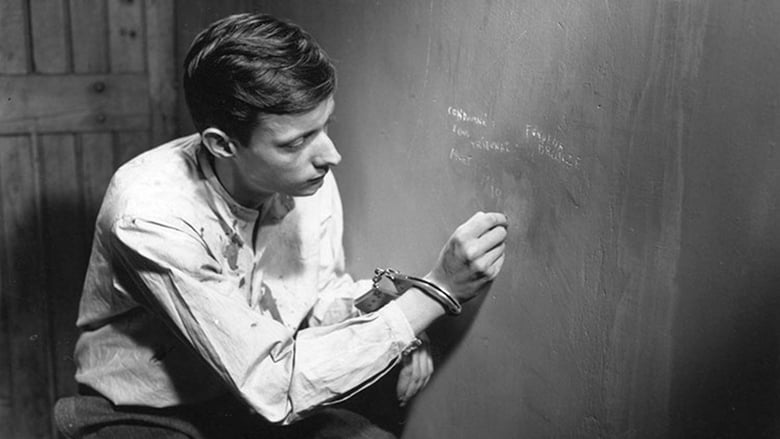
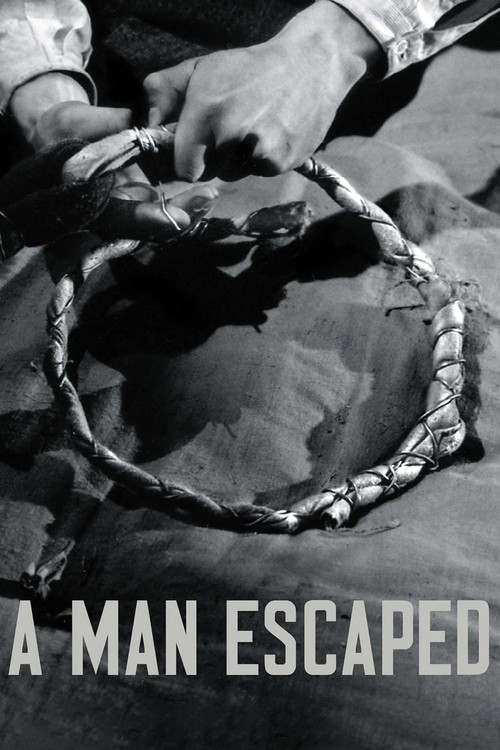
Based on the memoirs of André Devigny, a French Resistance fighter, "A Man Escaped" chronicles the procedural and near-silent efforts of Lieutenant Fontaine to escape a Nazi prison in Lyon in 1943. The film opens with Fontaine's immediate, failed attempt to flee the car taking him to Montluc prison, establishing his unwavering determination. We then witness his painstaking and methodical preparations for a second, more elaborate escape. Using scavenged items like a sharpened spoon and threads from his bedding, he slowly and meticulously crafts the tools for his liberation.

The narrative is intensely focused on Fontaine's perspective, confined to his cell and the limited interactions he has with other prisoners during brief moments outside. The film's tension builds not from dramatic confrontations, but from the meticulous depiction of process and the constant threat of discovery. Just as his plan is nearing fruition, he is given a new, young cellmate, François Jost, forcing Fontaine to decide whether to trust the boy with his life or to kill him. This decision becomes the final, crucial step in his journey toward freedom.

Core Meaning

The core meaning of "A Man Escaped" revolves around the themes of faith, free will, and the indomitable nature of the human spirit in the face of overwhelming despair. Director Robert Bresson was interested in portraying the escape not merely as a physical act, but as a spiritual journey. The film's alternate title, "The Wind Bloweth Where It Listeth" (a reference to John 3:8), points to a divine or spiritual grace that assists Fontaine, but Bresson emphasizes that this grace only aids those who actively help themselves. Fontaine's meticulous, patient work is a testament to the idea that faith must be accompanied by action. The film suggests that true freedom is an internal state of being, a product of hope and unwavering resolve, which can exist even within the confines of a prison cell. It's a profound meditation on the power of individual agency and the possibility of transcendence through focused, purposeful action.

Thematic DNA

Faith and Divine Grace 35%
Hope and Human Resilience 30%
The Poetry of Process 20%
Trust and Interdependence 15%

Faith and Divine Grace

The film is deeply imbued with spiritual, specifically Catholic, undertones. Bresson himself stated his aim was to “show the miracle [of] an invisible hand over the prison, directing what happens.” This theme is evident in the series of fortunate coincidences that aid Fontaine and the film's alternate title, which alludes to the mysterious workings of the Holy Spirit. However, the faith depicted is not passive; it requires human action. A fellow prisoner, a pastor, tells Fontaine that God will save him, to which Fontaine replies that God needs a helping hand, summarizing the film's synthesis of divine will and human agency.

Hope and Human Resilience

In the oppressive and death-filled environment of Montluc prison, where 7,000 prisoners died, hope is a radical act of defiance. Fontaine's relentless and methodical work on his escape plan, even when others deem it impossible, is a powerful depiction of human resilience. He not only maintains his own hope but also inspires it in others, such as his neighbor Blanchet, whom he encourages to “fight and hope.” The film posits that the will to survive and be free is an essential part of human nature that cannot be extinguished by physical confinement.

The Poetry of Process

Bresson elevates the mundane and repetitive actions of Fontaine's escape preparations into a form of art. The film meticulously details every step: the sharpening of the spoon, the carving of the door, the weaving of the ropes. This focus on process, on the 'how' rather than the 'what', strips the narrative of conventional melodrama and suspense, replacing it with a hypnotic, almost meditative tension. By concentrating on the physical labor and ingenuity involved, the film celebrates the profound meaning found in dedicated, purposeful work.

Trust and Interdependence

While largely a solitary endeavor, Fontaine's escape ultimately depends on a crucial act of trust. His decision to confide in his new teenage cellmate, Jost, a boy he initially suspects might be an informant, is the film's pivotal moral and practical dilemma. He must either kill Jost or trust him completely. His choice to trust, and the subsequent successful escape of the two men, suggests that while the spirit of freedom is individual, its ultimate realization can require connection and faith in others. The recurring musical motif of Mozart's Mass in C Minor often appears during moments of connection between prisoners, underscoring this theme of interdependence.

Character Analysis

Lieutenant Fontaine

François Leterrier

Archetype: The Determined Hero
Key Trait: Methodical Perseverance

Motivation

Fontaine is motivated by an elemental and unyielding desire for freedom. As a member of the French Resistance, his fight for personal liberty is also a continuation of his political and moral struggle against the Nazi occupation. He is driven by a pragmatic need to survive and a spiritual refusal to surrender to despair.

Character Arc

Fontaine's arc is not one of dramatic psychological change, but of unwavering resolve and execution. He begins the film with a singular goal—to escape—and every action he takes is in service of that goal. His journey is a testament to endurance. The primary development comes in his final moments before the escape, where his solitary struggle must open up to include another person, forcing him to make a profound choice between suspicion and trust.

François Jost

Charles Le Clainche

Archetype: The Catalyst / The Test
Key Trait: Ambiguity

Motivation

Initially, Jost's motivation is simply survival. He is a young deserter caught between warring factions. When Fontaine reveals the escape plan, Jost's motivation becomes symbiotic with Fontaine's: he must participate to live, as the alternative is to be killed by Fontaine to ensure his silence. He ultimately embraces the goal of freedom.

Character Arc

Jost is introduced late in the film and has a very short but crucial arc. He enters the cell as a potential threat, a possible informant dressed in a German army tunic. His presence tests Fontaine's resolve and forces a crisis of trust. By the end, he becomes a willing, if initially reluctant, partner in the escape, his youthful fear giving way to a shared determination.

Blanchet

Maurice Beerblock

Archetype: The Cynic turned Hopeful
Key Trait: Resignation

Motivation

Blanchet is initially motivated by a desire to be left alone in his despair. His transformation is motivated by the infectious and tangible hope that Fontaine represents. He sees in Fontaine's actions a possibility he had lost for himself.

Character Arc

Blanchet is the elderly prisoner in the neighboring cell who initially represents despair. He is resigned to his fate and at first refuses to communicate with Fontaine. However, inspired by Fontaine's relentless efforts and words of encouragement, Blanchet's cynicism slowly gives way to a glimmer of hope. He ultimately aids Fontaine by donating his blanket for the rope, a small but significant act of solidarity.

Orsini

Jacques Ertaud

Archetype: The Cautionary Tale
Key Trait: Impulsiveness

Motivation

Like Fontaine, Orsini is motivated by a desire for freedom. However, his approach is more rushed and less thought-out. Before his execution, he imparts a crucial piece of advice to Fontaine about making hooks from the lantern fixture, contributing to the eventual successful escape.

Character Arc

Orsini represents an alternative, more impulsive approach to escape. He has his own plan, but it is less meticulous than Fontaine's. His arc is short and tragic; his failed escape attempt leads to his execution. He serves as a stark reminder of the stakes and the necessity of Fontaine's careful, patient methodology.

Symbols & Motifs

Fontaine's Hands

Meaning:

Fontaine's hands symbolize human agency, free will, and the capacity to enact change through tangible work. They are the instruments of his liberation, transforming ordinary objects into tools of escape. They represent the practical, physical effort required to complement faith and hope.

Context:

The film opens with a close-up of Fontaine's uncuffed hands in the back of a car as he contemplates his first escape attempt. Throughout the film, Bresson's camera repeatedly focuses on his hands as they meticulously scrape wood, twist wires, and tie knots. These close-ups emphasize that the escape is a feat of manual labor and ingenuity, a testament to what the human will, expressed through physical action, can achieve.

The Cell Door

Meaning:

The wooden cell door is the primary physical and symbolic obstacle between Fontaine and freedom. It represents the oppressive power of the prison and the seemingly insurmountable challenges he faces. The slow, methodical act of dismantling it symbolizes the chipping away at despair and the deconstruction of limitations through persistent effort.

Context:

A significant portion of the film is dedicated to Fontaine's relationship with his door. He spends countless hours scraping at its panels with his sharpened spoon. Critic Tony Pipolo notes that Bresson “converts Fontaine’s interactions with his cell door… into a struggle between protagonist and antagonist.” Conquering the door is the first major victory in his long process of escape.

Sound

Meaning:

Sound in the film symbolizes the unseen world beyond Fontaine's confinement and serves as a primary source of both information and tension. For Fontaine, who lives in enforced silence, every sound—a guard's key, a distant train, a cough—becomes a crucial piece of information that helps him map his environment and plan his actions.

Context:

Bresson masterfully uses off-screen sound to create a rich and suspenseful auditory landscape. The rattling of keys warns Fontaine of an approaching guard, forcing him to pause his work. The whistle of a train provides auditory cover for the final, riskiest part of the escape. Bresson believed that what is heard can be more powerful than what is seen, a principle demonstrated throughout the film.

The Spoon

Meaning:

The spoon is a powerful symbol of transformation and ingenuity. It is an ordinary, mundane object of sustenance that Fontaine, through sheer will and effort, transforms into the primary tool of his liberation—a chisel. It represents how the means for escape and freedom can be found in the most unlikely of places.

Context:

Fontaine manages to keep a spoon after a meal and laboriously sharpens it on the concrete floor of his cell. The repetitive, grating sound of him sharpening and then scraping the door's wood panels becomes a key part of the film's soundscape, representing the slow, arduous nature of his quest for freedom.

Memorable Quotes

To fight. To fight the walls, to fight myself, to fight the door.

— Blanchet (quoting what Fontaine inspires in him)

Context:

Blanchet says this to Fontaine through their cell windows, explaining why he has decided to help him. He has been inspired by Fontaine's unwavering efforts, realizing that the fight for freedom is a multi-faceted battle against both external oppression and one's own internal demons.

Meaning:

This line, spoken by the initially hopeless Blanchet, encapsulates the film's central struggle. It shows that Fontaine's fight is not just against physical barriers, but also against the internal despair that imprisonment breeds. It highlights the film's theme of resilience and the spiritual dimension of the escape.

God will save you. ... He'll only save us if we give him a hand.

— Pastor Deleyris and Lieutenant Fontaine

Context:

During a brief period in the washroom, the pastor offers Fontaine spiritual comfort. Fontaine's pragmatic reply grounds the film's spiritual themes in the reality of his physical struggle. He acknowledges the possibility of grace but insists on the necessity of his own efforts.

Meaning:

This exchange perfectly articulates the film's theological position: divine grace and human agency are intertwined. It rejects a passive faith, arguing that miracles or salvation require active participation and hard work from the individual. It's the core of Bresson's concept of "Heaven helps those who help themselves."

Had I been alone I might still be there.

— Lieutenant Fontaine (voiceover)

Context:

This is part of Fontaine's voiceover narration in the film's closing moments, as he and Jost walk away from the prison into the foggy streets of Lyon. It reflects on the critical decision he made to trust Jost, acknowledging that his individual effort, however immense, would have been insufficient without a partner.

Meaning:

This final line of narration underscores the theme of interdependence. After a film that focuses so intensely on a solitary struggle, this quote reveals that the final, successful push to freedom was only possible through collaboration and trust in another person, his young cellmate Jost.

Philosophical Questions

What is the relationship between faith and action?

The film directly confronts this question through Fontaine's journey. While spiritual elements are present, the narrative relentlessly focuses on the physical, methodical labor of the escape. The dialogue between Fontaine and the pastor explicitly lays out the film's thesis: faith is not enough on its own. The film explores the idea that grace may exist, but it only manifests for those who are actively striving and working towards their own salvation. Freedom, both spiritual and physical, must be earned through painstaking effort.

Can the human spirit truly be imprisoned?

"A Man Escaped" suggests that while the body can be confined, the spirit of determination and hope cannot. Fontaine is physically trapped, but his mind is constantly working, planning, and resisting. His refusal to succumb to the despair that affects other prisoners demonstrates an internal freedom that precedes his physical escape. The film posits that the true prison is hopelessness, and that as long as one maintains the will to fight, one is never truly captive.

What is the nature of trust in extreme circumstances?

The sudden arrival of Jost presents Fontaine with a profound dilemma. In a world where survival depends on suspicion, he must make a radical leap of faith and trust a stranger with his life. The film explores trust not as a feeling, but as a necessary, pragmatic choice. Fontaine assesses Jost and ultimately decides that the risk of trust is preferable to the certainty of murder or the failure of his plan. The successful escape validates this choice, suggesting that interdependence and trust are essential for ultimate liberation.

Alternative Interpretations

While the dominant interpretation of "A Man Escaped" centers on a synthesis of divine grace and human action, other readings are possible. One perspective could de-emphasize the religious or spiritual element and view the film as a purely existentialist text. From this viewpoint, Fontaine's escape is not aided by an 'invisible hand' but is solely the product of his own will and methodical confrontation with an absurd, meaningless situation. His freedom is self-created in the face of nothingness. The 'miracles' or coincidences could be interpreted not as divine intervention but as random chance that a determined individual is prepared to exploit.

Another interpretation could focus on the political dimension. Instead of a spiritual allegory, the film can be read as a cinematic 'blueprint' for resistance against an oppressive regime. It is a practical, instructional guide on how to dismantle the structures of power (represented by the prison) using the very materials it provides. In this light, Fontaine is not a soul seeking salvation but a political agent enacting a strategy of liberation, and his ultimate trust in Jost is a necessary act of building a revolutionary cell, however small.

Cultural Impact

"A Man Escaped" is considered a masterpiece of French cinema and a seminal work in the career of Robert Bresson. Upon its release, it won Bresson the Best Director award at the 1957 Cannes Film Festival. Critically, it is revered for its purity, rigor, and minimalist style, which stood in stark contrast to more theatrical narrative films. Roger Ebert described watching it as "like a lesson in the cinema," noting he couldn't think of a single unnecessary shot. Its influence extends to numerous filmmakers who admire its precision and spiritual depth, including Andrei Tarkovsky, Christopher Nolan (who cited it as an influence on "Dunkirk"), and the Safdie Brothers.

The film perfected Bresson's unique cinematic language, which involved the use of non-professional actors ('models'), a focus on off-screen sound, and a narrative economy that stripped away all non-essentials to get to the core of the story. This ascetic style, which Bresson termed 'cinematography,' has been highly influential in arthouse and independent cinema. The film's philosophical and theological explorations of grace, free will, and resilience have also made it a subject of extensive scholarly analysis, solidifying its place as not just a great thriller, but a profound work of art.

Audience Reception

Audience reception for "A Man Escaped" has been overwhelmingly positive, particularly among cinephiles and those who appreciate minimalist and art-house filmmaking. It holds a 100% approval rating on Rotten Tomatoes. Viewers frequently praise the film's masterful creation of tension and suspense, despite the title revealing the outcome. Many are mesmerized by the meticulous attention to detail and the procedural nature of the escape, finding it gripping rather than slow. The film's profound themes of hope, resilience, and faith are often cited as deeply moving and inspiring.

Points of criticism, though rare, tend to come from viewers more accustomed to conventional Hollywood narratives. Some find the film's pacing to be slow and the acting style of the non-professional cast to be flat or emotionless, which can be an obstacle for those unfamiliar with Bresson's 'model' theory of performance. The reliance on voice-over narration has also been noted by some as occasionally redundant, with Fontaine narrating actions that are simultaneously being shown on screen.

Interesting Facts

  • The film is based on the true story of André Devigny, a member of the French Resistance who escaped from Montluc prison in Lyon in 1943. Devigny served as a technical advisor on the film.
  • Director Robert Bresson was himself a prisoner of war for over a year during World War II, an experience that deeply informed the film's authentic depiction of prison life.
  • The film was shot on location at the actual Montluc prison, which was still in operation. Prisoners were moved during the two weeks of filming to accommodate the production.
  • In line with his aesthetic of 'cinematography' over 'cinema', Bresson used non-professional actors, whom he referred to as 'models'. The lead, François Leterrier, was a philosophy student at the Sorbonne at the time.
  • Bresson was reportedly loaned the actual ropes and hooks that André Devigny had crafted and used in his real-life escape.
  • Bresson's original title for the film was "Aide-toi..." which is the beginning of the French expression "Aide-toi, le ciel t'aidera" meaning "Heaven helps those who help themselves."
  • The only music used in the film is selections from Mozart's Great Mass in C minor, which appears at key moments of connection or spiritual significance.

⚠️ Spoiler Analysis

Click to reveal detailed analysis with spoilers

Frequently Asked Questions

Explore More About This Movie

Dive deeper into specific aspects of the movie with our detailed analysis pages

Comments (0)

Leave a comment

No comments yet. Be the first to share your thoughts!