Skip to content
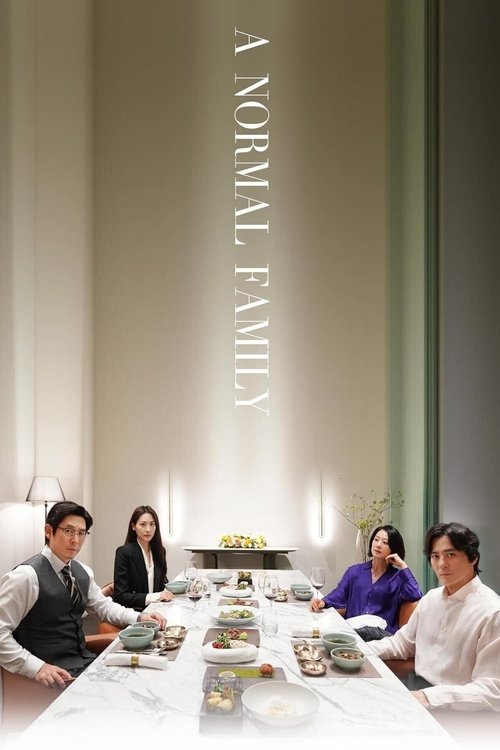
A Normal Family
A cold, glass-walled moral thriller where polished dinner plates reflect rotting consciences, and a family's veneer of civility cracks one course at a time until only instinct remains.
A Normal Family

A Normal Family

보통의 가족

"My child has committed a murder. What choice do I have?"

16 October 2024 South Korea 116 min 6.9 (153)

Director: Hur Jin-ho

Cast: Sul Kyung-gu, Jang Dong-gun, Kim Hee-ae, Claudia Kim, Hong Ye-ji

Drama Thriller Parental love versus moral duty Hypocrisy and the fragility of principles Class, wealth and privilege Appearances and the unknowability of one's children Family hierarchy and patriarchy in Korean society
Box Office: $4,399,821

Overview

A Normal Family (보통의 가족) is a South Korean psychological thriller directed by Hur Jin-ho and written by Park Eun-kyo and Park Joon-seok. It is based on Herman Koch's 2009 novel The Dinner, and it is the fourth screen adaptation of that book, after the Dutch Het Diner (2013), the Italian I nostri ragazzi (2014) and the American The Dinner (2017). It premiered at the 2023 Toronto International Film Festival and opened in South Korea in October 2024.

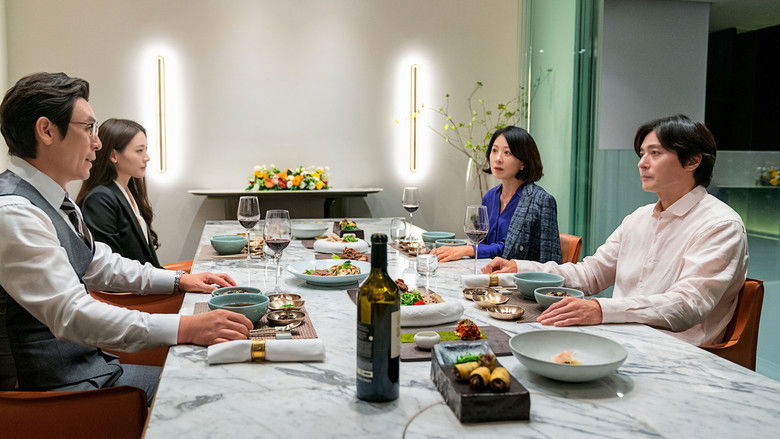
Two brothers seem to stand for opposite values. Jae-wan (Sul Kyung-gu) is a pragmatic, materialistic lawyer who will take any case, including the defence of a rich man's son who rammed his car into a stranger and the stranger's daughter. His younger brother Jae-gyu (Jang Dong-gun) is a principled pediatrician who puts patients ahead of profit. Once a month the brothers and their wives, Jae-wan's much younger second wife Ji-su (Claudia Kim) and Jae-gyu's strong-willed wife Yeon-kyung (Kim Hee-ae), meet for dinner at very expensive restaurants. These dinners are polite on the surface and tense underneath.

Everything changes when CCTV footage shows that their teenage children, Jae-wan's daughter Hye-yoon (Hong Ye-ji) and Jae-gyu's son Si-ho, brutally beat a homeless man. The four parents now have to choose between protecting their children and doing what is right. Over a series of dinners and private conversations, their positions keep moving, and the film keeps asking the audience what it would do in their place.

Core Meaning

The film's core idea is that morality held in comfort is not tested until it costs something personal. Hur said the novel's message touched on things he was curious about regarding current Korean society and people, so he adjusted the story to fit Korean life: the brothers' professions, cram-school pressure, patriarchal family duty, and the gap between wealth and poverty.

The title is ironic. The "normal family" is wealthy, respectable and envied, and that is exactly why it can hide its violence for so long. The film suggests that class privilege, keeping up appearances, and a parental love that has stopped asking questions can grow into something monstrous. In the end it argues that principles you only hold in theory may fall apart when your own child is involved, and that people who speak most loudly about virtue can be the ones who betray it most dramatically. As the Korea Times put it, the central question is: "What choices would you make if your child was a criminal?"

Thematic DNA

Parental love versus moral duty 30%
Hypocrisy and the fragility of principles 25%
Class, wealth and privilege 20%
Appearances and the unknowability of one's children 15%
Family hierarchy and patriarchy in Korean society 10%

Parental love versus moral duty

The main dilemma is whether to cover up the children's crime so they avoid juvenile prison, or to let them face justice. Each of the four parents takes a position, and each position shifts as the stakes rise. The film keeps asking how far parental love can go before it does more harm than good.

Hypocrisy and the fragility of principles

At the start Jae-gyu is the ethical brother and Jae-wan the cynic. The crisis pulls both of them in unexpected directions. Reviewers pointed out that the film is about how fragile moral standing is, and how easily ideas of right and wrong change when the threat is close to home.

Class, wealth and privilege

The victim is a homeless man, and the perpetrators are children of the elite. Lavish restaurants, Jae-wan's display of wealth, and his defence of a rich client's son all show how privilege bends guilt and accountability. Critics noted how the film shows the way privilege twists culpability within high society.

Appearances and the unknowability of one's children

The parents keep up a respectable facade and barely know the inner lives of their teenagers. Truthdig described the children's minds as a dark void, and noted that the parents' paralysis will be familiar to anyone who has felt unprepared for today's toxic digital culture.

Family hierarchy and patriarchy in Korean society

The film adds Korean details: a dementia-stricken mother who lives with Jae-gyu's family, disputes over who pays for her nursing home, hints of Christianity, and a strong sense of family duty. Reviewers noted that the adaptation places the story inside Korean culture and its still heavily patriarchal structure.

Character Analysis

Yang Jae-wan

Sul Kyung-gu

Archetype: Antihero / cynic who turns out to be the moral compass Key Trait: Cold rationality

Motivation

At first, success, money and status. Later, a pragmatic and stubborn sense that what was done cannot be undone or hidden.

Character Arc

He starts as a cold, materialistic lawyer who will defend anyone for a fee. When his own daughter's crime comes to light, he becomes the parent who argues that the children should be turned in. The cynic ends up standing for accountability.

Yang Jae-gyu

Jang Dong-gun

Archetype: Fallen idealist Key Trait: Righteousness that turns into ruthlessness

Motivation

His self-image as a good man, and in the end the urge to protect his son at any cost.

Character Arc

He begins as a principled pediatrician who volunteers abroad and lectures his brother about doing the right thing. Once his son's future is at risk, his ideals give way to a fierce protective instinct, and that leads him to the film's most shocking act.

All 5 characters and cast

Symbols & Motifs

The monthly dinners

Meaning:

These are rituals of civility and status, where good manners hide rivalry and moral rot.

Context:

The brothers and their wives meet once a month at very expensive restaurants. The film stages three key dinner scenes. Sul Kyung-gu described filming them as tense 'verbal combat'.

CCTV footage

Meaning:

An objective record that strips away the family's self-image. It is the truth they cannot argue their way out of, and also the evidence they consider hiding.

Context:

Security camera footage of the children beating a homeless man sets the central dilemma in motion.

Windows and glass

Meaning:

Distance and opacity. The characters stay unreachable and hard to read, seen but never fully understood.

Context:

NME noted that Hur often shoots the characters through windows, which creates distance between them and the viewer.

Cars and the road-rage case

Meaning:

Privilege used as a weapon. Violence carried out at speed and from behind glass, by people who expect to get away with it.

Context:

The opening road-rage case brings the brothers onto opposite sides professionally. Its image of a car used to destroy a life comes back in the climax.

The mother with dementia

Meaning:

An unreliable but prophetic voice that reveals buried family truths, including a violent streak the family does not acknowledge.

Context:

As one review noted, the aging matriarch casually warns one of the wives to watch out for her son's violent streak, a trait no one has seen yet.

Memorable Quotes

We did so many good deeds! We deserve that.
— A parent justifying the family's privilege (the line is quoted in Asian Movie Pulse's review; source available in English translation only)

Context

Said as the family reasons its way toward protecting the children. It shows how people who see themselves as virtuous turn their goodness into an excuse.

Meaning

It sums up the transactional idea of morality in the film: that past charity buys a pass for present crimes. Critics asked the same question: can good deeds tip the scale?

Why is this woman present during our family meeting?
— Yeon-kyung

Context

Yeon-kyung takes cruel pleasure in needling Ji-su while the family discusses the crisis (quoted in IndieWire's review; English translation).

Meaning

It shows the hierarchy and jealousy inside the family, and how Ji-su, the younger second wife, is treated as an outsider.

All 3 quotes

Philosophical Questions

Should a parent protect a child who has committed a terrible crime?

The film argues both sides through four parents. Some want to shield the teenagers from juvenile prison, others want just punishment as a moral lesson. It never says outright which is right, and it shows the disastrous cost of the choices the family makes.

Can good deeds offset wrongdoing?

The family appeals to their past charity and goodness to justify covering up the crime. Critics asked directly whether lives can be bought and whether good deeds can tip the scale. The film suggests they cannot.

Is everyone capable of violence?

The 'principled' brother's eventual act suggests that a violent side may be hidden in all of us. It also makes the viewer ask where their own breaking point would be.

Do principles mean anything if they have never been tested?

Jae-gyu's ethics are easy to hold while they cost him nothing. The film presents real morality as what a person does once their own interests are at stake.

How It Ends

Alternative Interpretations

Reading 1: a bleak view of human nature. NME read the ending as fulfilling Hur's and Koch's pessimism about humanity. In this view, everyone's civility is thin, and violence is always waiting underneath.

Full ending explanation

Cultural Impact

The film belongs to a wave of Korean cinema that examines class and privilege, but it comes from an unexpected director. Hur Jin-ho is associated with gentle romances, and here he moves into domestic noir. He placed Koch's European novel in a Korean setting of cram-school pressure, family duty and status anxiety, and critics broadly felt this made the story feel new even though it had already been filmed three times.

Critics responded strongly. NME called it a "morally complex masterpiece". IndieWire called it "deliciously cruel" and praised its refusal to give easy answers. The Korea Times praised how it builds psychological tension in confined spaces. The film holds a Metascore of 79 and an IMDb rating of about 7.1, and it travelled widely on the festival circuit from TIFF onward.

Commercially it underperformed in Korea and fell short of its break-even point. Even so, it has gained a reputation abroad, after a limited US release in April 2025, as one of the strongest versions of The Dinner. Several critics compared it favourably with the 2017 American version, which was faulted for preaching without the novel's cynicism.

Audience Reception

What was praised: Viewers and critics praised the six lead performances, especially Sul Kyung-gu and Kim Hee-ae, and the way the film puts the audience in every character's shoes without preaching. Cho Sung-woo's score was singled out as an active force in the film. Many also praised how unpredictable the story remains even though it has been adapted several times. IMDb reviewers called it a rare film that makes you think, and said its twists hit hard.

Criticism: Some found the first half slow, because the linear structure takes time to reach the assault video. The children's inner lives were felt to be underdeveloped, and IndieWire mentioned some shoddy CGI animals. Some viewers found the sudden, bleak ending too nihilistic or abrupt.

Overall verdict: The film is widely seen as a gripping, morally uncomfortable thriller and one of the strongest adaptations of The Dinner. It is admired more by critics and festival audiences than it was successful at the Korean box office.

Interesting Facts

  • This is the fourth screen adaptation of Herman Koch's 2009 novel The Dinner, after the Dutch film Het Diner (2013), the Italian I nostri ragazzi (2014) and the American The Dinner (2017).
  • Hur Jin-ho said the Italian version inspired him the most, but he changed the brothers' jobs to fit modern Korean society better.
  • The title 'The Dinner' sounds awkward in Korean, so it was changed to 보통의 가족, literally 'An Ordinary Family'.
  • Filming ran from July to September 2022, mainly in Seoul.
  • The film is Jang Dong-gun's first work with Hur Jin-ho in 11 years, since Dangerous Liaisons.
  • Sul Kyung-gu said the cast jokingly called the shoot 'verbal combat' because of the intense dialogue in the dinner scenes.
  • The world premiere was at the 2023 Toronto International Film Festival on September 14, 2023. The film also screened at the Busan, Hawai'i and Udine Far East festivals, among others, and won awards at Fantasporto and in Mons.
  • Hur said he was worried at first about making a decent adaptation, given how good the earlier versions were.
  • Although festivals and critics praised it, the film did not reach its break-even point of 1.5 million admissions in Korea. Worldwide gross was about US$6.4 million.
  • The film is a departure for Hur Jin-ho, who is best known for delicate romances such as Christmas in August and One Fine Spring Day.

Easter Eggs

The grandmother's 'senile' warning

The dementia-stricken matriarch casually warns about her son's violent streak, a trait no one has seen at that point. It is easy to dismiss, but it foreshadows the climax.

The opening road-rage case as a mirror

The car-ramming case that sets the brothers against each other at work is echoed in the film's violent ending, which turns the prologue into a grim prophecy.

A dialogue with earlier adaptations

Hur drew most on the Italian I nostri ragazzi, which also casts the brothers as a lawyer and a doctor. He abandoned the novel's single-dinner, flashback structure for a linear story spread over several days and locations.

Frequently Asked Questions

Explore More About This Movie

Dive deeper into specific aspects of the movie with our detailed analysis pages

Comments (0)

Leave a comment

No comments yet. Be the first to share your thoughts!

Similar Movies