
Skip to content
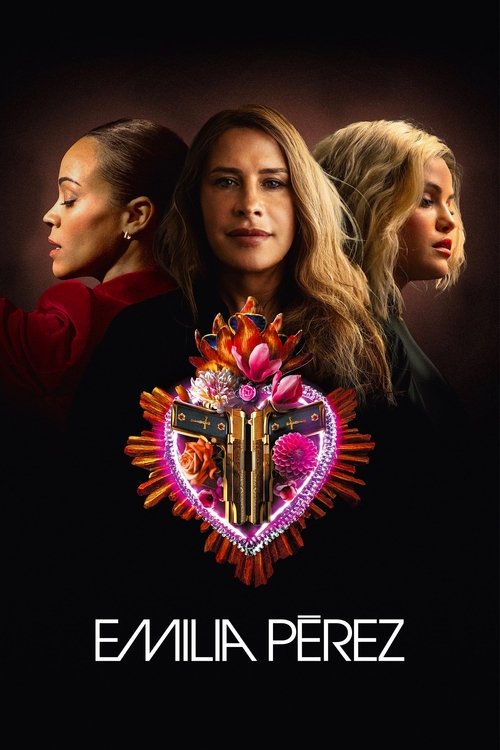
Emilia Pérez
A fiery operatic thriller bathed in shadow and neon, where raw desperation bleeds into a fever dream of reinvention, casting identity as a fragile, blood-stained mirror shattering across the Mexican night.
Emilia Pérez

Emilia Pérez

"Passion has a new name."

21 August 2024 Belgium 132 min 6.4 (2,004)

Director: Jacques Audiard

Cast: Zoe Saldaña, Karla Sofía Gascón, Selena Gomez, Adriana Paz, Edgar Ramírez

Drama Thriller Identity, Fluidity, and Self-Actualization Redemption, Guilt, and Atonement The Inescapability of the Past Institutional Corruption and Social Injustice Maternal Love and Possessiveness
Budget: $26,000,000
Box Office: $16,317,120

Overview

Set in Mexico City, Emilia Pérez centers on Rita Moro Castro (Zoe Saldaña), a brilliant but undervalued defense lawyer trapped in a corrupt legal firm that repeatedly keeps violent criminals out of prison. Rita’s life changes abruptly when she is secretly contacted by Juan "Manitas" Del Monte (Karla Sofía Gascón), the terrifying head of a feared drug cartel. Instead of asking for legal defense, Manitas offers Rita a fortune to organize a complete, covert disappearance so that Manitas can undergo gender-affirming surgery and live authentically as a woman named Emilia Pérez.

Rita arranges the complex medical journey and fakes Manitas' death, sending Manitas’ unsuspecting wife, Jessi (Selena Gomez), and their young children to live in Switzerland. Emilia undergoes her physical transformation abroad and begins her new life. However, years later, Emilia re-establishes contact with Rita in London and concocts a plan to bring her family back to Mexico City, hosting them in her mansion under the guise of being their long-lost aunt.

Once back in Mexico, Emilia seeks to atone for her past life of violence by establishing a non-profit foundation, La Lucecita, dedicated to locating and exhuming the mass graves of victims of cartel violence. What unfolds is a genre-blending, operatic story of identity, guilt, and family, as Emilia strives to construct a peaceful future while her past instincts and secret identity threaten to tear everything apart.

Core Meaning

Director Jacques Audiard explores the tension between radical personal rebirth and moral accountability. The film asks whether changing one's body and identity can truly erase past sins or alter a person's core nature. While Emilia’s gender transition is genuine and liberating, her lingering desire for authoritarian control over her family reveals that external and personal transformation does not automatically erase ingrained habits of power and violence. Ultimately, the movie presents a tragic critique of redemption: good deeds cannot completely wash away bloodstains when one continues to exercise control over others through deceptive means.

Thematic DNA

Identity, Fluidity, and Self-Actualization 30%
Redemption, Guilt, and Atonement 25%
The Inescapability of the Past 20%
Institutional Corruption and Social Injustice 15%
Maternal Love and Possessiveness 10%

Identity, Fluidity, and Self-Actualization

The film treats gender transition as both a deeply personal pursuit of authentic selfhood and a dramatic metaphor for rebirth. Emilia’s journey examines whether a person can fundamentally become someone new or if identity remains anchored to past actions.

Redemption, Guilt, and Atonement

Emilia attempts to balance her past atrocities as a cartel boss by founding La Lucecita to find missing victims. The narrative questions whether societal atonement is possible when built on top of past violence.

The Inescapability of the Past

Despite a physical transformation, new country, and new name, old habits of dominance and possessiveness resurface when Emilia’s control over her family is threatened.

Institutional Corruption and Social Injustice

Through Rita’s legal career and the backdrop of Mexico's missing persons crisis (desaparecidos), the film critiques a social system where money and power dictate justice.

Maternal Love and Possessiveness

Emilia’s intense urge to remain close to her children drives the narrative’s second half, demonstrating how love can metastasize into controlling possessiveness.

Character Analysis

Emilia Pérez / Juan "Manitas" Del Monte

Karla Sofía Gascón

Archetype: Antihero / Tragic Protagonist Key Trait: Dual nature balancing maternal warmth with underlying cartel ruthlessness

Motivation

To live authentically as a woman, protect her children, and seek redemption for her past crimes.

Character Arc

Terrifying, ruthless cartel kingpin who transforms into a woman living authentically and running a humanitarian NGO, eventually falling back into possessive, controlling tendencies leading to a tragic downfall.

Rita Moro Castro

Zoe Saldaña

Archetype: Catalyst / Moral Guide / Secondary Protagonist Key Trait: Pragmatic intellect and high kinetic energy

Motivation

Financial liberation, professional respect, and using her skills for genuine justice.

Character Arc

Frustrated defense attorney aiding corrupt criminals who becomes the architect of Emilia’s transformation and co-founder of La Lucecita, ultimately surviving as a moral guide who prioritizes protecting Emilia's children.

All 4 characters and cast

Symbols & Motifs

La Lucecita (The Little Light)

Meaning:

Symbolizes hope, moral redemption, and the effort to bring truth out of literal and figurative darkness.

Context:

Used as Emilia and Rita exhume mass graves to identify victims of cartel violence.

Facial Prosthetics and Mirrors

Meaning:

Symbolize the physical boundary between Manitas and Emilia, highlighting the tension between the mask worn for society and the true self beneath.

Context:

Used during scenes of physical transformation and quiet self-reflection.

Severed Fingers

Meaning:

A recurring motif of violence and cartel retribution that serves as a brutal reminder of her past life.

Context:

Appears when Gustavo and Jessi kidnap Emilia to force her to release her frozen funds.

Operatic Soliloquies and Whisper-Singing

Meaning:

Represent suppressed inner monologues and subconscious desires bursting forth.

Context:

Used when standard spoken dialogue in a corrupt world is insufficient to convey complex emotion.

Mexican Pink (Rosa Mexicano) & Architectural Shadows

Meaning:

Symbolize the hyper-curated sanctuary Emilia builds to insulate herself from external chaos.

Context:

Inspired by architect Luis Barragán, featuring vivid pink hues and strong geometric light within Emilia's mansion.

Memorable Quotes

Cambiar de cuerpo, cambiar de vida, cambiar de sexo, cambiar de alma.
— Chorus / Ensemble

Context

Sung during the surgical preparation scene.

Meaning

Captures the central thematic question of the film: whether changing physical reality fundamentally changes a person's soul.

Para cambiar a la sociedad, hay que cambiar primero la mente.
— Rita Moro Castro

Context

Performed during the song "El Mal".

Meaning

Exposes societal hypocrisy at an elite gala, arguing that systemic corruption stems from individual moral failure.

All 5 quotes

Philosophical Questions

Is Identity Inherent or Constructed?

Explored through whether changing one's body, name, and social role can erase past deeds, or if core psychological patterns persist.

Can Guilt Be Expiated Through Philanthropy?

Explored by examining if digging up mass graves can balance out having ordered similar acts of violence in a past life.

What Constitutes True Autonomy?

Explored through the question of whether a person can truly be free while maintaining secret control over their loved ones' lives.

Alternative Interpretations

The film can be interpreted through three main lenses:

Full ending explanation

Cultural Impact

Emilia Pérez made a significant mark on the international awards circuit, winning 2 Academy Awards (Best Supporting Actress for Zoe Saldaña and Best Original Song for "El Mal") out of 13 nominations, along with 4 Golden Globe Awards including Best Motion Picture – Musical or Comedy and Best Foreign Language Film.

However, the film sparked notable criticism in Mexico. Critics and local audiences pointed out a Eurocentric perspective, artificial studio depictions of Mexico, non-native Spanish accents, and perceived insensitivity toward the real tragedy of over 100,000 missing persons (desaparecidos). Public reaction was further complicated by controversial remarks from director Jacques Audiard describing Spanish as a "language of poor people and migrants," for which he later expressed regret.

Audience Reception

Audience reception was highly polarizing. Praised aspects included daring genre experimentation (combining musicals with narco-thrillers), standout performances by Zoe Saldaña and Karla Sofía Gascón, kinetic choreography by Damien Jalet, and memorable songs like "El Mal".

On the other hand, main points of criticism centered on tonal dissonance between serious themes (cartel violence, missing people) and lighter musical set-pieces, awkward Spanish phrasing translated from French/English, and Selena Gomez’s non-native accent. Overall, international critics praised its artistic risk-taking, while others criticized its cultural and linguistic handling.

Interesting Facts

  • Shot Entirely in Studio Soundstages in Paris: Despite taking place in Mexico City and Bangkok, the film was shot almost entirely on indoor soundstages near Paris to maintain absolute control over lighting, set construction, and musical blocking.
  • Literary Source: The film is loosely adapted from a single chapter of Boris Razon's 2018 French novel Écoute, which briefly mentioned a drug lord expressing a wish to transition.
  • Historic Cannes Ensemble Win: At the 2024 Cannes Film Festival, the Best Actress award was awarded jointly to the female ensemble (Karla Sofía Gascón, Zoe Saldaña, Selena Gomez, and Adriana Paz), with Gascón becoming the first openly trans actress to win a major award at Cannes.
  • Record Oscar Nominations: At the 97th Academy Awards, Emilia Pérez earned 13 nominations—the most ever for a non-English-language film in Oscar history.
  • Co-Produced by Saint Laurent: High-fashion house Saint Laurent, under creative director Anthony Vaccarello, co-produced the film via Saint Laurent Productions and designed custom wardrobe for the principal cast.
  • Zoe Saldaña’s Multitalented Performance: Saldaña performed all her own singing, dancing, and rapping in Spanish, drawing on her early background as a trained dancer.

Easter Eggs

Luis Barragán Architectural Homage

Production designer Emmanuelle Duplay modeled Emilia’s Mexican mansion after Pritzker Prize-winning Mexican architect Luis Barragán, using bold geometric cuts, high courtyard walls, and vibrant "Mexican Pink" to sculpt natural light.

Grand Opera Structure

The film follows the classical five-act structure of a 19th-century grand opera (complete with arias, recitatives, dynamic choruses, and a tragic finale), disguised as a contemporary narco-thriller.

Nota Roja Headlines

Newspaper stands shown in the street scenes display real-style nota roja (sensationalist crime journalism) headlines alongside images of real Mexican street protests against femicide.

Frequently Asked Questions

Explore More About This Movie

Dive deeper into specific aspects of the movie with our detailed analysis pages

Comments (0)

Leave a comment

No comments yet. Be the first to share your thoughts!

Similar Movies