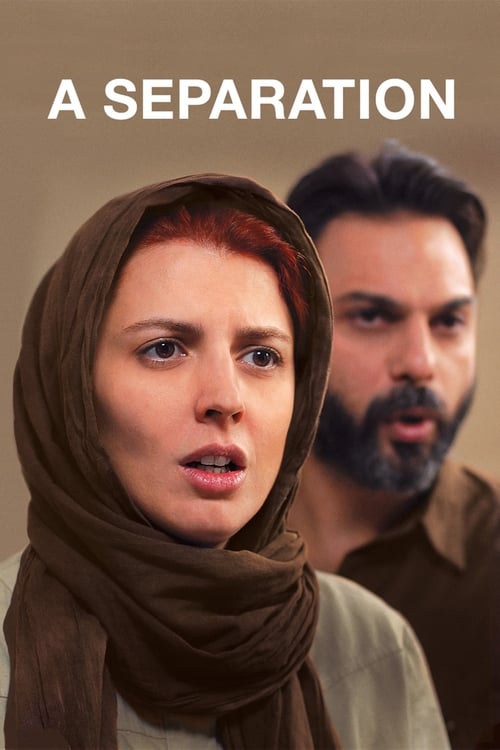
A Separation
جدایی نادر از سیمین
"Ugly truth, sweet lies."
Overview
"A Separation" begins with a middle-class Iranian couple, Nader and Simin, in court seeking a divorce. Simin wishes to leave Iran for a better future for their 11-year-old daughter, Termeh, but Nader refuses to abandon his elderly father, who suffers from Alzheimer's disease. When the judge denies their request, Simin moves in with her parents, leaving Nader to care for his father alone.
Nader hires Razieh, a devout, lower-class woman, to look after his father while he is at work. This arrangement, born of desperation, quickly becomes fraught with tension due to religious and class differences. A volatile incident occurs between Nader and Razieh, leading to a shocking accusation that propels both families into a tangled and escalating legal and moral battle.
The film meticulously peels back layers of deceit, half-truths, and cultural pressures as each character's perspective is presented without clear heroes or villains. Caught in the middle, Termeh is forced to navigate the complex adult world of compromised ethics, bearing silent witness to the painful erosion of her family and her own innocence.

Core Meaning
The core meaning of "A Separation" is an exploration of moral ambiguity and the elusiveness of objective truth in a society fractured by class, gender, and religious dogma. Director Asghar Farhadi deliberately avoids taking sides, creating a narrative where every character has a justifiable, albeit flawed, reason for their actions. The film posits that small, seemingly insignificant choices and lies can cascade into devastating consequences, blurring the lines between right and wrong. Ultimately, it suggests that these personal conflicts are microcosms of broader societal divisions and that true separation is not just between people, but between differing moral codes and social realities that struggle to coexist.
Thematic DNA
Moral Ambiguity and Truth
The film's central tension revolves around the characters' complex moral decisions and the web of lies they create. Nader lies about knowing Razieh was pregnant, Razieh is dishonest about the true cause of her miscarriage, and even Termeh lies to protect her father. Farhadi masterfully portrays a world without clear heroes or villains, forcing the audience to constantly shift allegiances and question what constitutes the 'truth' when every action is filtered through personal desperation, pride, and fear. The climax, where Razieh cannot swear on the Quran, highlights the collision between legal truth and religious conviction.
Class Conflict
A significant 'separation' in the film is the vast gulf between the middle-class, secular world of Nader and Simin and the lower-class, devoutly religious world of Razieh and Hodjat. This is evident in their homes, their manner of speaking, and their worldviews. Nader's frustration and condescension clash with Hodjat's explosive anger, which stems from his feelings of powerlessness and social humiliation. The conflict is not just between two individuals but between two distinct strata of Iranian society with different codes of honor and justice.
Gender and Patriarchy
The film subtly critiques the patriarchal structures of Iranian society. Simin's desire to leave is dismissed by a male judge, and she has little legal power without her husband's consent. Razieh must seek her husband's permission to work and calls a religious authority to ask if she can clean Nader's father. Despite these constraints, the female characters are often the primary drivers of the narrative, struggling for agency within a system that limits their choices.
Justice and Law
The characters repeatedly find themselves in Iran's legal system, which is depicted as bureaucratic and impersonal. The courtroom scenes are not grand dramatic spectacles but tense, realistic interrogations where the truth is obscured rather than revealed. The system forces characters to become their own detectives and advocates. The concept of justice is shown to be subjective, with legal outcomes often depending on who can present a more convincing story, and the possibility of settling matters with 'blood money' (diyat) introduces a financial dimension to moral culpability.
Character Analysis
Nader
Payman Maadi
Motivation
Nader's primary motivation is to uphold his duty to his ailing father and maintain his sense of honor. He fights the accusations against him not just to avoid prison, but to prove he is in the right. His actions are driven by a mix of familial love, pride, and a belief that the principles of his middle-class world should prevail.
Character Arc
Nader begins as a seemingly reasonable man burdened by responsibility. His defining trait is a stubborn pride and a belief in his own righteousness. As the conflict escalates, his refusal to compromise and his willingness to lie to protect himself reveal deep character flaws. His arc is not one of transformation but of revelation; the crisis exposes the moral compromises he is willing to make, which ultimately damages his relationship with his daughter, Termeh.
Simin
Leila Hatami
Motivation
Simin's core motivation is to provide a better future for her daughter, Termeh, which she believes is not possible in Iran. This propels her to seek a divorce and drives all of her initial actions. Even when she returns, her motivation is to protect her family, particularly her daughter, from the consequences of Nader's actions.
Character Arc
Simin initiates the entire plot with her desire to leave Iran. Though she physically separates from the main conflict for a portion of the film, she is drawn back in to help Nader and Termeh. Her arc shows a woman caught between her desire for a different future and her lingering familial obligations. She is pragmatic, attempting to solve the crisis with a financial settlement, but ultimately finds herself powerless to fix the deeper moral and emotional fractures.
Razieh
Sareh Bayat
Motivation
Razieh is motivated by two powerful, often conflicting, forces: her family's desperate need for money and her profound religious convictions. She takes the job to help her indebted husband, but her actions are constantly checked by her fear of sin. This internal conflict defines her character and drives her ultimate, pivotal decision.
Character Arc
Razieh is introduced as a timid, deeply religious woman forced by economic desperation into a compromising situation. Her arc is a tragic journey through fear, guilt, and moral crisis. Pressured by her volatile husband and her own dire circumstances, she participates in a lie. However, her unwavering religious faith provides a moral boundary she cannot cross, leading to her confession and the story's climax. She represents the struggle of faith in the face of immense hardship.
Hodjat
Shahab Hosseini
Motivation
Hodjat is motivated by a desperate need to reclaim his honor and secure justice for his family, specifically for the loss of his unborn child. He feels cheated by the system and belittled by Nader's higher social status. He fights aggressively for financial compensation, which represents not just money, but a form of retribution and validation.
Character Arc
Hodjat is presented as an aggressive, hot-tempered man, humiliated by his unemployment and debts. He serves as the primary antagonist, physically and verbally threatening Nader. However, his arc reveals deeper layers. His rage is rooted in a sense of injustice and the feeling that his social standing denies him respect. In the final scene, his violent outburst turns inward—he hits himself in frustration—showing that his anger is not just at Nader, but at his own powerlessness and his wife's deception.
Termeh
Sarina Farhadi
Motivation
Termeh's primary motivation is a desperate desire for stability and truth. She loves both her parents and initially tries to mediate. As the situation worsens, her motivation shifts to protecting her father, even if it means compromising her own integrity. She is driven by love and loyalty, but is increasingly weighed down by the moral complexities she is forced to witness.
Character Arc
Termeh begins as a quiet, observant child. Her arc is a painful coming-of-age story where she is forced to confront the moral failings of her parents. She becomes the film's moral center, quietly judging their actions and lies. Her decision to lie in court to protect her father is a pivotal moment, marking a loss of innocence. The film ends with her facing an impossible choice, symbolizing the burden of her parents' conflict now resting entirely on her shoulders.
Symbols & Motifs
Doors and Windows
Doors and windows symbolize the barriers—physical, emotional, and social—that separate the characters. They represent obscured truths, partial perspectives, and the divisions between private and public life.
Throughout the film, cinematographer Mahmoud Kalari frequently shoots through doorways and glass, creating frames within the frame. Key events, like Nader pushing Razieh out, are seen through the frosted glass of the front door, denying the viewer a clear perspective. Termeh often watches her parents' conflicts from behind a door or window, signifying her exclusion from their world and her fragmented understanding of the truth.
The Father's Alzheimer's
Nader's father symbolizes the weight of tradition, duty, and the past. His inability to communicate and his memory loss mirror the characters' broader failure to communicate and their selective, often self-serving, memory of events. He is the catalyst for the entire conflict, yet he remains a silent, unknowing center of the storm.
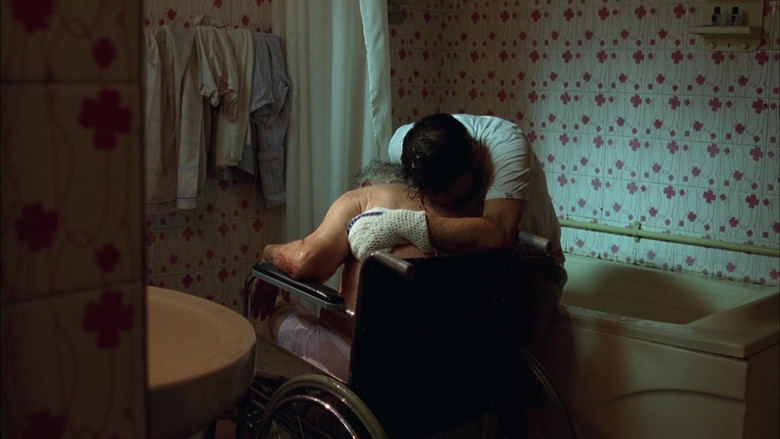
Nader's refusal to leave his father is the reason Simin seeks a divorce. The daily, difficult task of caring for him—washing him, preventing him from wandering off—leads directly to the hiring of Razieh and the subsequent tragic events. The moment Nader breaks down and cries while washing his father reveals his own vulnerability and the immense pressure he is under.
The Quran
The Quran represents an absolute moral authority that transcends the flawed, subjective justice of the legal system and the characters' personal lies. For Razieh, it is the ultimate arbiter of truth, a line she is unwilling to cross.
In the film's climax, Nader agrees to pay 'blood money' but demands that Razieh first swear on the Quran that his push caused her miscarriage. Despite the desperate need for the money and pressure from her husband, her faith prevents her from taking a false oath, as she knows she was also hit by a car. This moment becomes the ultimate revelation of truth in a film filled with deception.
Philosophical Questions
What is the nature of truth when everyone has their own valid, subjective perspective?
The film dismantles the idea of a single, objective truth. Each character's version of events is shaped by their social class, religious beliefs, and personal motivations. Nader believes he is justified because he was angry and didn't know about the pregnancy. Razieh omits the fact that she was hit by a car. The legal system tries to establish facts, but it only uncovers a web of half-truths. The film suggests that truth is not a fixed point but a shifting landscape, and what we choose to believe often depends more on our empathy for the person telling the story than on the evidence itself.
To what extent can moral principles be compromised in the face of desperation and survival?
"A Separation" is a case study in situational ethics. Nearly every character compromises their principles. Nader, who values honesty, lies to the court. Razieh, deeply devout, lies about the cause of her miscarriage to secure needed money. The film explores the immense pressure that social and economic hardship exerts on one's moral compass. It asks whether these characters are inherently dishonest or if their actions are understandable, even inevitable, products of a system that leaves them with impossible choices. Only Razieh's refusal to swear on the Quran provides a moment of absolute, uncompromised morality, but it comes at a great personal cost.
Where does personal responsibility end and societal failure begin?
While the characters make individual choices that lead to tragedy, the film constantly points to the larger societal structures that constrain them. Is the conflict Nader's fault, or is it the fault of a society with rigid class divides and a patriarchal legal system that offers women like Simin and Razieh few good options? The film suggests that personal responsibility is deeply intertwined with social context. The characters are not just acting in a vacuum; they are reacting to the pressures of their culture, their economy, and their legal system, making it difficult to assign ultimate blame.
Alternative Interpretations
The film's deliberate ambiguity, especially its ending, has invited multiple interpretations.
One interpretation sees the film as a political allegory for modern Iran. The 'separation' is not just between Nader and Simin, but between tradition (represented by Nader's duty to his father and Razieh's faith) and modernity (Simin's desire to emigrate). Termeh's final, unseen choice represents the future generation of Iran being forced to choose between these two opposing paths, with no easy answer. The failing patriarch with Alzheimer's could also symbolize an older generation and a past that is losing its coherence and authority.
Another perspective focuses on the film as a purely humanist drama, transcending its specific cultural context. From this viewpoint, the story is a universal exploration of marriage, ethics, pride, and desperation. The Iranian setting provides the specific textures and obstacles, but the core dilemmas—how far one would go to protect one's family, the corrosive effect of lies—are relatable to any culture. Farhadi himself has encouraged this view, stating that the issues of human relationships are not specific to a given place.
The ending, where Termeh's decision is not revealed, is central to these interpretations. Does she choose the flawed but present father (staying in Iran) or the mother who offers an escape (leaving)? The lack of an answer suggests that any choice is tragic and that the damage is already done. It forces the audience to leave the cinema debating the moral weight of each parent's position, becoming the final judge that the film's opening scene addressed.
Cultural Impact
"A Separation" achieved immense international acclaim at a time of significant political tension between Iran and the West. Its success, including winning the Golden Bear at the Berlin Film Festival and the first-ever Academy Award for an Iranian film, served as a powerful act of cultural diplomacy. The film provided global audiences with a nuanced, humanistic portrait of contemporary Iranian life, challenging monolithic, media-driven stereotypes. It moved beyond the tropes of Iranian neorealism by presenting a complex, dialogue-driven thriller that was universally relatable.
Within Iran, the film's reception was complex. While celebrated by many, its critical look at the country's social fabric, class divisions, and bureaucratic legal system drew the ire of some conservative officials. Despite this, its success demonstrated the power of Iranian cinema on the world stage. The film's influence can be seen in its contribution to a wave of realist dramas focusing on moral ambiguity and intricate social webs. Its open-ended, questioning style, which trusts the audience to pass judgment, has been widely discussed and emulated.
Audience Reception
Audiences worldwide praised "A Separation" for its gripping, intelligent, and emotionally resonant storytelling. It holds a 99% critic score on Rotten Tomatoes, indicating near-universal acclaim. Viewers were particularly impressed by its ability to function as both a tense thriller and a profound human drama. Many lauded the film's balanced perspective, which refuses to paint any character as a simple hero or villain, thereby challenging the audience to constantly re-evaluate their sympathies.
The main points of praise focused on the superb, naturalistic performances, Asghar Farhadi's masterful screenplay, and the film's moral complexity. However, some viewers found the film's pacing slow or its tone relentlessly bleak. A minor point of criticism from some Western audiences was the initial difficulty in navigating the specifics of the Iranian legal and cultural system, though most felt the film's universal themes of family, honesty, and class transcended these barriers. The ambiguous ending was a major point of discussion, with most viewers finding it powerful and thought-provoking, while a few expressed frustration at the lack of resolution.
Interesting Facts
- The film won the Academy Award for Best Foreign Language Film in 2012, making it the first Iranian film to ever win an Oscar.
- Sarina Farhadi, who plays the daughter Termeh, is the real-life daughter of director Asghar Farhadi.
- Director Asghar Farhadi was briefly banned from making the film by Iranian authorities due to his outspoken support for other filmmakers who were penalized by the government.
- The film has no traditional musical score; Farhadi intentionally used only natural, diegetic sound to enhance the sense of realism and tension.
- The initial idea for the film came to Farhadi from a single, haunting image he had in his mind: a young man washing his elderly father who has Alzheimer's.
- To prepare for the film, Asghar Farhadi attended real family court sessions in Iran to observe and capture the authenticity of the proceedings.
- The film was shot entirely on location in Tehran, using real apartments and courtrooms to increase its grounded, intimate atmosphere.
⚠️ Spoiler Analysis
Click to reveal detailed analysis with spoilers
Frequently Asked Questions
Explore More About This Movie
Dive deeper into specific aspects of the movie with our detailed analysis pages
Comments (0)
No comments yet. Be the first to share your thoughts!