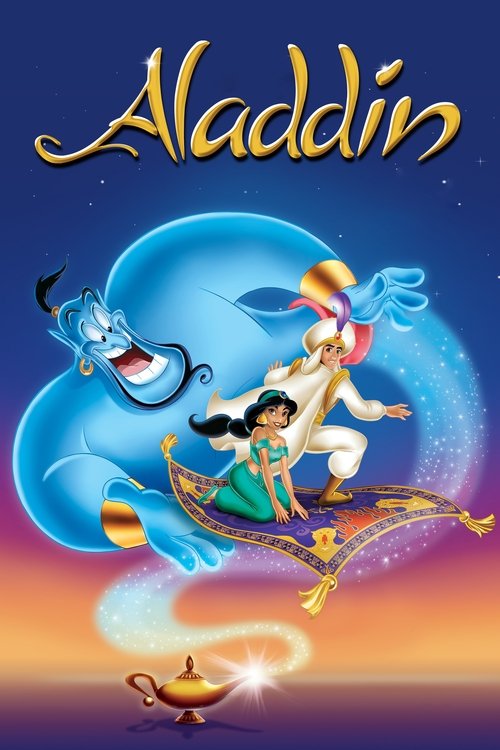
Aladdin
"Imagine if you had three wishes, three hopes, three dreams and they all could come true."
Overview
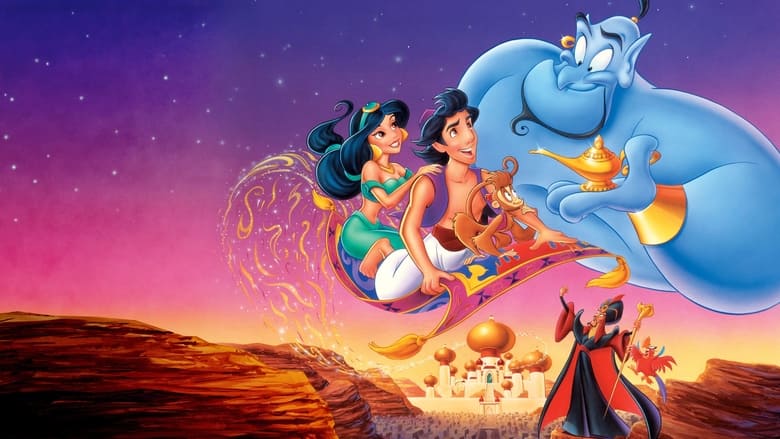
Set in the bustling, fictional Middle Eastern city of Agrabah, the story follows Aladdin, a charming but impoverished street urchin who survives by stealing food while dreaming of a better life. His world collides with that of Princess Jasmine, a fierce and independent royal who has disguised herself to escape the suffocating confines of her palace and the pressure of an impending arranged marriage. Their brief connection is cut short when Aladdin is thrown into the palace dungeons by the Sultan's scheming grand vizier, Jafar.
Manipulated by Jafar, Aladdin is sent into the mystical Cave of Wonders to retrieve a magical oil lamp. The mission goes awry, leaving Aladdin trapped, but he soon discovers the lamp's astonishing secret: a wildly eccentric, shape-shifting Genie who grants him three wishes. Hoping to win Jasmine's heart, Aladdin uses his first wish to transform himself into the wealthy and flamboyant Prince Ali.
However, Aladdin soon realizes that winning the princess requires more than just a magical disguise, as Jasmine is unimpressed by his newfound wealth and arrogance. Meanwhile, Jafar continues his relentless pursuit of the lamp, intending to use its cosmic power to usurp the throne. Aladdin must navigate a treacherous web of lies, magic, and royal politics to stop Jafar and prove that his true value lies not in his fabricated title, but in his brave and selfless heart.
Core Meaning
At its heart, the film emphasizes that true worth comes from within, encapsulated by the recurring metaphor of the diamond in the rough. The narrative carries a powerful message about the importance of authenticity, honesty, and self-acceptance. While magic, wealth, and power can alter external circumstances, they cannot change a person's core character. Aladdin's ultimate triumph occurs not when he uses magic to pretend to be someone he is not, but when he sheds his disguises, embraces his true self, and makes the selfless choice to keep his promise to free the Genie.
Thematic DNA
Identity and Authenticity
Almost every major character struggles with their identity and societal roles. Aladdin feels worthless because of his poverty and fakes being a prince to feel worthy of love. Jasmine feels trapped by her royal title and the laws that dictate her future. Even the Genie is defined by his magical servitude rather than his individuality. The film resolves these conflicts by rewarding characters only when they shed their disguises and embrace their true, authentic selves.
Freedom vs. Imprisonment
The dichotomy of freedom and captivity is a recurring motif. Jasmine is a prisoner in a luxurious palace; Aladdin is trapped by systemic poverty; the Genie is a cosmic prisoner bound to a lamp; and even the Sultan is intellectually trapped by Jafar's hypnosis and ancient traditions. The ultimate reward in the narrative is not wealth or power, but the gift of freedom and agency over one's own life.
The Corrupting Nature of Power
Jafar embodies the insatiable lust for power. Unlike Aladdin, who desires wealth merely to survive and find love, Jafar seeks dominance for its own sake. His trajectory demonstrates that power without moral grounding leads to self-destruction. His final wish to become a genie grants him phenomenal cosmic power but curses him with the ultimate loss of freedom.
Class Division and Social Prejudice
The film highlights the stark contrast between the starving commoners of Agrabah and the isolated, opulent lives of the royalty. Aladdin is instantly dismissed as a street rat by guards and noblemen alike, illustrating how society equates poverty with moral failure. The narrative dismantles this prejudice by proving that a pauper can possess far more nobility than a wealthy aristocrat.
Character Analysis
Aladdin
Scott Weinger
Motivation
Initially, he wishes to escape poverty and be respected. Later, his primary motivation becomes winning Princess Jasmine's heart and proving he is more than just a street urchin.
Character Arc
Aladdin starts as a kind-hearted but insecure thief who believes his worth is tied to his wealth. He uses magic to create a false, wealthy persona, but his lies nearly cost him everything. He eventually realizes that his true strength is his cleverness and his good heart, ultimately sacrificing his own magical desires to free his friend.
Princess Jasmine
Linda Larkin
Motivation
To marry for love rather than political obligation, and to experience the world outside the palace walls as a free, autonomous individual.
Character Arc
Jasmine begins feeling suffocated by royal protocols and the patriarchal law forcing her to marry a prince. She defies these norms by running away and repeatedly rejecting arrogant suitors. By the end of the film, her defiance and love for Aladdin inspire her father to change the oppressive law entirely.
The Genie
Robin Williams
Motivation
To be his own master and gain freedom from the confines of the magic lamp.
Character Arc
An all-powerful magical being who has spent millennia fulfilling the selfish desires of others while longing for his own freedom. Through his friendship with Aladdin, he learns to trust a human, and his arc concludes when he finally attains the liberty he has always dreamed of.
Jafar
Jonathan Freeman
Motivation
Absolute power and total dominance over Agrabah and the world.
Character Arc
The Sultan's trusted vizier who secretly harbors immense ambition. He transitions from a manipulative shadow-ruler to a tyrannical sorcerer, but his boundless greed causes his downfall when he wishes to become a genie, failing to realize the captivity that accompanies the cosmic power.
Symbols & Motifs
The Magic Lamp
The lamp symbolizes immense power, temptation, and the allure of easy solutions. However, it also represents bondage, as whoever wields its power is still ultimately constrained by the rules of the magic and their own character flaws.
It is the central driving force of the plot, sought desperately by Jafar and utilized by Aladdin to change his fate, yet it is ultimately abandoned by the hero in favor of genuine human connection and freedom.
The Cave of Wonders
The cave serves as a test of moral purity and temptation. It visually represents the dangers of unbridled greed.
Aladdin is permitted entry because he is a diamond in the rough, but the cave collapses violently when Abu succumbs to the temptation of touching a forbidden ruby, demonstrating that giving in to greed leads to destruction.
The Title 'Street Rat'
This derogatory term represents systemic societal prejudice and internal insecurity.
Aladdin is repeatedly called a street rat by the authorities and Prince Achmed. He internalizes this, believing he must become Prince Ali to be worthy of Jasmine, before finally reclaiming his self-worth and discarding the label's power over him.
The Birdcage
The birdcage is a direct visual metaphor for Princess Jasmine's gilded captivity.
Early in the film, Jasmine sadly releases white doves from a cage, reflecting her own desire to escape the palace walls and fly free from the strict patriarchal marriage laws dictating her life.
Memorable Quotes
I am not a prize to be won!
— Princess Jasmine
Context:
Jasmine angrily shouts this at the Sultan, Jafar, and Prince Ali when she discovers them discussing who she will marry without her presence or consent.
Meaning:
This is a powerful assertion of Jasmine's agency and autonomy. It highlights the film's progressive stance on female empowerment and critiques the patriarchal tradition of treating women as property in arranged marriages.
Ten thousand years will give you such a crick in the neck!
— The Genie
Context:
This is the very first thing the Genie says after Aladdin inadvertently rubs the magic lamp inside the Cave of Wonders, breaking the Genie's millennia-long imprisonment.
Meaning:
A brilliant introduction to the Genie's character, instantly establishing his fast-paced, anachronistic humor while subtly underlining the tragedy of his eternal captivity.
Like so many things, it is not what is outside, but what is inside that counts.
— The Peddler
Context:
Spoken by the mysterious peddler at the very beginning of the film as he attempts to sell the seemingly ordinary, beat-up oil lamp to the audience.
Meaning:
This quote establishes the central thematic thesis of the entire film: true value is found in one's character, not their wealth, titles, or physical appearance.
Aladdin, you've just won the heart of the princess. What are you gonna do next?
— The Genie
Context:
The Genie asks this to Aladdin in the style of an enthusiastic sports announcer right after the Sultan agrees to let Aladdin and Jasmine marry.
Meaning:
A clever, meta-theatrical pop culture reference to the famous I'm going to Disney World! Super Bowl commercial campaigns.
Philosophical Questions
Is freedom truly attainable, or just a change in masters?
The Genie desires freedom from the lamp, yet even when freed, he remains bound by his affection for Aladdin and his inherent nature. Similarly, Aladdin seeks freedom from poverty, only to find himself trapped by the lies of his princely persona, raising the question of whether societal and psychological constraints are just as binding as magical ones.
Does the end justify the means when pursuing love?
Aladdin continuously lies to Jasmine about his true identity, rationalizing that the deceit is the only way to bypass an unjust law. The film asks whether a relationship built on a foundation of magical deception can ever be authentic or healthy.
Is power inherently corrupting?
Jafar's arc suggests that the pursuit of absolute power strips away one's humanity. Even the Genie, who possesses ultimate cosmic power, views his abilities as a curse rather than a blessing, implying that extreme power is antithetical to a fulfilling existence.
Alternative Interpretations
One of the most popular fan theories and alternative interpretations posits that the events of Aladdin do not take place in the ancient past, but rather in a distant, post-apocalyptic future. Proponents of this theory point to the Genie's constant references to 20th-century pop culture (like Jack Nicholson and Arnold Schwarzenegger) and his claim that he has been trapped in the lamp for 10,000 years. If he was trapped during the 1990s, the film would take place around the year 11,990, explaining magic as lost, hyper-advanced technology and Agrabah as a post-apocalyptic civilization.
Another prevalent interpretation involves the Peddler at the beginning of the film. For years, fans theorized that the Peddler, who shares the Genie's voice actor (Robin Williams), four-fingered hands, and a similar beard, was actually the Genie in disguise after being freed. Co-director Ron Clements eventually confirmed this was the original intention, but some viewers take it a step further: they interpret that the entire story of Aladdin is merely a fabricated, exaggerated sales pitch invented by the clever Peddler just to sell a worthless, broken lamp to the viewer.
Furthermore, some critics read the film as a dark reflection of Western imperialism, where the good characters are essentially those who adopt Western capitalist and democratic ideals (marrying for love, seeking upward mobility), while the villains represent archaic, stereotyped Eastern despotism.
Cultural Impact
Released during the peak of the Disney Renaissance, Aladdin was a monumental critical and commercial success, becoming the highest-grossing film of 1992. It revolutionized feature animation by proving that A-list celebrities could be major selling points for voice acting; Robin Williams' frenetic, improvisational performance as the Genie became a cultural touchstone and changed the industry standard for animated casting forever.
Musically, the film cemented Alan Menken, Howard Ashman, and Tim Rice as legends, with A Whole New World winning the Academy Award for Best Original Song and becoming the only Disney song to ever win the Grammy Award for Song of the Year. It introduced a soundtrack that has remained a staple of global pop culture for decades.
However, the film's cultural legacy is also heavily debated. It has faced significant retrospective criticism for its reliance on Orientalist tropes and Middle Eastern stereotypes. Critics and scholars, drawing on Edward Said's theories of Orientalism, have pointed out the problematic homogenization of Arab culture, the exaggerated, villainous accents of characters like Jafar compared to the Anglicized voices of Aladdin and Jasmine, and controversial original lyrics in the opening song Arabian Nights (which were altered following protests from the American-Arab Anti-Discrimination Committee). Despite these controversies, the film's impact remains undeniable, inspiring a hit Broadway musical, multiple sequels, a television series, and a billion-dollar live-action remake in 2019.
Audience Reception
Upon its release, audiences and critics overwhelmingly embraced Aladdin. It holds a rare A+ CinemaScore and boasts near-universal acclaim on review aggregators. Viewers consistently praised Robin Williams' transcendent, scene-stealing performance as the Genie, which infused the film with a kinetic, anarchic energy previously unseen in Disney animations. The lush, vibrant animation of the Cave of Wonders and the magical carpet ride during A Whole New World were highlighted as visual masterpieces, while the soaring musical score became instantly iconic.
However, modern audience reception has become more polarized regarding the film's cultural representation. Many contemporary reviews criticize the film's Orientalism, pointing out the Anglicized features and voices of the heroes juxtaposed against the caricatured, heavily accented villains. The fictional setting of Agrabah is often criticized as an offensive, monolithic mishmash of various Middle Eastern and South Asian cultures. Despite these very real cultural critiques, the film remains widely beloved for its emotional core, its fast-paced humor, and its foundational role in the childhoods of millions of viewers.
Interesting Facts
- Robin Williams ad-libbed so much of his dialogue (recording over 16 hours of material) that the film was deemed ineligible for the Best Adapted Screenplay category at the Academy Awards.
- The character of Aladdin was originally designed to resemble Michael J. Fox, but the executives felt he wasn't charismatic enough, so the design was reworked to look more like Tom Cruise.
- The initial script featured a prominent role for Aladdin's mother, and a song titled 'Proud of Your Boy' was written for her by Howard Ashman. She was ultimately cut to streamline the story, though the song was later reinstated in the Broadway musical.
- The film was initially set in Baghdad, but the setting was changed to the fictional city of Agrabah due to the ongoing Gulf War in 1991.
- Howard Ashman, the brilliant lyricist who pitched the idea for the movie and wrote several of its iconic songs, tragically passed away from AIDS complications before the film was completed.
Easter Eggs
Sebastian the Crab cameo
While the Genie is looking for a royal recipe to transform Aladdin into a prince, he pulls out Sebastian from Disney's The Little Mermaid (which was also directed by Ron Clements and John Musker). A few notes of Under the Sea briefly play in the background.
The Beast figurine
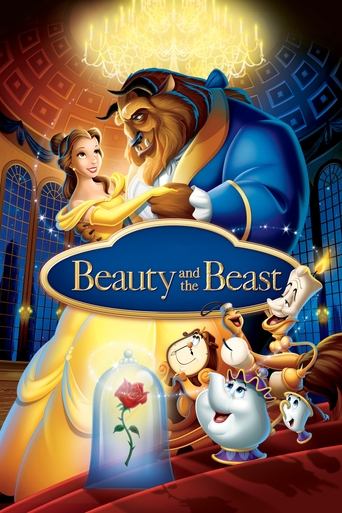
When the Sultan is absentmindedly stacking a tower of small animal figurines, the Beast from Disney's 1991 film Beauty and the Beast can be clearly seen as one of the toys.
Directors' Cameo
Directors Ron Clements and John Musker animated themselves into the film. They appear as two background characters in the crowd when Prince Achmed arrives at the Sultan's palace.
Hidden Mickeys
In true Disney fashion, there are several Hidden Mickeys. Most notably, when Jafar's spell is broken and Rajah transforms from a tiger cub back into a full-sized tiger, his head briefly morphs into the shape of Mickey Mouse for a few frames.
Pinocchio face
When Aladdin promises to use his third wish to set the Genie free, the Genie's face briefly transforms into Pinocchio, complete with a growing nose, indicating his skepticism and belief that Aladdin is lying.
⚠️ Spoiler Analysis
Click to reveal detailed analysis with spoilers
Frequently Asked Questions
Explore More About This Movie
Dive deeper into specific aspects of the movie with our detailed analysis pages
Comments (0)
No comments yet. Be the first to share your thoughts!