Lucky and Zorba
A heartfelt animated fable where a poisoned seagull's final gift transforms a port cat into an unlikely father, blending environmental caution with a tender tale of found family and the courage to take flight.
Lucky and Zorba

Lucky and Zorba

La gabbianella e il gatto

"Together they learn the true meaning of friendship."

22 December 1998 Italy 75 min ⭐ 7.7 (631)
Director: Enzo D'Alò
Cast: Carlo Verdone, Luis Sepúlveda, Antonio Albanese, Melba Ruffo, Sofia Baratta
Animation Family
Embracing Differences & Found Family Environmental Conservation Courage and Self-Discovery Solidarity and Community

Overview

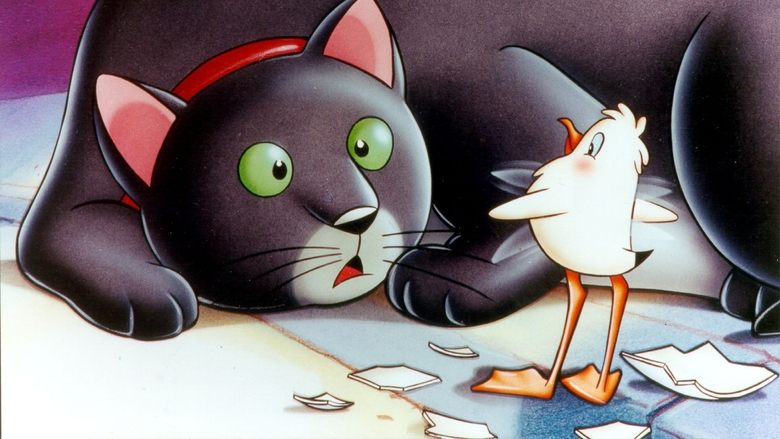
Set in the bustling port of Hamburg, the story begins when Kengah, a seagull, is fatally poisoned by an oil spill—referred to as the 'black plague.' In her dying moments, she crash-lands in the garden of a comfortable black cat named Zorba. Before passing away, she extracts three solemn promises from him: he must not eat her egg, he must care for the chick until it hatches, and most daunting of all, he must teach the newborn how to fly.

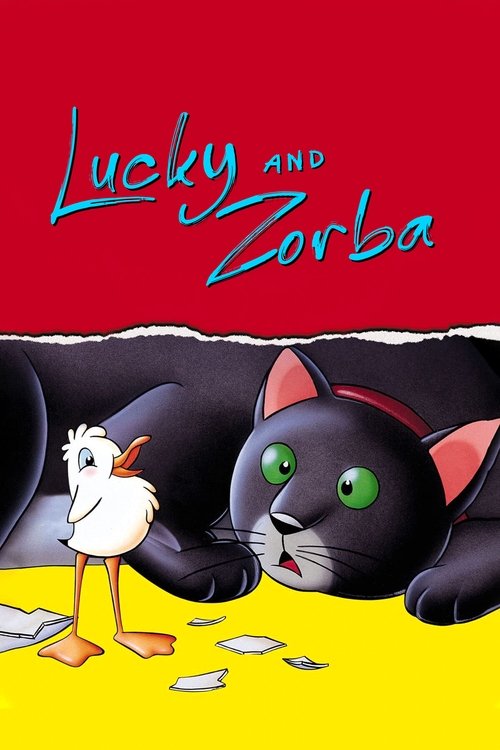
Zorba, bound by his word and his honor, suddenly finds himself acting as a father to a baby seagull named Lucky (Fortunata in the original Italian). Raised entirely by Zorba and his eclectic group of feline friends, Lucky grows up firmly believing she is a cat. However, her idyllic upbringing is threatened by an underground army of sewer rats, led by the tyrannical Big Rat, who plot to take over the city and see the young bird as a tasty snack.

As Lucky matures, she faces an existential crisis regarding her true identity. She must eventually confront her avian nature and overcome her deep-seated fear of the sky. To fulfill his final, seemingly impossible promise, Zorba is forced to break the most sacred rule of the cats and seek the help of a human, leading to an emotional and triumphant leap of faith.
Core Meaning

The central message of Lucky and Zorba revolves around the beauty of accepting and nurturing those who are fundamentally different from us. Director Enzo D'Alò and author Luis Sepúlveda crafted a poignant narrative that argues true love transcends species, race, and origins. The film illustrates that family is defined by actions, devotion, and mutual respect rather than biology.

Additionally, it carries a profound environmental message, warning against humanity's destructive impact on nature, symbolized by the devastating oil spill. Ultimately, the film's philosophical core is summarized by its most famous quote: 'Only those who dare to fly, fly.' It is a resonant call to embrace one's destiny, overcome paralyzing fears, and take the necessary leap of faith to achieve true freedom and self-actualization.

Thematic DNA

Embracing Differences & Found Family 40%
Environmental Conservation 25%
Courage and Self-Discovery 20%
Solidarity and Community 15%

Embracing Differences & Found Family

This is the dominant theme of the film, showcased through Zorba's adoption of a baby bird—his natural prey. The cats raise Lucky with complete unconditional love, proving that family is forged through care, loyalty, and emotional bonds rather than biological sameness.

Environmental Conservation

The story opens with a stark environmental critique. The devastating oil spill, referred to as the 'black plague,' highlights the deadly consequences of human pollution on wildlife, setting the entire tragic but hopeful narrative in motion.

Courage and Self-Discovery

Lucky's journey is one of profound self-discovery. She must unlearn her perceived identity as a cat to discover her true potential as a seagull, requiring immense courage to face the terrifying prospect of leaping into the open sky.

Solidarity and Community

Zorba does not act alone; he relies on the collective wisdom and bravery of his feline friends (and eventually a human) to protect Lucky from the rats and fulfill his vow, illustrating the power of community cooperation.

Character Analysis

Zorba

Carlo Verdone

Archetype: Reluctant Father / Honorable Hero
Key Trait: Honorable

Motivation

To protect Lucky from all dangers and faithfully fulfill the three promises he made to her dying mother.

Character Arc

Zorba transforms from a comfortable, carefree port cat into a fiercely devoted father. He overcomes the instincts of his species to honor a promise, ultimately learning the painful parental lesson of letting go so his child can soar.

Lucky (Fortunata)

Sofia Baratta / Domitilla D'Amico

Archetype: The Innocent / Coming-of-Age Hero
Key Trait: Curious

Motivation

To belong, feel safe with her feline family, and eventually find the courage to discover her true nature.

Character Arc

Starting her life convinced she is a cat, Lucky faces a harsh identity crisis when mocked by others. She eventually accepts her avian heritage, conquering her fears to take her rightful place in the sky.

Big Rat (Grande Topo)

Antonio Albanese

Archetype: Big Bad / Tyrant
Key Trait: Ruthless

Motivation

Power, domination of the port city, and consuming the young seagull.

Character Arc

He leads the disgruntled sewer rats in a plot to overthrow the cats and take over the town. He schemes from the shadows but is ultimately defeated by the unified cats.

Kengah

Alida Milana

Archetype: Tragic Mother
Key Trait: Devoted

Motivation

To ensure the survival of her unhatched egg at all costs.

Character Arc

Her arc is brief but foundational. She uses the last ounce of her dying strength to secure a future for her unborn child, placing absolute trust in a natural predator.

The Poet

Luis Sepúlveda

Archetype: Mentor
Key Trait: Wise

Motivation

To use his understanding of beauty and dreams to help Zorba achieve the impossible.

Character Arc

He acts as the human bridge to the animal world. Recognized by the cats as a dreamer, he steps in during the climax to facilitate Lucky's first flight.

Symbols & Motifs

The Oil Slick (La Macchia Nera)

Meaning:

It symbolizes humanity's negligence, moral decay, and the tragic destruction of the natural environment.

Context:

It is introduced at the very beginning when Kengah dives into what she thinks is water, only to be poisoned by the crude oil leaked from a sinking petrol ship.

The Egg

Meaning:

The egg represents fragile innocence, new life, and the physical embodiment of a sacred vow between two completely different species.

Context:

Kengah leaves the egg with Zorba just before her death, and it becomes the central object of protection for the first act of the film.

The Bell Tower

Meaning:

It symbolizes the ultimate threshold of fear, the leap into the unknown, and the transition from childhood dependency to true freedom.

Context:

Used in the climax of the film during a rainstorm, where Zorba and the Poet take Lucky so she can finally attempt to fly.

Memorable Quotes

Che vola solo chi osa farlo.

— Zorba

Context:

Spoken to the human (the Poet) when discussing the essence of flight and bravery as they prepare Lucky for her ultimate test.

Meaning:

This iconic line encapsulates the entire philosophy of the film: potential is meaningless without the courage to take a leap into the unknown.

Prometto che non mi mangerò l'uovo, ne avrò cura finché non sarà nato il piccolo e gli insegnerò a volare.

— Zorba

Context:

Zorba makes this solemn pledge to the dying seagull Kengah after she crash-lands on his balcony.

Meaning:

This is the foundational vow that drives the entire narrative, representing honor and a binding commitment across species.

Amico gatto, si vede che sei un animale buono e di nobili sentimenti. Per questo ti chiedo di farmi tre promesse.

— Kengah

Context:

Kengah's dying words to Zorba, recognizing his gentle nature before entrusting him with her unborn child.

Meaning:

It highlights the themes of trust and inherent goodness, breaking down the barriers between predator and prey in the face of tragedy.

Philosophical Questions

Can true love and family exist outside the boundaries of biological connection?

The film deeply explores this by having Zorba, a predatory cat, raise a baby seagull. It challenges the biological imperative, suggesting that empathy, dedication, and the keeping of a promise are the true foundations of family, rather than shared DNA or species.

What does it mean to dare?

Through the central motif of flying, the film questions the nature of courage. Daring is depicted not as the absence of fear, but as the willingness to step into the unknown (jumping off the bell tower) and trusting one's inner potential, even when one's environment has taught them otherwise.

How does environmental degradation reflect humanity's moral decay?

The 'black plague' of the oil spill is a stark philosophical indictment of human negligence. The film posits that humanity's careless destruction of nature forces the innocent animal kingdom to bear the fatal consequences, prompting cross-species alliances just to survive human-made disasters.

Alternative Interpretations

While primarily viewed as a heartwarming family film, critics and audiences have explored several deeper allegorical interpretations.

  • Political and Social Resistance: The conflict between the civilized, community-oriented cats and the fascist-like army of sewer rats led by Big Rat can be interpreted as an allegory for political resistance. The rats, operating in the shadows and plotting a forceful takeover, represent corrupt or dictatorial forces, while the diverse group of cats represents the solidarity of the working class and marginalized groups.
  • The Transnational Adoption Metaphor: Lucky's journey is frequently analyzed as a metaphor for trans-racial or cross-cultural adoption. Raised by a 'parent' of a different species, she initially rejects her biological heritage to blend in. Her ultimate flight is not a rejection of her adoptive father, but a healthy integration of her biological identity with the love and support of her found family.
  • Coming Out and True Identity: Some modern readings view Lucky's realization of her identity as a parallel to the 'coming out' experience. She has to overcome the societal expectations of her immediate environment to embrace her true, authentic self, supported by allies who love her unconditionally.

Cultural Impact

Upon its release in 1998, Lucky and Zorba (La gabbianella e il gatto) became an unprecedented triumph for Italian animation. Helmed by Enzo D'Alò and produced by Lanterna Magica, it proved that European traditional animation could compete with major Hollywood studios in its domestic market, achieving massive box office success.

Its cultural impact in Italy cannot be overstated; it became an instant childhood staple and was widely adopted by the Italian educational system. Schools across the country used both the film and Luis Sepúlveda's original book to teach children about environmental conservation, the dangers of pollution, and the vital importance of integration and cross-cultural acceptance.

The film's iconic phrase, 'Vola solo chi osa farlo' (Only those who dare may fly), has permeated Italian pop culture as an enduring motivational mantra. Critics highly praised its poetic storytelling, gentle pacing, and beautiful Mediterranean visual flair. It successfully translated Sepúlveda's magical realism into an accessible, heartfelt European fairy tale, leaving a lasting legacy in the landscape of 1990s animated cinema.

Audience Reception

Audiences and critics alike have overwhelmingly praised Lucky and Zorba for its profound emotional resonance, poetic storytelling, and beautifully traditional, hand-drawn 2D animation. Viewers frequently highlight the touching dynamic between Zorba and Lucky, and Carlo Verdone's warm, charismatic vocal performance is often singled out as a major highlight of the original Italian release.

The film's environmental and social themes were lauded for treating children with intelligence and respect, completely avoiding condescension. The poignant soundtrack, especially the score by David Rhodes and the main theme by Ivana Spagna, also received significant praise for elevating the emotional beats.

Some minor criticisms came from literary purists who felt that the expansion of the rats' role into typical cartoon 'Big Bad' villains detracted slightly from the more grounded, introspective tone of Sepúlveda's original novella. However, the overall verdict remains incredibly positive, with the film widely considered a crown jewel of European animation and a timeless masterpiece about love, tolerance, and courage.

Interesting Facts

  • With a budget of approximately $6.8 million, it was the most expensive Italian animated film at the time of its release in 1998.
  • Luis Sepúlveda, the acclaimed Chilean author of the original 1996 novella, made a special cameo by voicing the character of the Poet in the Italian version.
  • The film was a massive box office success in Italy, grossing around $6.8 million and becoming a generational classic.
  • Unlike the original book where the rats are minor antagonists, the film elevates them to the main villains with a full-blown musical plot to take over the town.
  • The film's uplifting theme song, 'So volare' (I Can Fly), was performed by the popular Italian pop singer Ivana Spagna.
  • During the climax, the cats use a 'Trojan Cheese' strategy—hiding inside a giant wheel of cheese—to infiltrate the rat headquarters and rescue Lucky.

Easter Eggs

Luis Sepúlveda's Cameo as the Poet

The original author of the story provides the voice for the human Poet. This serves as a beautiful meta-reference, as the literal creator of the story acts as the wise mentor who steps into the narrative to guide the characters toward their final resolution.

⚠️ Spoiler Analysis

Click to reveal detailed analysis with spoilers

Frequently Asked Questions

Explore More About This Movie

Dive deeper into specific aspects of the movie with our detailed analysis pages

Comments (0)

Leave a comment

No comments yet. Be the first to share your thoughts!