Warning: full spoilers follow, based on the plot and ending details reported by reviewers and reference sources.
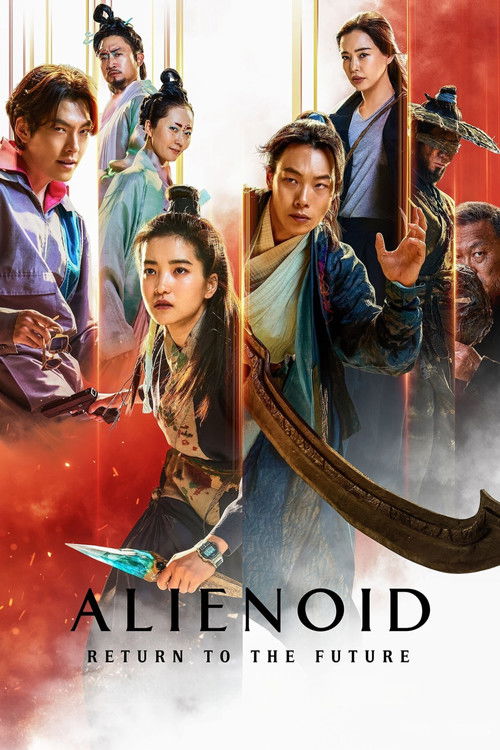
The setup. Lee Ahn, sent from 2022 back to 1391, has grown up in the past. Her possession of a gun has made her both notorious and hunted across Goryeo. Her objective is twofold: retrieve the Divine Sword, which unlocks the gate of time, and stop the escape of an alien prisoner locked inside a human body. To get home she must also find Thunder, the android intelligence bound to her guardian.
The alien inside Mureuk. The film's central buried secret concerns Mureuk himself. A weird presence in his body disturbs him throughout, and the two mages of Samgaksan, Heug-seol and Cheong-woon, pursue him precisely because they suspect an alien lies within. This reframes everything about him retroactively: the trickster swordsman whose abilities never quite matched his boasting has been carrying something that is not his. The suspicion that drives the middle of the film is not paranoia — the premise of aliens imprisoned in unsuspecting human bodies means anyone can be a cell, and Mureuk is the case that matters.
The competing claimants. The battle for the sword is a four-way convergence. Neung-pa, a blind swordsman, wants the rumoured divine blade to open his eyes. Ja-jang wants to claim it outright. The mages want it and want the alien in Mureuk. Lee Ahn needs it to open the gate. Each faction's desire is a character study disguised as a plot obstacle, and the collisions between them generate most of the middle act.
The present-day thread. In the modern timeline, the escaped alien prisoner known as The Architect detonates haava, an alien substance, killing several people. Min Gae-in, an accidental witness to the alien, begins investigating the incident. This is the film's bridge: the contemporary consequence of a containment failure whose origin lies centuries earlier, which is why the two timelines must eventually meet.
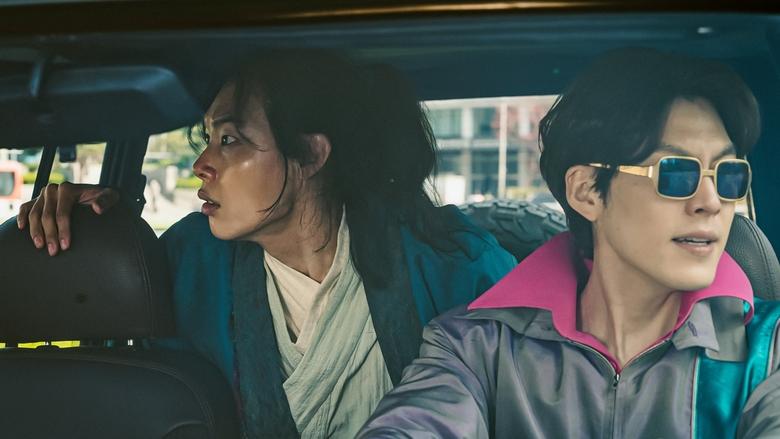
The inversion. The third act deliberately reverses the first film's structure. Where Part One dropped aliens into the past, Part Two brings the magical, Goryeo-era characters forward into the present. Talismans, sword-summoning and Taoist sorcery are suddenly operating in a modern world of vehicles and industrial infrastructure — the mismatch that reviewers found the film's most refreshing idea.
The finale. The climax escalates in stages: a car chase gives way to a brawl fought across the carriages of a moving cargo train, which culminates in a mutant alien showdown inside an abandoned power plant. Humans and monks work together to save everyone by returning to the present, and the hidden secrets seeded across both films are disclosed in the course of the fight for the sword. Several critics judged the resolution anticlimactic relative to the accumulated stakes, feeling the plot barely holding together into the final stretch.
What clarifies in hindsight. On reflection, the diptych's design becomes legible: Part One exists to scatter characters across eras, Part Two to weave them and the worldview back together, which is why the sequel is shorter and denser. The Divine Sword's real function is structural — it forces every faction into the same room so the mythology can be resolved. And the film's emotional payload is not the apocalypse averted but the reunion achieved: the machinery of time travel exists so that a girl stranded six centuries from home can be collected by the people, and machines, who never stopped looking for her.