
Skip to content
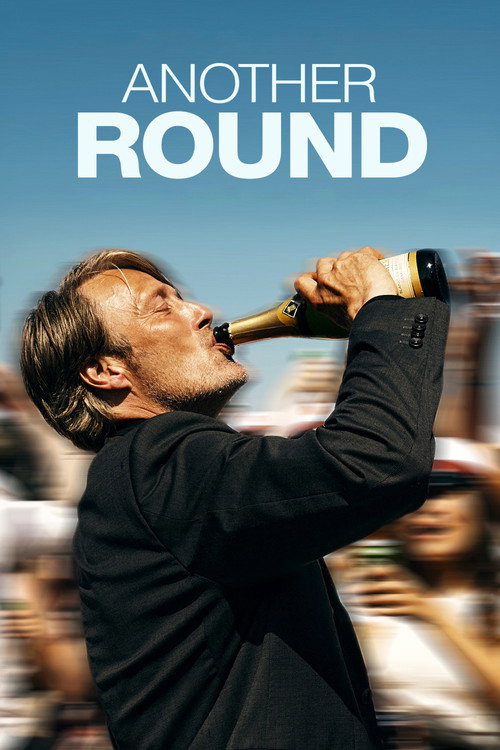
Another Round
A bittersweet Danish tragicomedy that sways between euphoria and grief, where four tired teachers pour courage into a glass and discover life fizzing briefly, dangerously, before it spills.
Another Round

Another Round

Druk

"What is youth? A dream. What is love? The content of the dream."

24 September 2020 Denmark 117 min 7.6 (3,675)

Director: Thomas Vinterberg

Cast: Mads Mikkelsen, Thomas Bo Larsen, Magnus Millang, Lars Ranthe, Maria Bonnevie

Drama Comedy Midlife crisis and lost vitality The double nature of alcohol Friendship and male fellowship Youth, fear of failure and existential anxiety Grief and the celebration of life
Budget: $5,150,000
Box Office: $21,700,000

Overview

Martin (Mads Mikkelsen) is a history teacher at a Danish high school who has become bored with his own lessons. His students have noticed, and so has his family. He and three colleagues — psychology teacher Nikolaj, music teacher Peter and the school's lonely gym teacher Tommy — each feel that life is slipping past them.

At a dinner, the friends discuss a theory attributed to Norwegian psychiatrist Finn Skårderud: that people are born with a blood alcohol shortfall of 0.05%, and that keeping that level up would make them more creative, relaxed and socially brave. Half as a joke and half as a lifeline, they decide to test it on themselves as a "scientific experiment," drinking during the working day.

At first the results look good. Lessons come alive and the men feel young again. But as they push the experiment further, Thomas Vinterberg's film becomes an honest, funny and painful study of friendship, middle age and the fine line between feeling alive and falling apart.

Core Meaning

Another Round is neither a temperance lecture nor a celebration of drinking. Critics note that the film does not pass moral judgement. It asks what it takes to feel fully alive and admits that the same thing that frees us can also destroy us. Alcohol is the device. The real subject is the loss of vitality in middle age and the urge to get back the recklessness, love and courage of youth.

Vinterberg's daughter Ida died in a car accident four days into filming. After that, the project changed into what he called an "ode to life" and "her monument." The film ends in grief and joy together: life is fragile and short, so it should be cherished and fully lived, even knowing its dangers.

Thematic DNA

Midlife crisis and lost vitality 30%
The double nature of alcohol 25%
Friendship and male fellowship 15%
Youth, fear of failure and existential anxiety 15%
Grief and the celebration of life 15%

Midlife crisis and lost vitality

All four teachers are stuck in some way. Martin is emotionally absent from his marriage and his classroom, Tommy is alone, Peter never had the family he wanted, and Nikolaj is worn out by small children. The experiment is their attempt to wake up again.

The double nature of alcohol

The film shows how alcohol affects different people in different ways. For some of the men it brings short-lived confidence and joy. For Tommy it leads to dependency and death. Denmark's drinking culture, from teenagers to teachers, is shown with both affection and alarm.

Friendship and male fellowship

The experiment is a group ritual. Its highs and its fallout are shared, and in the end grief brings the friends back together. The film is as much about the comfort of companionship as about drinking.

Youth, fear of failure and existential anxiety

Framed by Kierkegaard's lines about youth and love, the film sets the teachers' crisis next to the pressure on their students, who face exams and the fear of failing. Kierkegaard's idea of anxiety as the way a person deals with possible failure connects the two generations.

Grief and the celebration of life

The film was made in the shadow of Ida Vinterberg's death, and it moves from a funeral to an ecstatic dance. It argues that joy and loss are inseparable and that life should be embraced anyway.

Character Analysis

Martin

Mads Mikkelsen

Archetype: Everyman / reluctant hero Key Trait: Melancholy restraint that hides dormant passion

Motivation

To feel alive again and to reconnect with his wife, his students and the young man he used to be.

Character Arc

He starts as a burnt-out history teacher who bores his students and has drifted away from his family. Alcohol briefly makes him brilliant in the classroom and warmer at home. Then excess nearly destroys his marriage. After the loss of a friend, he finds release and acceptance in the final dance.

Tommy

Thomas Bo Larsen

Archetype: Tragic figure Key Trait: Gentle, lonely vulnerability

Motivation

To escape his loneliness and emptiness.

Character Arc

The school's lonely gym teacher is the one who cannot stop once the experiment ends. His slide into dependency ends when he sails his boat out to sea and never returns.

All 5 characters and cast

Symbols & Motifs

The 0.05% blood alcohol level

Meaning:

The idea that something is missing from ordinary life and that a precise dose could restore it. It stands for the modern wish to fix existential emptiness with a formula.

Context:

Based on Finn Skårderud's theory, it becomes the teachers' "scientific" starting point. They record their findings until the experiment grows beyond any controlled dose.

Martin's final dance

Meaning:

Release, rebirth and surrender to life. The body finally expresses what Martin has held back.

Context:

At the harbour, among celebrating graduates and to Scarlet Pleasure's "What a Life," Martin jumps, kicks and flips. Mikkelsen is a trained dancer and gymnast.

The sea and Tommy's boat

Meaning:

Escape, loneliness and the point of no return, where freedom turns into oblivion.

Context:

Tommy drunkenly sails out to sea and never comes back. The final dance takes place at the water's edge soon after his funeral.

Kierkegaard's epigraph

Meaning:

Youth as a dream and love as its contents: a lost paradise the middle-aged men long for.

Context:

The film opens with the quote from Either/Or. Kierkegaard comes back later when a student discusses the concept of anxiety.

The graduates' celebration

Meaning:

A youth that is reckless and full of promise, which the teachers have lost and briefly reach again.

Context:

The film opens and closes with students drinking and celebrating, so the adults' story sits inside the culture of youth.

Memorable Quotes

What is youth? A dream. What is love? The dream's contents.
— Søren Kierkegaard (opening epigraph)

Context

The film opens with this quote from Kierkegaard's Either/Or, before the students' drinking celebration.

Meaning

It sets up the film's nostalgia for youth and love. These are the "dreams" the middle-aged teachers try to recover through alcohol.

Philosophical Questions

Is something missing from ordinary human existence, and can it be chemically restored?

The 0.05% theory suggests that sober life is deficient. At first the film seems to support this, as the teachers blossom. Then it shows the cost, suggesting that the "missing" thing is really courage, love and presence, which no dose can supply safely.

How should we live with the anxiety of possible failure?

Through the Kierkegaard references and the students' exam pressure, the film suggests that accepting fallibility, and not escaping it, is the basis of a full life.

Can joy and grief exist in the same moment?

The move from Tommy's funeral to Martin's dance, made in the shadow of the director's own loss, argues that celebrating life does not deny death. It may be the only honest answer to death.

Where is the line between living fully and self-destruction?

Each teacher reaches a different limit. The film refuses to draw one universal line and shows how the same substance means freedom for one person and ruin for another.

How It Ends

Alternative Interpretations

A celebration of life: Many critics see the ending as a joyful affirmation. The film does not pass moral judgement and instead shows life as something to be cherished as it is. Martin's dance is pure liberation.

Full ending explanation

Cultural Impact

Vinterberg made Another Round after Festen and The Hunt. It looks honestly at Denmark's drinking culture, which the film shows among both teenagers and adults. The production was shaped by tragedy: Ida Vinterberg's death early in filming turned the film into what the director called an ode to life.

It won the Academy Award for Best International Feature Film, and Vinterberg's acceptance speech dedicating the award to his daughter was one of the most moving moments of that ceremony. Mikkelsen's final dance was widely praised as one of the most spectacular movie scenes of its year. It spread across social media, and Scarlet Pleasure's "What a Life" became a drinking anthem in Denmark.

The film's international success led to reports of an English-language remake starring Leonardo DiCaprio, which some commentators questioned. Philosophically, the film draws on Kierkegaard and on real psychiatric speculation (Finn Skårderud) and uses them to explore existential questions about vitality, anxiety and the meaning of a lived life.

Audience Reception

Audiences rated the film highly (about 7.7/10 on IMDb), and it was widely admired on Letterboxd. Viewers praised Mads Mikkelsen's performance above all, especially the final dance, which many called their favourite movie moment of the year. They also praised the balance between comedy and tragedy, the warm chemistry among the four friends, and the film's emotional honesty, which the story of Ida Vinterberg deepened for many.

The main criticism and controversy was about its attitude to alcohol. Some viewers felt the film glamorises drinking or is too ambivalent about it. Others praised it for refusing to moralise. Some thought the premise was predictable in its rise-and-fall structure.

Overall verdict: a humane, life-affirming and bittersweet film, widely regarded as one of Vinterberg's best and confirmed by its Oscar win.

Interesting Facts

  • The central premise comes from a theory attributed to Norwegian psychiatrist Finn Skårderud: that humans are born with a blood alcohol shortfall of 0.05%, and that keeping that level up improves creativity and social courage.
  • Vinterberg's daughter Ida was killed in a car accident four days after filming began in May 2019. She was supposed to play Mikkelsen's daughter in the film.
  • Vinterberg chose to finish the film in Ida's honour because she loved the project. The film is dedicated to her, and he called it her monument.
  • The film won the Academy Award for Best International Feature Film. In his tearful acceptance speech, Vinterberg paid tribute to Ida.
  • Mads Mikkelsen is a trained dancer and gymnast, which made the final harbour dance possible.
  • Mikkelsen found out that the lead singer of Scarlet Pleasure, whose song 'What a Life' plays over the finale, was someone he had driven home a couple of times years earlier when the singer was a drunk young man.
  • Because of the film, 'What a Life' became a kind of drinking anthem in Denmark.
  • An English-language remake starring Leonardo DiCaprio was reported after the film's Oscar success.
  • The film is Vinterberg's latest collaboration with Mads Mikkelsen after The Hunt (Jagten, 2012).

Easter Eggs

The Kierkegaard framing

The opening epigraph from Either/Or and the later classroom mention of Kierkegaard's concept of anxiety place the film within Danish existentialist philosophy. Kierkegaard is Denmark's best-known philosopher.

The singer Mikkelsen once drove home

The song that plays over Martin's liberating drunken dance is sung by someone Mikkelsen really did drive home when that person was young and drunk. Life and fiction overlap in a small way here.

Frequently Asked Questions

Explore More About This Movie

Dive deeper into specific aspects of the movie with our detailed analysis pages

Comments (0)

Leave a comment

No comments yet. Be the first to share your thoughts!

Similar Movies