
Skip to content
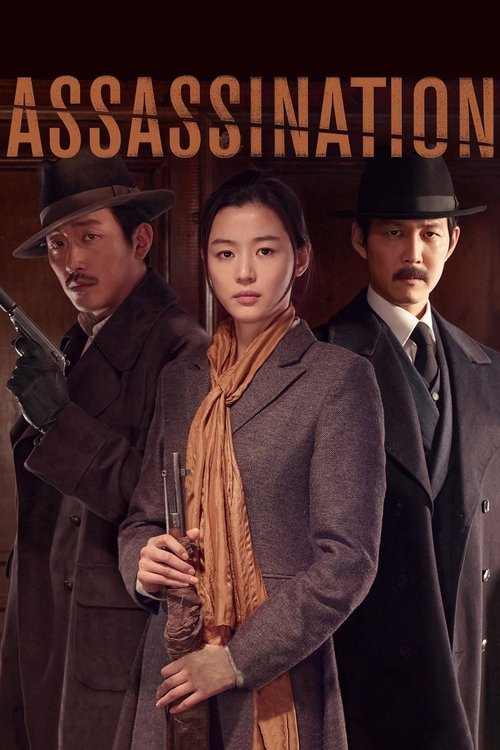
Assassination
Enveloped in the dust and gunsmoke of 1930s colonial espionage, this pulse-pounding thriller burns with grief and defiance, mirroring a sniper's cracked crosshairs locked onto a fractured, betrayed motherland.
Assassination
Assassination

암살

"The country falls. The operation begins."

22 July 2015 South Korea 140 min 7.3 (291)

Director: Choi Dong-hoon

Cast: Gianna Jun, Ha Jung-woo, Lee Jung-jae, Oh Dal-su, Cho Jin-woong

Drama History Action Thriller The Moral Cost of Collaboration vs. Resistance Historical Memory and the Tragedy of Unresolved Justice Duality, Identity, and Divergent Destinies Redemption through Acknowledgment
Box Office: $96,119,773

Assassination — Ending Explained

⚠️ Spoiler Analysis

The central turning point of the plot arrives when Ahn Ok-yun discovers that pro-Japanese billionaire Kang In-guk is her biological father, and that she has a twin sister named Mitsuko living a pampered aristocratic existence in Seoul. When Mitsuko discovers Ok-yun's identity and visits her safehouse, Kang In-guk arrives with Japanese gendarmes and ruthlessly executes Mitsuko on the spot, believing her to be the resistance assassin.

Capitalizing on her identical appearance, Ok-yun assumes Mitsuko's persona and attends the high-society wedding between Mitsuko and Japanese officer Kawaguchi Shunsuke. The wedding becomes a blood-soaked ambush: Big Gun Chu Sang-ok, though gravely wounded from an earlier gunfight, storms the banquet hall, while Hawaii Pistol and Old Man join the firefight. Together, they eliminate General Kawaguchi and Kang In-guk, with Hawaii Pistol shooting Kang to spare Ok-yun the unbearable psychological burden of patricide.

While attempting to flee through the city sewers, Hawaii Pistol and Old Man are cornered by traitor Yeom Seok-jin and Japanese troops. Both die in a hail of bullets, but not before Hawaii Pistol fatally stabs Yeom. Yeom survives his wounds, however, and resurfaces in 1949 as a senior police investigator. When the Special Committee on Anti-National Activities attempts to prosecute him, Yeom successfully exploits the court through dramatic patriotic theatrics and escapes punishment. However, his triumph is short-lived: Ahn Ok-yun and resistance survivor Myung-woo track him down to an alleyway and shoot him dead, finally executing Kim Gu's 16-year-old death warrant.

Alternative Interpretations

While widely celebrated as a stirring patriotic blockbuster, several critics interpret the film's climax as a deliberate critique of historical wish-fulfillment. The cathartic execution of Yeom Seok-jin in 1949 represents an idealized counter-history that contrasts sharply with reality, where the vast majority of real-life Korean collaborators retained wealth, administrative influence, and political power in post-war South Korea. Viewed through this lens, the film's triumphant final gunshot is not pure celebration, but a bitter, melancholic reminder of justice that never arrived in the real world.

Alternatively, the film can be read as a revisionist feminist action text. Rather than relegating female characters to tragic victims or decorative love interests, Ahn Ok-yun is established as the tactical leader and moral anchor of the resistance cell. Her male counterparts—including Hawaii Pistol and Big Gun—repeatedly sacrifice themselves to protect her mission and ensure her survival, positioning female agency at the absolute core of the nation's liberation fight.

Explore More About This Movie

Dive deeper into specific aspects of the movie with our detailed analysis pages

Similar Movies