Skip to content
Assassination
Enveloped in the dust and gunsmoke of 1930s colonial espionage, this pulse-pounding thriller burns with grief and defiance, mirroring a sniper's cracked crosshairs locked onto a fractured, betrayed motherland.
Assassination

Assassination

암살

"The country falls. The operation begins."

22 July 2015 South Korea 140 min 7.3 (291)

Director: Choi Dong-hoon

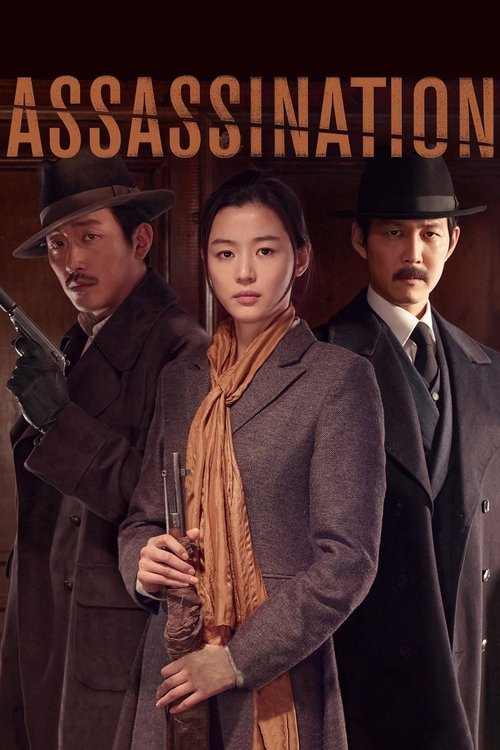
Cast: Gianna Jun, Ha Jung-woo, Lee Jung-jae, Oh Dal-su, Cho Jin-woong

Drama History Action Thriller The Moral Cost of Collaboration vs. Resistance Historical Memory and the Tragedy of Unresolved Justice Duality, Identity, and Divergent Destinies Redemption through Acknowledgment
Box Office: $96,119,773

Overview

Set against the turbulent backdrop of Japanese colonial rule in the 1930s, Assassination chronicles an audacious covert plot orchestrated by the Korean Provisional Government in exile. Operative Yeom Seok-jin is tasked by resistance leaders Kim Gu and Kim Won-bong to assemble a specialized strike team to infiltrate Japanese-occupied Gyeongseong (modern-day Seoul). Their high-stakes mission is to eliminate two high-priority targets: General Kawaguchi Mamoru, commander of the Japanese forces in Korea, and Kang In-guk, an influential and unscrupulous Korean industrialist collaborating with the imperial regime.

To carry out the dangerous operation, Yeom recruits three imprisoned or exiled freedom fighters: Ahn Ok-yun, a deadly marksman serving with the Korean Independence Army in Manchuria; Chu Sang-ok, affectionately known as 'Big Gun', a boisterous gunslinger from the Sinheung Military Academy; and Hwang Deok-sam, an explosives specialist. Together, this makeshift squad is smuggled into Gyeongseong to prepare their ambush from a safehouse operating under the guise of the stylish Café Anemone.

However, the mission is fatally compromised from within before it even begins. Yeom Seok-jin secretly harbors dark loyalties and hires 'Hawaii Pistol', an enigmatic hitman for hire, along with his loyal partner 'Old Man', to hunt down and assassinate the three resistance operatives. As conflicting agendas, mistaken identities, and explosive shootouts collide in the heart of colonial Seoul, the characters are thrust into a deadly game of cat and mouse where the ultimate prize is national survival and personal redemption.
Core Meaning

At its heart, Assassination explores the enduring moral imperative of resistance against systemic oppression, even in the face of near-certain futility. Director Choi Dong-hoon interrogates why ordinary men and women chose to sacrifice their lives for an abstract dream of freedom when survival and personal enrichment favored cowardice and collaboration. The film serves as a poignant reminder that even if individual violent acts could not instantly topple an imperial empire, the refusal to surrender kept the cultural soul and dignity of the nation alive. Concurrently, the narrative issues a biting critique of historical pragmatism and unpunished treachery, stressing that a nation cannot truly achieve justice until it honestly confronts the ghosts of its own opportunists and collaborators.

Thematic DNA

The Moral Cost of Collaboration vs. Resistance 35%
Historical Memory and the Tragedy of Unresolved Justice 25%
Duality, Identity, and Divergent Destinies 20%
Redemption through Acknowledgment 20%

The Moral Cost of Collaboration vs. Resistance

The central thematic dichotomy is embodied by the parallel trajectories of Ahn Ok-yun and Yeom Seok-jin. While Ok-yun endures poverty, harsh exile in Manchuria, and mortal danger to strike against colonial masters, Yeom trades his revolutionary fervor for personal survival and Japanese patronage. The film shows how betrayal often begins as pragmatic self-preservation before degenerating into absolute moral rot.

Historical Memory and the Tragedy of Unresolved Justice

The narrative framing around the Special Investigation Committee for Anti-National Activities in 1949 highlights South Korea's painful post-liberation reality. By showing how pro-Japanese traitors reinvented themselves as anti-communist patriots and evaded legal accountability, the film underscores the tragedy of forgotten sacrifices and systemic historical amnesia.

Duality, Identity, and Divergent Destinies

The physical identity swap between the twin sisters Ahn Ok-yun and Mitsuko serves as a visual metaphor for the divided fate of Korea under colonial rule. Born into the same family, one child grows up amidst the luxury of the collaborator elite, while the other survives in frozen exile as a hunted guerrilla fighter, illustrating how external circumstance and choice construct completely opposing realities.

Redemption through Acknowledgment

Through characters such as Hawaii Pistol, a cynical mercenary traumatized by patricide who begins as an ideological nihilist, the film shows how apolitical bystanders are drawn into collective struggles. Choosing solidarity over cynically detached self-interest allows him to reclaim personal honor and meaning.

Character Analysis

Ahn Ok-yun

Gianna Jun (Jun Ji-hyun)

Archetype: Tragic Hero / Reluctant Avenger Key Trait: Unwavering precision and moral clarity under fire

Motivation

To deliver a clear signal to both oppressors and her people that the resistance lives, and to avenge her mother and fallen comrades.

Character Arc

Begins as an emotionally guarded sniper hardened by brutal Manchurian skirmishes; upon discovering her tragic heritage as the separated daughter of a collaborator, she embraces her leadership role and carries out the final act of historical justice decades later.

Yeom Seok-jin

Lee Jung-jae

Archetype: Fallen Patriot / Traitor Key Trait: Charismatic deceit and chameleon-like opportunism

Motivation

Self-preservation, opportunistic greed, and cynical disbelief in the possibility of Korea ever regaining independence.

Character Arc

Starts as a heroic, passionate freedom fighter in 1911, but after breaking under Japanese torture, he becomes a duplicitous mole within the provisional government, eventually reinventing himself as a decorated high-ranking police chief after liberation.

All 5 characters and cast

Symbols & Motifs

Broken Eyeglasses / Optical Lenses

Meaning:

Signifies clarity of conviction amidst distortion, personal vulnerability, and the fractured vision of an occupied people.

Context:

Sniper Ahn Ok-yun wears cracked glasses taped together while aiming her Mosin-Nagant rifle, symbolizing her sharp focus despite physical hardship and deep emotional damage.

Café Anemone and Gramophone Music

Meaning:

Represents the fleeting illusion of cosmopolitan modernity and romance hiding the brutal reality of the colonial underground.

Context:

Resistance operatives use the Western-style café run by Madame as an undercover meeting depot, where jazzy European records cover the whispers of clandestine revolution and impending bloodshed.

The Twin Sister's Mirror Image and Bridal Gown

Meaning:

Symbolizes the fractured national soul and the subversion of bourgeois domesticity into revolutionary warfare.

Context:

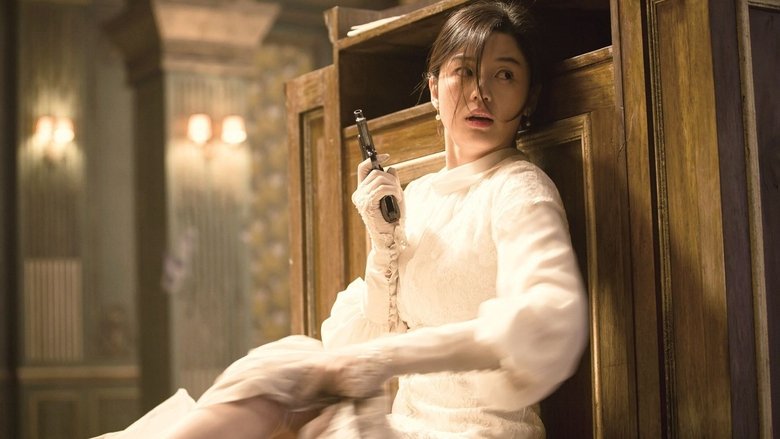
When Ok-yun takes the place of Mitsuko and conceals a Mauser pistol beneath her white bridal dress during the wedding sequence, the ceremony transforms into a crucible of violent rebellion.

The Resistance Group Photograph

Meaning:

Represents immortality through collective memory, defiance against obscurity, and the sanctity of forgotten martyrs.

Context:

Before departing for Seoul, the assassination trio poses together holding firearms and the Korean flag; decades later, Kim Gu and Kim Won-bong gaze upon that faded picture to mourn their fallen comrades.

Memorable Quotes

알려줘야지. 우리는 계속 싸우고 있다고.
— Ahn Ok-yun

Context

Spoken when asked whether assassinating two men will truly liberate their occupied nation.

Meaning

Articulates the core ideological justification for the resistance, expressing that the symbolic value of fighting is essential even when total victory seems improbable.

몰랐으니까... 해방될 줄 몰랐으니까! 알면 그랬겠나?
— Yeom Seok-jin

Context

Screamed in desperation in an alleyway in 1949 when Ahn Ok-yun confronts him after his court acquittal.

Meaning

Exposes the pathetic, spineless rationalization of historical collaborators whose morality was purely dictated by whichever empire appeared victorious.

All 4 quotes

Philosophical Questions

Does symbolic resistance retain inherent moral value even when practical success is unattainable?

Ahn Ok-yun's insistence that they must keep fighting to show 'that we are still here' defends the deontological belief that defying oppression is a moral duty in itself, entirely detached from utilitarian calculations of immediate success.

Can personal survival justify moral compromise under totalitarian rule?

Yeom Seok-jin's agonizing trajectory from tortured freedom fighter to double agent probes where understandable human fragility ends and culpable ethical betrayal begins.

Is extrajudicial retribution justified when formal legal institutions fail to deliver justice?

The 1949 epilogue challenges conventional views of the rule of law by asking whether vigilante assassination becomes a moral necessity when state courts pardon monstrous crimes against humanity.

How It Ends

Alternative Interpretations

While widely celebrated as a stirring patriotic blockbuster, several critics interpret the film's climax as a deliberate critique of historical wish-fulfillment. The cathartic execution of Yeom Seok-jin in 1949 represents an idealized counter-history that contrasts sharply with reality, where the vast majority of real-life Korean collaborators retained wealth, administrative influence, and political power in post-war South Korea. Viewed through this lens, the film's triumphant final gunshot is not pure celebration, but a bitter, melancholic reminder of justice that never arrived in the real world.

Full ending explanation

Cultural Impact

Released in July 2015 to coincide with the 70th anniversary of Korea's Liberation Day (August 15), Assassination became a cultural phenomenon in South Korea, sparking passionate nationwide conversations regarding historical justice and national identity. The film brought renewed public scrutiny to the real-life historical failure of the Special Investigation Committee for Anti-National Activities (Banmin Teukwi), which was dismantled by the Syngman Rhee administration before pro-Japanese collaborators could face comprehensive legal punishment.

The film swept major national honors, taking home Best Film at both the 36th Blue Dragon Film Awards and the 52nd Baeksang Arts Awards. Moreover, it set a creative precedent for high-budget Korean period cinema, demonstrating that colonial-era settings—long regarded by local studios as commercial box-office risks—could yield sophisticated, critically acclaimed, and massively profitable cinematic blockbusters.

Audience Reception

Audiences and critics praised Assassination for its breakneck pacing, opulent period set design, and masterful balance of comedy, espionage thrills, and emotional pathos. Gianna Jun's dual performance received universal acclaim, earning her Best Actress accolades for subverting conventional melodrama with cold, determined marksmanship. Ha Jung-woo and Lee Jung-jae were similarly singled out for delivering magnetic, morally textured turns.

Minor criticisms centered on its 140-minute runtime, occasional narrative coincidences—such as the sudden twin sister revelation—and the rapid tonal shifts between slapstick humor and grim colonial violence. Nevertheless, audience verdict was overwhelmingly celebratory, turning the film into one of the biggest commercial milestones in modern Korean cinema history.

Interesting Facts

  • Gianna Jun underwent rigorous physical firearms training to comfortably run, leap, and aim a 5-kilogram Mosin-Nagant sniper rifle without blinking during muzzle flashes.
  • Lee Jung-jae lost approximately 15 kilograms (33 pounds) and purposely stayed awake for 48 hours prior to filming the 1949 courtroom scene to convey the gaunt, physically exhausted state of an aging Yeom Seok-jin.
  • The production crew built a massive 13,500-square-meter historical open set in Goyang to recreate 1930s Seosomun Street in Gyeongseong, alongside extensive location filming at Chedun Film Studio in Shanghai.
  • With over 12.7 million admissions and more than $90 million at the box office, the movie made Choi Dong-hoon only the second South Korean director ever to have two films surpass the coveted 10-million-ticket threshold, following Yoon Je-kyun.
  • Actor Jo Seung-woo delivered a memorable special appearance as real-life Korean independence leader Kim Won-bong without demanding formal top-billing on the movie's main poster.
  • Costume designer Cho Sang-gyeong and Son Na-ri earned the Best Costume Design award at the 36th Blue Dragon Film Awards for creating meticulous period trench coats, military uniforms, and glamorous 1930s dresses.

Easter Eggs

Major casting reunion from Choi Dong-hoon's heist hit 'The Thieves' (2012)

Leading cast members Gianna Jun, Lee Jung-jae, Oh Dal-su, and Kim Hae-sook previously shared top billing in Choi's record-breaking caper film, creating playful actor dynamics that subvert their previous heist chemistry into deadly political espionage.

The symbolic meaning behind Café Anemone

The choice of flower name directly foreshadows tragic romance and betrayal, as the anemone historically symbolizes forsaken love, fading hope, and anticipation of mortality in classic floral lexicons.

Historic meeting of Kim Gu and Kim Won-bong

The early scene unites two historically antagonistic leaders of different independence factions, dramatizing their actual real-life cooperative efforts to pool resources against Japanese colonial command.

Frequently Asked Questions

Explore More About This Movie

Dive deeper into specific aspects of the movie with our detailed analysis pages

Comments (0)

Leave a comment

No comments yet. Be the first to share your thoughts!

Similar Movies