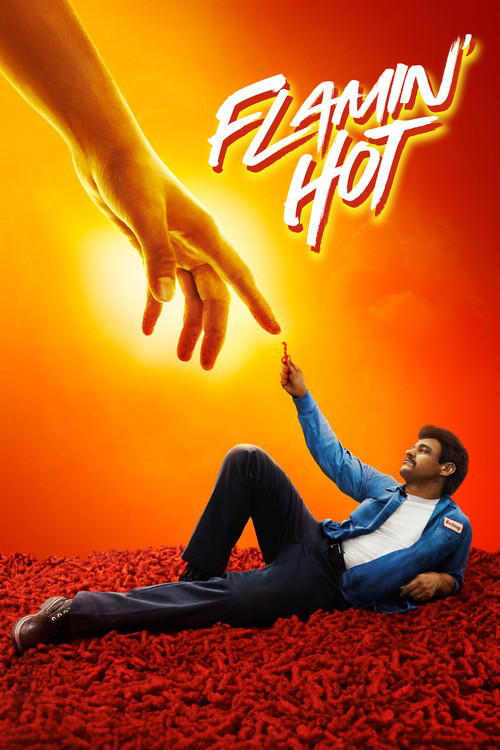
Flamin' Hot
An inspiring biographical drama, infused with vibrant comedic energy, that charts a determined man's fiery ascent from janitor to marketing revolutionary.
Flamin' Hot

Flamin' Hot

"The flavor you know. The story you don't."

11 March 2023 United States of America 99 min ⭐ 8.0 (769)
Director: Eva Longoria
Cast: Jesse García, Annie Gonzalez, Emilio Rivera, Vanessa Martinez, Dennis Haysbert
Drama History
The American Dream and Upward Mobility Cultural Identity and Representation Perseverance and Self-Belief Family and Community Support

Overview

"Flamin' Hot" tells the story of Richard Montañez, a janitor at Frito-Lay who claims to have invented the iconic Flamin' Hot Cheetos. The film, directed by Eva Longoria, follows Richard's journey from his upbringing in a Mexican-American family in Southern California to his struggles to provide for his wife and children. Facing economic hardship and prejudice, Richard's life takes a turn when he lands a job as a janitor at the Frito-Lay plant.

Driven by a desire to see his community represented in the snack aisle, Richard, with the help of his wife Judy, develops a spicy seasoning inspired by Mexican street corn. He pitches his idea directly to PepsiCo CEO Roger Enrico, believing that a product tailored to the Latino market could be a massive success. The film chronicles his determined, and often humorous, efforts to convince the corporate world to take a chance on his revolutionary idea, facing skepticism and internal resistance along the way.

The narrative focuses on Montañez's perseverance, the unwavering support of his family, and the power of community in overcoming obstacles. It's a story about embracing one's heritage and using it as a source of strength and innovation in a world that often overlooks it.

Core Meaning

At its core, "Flamin' Hot" is a celebration of the underdog and the quintessential American Dream, viewed through a specifically Mexican-American lens. Director Eva Longoria intended the film not as a factual history of the Cheeto, but as an inspirational story about Richard Montañez's journey and his truth. The film's central message is about perseverance, self-belief, and the importance of cultural identity. It champions the idea that innovation can come from anyone, regardless of their background or position, and underscores the power of a community's voice and economic influence. The film seeks to inspire audiences by showing how one person's passion and connection to their heritage can disrupt an entire industry and create a global phenomenon.

Thematic DNA

The American Dream and Upward Mobility 35%
Cultural Identity and Representation 30%
Perseverance and Self-Belief 25%
Family and Community Support 10%

The American Dream and Upward Mobility

The film is a classic rags-to-riches story, portraying Richard Montañez's journey from a janitor with a criminal record to a successful marketing executive. It explores the theme of the American Dream, suggesting that with hard work, ingenuity, and perseverance, anyone can overcome their circumstances. Richard's rise through the corporate ladder at Frito-Lay serves as a testament to this ideal, even as the film acknowledges the systemic barriers of racism and classism he faces.

Cultural Identity and Representation

A central theme is the power and importance of cultural heritage. Richard's idea for Flamin' Hot Cheetos stems directly from the flavors of his Mexican-American community. The film highlights the untapped potential of the Latino market and argues for the importance of cultural representation in mainstream products and media. It's a story about channeling one's background not as a limitation, but as a unique strength and source of innovation.

Perseverance and Self-Belief

Richard's journey is defined by his refusal to take "no" for an answer. Despite facing skepticism from his superiors and setbacks in the corporate system, his unwavering belief in his idea and himself propels him forward. The film emphasizes the importance of tenacity and having a vision, showcasing how Richard's determination, fueled by the support of his wife Judy, is the key ingredient to his success.

Family and Community Support

The film underscores that success is not achieved in isolation. Richard's wife, Judy, is his biggest supporter and a crucial partner in developing the Flamin' Hot concept. Furthermore, when corporate marketing fails, it is Richard's local community that rallies to prove the product's viability through a grassroots effort. This highlights the theme that family and community are essential foundations for individual achievement.

Character Analysis

Richard Montañez

Jesse García

Archetype: The Underdog Hero
Key Trait: Determined

Motivation

His primary motivation is to create a better life for his family and to prove his worth in a system that consistently underestimates him. He is driven by a deep sense of pride in his Mexican-American heritage and a belief that his community deserves to be seen and catered to by corporate America.

Character Arc

Richard begins as a former gang member and janitor, struggling to make ends meet and facing constant discrimination. Fueled by an idea and a desire to provide for his family, he learns to navigate the corporate world, transforming from a blue-collar worker into a confident and visionary marketing executive. He learns to embrace his heritage as his greatest asset, ultimately earning respect and success.

Judy Montañez

Annie Gonzalez

Archetype: The Supportive Partner
Key Trait: Loyal

Motivation

Her motivation is rooted in her fierce love for her husband and family. She believes in Richard's potential even when he doubts himself and is committed to building a stable and proud life for their children.

Character Arc

Judy is Richard's steadfast supporter from the beginning. While she shares his struggles, her arc is one of unwavering faith and resilience. She is not just a passive supporter but an active collaborator in the Flamin' Hot project, helping him develop the recipe and encouraging him to persevere through moments of doubt. Her strength and belief in him are the emotional backbone of his journey.

Roger Enrico

Tony Shalhoub

Archetype: The Mentor/Ally
Key Trait: Visionary

Motivation

Enrico is motivated by the need to revitalize a struggling Frito-Lay and is open to innovative ideas from any source. Personally, he is motivated by a sense of empathy for Richard, seeing a kindred spirit and wanting to reward hard work and passion.

Character Arc

As the CEO of PepsiCo, Enrico is initially an intimidating and distant corporate figure. However, he reveals himself to be a surprisingly open-minded leader. His arc involves recognizing the potential in Richard's unconventional idea and his personal story. He becomes Richard's crucial ally, championing his idea against internal opposition because he sees a reflection of his own immigrant, underdog story in Richard.

Clarence C. Baker

Dennis Haysbert

Archetype: The Wise Mentor
Key Trait: Principled

Motivation

Clarence is motivated by a strong work ethic and a sense of fairness. He sees Richard's potential and genuine curiosity and is moved to help him, imparting wisdom gained from his own years of experience as a minority in a corporate environment.

Character Arc

Clarence is a veteran engineer at the Frito-Lay plant who initially appears gruff and adheres strictly to the rules. He develops a mentor-like relationship with Richard, teaching him about the machinery and, more importantly, about navigating the corporate structure with dignity and intelligence. He becomes one of Richard's key supporters within the plant.

Symbols & Motifs

Flamin' Hot Cheetos

Meaning:

The snack itself symbolizes more than just a product. It represents cultural recognition, the infusion of Mexican-American identity into mainstream American culture. It's a symbol of innovation from an unexpected source and the economic power of an often-overlooked demographic.

Context:

Throughout the film, the creation and popularization of the spicy snack drive the plot. Richard's initial idea, born from adding chili to unflavored Cheetos, mirrors the way his community adds spice to their own food, making the product an extension of his culture.

The Janitor's Uniform

Meaning:

The uniform symbolizes Richard's initial station in life and the low expectations society has for him. It represents the class and racial barriers he must overcome. Shedding it at the end for a suit signifies his ultimate triumph and upward mobility.

Context:

Richard is consistently seen in his janitor's uniform for the first half of the film, often being dismissed or looked down upon by executives. His desire to learn the machinist's job while still a janitor shows his ambition to move beyond the role the uniform represents. His promotion at the end is visually marked by him receiving his own office and no longer wearing the uniform.

Chili Powder

Meaning:

The chili powder symbolizes Mexican-American heritage and the "spice" or unique perspective that Richard brings to the bland corporate world of Frito-Lay. It is the literal and metaphorical secret ingredient to his success.

Context:

The film shows Richard and his family experimenting with different chili powders and spices in their kitchen to create the perfect flavor. This act of creation is rooted in family and culture, contrasting with the sterile, data-driven environment of the Frito-Lay corporation.

Memorable Quotes

It's gonna change everything. Spicy Doritos, Fritos, Cheetos.

— Richard Montañez

Context:

Richard says this to his wife, Judy, as he fully grasps the potential of his idea. He sees beyond a single spicy Cheeto to a whole flavor revolution within Frito-Lay.

Meaning:

This line encapsulates Richard's grand vision. It's not just about one snack; it's about creating an entire product line that caters to a new market, demonstrating his forward-thinking and ambitious nature.

When the world treats you like a criminal, you become one.

— Richard Montañez (voiceover)

Context:

This line is delivered as a voiceover narration as the film depicts a young Richard being wrongfully arrested, framing his entry into a life of crime as a reaction to the injustice he faced.

Meaning:

This quote explains Richard's past involvement with gangs not as a moral failing, but as a consequence of societal prejudice and lack of opportunity. It provides context for his character and highlights the systemic issues he has had to overcome.

We all write our own stories, we create our own destinies. You think I was gonna let someone else steal mine? Nah. Never!

— Richard Montañez (voiceover)

Context:

This is part of the closing narration of the film, as Richard reflects on his journey and success. It plays over scenes of him in his new executive role, solidifying his legacy.

Meaning:

This quote serves as the film's thesis statement, emphasizing themes of agency, self-determination, and ownership of one's narrative. It's a defiant declaration of his success and a response to those who doubted or tried to erase his contribution.

Philosophical Questions

What is the relationship between 'personal truth' and 'historical fact' in storytelling?

The film deliberately centers on what it calls Richard Montañez's "truth," even in the face of contradictory evidence from Frito-Lay and journalists. This raises the philosophical question of whether the inspirational and emotional truth of a person's life journey holds more value than a strict adherence to historical fact, especially when telling stories about underrepresented communities. The film prompts the audience to consider if a story's power to inspire can justify embellishment and who gets to be the arbiter of the 'official' version of history—the corporation with the records or the individual with the lived experience of rising through its ranks.

Does the 'American Dream' truly exist for everyone?

"Flamin' Hot" presents a powerful narrative of achieving the American Dream. However, it also consistently shows the systemic racism and classism Richard must overcome. The film forces viewers to ask whether Richard is an exception that proves the rule or an example of a path available to all. Is his success a testament to the fairness of the system, or is it a story of a remarkable individual succeeding in spite of a system designed to hold him back? The film celebrates the dream while simultaneously exposing the immense obstacles that make it unattainable for so many.

Alternative Interpretations

One of the primary alternative interpretations of "Flamin' Hot" views the film less as a biopic and more as a fable or a myth about corporate America. In this reading, the literal truth of whether Richard Montañez invented the snack is secondary to what the story represents. The film can be seen as a critique of a corporate system where great ideas are often co-opted or where the contributions of lower-level, minority employees are erased. Richard's fight to get credit is a metaphor for the broader struggle for recognition faced by many.

Another interpretation views the film as a conservative fantasy of capitalism. From this perspective, the film idealizes the corporation by presenting a narrative where a kind CEO ultimately recognizes the hard work of a janitor and rewards him, suggesting the system works for those who try hard enough. This reading suggests the film serves as a form of corporate apologia, smoothing over the harsher realities of labor, class struggle, and the unlikelihood of such dramatic upward mobility, thereby reinforcing the idea of meritocracy without challenging the underlying power structures.

Cultural Impact

"Flamin' Hot" arrived at a time of increased conversation about representation in Hollywood. As a major studio film directed by a prominent Latina, Eva Longoria, and centered on a Mexican-American success story, it was seen as a significant win for Latino representation. The film celebrates Chicano culture, not as a monolith, but with specificity and authenticity, which resonated deeply with many in the Latinx community.

The film's reception was complicated by the controversy over the veracity of Richard Montañez's story. A 2021 Los Angeles Times report alleged that Montañez did not invent the Flamin' Hot flavor, a claim Frito-Lay supported. This sparked a wider debate about truth in biopics and the nature of storytelling. However, the filmmakers and many supporters argued that the film's inspirational message and focus on Montañez's undeniable rise from janitor to executive were more important than the specific details of the snack's invention. For them, the story represented a larger truth about overcoming systemic barriers.

Critically, the film received mixed reviews. Some praised it as a crowd-pleasing, heartwarming, and funny underdog story with strong performances. Others found it to be formulaic, overly sentimental, and bland compared to its spicy subject matter. Despite the mixed critical reception and the controversy, the film became the most-streamed movie premiere ever for Searchlight Pictures, indicating a strong audience connection to its uplifting narrative and cultural significance.

Audience Reception

Audience reception for "Flamin' Hot" was largely positive, with many viewers finding it to be an inspiring, feel-good, and entertaining film. It won the audience award at the SXSW film festival, indicating a strong early connection with viewers. Many praised the movie's heartwarming story of an underdog succeeding against the odds, its celebration of Mexican-American culture, and the strong performances by Jesse Garcia and Annie Gonzalez. The film's humor and uplifting message about family, community, and perseverance resonated with a broad audience, making it a popular choice for family viewing.

The main point of criticism among some viewers revolved around the historical inaccuracies, with some feeling the film was dishonest by presenting Montañez's disputed claim as fact. However, many other viewers sided with the filmmakers' perspective that the movie was about Montañez's personal journey, not a historical document, and that the inspirational core of the story was what mattered most. Overall, the audience verdict was that of a charming and motivational biopic, regardless of its factual liberties.

Interesting Facts

  • The film is Eva Longoria's feature-length directorial debut.
  • "Flamin' Hot" premiered at the South by Southwest (SXSW) film festival on March 11, 2023.
  • The movie had a unique dual-streaming release on both Hulu and Disney+ on June 9, 2023.
  • The film is based on Richard Montañez's memoir, "A Boy, a Burrito and a Cookie: From Janitor to Executive".
  • The song "The Fire Inside," written by Diane Warren for the film, received an Academy Award nomination for Best Original Song.
  • A significant controversy arose in 2021 when a Los Angeles Times investigation disputed Montañez's claim to have invented the snack, with Frito-Lay stating he was not involved.
  • Director Eva Longoria and the filmmakers have maintained that the film is about Richard Montañez's personal journey and "his truth," not a documentary about the Cheeto's creation.
  • "Flamin' Hot" made history as the first Latino-focused film to be screened at the White House.

⚠️ Spoiler Analysis

Click to reveal detailed analysis with spoilers

Frequently Asked Questions

Explore More About This Movie

Dive deeper into specific aspects of the movie with our detailed analysis pages

Comments (0)

Leave a comment

No comments yet. Be the first to share your thoughts!