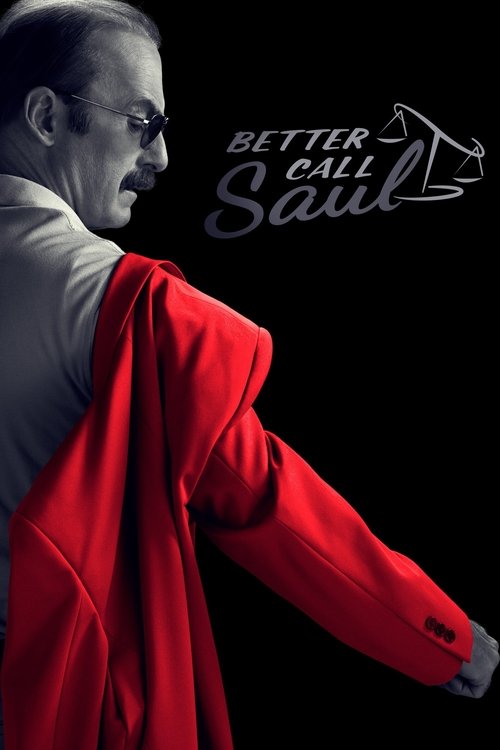
Better Call Saul
A slow-burn legal drama that meticulously charts a man's moral decay, painting a tragic portrait of ambition curdling into corruption under the vast, lonely New Mexico sky.
Better Call Saul

Better Call Saul

"Putting the "criminal" in "criminal lawyer.""

08 February 2015 — 15 August 2022 United States of America 6 season 63 episode Ended ⭐ 8.7 (5,880)
Cast: Bob Odenkirk, Jonathan Banks, Rhea Seehorn, Patrick Fabian, Michael Mando
Drama Crime
Moral Ambiguity and Corruption Identity and Transformation Family and Betrayal Success vs. Integrity

Overview

Set primarily in the early 2000s, "Better Call Saul" chronicles the transformation of James "Jimmy" McGill, a well-meaning but corner-cutting public defender, into the flamboyant and morally compromised criminal lawyer known as Saul Goodman. The series serves as a prequel to the acclaimed "Breaking Bad," exploring the events that shaped Jimmy's descent while also developing the backstories of other characters from that universe, most notably the stoic "fixer" Mike Ehrmantraut.

Across six meticulously paced seasons, the narrative is split between Jimmy's legal world and the burgeoning Albuquerque drug trade. We witness Jimmy's complex and often fraught relationship with his brilliant but mentally ill older brother, Chuck McGill, and his close bond with fellow lawyer Kim Wexler, whose own moral compass is tested by her association with Jimmy. The series masterfully intertwines these personal dramas with the rise of drug kingpin Gus Fring and the cartel politics involving the Salamanca family, showing how Jimmy's path gradually and irrevocably converges with the criminal underworld. The story also utilizes flash-forwards to reveal Jimmy's post-"Breaking Bad" life as "Gene Takavic," a Cinnabon manager in Omaha, Nebraska, living in fear of his past catching up to him.
Core Meaning

The core meaning of "Better Call Saul" is an exploration of choice, consequence, and the nature of identity. It posits that a person's path is not a single, dramatic break from morality, but a series of small, often well-intentioned compromises that lead to an inescapable destination. The creators, Vince Gilligan and Peter Gould, examine the question, "What problem does becoming Saul Goodman solve?" for Jimmy McGill. The answer is that the persona of Saul Goodman is both a shield against his insecurities and a fulfillment of his worst impulses. The series serves as a profound character study, suggesting that while external forces and relationships shape us, we are ultimately the architects of our own character through the choices we repeatedly make. It is a tragedy about a man who, despite moments of genuine goodness, cannot escape his own self-destructive nature.

Thematic DNA

Moral Ambiguity and Corruption 35%
Identity and Transformation 30%
Family and Betrayal 20%
Success vs. Integrity 15%

Moral Ambiguity and Corruption

The central theme is the gradual erosion of morality. Jimmy McGill doesn't start as a villain but slowly descends into one through a series of ethically gray decisions. His desire for success and to prove his worth, particularly to his brother Chuck, often leads him to cut corners. This theme is mirrored in other characters like Kim Wexler, who is drawn into Jimmy's schemes, and Mike Ehrmantraut, a principled man who uses his skills for criminal enterprises to provide for his family, demonstrating that the line between right and wrong is often blurred.

Identity and Transformation

The series is fundamentally about the creation of an alternate persona. Jimmy McGill's transformation into Saul Goodman is a defense mechanism and a branding exercise that eventually consumes him. The show constantly questions whether we can truly change or if we are destined to be who we are. The black-and-white flash-forwards to "Gene Takavic" further explore this, showing a man trapped by the identities he created, ultimately culminating in his decision to reclaim his original name, Jimmy McGill, as an act of redemption.

Family and Betrayal

Family dynamics are a powerful, often destructive, force in the series. The most significant is the relationship between Jimmy and his older brother, Chuck McGill. Chuck's resentment and belief that Jimmy is fundamentally corrupt ("a chimp with a machine gun") actively sabotage Jimmy's attempts at legitimacy, pushing him further toward the Saul Goodman persona. This theme also extends to the Salamanca family, driven by violent loyalty, and Mike's deep-seated guilt over his son's death, which motivates his entire journey.

Success vs. Integrity

Jimmy's journey is a constant battle between his desire for professional success and his personal integrity. He achieves success at a reputable law firm but feels constrained and ultimately sabotages it because it doesn't align with his true nature. He finds he is more successful, and perhaps more himself, when he bends and breaks the rules. Kim Wexler faces a similar conflict, torn between her prestigious career in corporate law and the thrill and perceived justice of the cons she runs with Jimmy, leading to her eventual downfall.

Character Analysis

Jimmy McGill / Saul Goodman / Gene Takavic

Bob Odenkirk

Archetype: Anti-hero / The Trickster
Key Trait: Charismatic and morally flexible

Motivation

Initially, Jimmy is motivated by a desire to prove his worth and gain his brother's respect. After Chuck's death, his motivation shifts towards a nihilistic embrace of his own worst impulses, often egged on by his relationship with Kim. Ultimately, his deepest motivation is his love for Kim, which prompts his final act of self-sacrifice and redemption, choosing to face the consequences of his actions to protect her.

Character Arc

Jimmy begins as a small-time con artist turned earnest lawyer desperate for the approval of his brother, Chuck. Rejection and betrayal from Chuck, combined with his own self-destructive tendencies, slowly erode his moral compass. He embraces his 'Slippin' Jimmy' past, transforming it into the persona of 'Saul Goodman,' a flamboyant 'criminal' lawyer. This identity allows him to be successful but pulls him deep into the criminal underworld. After the events of 'Breaking Bad,' he lives a paranoid, colorless existence as Gene Takavic in Omaha. His arc concludes with a final, public confession in court, where he sheds the Saul persona to reclaim his identity as Jimmy McGill, accepting a long prison sentence as a form of penance and an act of love for Kim Wexler.

Kim Wexler

Rhea Seehorn

Archetype: The Confidante / Femme Fatale
Key Trait: Pragmatic and internally conflicted

Motivation

Kim is motivated by a drive for justice, but her definition of it becomes warped. She wants to help the 'little guy' and sees bending the rules as a way to achieve that. She is also motivated by her complex love for Jimmy; she is both enabled by him and enables him. Her internal struggle is between her ambition within the system and her desire to subvert it.

Character Arc

Kim starts as a highly principled and ambitious lawyer at HHM, serving as Jimmy's confidante and moral anchor. Over the seasons, she finds herself increasingly drawn to Jimmy's morally ambiguous schemes, enjoying the thrill of the con. Her character arc is one of internal conflict, battling her 'good' professional side with the 'bad' side that enjoys breaking the rules with Jimmy. This culminates in her actively planning the downfall of Howard Hamlin, which has tragic, unforeseen consequences. Wracked with guilt, she abandons her legal career and relationship with Jimmy for a mundane, purgatorial life in Florida. She finally finds a measure of peace after confessing her role in Howard's death, spurred by Jimmy's final actions.

Mike Ehrmantraut

Jonathan Banks

Archetype: The Stoic / The Mentor
Key Trait: Pragmatic and professional

Motivation

Mike's primary motivation is to provide a financial safety net for his granddaughter, Kaylee, and her mother, Stacey. This is driven by a deep sense of guilt and responsibility for his son's death, seeing it as a way to atone for his past corruption as a police officer.

Character Arc

Mike is introduced as a parking lot attendant, a disgraced ex-cop from Philadelphia burdened by guilt over the death of his son. His arc is a slow, tragic descent into the criminal world as he uses his skills as a 'fixer' to provide financially for his daughter-in-law and granddaughter. He operates by a strict, albeit criminal, code of honor, valuing professionalism and loyalty. Throughout the series, he becomes increasingly entangled with the Salamanca cartel and Gus Fring, gradually losing pieces of his soul with each violent act. By the end, he is a key player in Fring's empire, a man who started doing bad things for good reasons only to find himself consumed by the darkness.

Chuck McGill

Michael McKean

Archetype: The Antagonist / The Sibling Rival
Key Trait: Principled and resentful

Motivation

Chuck is motivated by a rigid, almost fanatical belief in the supremacy of the law. However, his deeper, more personal motivation is a profound and bitter jealousy of Jimmy's natural charisma and the affection he received from their mother. He needs to believe Jimmy is irredeemable to validate his own life choices and feelings of superiority.

Character Arc

Chuck is a brilliant, esteemed founding partner of the HHM law firm who suffers from a psychosomatic allergy to electricity. He presents himself as a man of high principle and a guardian of the law's sanctity. His arc reveals that his morality is a shield for his deep-seated jealousy and resentment of his younger brother, Jimmy. He refuses to believe Jimmy can change from his 'Slippin' Jimmy' past and actively works to undermine his legal career. Chuck's relentless campaign against Jimmy ultimately leads to his own professional humiliation and a tragic suicide, but his psychological influence looms over Jimmy for the rest of the series.

Symbols & Motifs

Color Palette

Meaning:

Colors are used symbolically to represent characters' morality and environment. Jimmy is often associated with bright, flashy colors (like his suits), signifying his 'Saul Goodman' persona. In contrast, the world of corporate law (HHM) is depicted in cool, sterile blues and grays. The black-and-white of the "Gene" flash-forwards represents a life devoid of vibrancy and a soul in purgatory.

Context:

Throughout the series, Jimmy's wardrobe becomes more flamboyant as he leans into his Saul identity. The stark black-and-white sequences that open most seasons set a somber tone for his future, which is paid off in the final episodes that are almost entirely in monochrome until a single flame of color appears in a shared cigarette with Kim, symbolizing a brief moment of genuine connection.

Zafiro Añejo Tequila

Meaning:

The fictional brand of premium tequila, with its distinctive agave-shaped bottle stopper, symbolizes the spoils of a successful con, ill-gotten gains, and the bond between Jimmy and Kim. It represents a point of no return—a memento of their choice to break bad together.

Context:

First appearing when Jimmy and Kim con a stockbroker, the expensive tequila becomes a recurring motif. They keep the intricate stopper as a souvenir. In the final season, Kim sees the stopper in a jewelry store, triggering her guilt and leading her to confess her role in Howard Hamlin's death. It serves as a tangible reminder of their shared past and transgressions.

Montages

Meaning:

The series frequently uses stylized montages to depict process, the passage of time, and the meticulous nature of both legal work and criminal schemes. They visually represent the slow, methodical nature of Jimmy's transformation and the intricate planning of characters like Mike and Gus.

Context:

Numerous montages appear across all seasons, from Jimmy's efforts to build his elder law practice to Mike's systematic dismantling of a vehicle. A notable split-screen montage in Season 6 shows Jimmy and Kim's lives diverging while still being connected, visually emphasizing their growing emotional distance despite their physical proximity.

Memorable Quotes

Jimmy, with a law degree is like a chimp with a machine gun.

— Chuck McGill

Context:

Spoken to Kim Wexler in Season 1, Episode 9, "Pimento." Chuck delivers this line as he explains why he has been secretly sabotaging Jimmy's career and preventing him from becoming a partner at HHM.

Meaning:

This quote encapsulates Chuck's core belief about his brother. He sees Jimmy not as a reformed man but as a dangerously chaotic and amoral force who has been given a powerful weapon—the law—which he will inevitably use to cause destruction. It's the ultimate expression of his lack of faith in Jimmy's capacity for change.

I broke my boy.

— Mike Ehrmantraut

Context:

Spoken to his daughter-in-law, Stacey, in Season 1, Episode 6, "Five-O." Mike finally breaks down and tells the true story of his son's death.

Meaning:

This is a rare and devastating admission of guilt from the typically stoic Mike. He confesses that his own corruption as a cop forced his son, a clean cop, to compromise his morals, which led directly to his murder. The line is the emotional core of Mike's character, explaining the immense burden of guilt that drives all his subsequent actions.

You don't save me. I save me.

— Kim Wexler

Context:

Spoken to Jimmy in Season 4, Episode 6, "Piñata." Jimmy is concerned about Kim's well-being as she takes on more pro bono work after a car crash, but she pushes back against his attempts to 'save' her.

Meaning:

This line defines Kim's fierce independence and her complex relationship with Jimmy. While she is drawn to his world, she refuses to be a damsel in distress or a passive victim of his actions. It's a declaration of her own agency, for better or for worse, asserting that she is a willing and active participant in their shared path.

S'all good, man!

— Jimmy McGill

Context:

First explained in Season 4, Episode 10, "Winner." After being reinstated to the bar, Jimmy shocks Kim by revealing he won't be practicing under his own name, but under the pseudonym 'Saul Goodman,' derived from this phrase.

Meaning:

This seemingly flippant phrase is the origin of Jimmy's new identity. It represents his desire to find an easy, reassuring answer to complex problems and his skill at putting people at ease through charm and deflection. It's the birth of the brand that will eventually consume him.

The truth is... Walter White couldn't have done it without me.

— Jimmy McGill

Context:

Spoken in court during his sentencing in the series finale, Season 6, Episode 13, "Saul Gone." He says this in front of Kim, shedding his plea deal to confess the whole truth.

Meaning:

In his final confession, Jimmy can't resist one last piece of ego. But this line is more than a boast; it's an acceptance of his full complicity. He acknowledges that he wasn't just a victim or a bystander in Heisenberg's empire, but a crucial and willing architect. It's a key part of him taking responsibility for the full scope of his actions.

Episode Highlights

Five-O

S1E6

This episode breaks from Jimmy's storyline to give a powerful, self-contained origin story for Mike Ehrmantraut. Through flashbacks, we learn the tragic story of his son's death and witness Mike's methodical revenge on the corrupt cops responsible. It establishes the deep guilt and motivation that drive his character for the rest of the series.

Significance:

It transformed Mike from a simple 'fixer' into one of the show's most complex and sympathetic characters. Jonathan Banks' Emmy-nominated performance anchors this episode, which is a masterclass in backstory and emotional revelation, setting the stage for his entire arc.

Chicanery

S3E5

The conflict between Jimmy and Chuck culminates in a tense bar association hearing. Jimmy masterfully turns the tables on his brother by secretly planting a battery on him, exposing Chuck's electromagnetic hypersensitivity as a mental illness in front of his peers. The episode is a brilliant courtroom drama that results in Chuck's complete public breakdown.

Significance:

Considered by many to be the series' best episode, "Chicanery" is the climax of the brothers' feud. Jimmy's victory is a hollow one, as it destroys the person he once admired most and sets both of them on a tragic path from which they cannot recover. It is a pivotal moment in Jimmy's descent into Saul Goodman.

Winner

S4E10

Jimmy gives a seemingly heartfelt speech about his brother to win his law license reinstatement. However, it's revealed to be a calculated performance, shocking Kim. He then declares he won't be practicing under the name McGill, officially adopting the moniker 'Saul Goodman.' In the B-plot, Mike is forced to execute a German engineer, Werner Ziegler, cementing his tragic path.

Significance:

This episode marks the official birth of 'Saul Goodman.' The moment Jimmy reveals his insincerity to Kim creates a crucial fracture in their relationship and shows that the last vestiges of the old Jimmy are gone, replaced by a cynical and manipulative persona.

Bad Choice Road

S5E9

After a traumatic ordeal in the desert, a shaken Jimmy returns home to a worried Kim. In the episode's stunning climax, Lalo Salamanca unexpectedly arrives at their apartment to confront Jimmy. Kim, in a moment of bravery and quick thinking, stands up to the menacing Lalo, defending Jimmy and saving both their lives.

Significance:

This episode brings the two halves of the show—the legal world and the cartel world—crashing together in a terrifying way. Kim's confrontation with Lalo is a major turning point for her character, showing she is no longer a passive observer but an active and capable player in the criminal game.

Plan and Execution

S6E7

The mid-season finale sees Jimmy and Kim's elaborate plan to ruin Howard Hamlin come to fruition. As they celebrate their victory, their worlds are shattered when Lalo Salamanca appears in their apartment and, without warning, murders Howard. The shocking and brutal act is a direct consequence of their actions.

Significance:

This episode is the point of no return for Jimmy and Kim. The 'fun and games' of their cons have a real, horrific, and bloody consequence. Howard's murder destroys their relationship and sends both of their lives into a tailspin, directly leading to Kim leaving Jimmy and the final stages of his transformation.

Saul Gone

S6E13

In the series finale, Jimmy (as Gene) is caught. He brilliantly negotiates a lenient plea deal but abandons it in court after learning Kim has confessed. He proceeds to confess to all his crimes, taking responsibility for his role in Walter White's empire and, most importantly, clearing Kim's name. He reclaims the name Jimmy McGill and is sentenced to 86 years in prison, sharing one last, poignant cigarette with Kim.

Significance:

The finale provides a thematically perfect and emotionally resonant conclusion. It argues for redemption through accountability. Jimmy's final act is not a con but a genuine sacrifice, proving that despite his transformation into Saul Goodman, the man he was—and the love he had for Kim—was never truly gone.

Philosophical Questions

Are we defined by our worst impulses or our best intentions?

The series constantly explores the duality of Jimmy McGill. He has genuine moments of kindness and a desire to do good, particularly for his clients and for Kim. However, he is repeatedly drawn to his 'Slippin' Jimmy' persona. The show asks whether his good intentions are negated by the disastrous consequences of his actions. The finale suggests that redemption is possible not by erasing the bad, but by finally taking responsibility for it, implying that our ultimate definition comes from accepting the totality of who we are.

Can a person truly change, or are we slaves to our nature?

This question is central to the conflict between Jimmy and his brother Chuck. Chuck believes people don't change and that Jimmy will always be 'Slippin' Jimmy.' Jimmy spends much of the series trying to prove him wrong, only to seemingly prove him right by becoming Saul Goodman. The finale offers a nuanced answer: Jimmy doesn't change back into his 'good' self, but he does make a different choice. He chooses accountability over escape. This suggests that while our fundamental nature might be fixed, we always retain the agency to make choices that defy our ingrained patterns, even if it's at the very end.

What is the nature of justice?

"Better Call Saul" critiques the legal system from multiple angles. There's the formal, often rigid justice of the courtroom, represented by HHM, and the 'street justice' of the cartel. Jimmy operates in the gray area between them, often bending the law to achieve what he perceives as a fairer outcome for his underdog clients. The series questions whether true justice is about adherence to process or achieving a moral outcome, and it shows how easily the pursuit of one's own version of justice can lead to profound injustice, as seen in the death of Howard Hamlin.

Alternative Interpretations

The ending of "Better Call Saul" is largely seen as a tragic but fitting act of redemption, but it invites several interpretations. One perspective is that Jimmy's confession is his ultimate con: not of the legal system, but of himself. Throughout the series, he’s been unable to reconcile the 'good' Jimmy with the 'bad' Saul. By publicly confessing and accepting his sentence as Jimmy McGill, he finally integrates both halves, finding peace not in freedom, but in accountability.

Another interpretation focuses on the final scene with Kim. The shared cigarette, mirroring their first scene together, can be seen as a sign of enduring connection and forgiveness. However, it can also be read as a final, bittersweet farewell. Kim walks away, leaving Jimmy in prison, suggesting that while their bond is real, their paths have permanently diverged. She is free to find her own form of redemption, while he must live with his choices. The ambiguity lies in whether this is a tragic end or a peaceful acceptance of their separate fates.

A more cynical view is that Jimmy's actions are still selfish. Knowing Kim had confessed, his grand courtroom gesture could be seen as one last performance to win back her admiration, reclaiming the narrative and becoming a 'hero' in his own story, even if it means life in prison. He ensures he will be remembered by her not as the pathetic Gene Takavic, but as the man who sacrificed himself for her.

Cultural Impact

"Better Call Saul" is widely regarded as one of the greatest television series of all time and a rare example of a spin-off that is considered by many critics and fans to be on par with, or even superior to, its celebrated predecessor, "Breaking Bad." Created by Vince Gilligan and Peter Gould, the show defied expectations by opting for a slower, more deliberate character study over the high-octane plot of "Breaking Bad." Its critical acclaim stems from its masterful writing, nuanced performances (particularly from Bob Odenkirk and Rhea Seehorn), and its distinct visual style.

The series has had a significant impact on television storytelling, demonstrating the value of patience and subtlety in character development. It set a new benchmark for prequels, showing how to enrich a pre-existing universe by adding emotional depth and context rather than simply relying on fan service. The character of Kim Wexler, who was not in "Breaking Bad," is often cited as one of the best new characters in modern television, a testament to the show's strong writing and Rhea Seehorn's performance. The ongoing debate among fans and critics about whether "Saul" surpassed "Breaking Bad" has cemented its place in pop culture discussions about television's golden age. Its legacy is that of a complex, tragic, and deeply human drama that stands on its own as a monumental achievement in the medium.

Audience Reception

"Better Call Saul" received widespread critical acclaim throughout its run, and audience reception was similarly positive, though it evolved over time. Initially, some viewers found the show's pacing to be slow compared to the more action-oriented "Breaking Bad," particularly in the first season which focused heavily on Jimmy's legal struggles and relationship with Chuck. However, as the series progressed and the stakes were raised, a dedicated fanbase grew to appreciate its deliberate pacing and deep character development.

The show's writing, acting (especially by Odenkirk, Seehorn, and Banks), and cinematography were consistently praised by audiences. Many viewers came to regard it as equal to, if not better than, its predecessor due to its emotional depth and nuanced exploration of its characters. The introduction of antagonists like Lalo Salamanca in later seasons was particularly lauded for injecting new levels of suspense. The series finale, "Saul Gone," was overwhelmingly praised by audiences as a satisfying and emotionally resonant conclusion to Jimmy McGill's story, a rare feat for a highly anticipated finale.

Interesting Facts

  • The show was originally conceived as a half-hour comedy before creators Vince Gilligan and Peter Gould decided a one-hour drama format would better suit the character's complexity.
  • The idea for a Saul Goodman spinoff started as a running joke in the writers' room during the production of 'Breaking Bad.'
  • Bob Odenkirk based his portrayal of Saul Goodman's persona on his first agent, Ari Emanuel, known for his larger-than-life personality.
  • Michael McKean (Chuck McGill) was cast largely on the recommendation of 'Breaking Bad' star Bryan Cranston.
  • During the filming of the final season, Bob Odenkirk suffered a major heart attack on set. He was surrounded by cast members Rhea Seehorn and Patrick Fabian who helped get him immediate medical attention.
  • For the scenes where Jimmy works as 'Gene Takavic,' Bob Odenkirk received official training from Cinnabon on how to be a bakery manager.
  • Many of the principal cast members, including Bob Odenkirk, Rhea Seehorn, and Patrick Fabian, lived together in a house Odenkirk owned in Albuquerque during filming, which fostered their close on-screen chemistry.

Easter Eggs

The 'Kevin Costner' story

In 'Breaking Bad,' Saul tells Walter White a story about how he once convinced a woman he was Kevin Costner. In Season 1 of 'Better Call Saul,' we see this event happen when a woman Jimmy conned wakes up next to him and berates him for the lie.

The Cinnabon in Omaha

In his final scene in 'Breaking Bad,' Saul tells Walt that if he's lucky, in a month from now, best-case scenario, he'll be a manager of a Cinnabon in Omaha. The very first scene of 'Better Call Saul' reveals this is exactly what happened, showing him working at the Cinnabon under the name Gene Takavic.

Dedicado a Max

In 'Breaking Bad,' we learn in a flashback that Gus Fring's partner, Max Arciniega, was murdered by Hector Salamanca. In 'Better Call Saul,' we see a fountain in a village Gus funds with a plaque that reads 'Dedicado a Max,' showing the depth of his long-held grief and quest for revenge.

Lalo Salamanca's Fate

In his first appearance in 'Breaking Bad' (Season 2, Episode 8), Saul, held at gunpoint by Walt and Jesse, frantically asks, \"Did Lalo send you? No Lalo?\" 'Better Call Saul' builds the entire character of Lalo Salamanca from this throwaway line, making him a formidable and terrifying antagonist whose story is resolved when he is buried under Gus Fring's future superlab.

Jesse Pinkman's Graffiti

In a scene where Jimmy uses a payphone, the graffiti tag 'JP' can be seen. This is a subtle nod to Jesse Pinkman, who was known for his delinquency and whose own graffiti was seen in his house in 'Breaking Bad.'

⚠️ Spoiler Analysis

Click to reveal detailed analysis with spoilers

Frequently Asked Questions

Explore More About This Movie

Dive deeper into specific aspects of the movie with our detailed analysis pages

Comments (0)

Leave a comment

No comments yet. Be the first to share your thoughts!