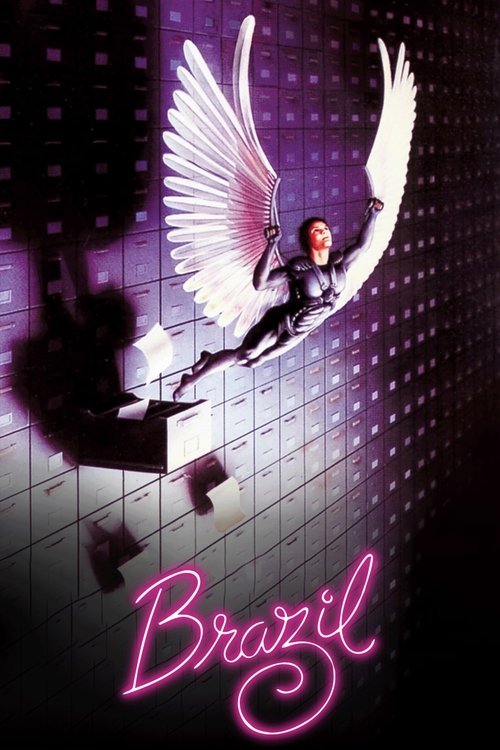
Brazil
"It's only a state of mind."
Overview
Terry Gilliam's Brazil (1985) plunges viewers into a hyper-bureaucratic, dystopian retro-future where the state monitors everything and efficiency is a paradox. The film follows Sam Lowry, a low-ranking Ministry of Information employee who is content to coast through his mundane existence until a literal bug in the system causes a devastating typographical error. The mistake leads to the wrongful arrest and death of an innocent cobbler, Mr. Buttle, instead of the suspected renegade heating engineer, Mr. Tuttle.
As Sam attempts to rectify the administrative error, he encounters Jill Layton, a truck driver who perfectly resembles the angelic warrior woman from his soaring, heroic daydreams. His pursuit of Jill drags him out of his safe apathy and straight into the crosshairs of the oppressive government machinery.
What begins as a quirky satire of office life transforms into a nightmarish, surrealistic fight for survival. Sam's journey exposes the terrifying absurdity of a society that values paperwork over human life, leading to a climax where the boundaries between reality, fantasy, and madness violently blur.
Core Meaning
Terry Gilliam's Brazil operates as a post-Orwellian warning about the dehumanizing power of bureaucracy, consumerism, and state control. The film suggests that when society prioritizes procedure and paperwork over human empathy, it creates an absurd but terrifying totalitarianism. However, rather than simply critiquing the state, Gilliam deeply examines the individual's response to such oppression. Sam Lowry's tragedy is that his rebellion is entirely internal; his rich imagination, while a beautiful refuge, ultimately serves as a mechanism of escapism rather than a tool for meaningful change. The film argues that retreating into fantasy in the face of systemic horror may be the only way the individual can survive mentally, but it is ultimately a defeat in the physical world.
Thematic DNA
Bureaucracy and the Dehumanization of Society
The film portrays a world strangled by red tape, where the Ministry of Information requires a form for every human action [1.14]. Human lives, such as Mr. Buttle's, are extinguished merely because of a typographical error, and the system's only concern is issuing a 'refund check' for the mistake rather than mourning a life. People are reduced to statistics and paperwork, completely stripped of their humanity.
Escapism vs. Reality
Through Sam Lowry's recurring daydreams of flying as a winged warrior, the film explores how people use fantasy to cope with an unbearable reality. Sam's imagination is his only sanctuary from his drab, concrete existence, but this escapism makes him politically passive. The film tragically concludes that while the mind can always find freedom in delusion, physical and societal liberation requires facing reality.
Vanity and Apathy
Sam's mother, Ida Lowry, and her elite social circle represent the wealthy's willing blindness to the horrors of the state. They are obsessed with superficial youth, undergoing endless, grotesque plastic surgeries, and they casually ignore terrorist bombings happening right next to them in restaurants. This highlights how consumerism and vanity act as an anesthetic against moral responsibility.
The Inefficiency of the Technocracy
Despite the government's absolute control, nothing in the world of Brazil actually works. Elevators break, heating systems fail, and technology is absurdly convoluted. This satirizes the idea of the 'efficient' totalitarian state, showing instead a bloated, incompetent machine that only succeeds in violently maintaining its own existence.
Character Analysis
Sam Lowry
Jonathan Pryce
Motivation
Initially, his motivation is purely escapist—to be left alone to dream. Later, his sole drive becomes finding and protecting Jill Layton, prioritizing romantic fantasy over political reality.
Character Arc
Sam begins as a content, apathetic bureaucrat who avoids promotion to stay out of trouble [1.8]. When he finds Jill, the literal woman of his dreams, he is forced to engage with the system. His rebellion, however, is too late, and his arc tragically ends in a complete psychotic break, retreating forever into his own mind.
Harry Tuttle
Robert De Niro
Motivation
He is driven by a desire for action and efficiency, despising the state's endless paperwork. He just wants to fix things without filling out a 27B/6.
Character Arc
Tuttle remains a static figure of rebellion, dropping in and out of the narrative to act as a foil to the sluggish government workers. In Sam's final delusion, Tuttle is consumed by the very paperwork he fought against, symbolizing the overwhelming power of bureaucracy.
Jill Layton
Kim Greist
Motivation
She seeks justice and truth regarding the state's mistakes, showing a pragmatic and courageous rebellion that sharply contrasts with Sam's passive dreaming.
Character Arc
Jill starts as a civilian desperately trying to rectify the wrongful arrest of her neighbor. She is labeled a terrorist for her persistence. Though she initially rejects Sam's advances, she eventually allies with him, but her real-world fate is grimly sealed off-screen by the state.
Jack Lint
Michael Palin
Motivation
Career advancement, providing for his family, and following orders without questioning the moral implications of his actions.
Character Arc
Jack is Sam's successful, ambitious friend. Throughout the film, he happily accepts promotions and perfectly adapts to the cruel system. He eventually becomes Sam's literal torturer, maintaining his polite, friendly demeanor while committing atrocities.
Symbols & Motifs
The Ducts
The large, intrusive metallic tubes and ducts represent the ugly, invasive nature of the government [1.10]. They pump the essential services (and surveillance) into every home, symbolizing how the state violates private spaces.
They are omnipresent in apartments and restaurants. When Sam's air conditioning breaks, Central Services rips open his walls, having the ducts violently spill out into his living space like mechanical guts.
The Winged Armor
Sam's winged persona represents romantic individualism, heroism, and absolute freedom—everything that the real world denies him.
This symbol appears exclusively in Sam's recurring daydreams, where he flies above the clouds to fight giant monsters and rescue his dream woman, contrasting sharply with his grey, grounded reality.
The Giant Samurai
The towering, mechanical Samurai in Sam's dreams symbolizes the soulless, technologically armed state and the overwhelming obstacles constructed by bureaucracy.
Sam fights this giant in his fantasies. When he finally cracks open the Samurai's mask, he is horrified to see his own face underneath, suggesting his complicity in the very system he subconsciously hates.
Plastic Surgery
The grotesque cosmetic procedures represent the decay of the upper class, their obsession with vanity, and society's desperate attempt to mask its own rotting core.
Sam's mother, Ida, undergoes constant 'rejuvenation' procedures with Dr. Jaffe, while her friend Mrs. Terrain suffers horrific, dissolving complications from an opposing surgeon. Both ignore the dying world around them.
Memorable Quotes
Listen, kid, we're all in it together.
— Harry Tuttle
Context:
Tuttle says this to Sam while illegally fixing his air conditioning, establishing himself as a renegade who actually cares about helping others.
Meaning:
A rare expression of solidarity in an otherwise deeply selfish, paranoid, and disconnected society [1.12].
I came into this game for the action, the excitement. Go anywhere, travel light, get in, get out, wherever there's trouble, a man alone. Now they got the whole country sectioned off, you can't make a move without a form.
— Harry Tuttle
Context:
Tuttle explains to Sam why he went rogue and left Central Services to become an independent, illegal repairman.
Meaning:
It highlights the absurdity of the dystopian society—even an air-conditioning repairman feels like a swashbuckling outlaw because the bureaucracy is so restrictive.
Information Transit got the wrong man. I got the *right* man. The wrong one was delivered to me as the right man, I accepted him on good faith as the right man. Was I wrong?
— Jack Lint
Context:
Jack defends his role in the torture and death of the innocent Mr. Buttle, refusing to take any moral responsibility for the fatal mistake.
Meaning:
This is the ultimate bureaucratic justification for evil. It demonstrates how systems pass the blame, ensuring no individual feels responsible for atrocities like torturing an innocent man to death.
This is your receipt for your husband... and this is my receipt for your receipt.
— Arresting Officer
Context:
The Ministry officers say this to Mrs. Buttle immediately after violently kidnapping her husband in the middle of the night.
Meaning:
A bleakly hilarious summation of the film's core theme: the state values procedural paperwork over human emotion, even in the face of a terrifying abduction.
My complication had a little complication.
— Mrs. Terrain
Context:
Mrs. Terrain explains the horrific deterioration of her face following botched plastic surgeries, all while maintaining a polite, conversational tone.
Meaning:
This line serves as dark comedy highlighting the absurd lengths the elite will go to for youth, ignoring the literal rot of their own bodies.
Philosophical Questions
Is escapism a form of rebellion or a mechanism of surrender?
The film asks whether retreating into one's own imagination is a triumph of the human spirit or a tragic defeat [1.5]. While Sam's fantasy life keeps his soul alive in a dead world, his failure to act in reality allows the oppressive system to continue unchallenged until it destroys him.
How does bureaucracy dilute moral responsibility?
Through characters like Jack Lint, the film explores the banality of evil. When actions are broken down into departments, forms, and transit protocols, individuals stop seeing the human cost of their work, allowing ordinary people to commit horrific acts simply by 'doing their job'.
Can true love survive in a completely rationalized, surveilled society?
Sam and Jill's romance is doomed by the state because genuine human connection and uncontrollable emotions are antithetical to a system that requires perfect predictability, paperwork, and obedience.
Alternative Interpretations
The most debated aspect of Brazil is its ending and the nature of Sam's final state. One interpretation is deeply pessimistic: Sam's retreat into insanity is the ultimate victory of the totalitarian state. They have completely crushed his body and his mind, proving that individual rebellion is utterly futile against the machine.
Conversely, Gilliam himself has famously referred to the ending as a 'happy' one. In this reading, Sam has achieved the ultimate victory over his oppressors. Realizing they can never break his spirit, he escapes into the impregnable fortress of his own imagination. The state can torture his body, but they can no longer reach his true self, making his insanity an act of ultimate defiance.
A third interpretation suggests that the entire film—not just the final act—is occurring within Sam's mind or is a highly subjective, unreliable narrative. The surreal coincidences, the bizarre machinery, and the cartoonish physics of the world point to a reality that is already filtered through a fractured psyche from the very first frame.
Cultural Impact
Released in 1985, Brazil arrived right after the actual year 1984, a period ripe with Orwellian reflections. However, Terry Gilliam's vision stood out by injecting surreal, Pythonesque dark comedy into the dystopian genre. It heavily influenced the visual and thematic language of future science fiction, inspiring 'cyberpunk' and 'steampunk' aesthetics, as well as laying thematic groundwork for films like Fight Club and The Matrix.
While it was initially subjected to severe studio interference and a delayed US release by Universal Pictures, it immediately garnered critical acclaim in Europe and later in the US, securing two Academy Award nominations. Today, Brazil is widely regarded as a cinematic masterpiece and a seminal cult classic. Its prophetic commentary on bureaucratic overreach, state surveillance, the militarization of police forces, and society's absurd reliance on failing technology has only become more relevant in the modern digital age.
Audience Reception
Audiences initially found Brazil to be highly polarizing due to its dense, chaotic visual style and bleak narrative. However, modern viewers universally praise the film for its stunning, retro-futuristic production design and its darkly hilarious script. Critics and fans laud Jonathan Pryce's nuanced performance and Robert De Niro's scene-stealing role as Harry Tuttle.
The main points of criticism often revolve around the film's pacing and its overwhelmingly oppressive atmosphere, which can be an exhausting experience for some viewers. The intentional sensory overload of the set design and the surreal narrative jumps leave some feeling confused. Nevertheless, the overarching verdict is that Brazil is a brilliant, prescient masterpiece of dystopian cinema, celebrated for its uncompromising vision and devastatingly memorable finale.
Interesting Facts
- DirectorTerryGilliamfoughtamassive, publicbattlewithUniversalPicturesoverthefilm'sending.Thestudiowanteda'LoveConquersAll'cutwhereSamandJillescape, butGilliamfoughtbackrelentlesslytokeephisoriginaldarkending[1.7].
- The film's working titles included 'The Ministry' and '1984 ½', the latter being a nod to both George Orwell's famous dystopian novel and Federico Fellini's surreal masterpiece '8 ½'.
- Robert De Niro was originally offered a smaller role, but he specifically asked to play the renegade repairman Harry Tuttle instead, leading to his scenes being expanded.
- An incredibly complex dream sequence involving Sam flying over a vast 'sea of eyeballs' was attempted during production but proved too difficult and was ultimately cut from the final film.
- Director Terry Gilliam heavily utilized 14mm lenses to create a distorted, wide-angle look for the film. This technique became so synonymous with his visual style that the 14mm lens is informally known as 'The Gilliam' among filmmakers.
Easter Eggs
Form 27B/6
The infamous form 27B/6, required for any mechanical repairs, is a nod to George Orwell. Orwell's apartment in London, where he wrote part of his dystopian novel 1984, was located at 27B Canonbury Square, Apartment 6 [3.2]. Additionally, this form is later referenced as an Easter egg in the film Star Wars: The Last Jedi (2017) as parking violation 27B/6.
The Ministry of Information Logo
The imposing logo of the Ministry of Information subtly resembles a spiked torture device, but it is often displayed in a cheerful, corporate manner, masking the state's inherent violence with bureaucratic branding.
Aquarela do Brasil
The title of the film and its recurring musical motif is the 1939 song 'Aquarela do Brasil'. Its upbeat, romantic, and escapist tone provides a stark, ironic contrast to the dreary, oppressive, and grey reality of the film's dystopian setting.
⚠️ Spoiler Analysis
Click to reveal detailed analysis with spoilers
Frequently Asked Questions
Explore More About This Movie
Dive deeper into specific aspects of the movie with our detailed analysis pages
Comments (0)
No comments yet. Be the first to share your thoughts!