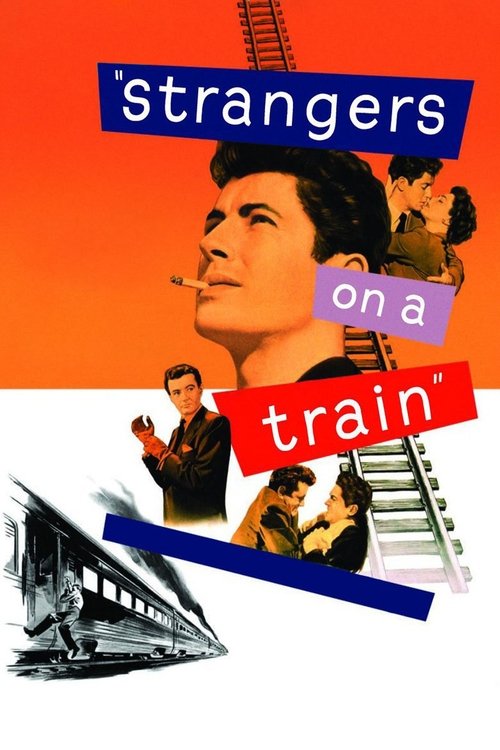
Strangers on a Train
A taut psychological thriller dripping with paranoid tension, where a chance encounter hurtles two men along parallel tracks of darkness. Like an out-of-control carousel, the narrative violently spins innocence and guilt into a twisted web of shared madness.
Strangers on a Train

Strangers on a Train

"It starts with a shriek of a train whistle... and ends with shrieking excitement!"

27 June 1951 United States of America 101 min ⭐ 7.7 (1,842)
Director: Alfred Hitchcock
Cast: Farley Granger, Ruth Roman, Robert Walker, Leo G. Carroll, Patricia Hitchcock
Crime Thriller
Duality and Doppelgängers The Burden of Shared Guilt Order vs. Chaos Repressed Homosexual Subtext
Budget: $1,200,000
Box Office: $7,000,000

Overview

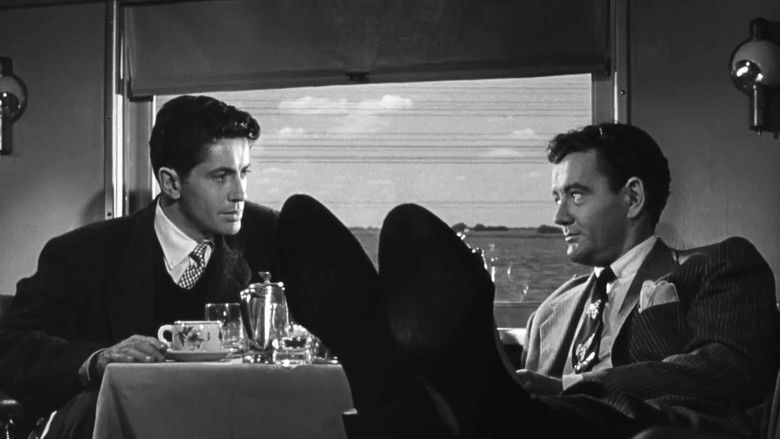
Directed by Alfred Hitchcock, Strangers on a Train (1951) is a masterful psychological thriller based on the debut novel by Patricia Highsmith. The film introduces us to Guy Haines, a polite amateur tennis champion desperate to divorce his unfaithful wife, and Bruno Antony, a wealthy, flamboyant psychopath who hates his overbearing father. Their lives collide during a chance encounter on a train, where Bruno proposes a seemingly perfect, untraceable crime: a "criss-cross" murder scheme where they swap victims to eliminate each other's problems without leaving a motive.

While Guy brushes off the conversation as a dark joke, the deranged Bruno takes him seriously and proceeds to hold up his end of the twisted bargain. What follows is a relentless, suffocating game of cat-and-mouse as Bruno invades Guy's pristine public life, demanding he fulfill a deadly debt. Hitchcock ratchets up the tension through a stunning mastery of visual storytelling, crafting a narrative where the boundaries between the innocent and the guilty become dangerously blurred.
Core Meaning

At its core, Strangers on a Train is an exploration of the duality of human nature and the thin, fragile line separating civilized morality from suppressed, primal desires. Hitchcock suggests that evil is not merely an external force that attacks from the outside, but rather a manifestation of our own darkest impulses. Bruno acts as Guy's shadowy alter ego—a walking id who executes the very dark wish Guy harbors but lacks the ruthless will to commit.

The film implies that even the most seemingly innocent individuals possess a latent capacity for violence. By inextricably binding the polished, socially acceptable athlete with the charismatic psychopath, Hitchcock makes the unsettling argument that guilt isn't solely defined by the physical act of murder, but by the secret desires that precipitate it. It is a cynical, suspenseful meditation on shared guilt and the inescapable shadows of the human psyche.

Thematic DNA

Duality and Doppelgängers 35%
The Burden of Shared Guilt 25%
Order vs. Chaos 20%
Repressed Homosexual Subtext 20%

Duality and Doppelgängers

The concept of doubles is woven into the very fabric of the film, beginning with the opening shots of crossing train tracks and two pairs of feet. Bruno and Guy serve as dark mirrors to one another: one representing the chaotic, repressed id, and the other the socially constrained ego. Hitchcock utilizes mirroring imagery, such as matching eyeglasses and dual women in Guy's life, to visually underscore the intertwined fates of these contrasting halves of a single psyche.

The Burden of Shared Guilt

Even though Guy does not commit a murder, he is implicated by his unspoken desire to see his wife dead. When Bruno commits the crime, Guy's initial relief tangles with his horror, turning him into an accomplice of conscience. The film questions the true nature of innocence, showing how the desire for a crime can be as corrupting as the act itself, trapping Guy in a psychological prison of his own making.

Order vs. Chaos

The film stages a constant battle between structured, polite society and unhinged anarchy. Guy inhabits a world of strict rules—represented by tennis matches and high-society politics—while Bruno thrives in disruptive chaos, popping balloons, ignoring social boundaries, and violently upending the status quo. The climactic, out-of-control carousel brilliantly symbolizes this chaos threatening to completely destroy the ordered world.

Repressed Homosexual Subtext

Hitchcock infuses the film with a palpable queer subtext, a daring move given the restrictive 1950s cultural climate. The dynamic between the men operates much like a predatory courtship, with the flamboyant, mother-obsessed Bruno relentlessly pursuing the handsome Guy. This subtext adds layers of tension, framing Guy's panic not just as fear of the law, but as a deep-seated anxiety over a forbidden, invasive intimacy that threatens his conventional heterosexual life.

Character Analysis

Bruno Antony

Robert Walker

Archetype: The Psychopathic Shadow
Key Trait: Charismatic malevolence

Motivation

Driven by an intense hatred for his overbearing father and a twisted, psychosexual fixation on Guy, Bruno seeks to forge an unbreakable bond through shared murder.

Character Arc

Bruno begins as a charming, overly familiar stranger on a train with a theoretical obsession for the "perfect murder." As the film progresses, his flamboyant eccentricity devolves into a menacing, relentless obsession, culminating in his violent death when the chaotic forces he unleashed finally crush him.

Guy Haines

Farley Granger

Archetype: The Flawed Everyman
Key Trait: Anxious ambition

Motivation

To protect his social standing, his burgeoning political career, and his romance with Anne, while desperately trying to sever his terrifying connection to Bruno.

Character Arc

Guy starts as an ambitious but passive man, eager to escape a toxic marriage and climb the social ladder. Swept into Bruno's nightmare, he is forced to shed his passivity, confront his own latent guilt, and take aggressive physical action to clear his name and save his future.

Anne Morton

Ruth Roman

Archetype: The Loyal Anchor
Key Trait: Steadfast devotion

Motivation

To defend the man she loves from an incomprehensible nightmare and preserve the respectable, ordered life they have planned together.

Character Arc

Initially presented as the idealized, high-society prize Guy is striving for, Anne evolves into a proactive ally. When the horrifying truth is revealed, she transitions from a passive love interest to a fiercely protective partner who helps orchestrate Guy's frantic defense.

Barbara Morton

Patricia Hitchcock

Archetype: The Macabre Observer
Key Trait: Morbid curiosity

Motivation

Driven by a cheeky fascination with scandal, crime, and the darker, more sensational elements of human behavior that disrupt her polite world.

Character Arc

Barbara remains a static but highly impactful character. She acts as the witty, morbidly curious voice of the audience, injecting dark humor into the narrative. Her physical resemblance to the murdered Miriam unexpectedly turns her into a psychological weapon against the killer.

Symbols & Motifs

The Cigarette Lighter

Meaning:

The monogrammed lighter symbolizes guilt, identity, and the inescapable bond between the two men. Engraved with crossed tennis rackets, it represents the "criss-cross" nature of their deadly pact.

Context:

Guy carelessly leaves it on the train, and Bruno weaponizes it, threatening to plant it at the murder scene to frame Guy. The lighter becomes the ultimate MacGuffin, driving the breathless race against time in the film's climax.

Crossing Train Tracks

Meaning:

The tracks symbolize the chaotic, intersecting trajectories of fate and the concept of duality. They visually establish the "criss-cross" theme that dictates the entire narrative structure.

Context:

In the opening sequence, Hitchcock shoots the intersecting rails from a low angle as they weave and separate, perfectly foreshadowing the inevitable collision of Guy and Bruno's vastly different lives.

The Runaway Carousel

Meaning:

The carousel represents a loss of control, the dizzying descent into madness, and the collapse of childhood innocence. It transforms an object of joy into an engine of terror.

Context:

During the spectacular climax at the amusement park, the carousel spins violently out of control while Guy and Bruno fight to the death, literally crushing the villain beneath the weight of his own chaotic machinations.

Miriam's Eyeglasses

Meaning:

The thick glasses represent a distorted, suffocating vision of the world, as well as a reflection of guilt. They also serve as an eerie visual link to Anne's younger sister, Barbara.

Context:

In one of the film's most iconic and chilling shots, the murder is shown entirely as a distorted reflection within Miriam's fallen glasses. Later, Barbara's identical glasses trigger a terrifying psychological breakdown in Bruno at a high-society party.

Memorable Quotes

I have a theory that you should do everything before you die.

— Bruno Antony

Context:

Spoken to Guy during their initial, fateful lunch in Bruno's private train compartment, casually laying the psychological groundwork for his twisted murder proposal.

Meaning:

This line perfectly encapsulates Bruno's lack of moral boundaries and his chaotic, hedonistic worldview. It establishes him as a man completely unburdened by societal norms.

Criss-cross! I'll do your murder; you do mine.

— Bruno Antony

Context:

Bruno enthusiastically explains his brilliant murder-swap scheme to a highly uncomfortable Guy, using his hands to demonstrate the intersecting nature of the plan.

Meaning:

The defining statement of the film's plot and its central theme of interwoven fates. It outlines the terrifyingly simple logic behind the "perfect", motive-free crime.

My theory is that everyone is a potential murderer.

— Bruno Antony

Context:

Bruno delivers this chilling observation while delightfully terrorizing two older women with morbid conversation at Senator Morton's high-society party.

Meaning:

This quote speaks directly to Hitchcock's overarching thesis: that darkness and the capacity for violence reside within all human beings, waiting for the right trigger.

I may be old-fashioned, but I thought murder was against the law.

— Guy Haines

Context:

Guy says this while trying to laugh off Bruno's initial proposal on the train, fundamentally failing to realize the psychopath is dead serious.

Meaning:

This sarcastic deflection highlights Guy's naive belief that the rules of polite society can protect him from a madman, showcasing his fatal underestimation of Bruno.

I still think it would be wonderful to have a man love you so much he'd kill for you.

— Barbara Morton

Context:

Barbara says this whimsically during a conversation about Miriam's death, much to the horror and discomfort of the more grounded characters around her.

Meaning:

The line injects dark humor while highlighting the romanticization of violence. It inadvertently underscores the perverse, possessive "love" Bruno exhibits toward Guy.

Philosophical Questions

Is the desire for a crime morally equivalent to committing it?

The film thrusts Guy into a state of profound guilt simply because he benefited from a murder he secretly wished for. It challenges the viewer to consider whether passive complicity and dark thoughts carry the same spiritual and moral weight as pulling the trigger.

How fragile is the boundary between civilization and savagery?

Through the juxtaposition of the highly structured world of tennis and politics with the chaotic violence of the amusement park, the film suggests that polite society is merely a thin veneer. It asks what it takes for a civilized person to resort to primal violence.

Are our fates inherently intertwined with strangers?

The "criss-cross" motif raises questions about destiny and chaos theory. The narrative illustrates how a single, random encounter in a public space can irrevocably alter the trajectory of a life, highlighting the terrifying lack of control we have over our own destinies.

Alternative Interpretations

One of the most widely discussed alternative readings of Strangers on a Train is its deeply embedded queer subtext. Many film scholars and critics argue that the dynamic between Guy and Bruno operates as a metaphor for repressed homosexuality and the anxieties of the 1950s "Lavender Scare." Bruno's flamboyant wardrobe, his overbearing mother, and his intense, predatory fixation on Guy read to many as a coded gay seduction. Guy's panicked rejection of Bruno can be interpreted not just as a fear of criminal implication, but as a terrified denial of his own latent desires, making the film a fascinating study of sexual panic in a conservative era.

Another prominent interpretation views the film through a strict psychoanalytic lens, treating Bruno not as a standalone character, but as the literal manifestation of Guy's darkest subconscious desires—his Jungian "shadow." In this reading, Guy secretly wishes his wife dead but is too constrained by societal norms to act. Bruno emerges from the ether of the train journey to enact the repressed wish of the ego. The film's escalating conflict is therefore seen as an internal psychological battle, where Guy must physically violently conquer his own dark side (Bruno) on the spinning carousel of his mind in order to restore order to his psyche.

Cultural Impact

Strangers on a Train stands as a towering achievement in Alfred Hitchcock's filmography, fundamentally shaping the psychological thriller genre. Released during the paranoia-tinged atmosphere of the early Cold War, the film resonated with a society increasingly anxious about hidden threats and the fragility of normal life. While initial critical reception was somewhat mixed—with some reviewers dismissing its premise as implausible—it was a massive box office success and soon underwent a major critical reevaluation. Today, it is widely considered one of Hitchcock's darkest and most elegant masterpieces, earning a spot on the American Film Institute's list of the top 100 thrilling American films.

The movie's cultural footprint is massive, introducing the "murder swap" trope into the cinematic lexicon. This premise has been homaged, parodied, and directly remade in countless films and television shows, most notably in Danny DeVito's dark comedy Throw Momma from the Train (1987) and the modern teen thriller Do Revenge (2022). Furthermore, cinematographer Robert Burks' striking, high-contrast visual style established a definitive look for psychological film noir, earning an Academy Award nomination and kicking off a legendary 12-film collaboration with Hitchcock. In 2021, the Library of Congress selected the film for preservation in the United States National Film Registry, cementing its legacy as a culturally, historically, and aesthetically significant work of art.

Audience Reception

Over the decades, Strangers on a Train has garnered widespread acclaim from both audiences and critics, maintaining a stellar reputation as a quintessential Hitchcock thriller. Viewers consistently praise the film's suffocating pacing and the sheer brilliance of its central premise. Robert Walker's performance as the charmingly deranged Bruno Antony is frequently singled out as the film's greatest asset, with modern audiences viewing him as one of cinema's most compelling and sympathetic psychopaths. The visual set-pieces, particularly the tennis match cross-cutting sequence and the dizzying carousel climax, are routinely lauded as masterclasses in cinematic suspense editing.

However, the film is not without its minor criticisms. Some viewers find Farley Granger's performance as Guy to be somewhat wooden and passive, though defenders argue this softness is necessary to contrast with Walker's aggressive charisma. Additionally, modern audiences occasionally point out logical leaps in the plot, such as the improbability of the police investigation's timeline or Guy's bafflingly poor decision-making. Despite these minor nitpicks, the overall verdict remains overwhelmingly positive; it is celebrated as an impeccably crafted, darkly humorous, and psychologically complex thriller that has aged remarkably well.

Interesting Facts

  • Alfred Hitchcock originally wanted William Holden for the role of Guy Haines, but Holden declined. Hitchcock settled for Farley Granger, feeling his softer persona worked well to highlight Guy's vulnerability to Bruno's dominance.
  • The terrifying climax featuring the out-of-control carousel was incredibly dangerous. A real carnival worker volunteered to crawl under the wildly spinning machine to hit the brakes. Hitchcock later called it the most personally frightening moment he ever filmed.
  • Robert Walker, who delivered a masterclass performance as the psychopathic Bruno Antony, tragically died just a year after the film's release in 1951 from an accidental reaction to prescription medication.
  • Hitchcock secured the rights to Patricia Highsmith's debut novel for a mere $7,500. He deliberately kept his name out of the negotiations so the publishers wouldn't inflate the price.
  • The famous murder scene was achieved by shooting a reflection in a large, specially designed distorting mirror to simulate the curved lenses of Miriam's fallen glasses.
  • Acclaimed hardboiled detective novelist Raymond Chandler worked on the screenplay, but he and Hitchcock clashed intensely. Chandler was eventually replaced by Czenzi Ormonde, though Chandler retained a writing credit.

Easter Eggs

Hitchcock's signature cameo

Alfred Hitchcock makes his customary appearance early in the film. Exactly 11 minutes in, he is seen boarding a train wrestling with a cumbersome double bass instrument as Guy gets off, adding a touch of physical comedy to the tense setup.

The Dorian Gray Painting

In the home of Bruno's eccentric mother, she proudly displays a frightening painting she has created. The horrific portrait bears a striking resemblance to the decaying picture in the 1945 film adaptation of The Picture of Dorian Gray, subtly nodding to the theme of a corrupted soul hidden behind a charming facade.

The Crossed Tennis Rackets

Guy's monogrammed lighter features an engraving of two crossed tennis rackets. This subtle design is a constant visual reminder of Bruno's "criss-cross" murder theory, emphasizing how deeply the two men's fates have become intertwined.

⚠️ Spoiler Analysis

Click to reveal detailed analysis with spoilers

Frequently Asked Questions

Explore More About This Movie

Dive deeper into specific aspects of the movie with our detailed analysis pages

Comments (0)

Leave a comment

No comments yet. Be the first to share your thoughts!