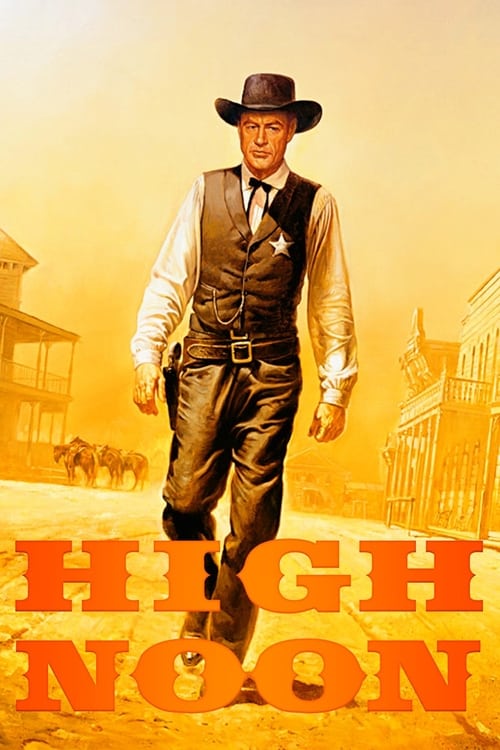
High Noon
"The story of a man who was too proud to run!"
Overview
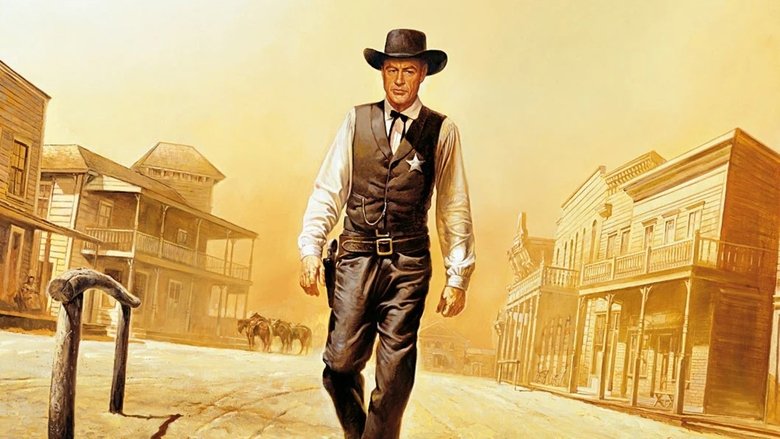
High Noon follows Will Kane, the recently retired marshal of Hadleyville, New Mexico Territory, who has just married Amy, a devout Quaker. As they prepare to leave town to start a new quiet life, word arrives that Frank Miller, a vicious killer Kane sent to prison years ago, has been released and is arriving on the noon train seeking revenge. The film unfolds in near real-time, chronicling Kane's desperate efforts to gather a posse before the clock strikes twelve.
Instead of fleeing, Kane feels duty-bound to protect the town he cleaned up. However, as he pleads with his friends, the judge, the church congregation, and his own deputy, he is met with a chorus of excuses, cowardice, and self-preservation. Even his new wife, bound by her strict pacifist beliefs, begs him to run and threatens to leave on the same train bringing Miller.
Stripped of the traditional heroics of the Western genre, the film becomes a profound psychological and moral drama. As the minutes tick down to an inevitable showdown, Kane realizes he must stand completely alone against Miller and his gang, forcing both him and the town to confront the true cost of integrity and civic responsibility.
Core Meaning
At its core, High Noon is a searing critique of complacency and the failure of civic duty in the face of evil. Screenwriter Carl Foreman explicitly wrote the film as an allegory for the Hollywood Blacklist and McCarthyism, where individuals were abandoned by their friends and colleagues out of fear and self-preservation during the Red Scare. The town of Hadleyville represents a society that talks about law and order but lacks the courage to defend it when threatened.
Beyond its specific political context, the film explores the heavy burden of personal integrity. Will Kane's refusal to run, even when given every logical reason to do so, underscores the existential dilemma of a man who must stay true to his conscience, regardless of whether the public supports him or even deserves his sacrifice.
Thematic DNA
Civic Duty and Cowardice
Kane's desperate search for a posse exposes the hypocrisy of a town that enjoys the benefits of peace but refuses to fight for it. The film meticulously dismantles the community's excuses, showing how fear overrides collective moral responsibility.
The Burden of Individual Integrity
Kane stands by his moral code, prioritizing honor and duty over his own life and happiness. His integrity is an isolating force; he must face his fate alone because his conscience will not allow him to take the easy way out and flee.
Compromise of Principles (Pacifism vs. Violence)
Amy's journey forces her to choose between her strict religious pacifism and her love for her husband. The film challenges the absolute nature of her non-violence, culminating in her pulling a trigger to save Kane's life.
The Illusion of the Western Hero
The film deconstructs the myth of the invincible cowboy. Kane is visibly afraid, vulnerable, and exhausted. He begs for help rather than stoically welcoming a fight, and he ultimately rejects the very community he saves in disgust.
Character Analysis
Will Kane
Gary Cooper
Motivation
An uncompromising sense of duty and the existential knowledge that running will never solve the problem, as the killers will simply hunt him down eventually.
Character Arc
Begins hopeful for a peaceful retirement, becomes increasingly isolated and disillusioned by his friends' betrayals, and finally rejects the town entirely after saving it.
Amy Fowler Kane
Grace Kelly
Motivation
To live a peaceful life free from the violence that killed her brother and father.
Character Arc
Starts as a devout Quaker completely opposed to violence, but ultimately breaks her vows and uses a gun to kill a man in order to save her husband's life.
Helen Ramírez
Katy Jurado
Motivation
Self-preservation and a refusal to be dragged down by the town's cowardice or men's egos.
Character Arc
A sharp, independent Mexican businesswoman and former lover of both Kane and Miller, she recognizes the town's doom early on and decides to sell her business and leave with her dignity intact.
Deputy Harvey Pell
Lloyd Bridges
Motivation
Jealousy, wounded ego, and a desire for unearned respect from his peers and Helen Ramírez.
Character Arc
He angrily quits his job when Kane refuses to recommend him as the new marshal, expecting Kane to beg for his help, but ends up fighting Kane in a cowardly attempt to force him to leave town.
Symbols & Motifs
The Ticking Clocks
The inescapable approach of fate and the relentless, suffocating pressure of time.
Shown in frequent, dramatic close-ups throughout the film, synchronizing the film's 85-minute run-time with the real-time narrative as noon approaches.
The Tin Star (Marshal's Badge)
Duty, law, and the thankless burden of public service.
Pinned to Kane's chest, the badge is heavily criticized by the old marshal as being for nothing, and is famously thrown into the dirt by Kane at the end of the film.
The Train
The unstoppable arrival of violence, the past catching up, and the threat of the outside world.
It brings Frank Miller to town at exactly high noon. The piercing sound of its whistle cuts through the tension of the final minutes, signaling the end of Kane's time to prepare.
Memorable Quotes
I've never run from anybody before.
— Will Kane
Context:
Kane explains to his wife Amy why they must turn their carriage around and go back to town instead of fleeing to safety.
Meaning:
Establishes Kane's core philosophy; his honor and identity prevent him from taking the easy way out, even when facing death.
You risk your skin catching killers and the juries turn them loose so they can come back and shoot at you again. If you're honest you're poor your whole life and in the end you wind up dying all alone on some dirty street. For what? For nothing. For a tin star.
— Martin Howe
Context:
Spoken by the embittered, arthritic former marshal when Kane comes to his house asking for his help in the fight.
Meaning:
A cynical deconstruction of the Western lawman myth, highlighting the thankless and fatal nature of pursuing justice.
I don't care who's right and who's wrong. There's got to be some better way for people to live.
— Amy Kane
Context:
Amy arguing with Kane about his decision to stay and face Miller, pleading with him to leave the violence behind.
Meaning:
Encapsulates the pacifist worldview that violence only breeds more violence, regardless of justification.
If Kane was my man, I'd never leave him like this. I'd get a gun. I'd fight.
— Helen Ramírez
Context:
Helen speaking pointedly to Amy in the hotel as they both prepare to leave town on the noon train.
Meaning:
A direct challenge to Amy's pacifism, highlighting the stark difference between Helen's pragmatic, fiercely loyal nature and Amy's ideological rigidity.
The public doesn't give a damn about integrity. A town that won't defend itself deserves no help.
— Martin Howe
Context:
Martin advising Kane to leave the hypocritical town to its own doomed fate.
Meaning:
Reflects the dark reality of public apathy and group cowardice, questioning whether an ungrateful society is worth dying for.
Philosophical Questions
What is the true nature of civic duty, and do citizens have a moral obligation to protect their community even when it requires extreme personal risk?
The film shows a town that gladly accepts the economic and social benefits of law and order but refuses to share the burden of maintaining it. It poses the uncomfortable question of whether a society that will not defend itself actually deserves to be saved by a hero.
Are there moral limits to absolute pacifism?
Amy's strict religious vows against violence are severely tested when her husband is about to be murdered. The film suggests that pacifism is often a luxury paid for by the violence of others, and that choosing not to fight can sometimes directly enable evil.
Is personal integrity dependent on external validation?
Kane chooses to fight an unwinnable battle even when the very people he is protecting explicitly tell him to leave. He acts not for glory, reward, or public approval, but because he cannot live with himself if he runs, questioning whether true honor is entirely internal.
Alternative Interpretations
The most prominent debate surrounding High Noon is its political allegory, which functions perfectly from two entirely opposing viewpoints. Originally, screenwriter Carl Foreman intended the film as a harsh critique of McCarthyism and the Hollywood Blacklist. In this reading, Will Kane represents the persecuted individual, the outlaws represent the HUAC interrogators, and the cowardly townspeople symbolize the Hollywood community who stood by and let their colleagues be ruined out of fear and self-preservation.
However, many conservative viewers and critics, as well as star Gary Cooper himself, interpreted the film as a Cold War/Pro-American allegory. In this interpretation, Kane represents the United States, forced to stand alone against the encroaching evil of Communism (Frank Miller's gang) and fight a necessary war (like Korea) while weak, isolationist, or appeasing allies (the townspeople) refuse to help.
A third interpretation views the film as a Deconstruction of Masculinity and the Western Myth. From a genre perspective, it critiques the violent foundation of the West. Kane's decision to drop his badge in the dirt at the end is seen not just as disgust with the town, but a rejection of the violent lawman archetype itself, choosing instead the domestic, peaceful life represented by Amy.
Cultural Impact
High Noon profoundly altered the trajectory of the Western genre and left a permanent mark on American cinema. Released in 1952 during the height of the Cold War and the Red Scare, it served as a highly controversial allegory for McCarthyism. Screenwriter Carl Foreman infused the script with his own experiences facing the HUAC, framing the cowardly townspeople as the Hollywood establishment that refused to stand up for blacklisted artists. This provoked intense polarization; conservatives like John Wayne and Howard Hawks despised the film, prompting them to make Rio Bravo (1959) as a direct, traditionalist rebuttal.
Despite the political controversy, the film was a massive critical and commercial success, winning four Academy Awards. It revolutionized the Western by introducing deep psychological realism and moral ambiguity, stripping away the mythic invincibility of the frontier hero. Will Kane was allowed to show fear, exhaustion, and vulnerability. Furthermore, the film's real-time narrative structure and its use of a ticking clock became a foundational blueprint for modern suspense thrillers.
Culturally, the film's impact has endured across the entire political spectrum. Paradoxically, while written as a leftist critique of McCarthyism, it was deeply beloved by several U.S. Presidents, including Dwight D. Eisenhower, Ronald Reagan, and Bill Clinton (who reportedly screened it 17 times at the White House). These leaders viewed it as a conservative metaphor for a lone leader standing up for freedom while weak allies do nothing, proving the universality of its core themes.
Audience Reception
Upon its release, High Noon received mixed initial reactions from traditional Western fans, who were frustrated by the lack of action, sweeping landscapes, and the depiction of a frightened, vulnerable hero asking for help. However, it quickly garnered immense critical acclaim for its psychological depth, tight pacing, and Gary Cooper's masterful, stoic performance. Audiences praised the relentless real-time suspense, the haunting musical score by Dimitri Tiomkin, and the innovative cinematography.
The main points of criticism came from political conservatives and genre purists who felt the film was un-American for depicting pioneers as cowardly. The ending, where Kane throws his badge in the dirt, was highly controversial and seen by some as an insult to law enforcement. Despite this initial friction, the overwhelming verdict over time has shifted to universal acclaim. Today, it is widely considered one of the greatest films ever made, holding a 94% on Rotten Tomatoes, with modern audiences continually praising its tension, its critique of groupthink, and its complex moral dilemmas.
Interesting Facts
- John Wayne was originally offered the role of Will Kane but turned it down, later calling the film 'un-American' because of its allegory against blacklisting and its depiction of a fearful lawman.
- Despite his intense hatred for the film, John Wayne accepted the Academy Award for Best Actor on behalf of Gary Cooper, who was in Europe during the ceremony.
- Screenwriter Carl Foreman was called before the House Un-American Activities Committee (HUAC) during production. When he refused to name names, he was blacklisted and his credit as co-producer was removed from the film.
- The film was shot in just 28 days on a tight budget. Director Fred Zinnemann and cinematographer Floyd Crosby deliberately used flat lighting and high-contrast black-and-white film to mimic bleak Civil War photographs.
- The film famously unfolds in approximately real-time. The 85-minute runtime matches the narrative time passing from 10:30 AM to noon.
Easter Eggs
Lee Van Cleef's Screen Debut
The legendary Western actor, who would later achieve global fame in Sergio Leone's The Good, the Bad and the Ugly, makes his feature film debut as Jack Colby, one of Frank Miller's henchmen. Curiously, he does not have a single line of dialogue in the entire film.
The 'Do Not Forsake Me' Motif
Dimitri Tiomkin's Oscar-winning title song isn't just an opening credits tune; its melody is woven throughout the entire orchestral score. It acts as an omnipresent musical motif, constantly reminding the audience of Kane's isolation, the ticking clock, and Amy's impending departure.
⚠️ Spoiler Analysis
Click to reveal detailed analysis with spoilers
Frequently Asked Questions
Explore More About This Movie
Dive deeper into specific aspects of the movie with our detailed analysis pages
Comments (0)
No comments yet. Be the first to share your thoughts!