Casino
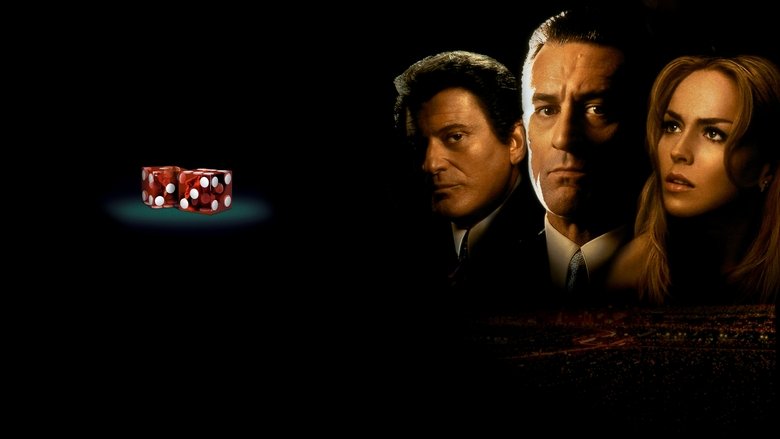
A crime drama of glittering excess and brutal consequences, where the seductive glow of Las Vegas masks a world of greed and betrayal, culminating in a fiery, inevitable downfall.
Casino

Casino

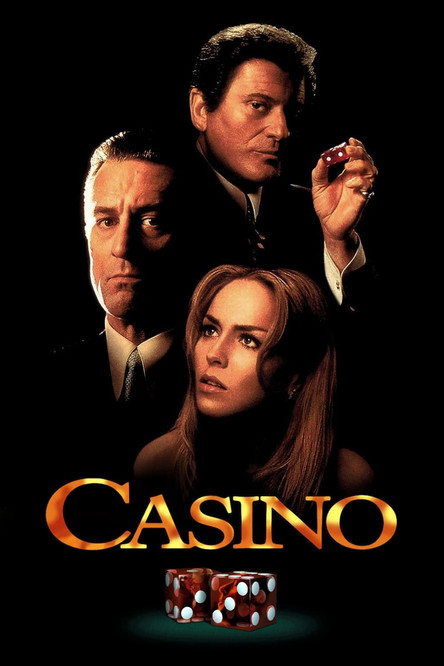
"No one stays at the top forever."

22 November 1995 France 179 min ⭐ 8.0 (6,197)
Director: Martin Scorsese
Cast: Robert De Niro, Sharon Stone, Joe Pesci, James Woods, Don Rickles
Drama Crime
The Rise and Fall of an Empire Greed and Corruption Betrayal and Trust Love and Obsession
Budget: $50,000,000
Box Office: $116,112,375

Overview

Martin Scorsese's 1995 epic crime drama, "Casino," chronicles the rise and fall of Sam "Ace" Rothstein, a meticulous gambling expert sent by the Chicago mob to run the Tangiers Casino in Las Vegas. With his childhood friend and ruthless enforcer, Nicky Santoro, by his side, Ace transforms the casino into a highly profitable venture for the mob. However, Ace's carefully constructed world begins to unravel when he falls for and marries Ginger McKenna, a beautiful but manipulative hustler with a destructive past.

As Ace's obsession with control clashes with Ginger's escalating addictions and her lingering ties to a former lover, their tumultuous relationship becomes a significant liability. Simultaneously, Nicky's increasingly violent and high-profile criminal activities draw unwanted attention from both law enforcement and the mob bosses back home. The once-unbreakable bond between Ace and Nicky fractures under the weight of greed, betrayal, and ambition, mirroring the eventual collapse of the mob's glittering empire in Las Vegas.
Core Meaning

"Casino" serves as a powerful allegory for the corrupting nature of the American Dream, viewed through the glitzy, deceptive lens of Las Vegas. Director Martin Scorsese explores the inherent unsustainability of an empire built on greed, violence, and a fragile trust. The film meticulously details the mechanics of power and control within the mob-run casinos, only to systematically deconstruct them, suggesting that such systems are doomed to implode from their own internal rot. Ultimately, "Casino" posits that in a world where everything and everyone has a price, loyalty is fleeting, and the very paradise built by these characters becomes the instrument of their damnation, eventually replaced by a sanitized, corporate version of Las Vegas.

Thematic DNA

The Rise and Fall of an Empire 35%
Greed and Corruption 30%
Betrayal and Trust 25%
Love and Obsession 10%

The Rise and Fall of an Empire

The film meticulously documents the establishment of a highly profitable, mob-controlled casino empire in Las Vegas, managed by Ace Rothstein's genius and protected by Nicky Santoro's brutality. It then charts its inevitable decline, brought about by internal conflicts, greed, and the characters' self-destructive flaws. The fall of the Tangiers casino mirrors the end of an era for the mob in Las Vegas, as corporations take over.

Greed and Corruption

Greed is the primary motivator for nearly every character in "Casino." The mob's skimming operation, Ace's desire for perfection and control, Ginger's insatiable need for money and security, and Nicky's violent pursuit of his own criminal enterprises all stem from a deep-seated avarice. This theme highlights how the relentless pursuit of wealth corrupts individuals and destroys relationships.

Betrayal and Trust

The narrative is driven by a series of betrayals. Ginger's relationship with her former pimp, Lester Diamond, and her affair with Nicky represent a profound betrayal of her marriage to Ace. Similarly, the lifelong friendship between Ace and Nicky disintegrates into suspicion and violence. The film explores the idea that in a world built on criminality, trust is a commodity that is easily and often traded.

Love and Obsession

Ace's love for Ginger quickly devolves into a destructive obsession. He believes he can possess and control her, just as he controls the casino. Ginger, on the other hand, feels trapped in a gilded cage, leading to her own destructive behavior. Their toxic relationship serves as a central catalyst for the plot's tragic unraveling.

Character Analysis

Sam 'Ace' Rothstein

Robert De Niro

Archetype: Antihero
Key Trait: Meticulous Control Freak

Motivation

Ace is motivated by a desire for perfection, control, and legitimacy. He wants to run the casino flawlessly and be seen as a respected figure, even as he facilitates the mob's illegal skim.

Character Arc

Ace begins as a highly successful and meticulous casino operator, a genius in the world of gambling who brings order and immense profit to the Tangiers. However, his obsession with control, his volatile marriage to Ginger, and his tumultuous relationship with Nicky lead to his downfall. After surviving a car bombing, he ends his career back where he started, as a sports handicapper, lamenting the end of the mob's era in Las Vegas.

Ginger McKenna

Sharon Stone

Archetype: Femme Fatale
Key Trait: Manipulative and Self-Destructive

Motivation

Ginger is primarily motivated by a need for money and security, but also a self-destructive desire for the chaotic freedom of her past life as a hustler. She is torn between the stability Ace offers and the manipulative hold of her former pimp, Lester Diamond.

Character Arc

Ginger starts as a savvy, high-end hustler who commands attention in Las Vegas. After marrying Ace for security and wealth, she feels increasingly trapped and controlled. Her struggles with alcohol and drug addiction, combined with her toxic connection to her past, lead her to a tragic downward spiral, culminating in her death from a drug overdose.

Nicky Santoro

Joe Pesci

Archetype: The Shadow
Key Trait: Violent and Ambitious

Motivation

Nicky is driven by a lust for power, money, and a reputation for being the toughest man in Vegas. He resents being in Ace's shadow and is determined to make his own mark through violence and intimidation.

Character Arc

Nicky arrives in Las Vegas as Ace's protector and the mob's enforcer. His initial role is to keep things in line, but his unchecked ambition and extreme violence lead him to build his own criminal empire. His recklessness and high profile eventually make him a liability to the mob and to Ace, leading to a falling out between the two friends and his eventual brutal murder at the hands of his own crew.

Symbols & Motifs

The Desert

Meaning:

The vast, empty desert surrounding Las Vegas symbolizes a place of secrets, violence, and finality. It's where problems are "solved" and bodies are buried, representing the lawless and brutal foundation upon which the glittering city is built. Ace's narration about the "holes in the desert" underscores this grim reality.

Context:

The desert is the setting for a tense confrontation between Ace and Nicky. It's also the final resting place for many of Nicky's victims and ultimately where Nicky and his brother are brutally murdered and buried.

The Casino's Count Room

Meaning:

The count room is the heart of the mob's operation, symbolizing the immense, flowing river of cash that is the source of their power. It represents the meticulous system of control and the institutionalized corruption of the skimming operation that funnels money back to the bosses.

Context:

The film dedicates significant time to explaining the intricate process of the skim, with scenes showing casino employees systematically diverting cash from the count room into a suitcase for the mob.

Ginger's Jewelry and Furs

Meaning:

The extravagant jewelry and furs Ace bestows upon Ginger symbolize his attempt to possess her and her status as his ultimate prize. They represent the wealth and luxury of her life with Ace, but also the gilded cage she finds herself in, as she is ultimately a commodity in this world.

Context:

Throughout the film, Ginger is adorned with increasingly lavish jewels and furs, which become a visual marker of her marriage to Ace. Her eventual desperate attempt to take money and jewels from their shared safety deposit box highlights their symbolic importance.

Memorable Quotes

In the casino, the cardinal rule is to keep them playing and keep them coming back. The longer they play, the more they lose. In the end, we get it all.

— Sam 'Ace' Rothstein

Context:

This is part of Ace's narration at the beginning of the film, explaining the fundamental principles of running a successful casino as the camera glides through the glamorous and bustling Tangiers.

Meaning:

This quote encapsulates the cold, calculated business philosophy of Las Vegas casinos. It underscores the theme of the house always having the advantage and reflects Ace's detached, statistical approach to his work and, by extension, to life.

When you love someone, you've gotta trust them. There's no other way. You've got to give them the key to everything that's yours. Otherwise, what's the point? And for a while, I believed that's the kind of love I had.

— Sam 'Ace' Rothstein

Context:

Ace says this in a voiceover as he reflects on his decision to marry Ginger and entrust her with access to his emergency cash stash, a decision that will have devastating consequences.

Meaning:

This quote is deeply ironic as it highlights Ace's biggest miscalculation. He attempts to apply a gambler's logic to love and trust, giving Ginger everything in the hopes of securing her loyalty, a bet that ultimately leads to his ruin.

No matter how big a guy might be, Nicky would take him on. You beat Nicky with fists, he comes back with a bat. You beat him with a knife, he comes back with a gun. And if you beat him with a gun, you better kill him, because he'll keep comin' back and back until one of you is dead.

— Sam 'Ace' Rothstein

Context:

Ace's narration introduces his childhood friend Nicky, explaining the roots of his fearsome reputation as they were growing up, setting the stage for Nicky's role as the muscle of the Vegas operation.

Meaning:

This quote perfectly characterizes Nicky's relentless and escalating capacity for violence. It establishes him as an unstoppable force of nature, foreshadowing the extreme brutality he will bring to Las Vegas and the danger he poses to everyone, including himself.

Today it looks like Disneyland.

— Sam 'Ace' Rothstein

Context:

Ace delivers this line in the film's closing narration, as he observes the demolition of the old casinos and the rise of new, themed mega-resorts, reflecting on the end of an era.

Meaning:

This final line of the film expresses a sense of disillusionment and perhaps a hint of contempt for the new, corporate-run Las Vegas. The wild, dangerous, and personal world that Ace and the mob controlled has been replaced by a sanitized, family-friendly, and impersonal version of the city.

Philosophical Questions

Does absolute power inevitably lead to self-destruction?

The film explores this question through the arcs of its main characters. Ace is given near-absolute control over the Tangiers, but his obsessive need for control in his personal life leads to his downfall. Nicky amasses immense power through violence, but his unchecked aggression and arrogance make him a target for both law enforcement and his own bosses. The mob's powerful empire, seemingly untouchable, crumbles from within due to the greed and recklessness of its key players. The film suggests that power, particularly when acquired through illicit means, contains the seeds of its own destruction.

Can love and trust exist in a world built on greed and betrayal?

"Casino" presents a cynical answer to this question through the relationship between Ace and Ginger. Ace's attempt to build a relationship on a foundation of wealth and possession, rather than genuine love, is doomed from the start. He believes he can buy Ginger's loyalty and trust, but her own nature and the corrupt environment they inhabit make true fidelity impossible. Their marriage becomes a microcosm of the larger world of the film, where every relationship is transactional and ultimately unreliable.

Alternative Interpretations

While "Casino" is largely viewed as a chronicle of the downfall of the mob in Las Vegas, an alternative interpretation sees it as a subversive take on the American Dream. Instead of a story about the struggle to achieve success, the film begins with the characters already at the top; their struggle is to maintain their empire against both external pressures and their own self-destructive natures. This perspective frames the film not just as a gangster epic, but as a critique of the emptiness and instability of success itself when built on a corrupt foundation. Another reading focuses on the film as a story of the Old West in a modern setting, with Las Vegas as a new frontier. Ace and Nicky are portrayed as pioneers who come to a "pure and untouched" land to make their fortune, employing their own brutal form of justice in a place where traditional authority is weak. This interpretation aligns the film with the classic Western genre, exploring themes of expansion, lawlessness, and the eventual "civilizing" of the frontier by corporate interests.

Cultural Impact

"Casino" has had a significant and lasting impact on pop culture, cementing the glamorous yet brutal image of mob-era Las Vegas in the public consciousness. Along with "Goodfellas," it defined the modern gangster genre for a generation, characterized by Scorsese's dynamic visual style, use of popular music, and complex, morally ambiguous characters. The film's depiction of the casino's inner workings, from the intricacies of the skim to the violent methods of dealing with cheaters, has influenced countless other films, television shows, and even the public perception of the casino industry itself. Sharon Stone's portrayal of Ginger McKenna became an iconic femme fatale role, and the film's fashion has been cited for its influence on style trends. More broadly, "Casino" serves as a historical document of a specific period in Las Vegas history, capturing the transition from mob control to corporate ownership, a theme that resonates as a critique of the changing nature of American enterprise.

Audience Reception

Audience reception for "Casino" has been largely positive, with many viewers hailing it as a masterpiece of the gangster genre and one of Scorsese's best films. Praised aspects frequently include the powerhouse performances from Robert De Niro, Sharon Stone, and Joe Pesci, the film's stylish direction, detailed storytelling, and masterful cinematography. However, a common point of criticism is its similarity in tone, style, and casting to Scorsese's earlier film, "Goodfellas," with some viewers feeling it retreads familiar ground. The film's three-hour runtime and extensive use of narration are also points of contention for some, who find the pacing slow or the exposition heavy. The graphic and brutal violence, particularly the infamous head-in-a-vise scene, is often cited as a shocking and controversial moment. Despite these criticisms, the overall verdict from audiences is that "Casino" is a compelling and epic crime drama.

Interesting Facts

  • The film is based on the non-fiction book "Casino: Love and Honor in Las Vegas" by Nicholas Pileggi, who also co-wrote the screenplay with Martin Scorsese.
  • The character of Sam "Ace" Rothstein was based on real-life casino executive Frank "Lefty" Rosenthal, while Nicky Santoro was based on mob enforcer Anthony "The Ant" Spilotro.
  • Sharon Stone's performance as Ginger earned her a Golden Globe Award and an Academy Award nomination for Best Actress.
  • Much of the film was shot on location at the Riviera Casino in Las Vegas during the early morning hours to avoid disrupting actual casino operations.
  • The costume budget for the film was $1 million, with Robert De Niro having 70 different custom-made outfits throughout the movie.
  • The opening title sequence, depicting Ace's car explosion, was the last work of legendary title designer Saul Bass.
  • Real-life mobster-turned-witness Frank Cullotta, who the character Frank Marino was based on, served as a technical advisor and had a cameo as a hitman in the film.

Easter Eggs

The character Andy Stone, played by Alan King, is based on the real-life mob associate Allen Dorfman. In Scorsese's later film "The Irishman" (2019), Dorfman is depicted being killed in a parking lot, which is exactly what happens to the character of Andy Stone in "Casino".

This creates a subtle link within Martin Scorsese's cinematic universe of crime films, connecting the narratives of "Casino" and "The Irishman" through the fate of this real-life figure. It's a nod for viewers familiar with the true stories behind both films.

The song "Stardust" is played three different times on the film's soundtrack.

This is a subtle reference to the Stardust Casino, which was the real-life casino run by Frank "Lefty" Rosenthal, the inspiration for Ace Rothstein. The fictional Tangiers in the film is largely based on the Stardust.

Martin Scorsese's mother, Catherine Scorsese, has a cameo appearance.

Catherine Scorsese, who famously appeared as Tommy DeVito's mother in "Goodfellas," has a small role as the mother of Artie Piscano, the Kansas City underboss whose careless talk in his grocery store leads to the FBI wiretap that brings the whole operation down. Her appearance is a trademark in many of her son's films.

⚠️ Spoiler Analysis

Click to reveal detailed analysis with spoilers

Frequently Asked Questions

Explore More About This Movie

Dive deeper into specific aspects of the movie with our detailed analysis pages

Comments (0)

Leave a comment

No comments yet. Be the first to share your thoughts!