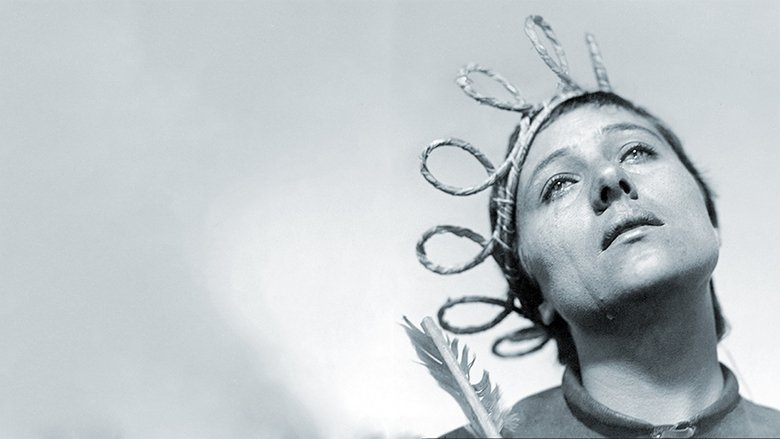
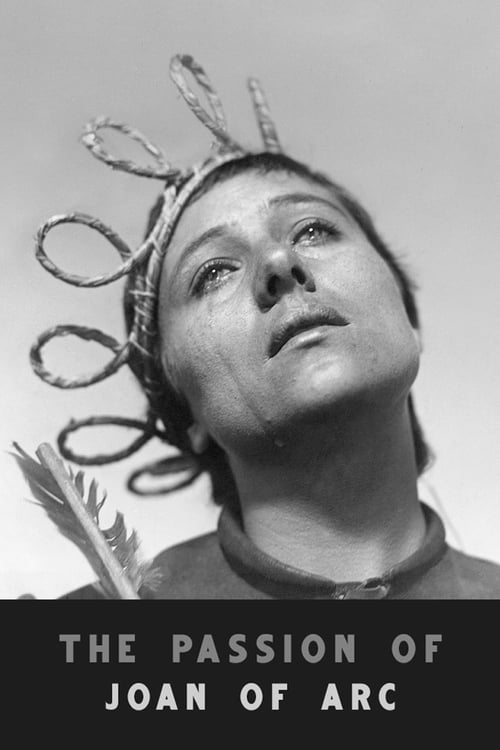
The Passion of Joan of Arc
A silent historical drama's raw emotional intensity, conveyed through a relentless storm of close-ups, captures the harrowing spiritual trial of a solitary soul against a monolithic institution.
The Passion of Joan of Arc

The Passion of Joan of Arc

La Passion de Jeanne d'Arc

"An Immortal Screen Classic that will live Forever!"

21 April 1928 France 82 min ⭐ 8.0 (1,028)
Director: Carl Theodor Dreyer
Cast: Maria Falconetti, Eugène Silvain, André Berley, Maurice Schutz, Antonin Artaud
Drama History
Individual Faith vs. Institutional Religion Suffering and Martyrdom The Power of the Human Face Misogyny and Persecution of Women
Box Office: $18,121

Overview

"The Passion of Joan of Arc" (1928), directed by Carl Theodor Dreyer, chronicles the final days of the 19-year-old French heroine. Captured by the English, Joan is brought before a French ecclesiastical court and charged with heresy. The film focuses intensely on her grueling interrogation, where numerous judges attempt to coerce her into recanting her divine visions and mission from God. Dreyer condenses the historical trial, which spanned months, into what feels like a single, agonizing day, highlighting Joan's psychological and spiritual torment.

The narrative eschews depicting Joan's military victories, concentrating instead on the brutal spiritual and mental battle between the lone, steadfast girl and the powerful, manipulative clerical court. Through a series of invasive questions, threats of torture, and deception, the judges relentlessly pressure her. The film masterfully portrays her resilience, moments of doubt, and the profound suffering she endures, relying almost entirely on facial expressions to convey the deep emotional and spiritual drama.

Core Meaning

Carl Theodor Dreyer intended "The Passion of Joan of Arc" to be a "hymn to the triumph of the soul over life." The film's core meaning lies in the exploration of individual faith clashing with institutionalized power and dogmatism. It examines the nature of suffering, martyrdom, and spiritual conviction. Dreyer focuses on Joan's internal struggle, portraying her not just as a historical icon or warrior, but as a terrified, yet resolute young woman whose personal connection to God is incomprehensible and threatening to the rigid religious authorities. The film suggests that true faith is a deeply personal and spiritual experience, often persecuted by the very institutions that claim to represent it. Joan's ultimate victory is not a military one, but a spiritual martyrdom that affirms her soul's integrity in the face of immense pressure and cruelty.

Thematic DNA

Individual Faith vs. Institutional Religion 35%
Suffering and Martyrdom 30%
The Power of the Human Face 20%
Misogyny and Persecution of Women 15%

Individual Faith vs. Institutional Religion

The film starkly contrasts Joan's pure, personal faith with the rigid, politicized, and often cruel institution of the church court. Her direct communion with God threatens the judges' authority. They are presented as manipulative hypocrites, using religious doctrine as a tool for political persecution. Joan's suffering highlights the conflict between a living, individual spirituality and a dogmatic, power-driven religious structure.

Suffering and Martyrdom

Joan's ordeal is explicitly framed as a "Passion," linking her suffering to that of Christ. The film relentlessly details her psychological and emotional torment, emphasizing her humanity and vulnerability. Her eventual decision to recant her confession and face death is portrayed as a triumphant martyrdom—a victory of the soul over the mortal fear of pain and death, achieving a spiritual deliverance.

The Power of the Human Face

Through its radical use of close-ups, the film posits that the human face is the ultimate landscape of emotion and spiritual truth. Renée Falconetti's performance, captured in intense, makeup-free detail, conveys Joan's entire journey of faith, terror, and resolve without the need for extensive dialogue or action. The close-up becomes a tool for creating profound intimacy and emotional intensity, making the viewer a direct witness to Joan's inner life.

Misogyny and Persecution of Women

The trial can be interpreted as an intense persecution of a woman who defies patriarchal norms. The all-male court relentlessly questions and belittles Joan, focusing on her male attire as a primary offense. The judges' aggressive, leering expressions and invasive questioning create an atmosphere of toxic masculinity, where a powerful, independent woman is seen as a threat that must be broken and controlled.

Character Analysis

Jeanne d'Arc (Joan of Arc)

Renée Jeanne Falconetti

Archetype: The Martyr
Key Trait: Spiritual endurance

Motivation

Her primary motivation is her profound and unshakeable faith in God and the divine visions she has received. She believes her mission is God-given, and her struggle is to remain faithful to that calling despite the extreme suffering and persecution she faces.

Character Arc

Joan begins as a steadfast believer, enduring her trial with unwavering faith in her divine mission. Under immense psychological pressure and the threat of being burned alive, her human fear surfaces, and she briefly breaks, signing a confession. However, this moment of weakness is swiftly followed by a resurgence of conviction. Realizing she has betrayed God, she recants her confession, fully embracing her role as a martyr and finding spiritual triumph in her death.

Bishop Pierre Cauchon

Eugène Silvain

Archetype: The Corrupt Judge
Key Trait: Manipulative authority

Motivation

His motivation is primarily political. Aligned with the English, he seeks to discredit Joan's divine claims, which legitimized the French crown, thereby undermining the French cause. He uses the authority of the Church to achieve a political objective.

Character Arc

Cauchon remains the steadfast head of the ecclesiastical court, driven by political motivations to convict Joan. He orchestrates the trial, using theological arguments and psychological manipulation to break her will. While he leads the persecution, the film occasionally shows glimmers of conflict or pity in his expression, suggesting a buried conscience, which becomes more apparent as he sorrowfully watches her execution.

Jean Massieu

Antonin Artaud

Archetype: The Sympathetic Official
Key Trait: Compassion

Motivation

His motivation shifts from fulfilling his role in the court to providing spiritual comfort to a person he comes to see as a true believer being unjustly persecuted. He is moved by her faith and suffering.

Character Arc

As the bailiff and one of the few who shows kindness to Joan, Massieu's character arc involves a quiet struggle between his official duties and his growing sympathy and belief in her sincerity. He initially participates in the trial but subtly aids her when possible. By the end, he is openly supportive, holding a makeshift cross for her to see as she dies.

Nicolas Loyseleur

Maurice Schutz

Archetype: The Deceiver
Key Trait: Deceitful

Motivation

His motivation is to trick Joan into a confession. He is a tool of the court, using deceit to break her spirit where direct interrogation fails.

Character Arc

Loyseleur acts as a key instrument of the court's deception. He pretends to be Joan's ally, a fellow prisoner from her region, to gain her trust and advise her to confess. He shows no significant change, remaining a manipulative figure whose actions are solely in service of the court's goal to entrap her. His feigned sympathy is one of the cruelest aspects of her psychological torment.

Symbols & Motifs

The Close-Up

Meaning:

The close-up functions as a symbol of both intense scrutiny and spiritual revelation. It isolates Joan, emphasizing her loneliness against her accusers, while also allowing the audience an intimate, unfiltered view into her soul and suffering. It transforms her face into the film's central landscape, where the entire drama unfolds.

Context:

Used relentlessly throughout the film, almost to the exclusion of establishing shots. Dreyer films both Joan and her interrogators in tight close-ups, creating a confrontational and claustrophobic atmosphere that traps the viewer in the intensity of the trial.

The Cross

Meaning:

The cross is a recurring symbol of Christ's passion, divine comfort, and Joan's ultimate martyrdom. It represents the true faith she clings to, in contrast to the corrupted version wielded by her judges.

Context:

A cross-shaped shadow on the floor of her cell provides Joan with comfort. A makeshift cross is given to her before her execution. The final shot of the film frames her stake against a cross on a nearby chapel, explicitly linking her death to Christ's sacrifice.

Crown of Thorns

Meaning:

This directly alludes to the mockery of Christ before his crucifixion, symbolizing Joan's martyrdom and her sanctification through suffering. It represents the cruel parody of justice and piety enacted by her tormentors.

Context:

In her cell, jailers taunt Joan by placing a woven crown of straw on her head. Later, after she recants her confession, the act of sweeping away this humble crown helps trigger her realization that she has betrayed her mission, prompting her to face her death.

Shaved Head

Meaning:

The shaving of Joan's head symbolizes her ultimate humiliation and the stripping away of her identity. However, it also becomes the catalyst for her final spiritual victory. It is a moment of violation that clarifies her purpose and leads her to recant her confession, choosing martyrdom over a life of imprisonment and compromise.

Context:

After Joan signs a confession to save herself from being burned, she is condemned to life imprisonment. As a jailer shaves her head, the dehumanizing act makes her realize she has been unfaithful to God, and she immediately demands to see the judges to retract her statement.

Memorable Quotes

Will I be with You tonight in Paradise?

— Jeanne d'Arc

Context:

This line appears on an intertitle as Joan is being led to the stake. She has recanted her confession and accepted her fate, and this is her final, prayerful thought before being burned.

Meaning:

This question, asked as she faces her execution, encapsulates the core of Joan's faith. It demonstrates that despite the horrific ordeal, her belief in God's promise and the afterlife remains unshaken. It is her final, human appeal for assurance, blending her profound faith with her fear of death.

Your victory and your deliverance... will be through your martyrdom.

— Jean Massieu (relaying the court's twisted message)

Context:

Spoken to Joan in her cell as she grapples with her fate. The idea is presented to her that her ultimate purpose is to die for her cause, reframing her impending execution as a spiritual victory.

Meaning:

This quote highlights the central theme of spiritual triumph through suffering. Joan initially believes her deliverance will be a physical rescue. She comes to understand, however, that her true victory lies not in escaping death, but in embracing it as the ultimate affirmation of her faith. Her martyrdom becomes her final, greatest triumph.

Philosophical Questions

What is the relationship between individual faith and organized religion?

The film explores this question by setting up an irreconcilable conflict between Joan's personal, direct experience of God and the rigid, hierarchical structure of the Church court. Her faith is pure and unmediated, while the religion of her judges is a system of power, politics, and dogma. The film asks whether institutions that claim to represent God can become the greatest obstacles to true faith, and whether a single individual's conviction can hold more spiritual truth than a powerful, established religion.

Where is the line between divine inspiration and madness?

The court's entire purpose is to force Joan to admit her visions are not from God, implying they are either demonic or a product of delusion. The film never explicitly shows her visions, focusing instead on her unwavering belief in them. It leaves the viewer to grapple with the nature of her experience. By portraying her suffering with such raw humanity and her faith with such integrity, the film challenges the viewer to question whether the sanity of the individual can be judged by a society that persecutes them. It forces us to consider that what one system calls heresy, another calls sainthood.

Can suffering be a path to spiritual triumph?

The film's title directly invokes the Passion of Christ, framing Joan's suffering not as a defeat but as a necessary trial leading to a spiritual victory. Joan endures immense psychological torture, fear, and betrayal. Yet, it is through this suffering, and her ultimate embrace of martyrdom, that she achieves what the film calls her "great victory" and "deliverance." The film poses the question of whether the ultimate test of faith is the willingness to endure unbearable pain, and whether spiritual transcendence can only be found by confronting and passing through the deepest forms of human suffering.

Alternative Interpretations

While the dominant interpretation focuses on spiritual faith and martyrdom, the film also invites other readings. A feminist interpretation sees Joan as a woman persecuted by a patriarchal system for defying gender norms. Her insistence on wearing men's clothes and her direct line to divine authority, bypassing the all-male church hierarchy, represents a profound threat to their power. Her trial becomes a symbolic struggle of a woman trying to maintain her autonomy and identity against a monolithic male institution determined to crush her.

A political interpretation views the trial less as a theological dispute and more as a political show trial. The French clergymen are aligned with the English, and their goal is to delegitimize the French king, Charles VII, whose coronation Joan inspired. By proving Joan a heretic, they prove that the king's power does not come from God. In this light, Joan is a political prisoner, and the religious charges are merely a pretext for political ends.

Another reading focuses on the film as an artistic and meta-cinematic statement. Dreyer's style, which deconstructs space and narrative continuity, can be seen as an exploration of cinema's unique ability to represent psychological and spiritual reality over physical reality. The film is not just about Joan's passion, but about the passion of seeing—the camera's ability to penetrate the soul through the landscape of the face.

Cultural Impact

"The Passion of Joan of Arc" is widely regarded as a landmark of cinema and one of the greatest films ever made. Its release came at the apex of the silent film era, and it represented a final, powerful statement of the medium's artistic potential before the dominance of sound.

Its primary influence on cinema was its radical and innovative visual language. Dreyer's relentless use of the close-up, his disorienting editing style that broke conventional rules (like the 180-degree rule), and his stark, makeup-free realism were revolutionary. This approach moved the focus of cinematic storytelling from external action to internal, psychological, and spiritual states, influencing countless directors like Ingmar Bergman and Luis Buñuel. It demonstrated the power of the human face to carry an entire narrative and emotional arc.

Upon its release, the film was a commercial failure and faced censorship from both government and religious authorities, including the Archbishop of Paris, who demanded cuts. Despite the initial difficulties, critics immediately recognized its artistic genius. Over the decades, its reputation has grown immensely, and it is now a cornerstone of film history studies. Renée Falconetti's haunting performance is legendary and is considered by many critics, including Pauline Kael and Roger Ebert, to be the finest ever recorded on film. The story of the film's lost and rediscovered prints has added to its mythical status.

Audience Reception

Upon its initial release, "The Passion of Joan of Arc" was a commercial flop and met with hostility from censors and some nationalist groups. However, many critics of the time lauded it as an unprecedented masterpiece. Over the decades, its critical standing has become nearly unanimous, with reviewers consistently hailing it as one of the greatest and most important films ever made.

Audiences and critics alike praise Renée Falconetti's central performance as arguably the most powerful in cinema history, noting its raw, emotional, and transcendent quality. The film's radical visual style—particularly its relentless use of close-ups—is overwhelmingly lauded for its emotional power and artistic innovation, though some viewers find it initially disorienting or claustrophobic. The main point of praise is the film's ability to create a profoundly moving and spiritual experience that feels timeless and intensely modern. There is very little modern criticism of the film's artistic merit; it is almost universally considered an essential and powerful work of art.

Interesting Facts

  • The screenplay is based almost entirely on the actual historical transcripts of Joan of Arc's trial from 1431.
  • Lead actress Renée Jeanne Falconetti, a comedic stage actress, never acted in another film. Her performance is often cited as one of the greatest in cinema history.
  • Director Carl Theodor Dreyer was notoriously demanding. Legends claim he forced Falconetti to kneel painfully on stone for extended periods to elicit authentic expressions of suffering.
  • No makeup was used on any of the actors, a radical choice at the time, to achieve a raw, realistic look and highlight every flaw and feature of their faces.
  • The large, expensive set, modeled on medieval architecture, was built as a single concrete structure but is almost never shown in its entirety, as Dreyer preferred to shoot in disorienting close-ups.
  • The original negative of the film was destroyed in a fire in 1928. Dreyer painstakingly assembled a second version from alternate takes, but that negative was also lost in another fire in 1929.
  • A nearly pristine print of Dreyer's original cut was miraculously discovered in 1981 in a janitor's closet at a mental institution in Oslo, Norway.
  • The film was controversial upon its announcement because many French nationalists were skeptical that a Danish, non-Catholic director could properly portray a French national saint.
  • Famed surrealist playwright Antonin Artaud plays the sympathetic monk Jean Massieu.

⚠️ Spoiler Analysis

Click to reveal detailed analysis with spoilers

Frequently Asked Questions

Explore More About This Movie

Dive deeper into specific aspects of the movie with our detailed analysis pages

Comments (0)

Leave a comment

No comments yet. Be the first to share your thoughts!