Skip to content
Cells at Work!
A vibrant, high-stakes biological metropolis pulsing with relentless dedication, where microscopic defenders wage theatrical, blood-splashed battles and fragile couriers navigate treacherous labyrinths to keep a fragile universe alive.
Cells at Work!

Cells at Work!

はたらく細胞

08 July 2018 — 28 February 2021 Japan 2 season 21 episode Ended 8.1 (314)

Cast: Kana Hanazawa, Tomoaki Maeno, Mamiko Noto, Kentaro Kumagai, Daisuke Ono

Animation Action & Adventure Comedy Collective Duty and Interdependence 'Self' vs. 'Non-Self' and the Tragic Ethics of Immunity Resilience, Growth, and Overcoming Inadequacy The Invisible Price of Bodily Maintenance Symbiosis and Ecological Balance

Overview

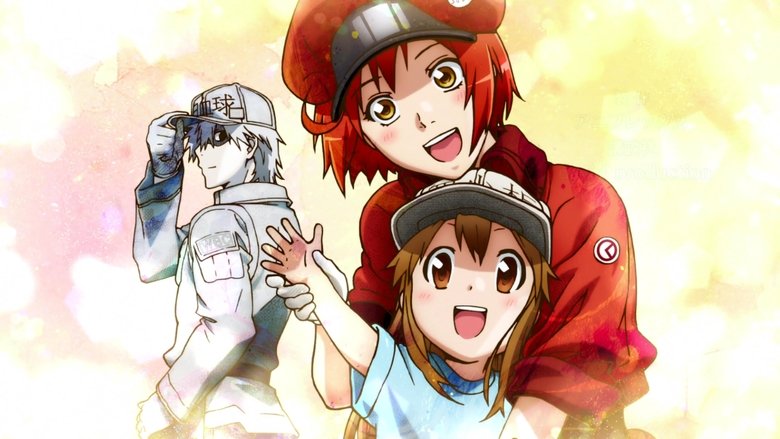
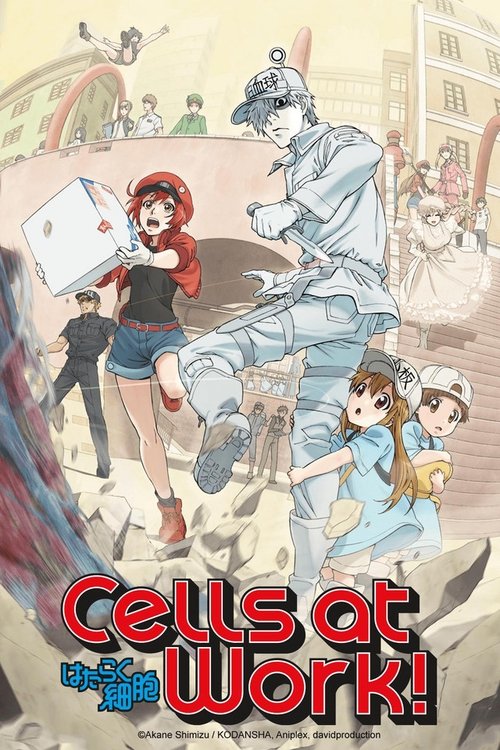
Cells at Work! (Hataraku Saibō) transforms the inner workings of the human anatomy into a bustling urban civilization populated by trillions of anthropomorphized cellular citizens. The story is anchored by the encounters between AE3803, an earnest yet directionally challenged Red Blood Cell delivering oxygen and nutrients, and U-1146, an unrelenting yet courteous Neutrophil (White Blood Cell) tasked with neutralizing bacterial and viral pathogens. Through their shared routines and unexpected reunions, the series builds an episodic yet interconnected portrait of the body's daily survival mechanisms.

Across its two-season run, the overarching narrative progresses from isolated, routine workplace emergencies—such as abrasions, seasonal allergies, influenza, and food poisoning—toward increasingly complex systemic crises. Season 1 establishes the baseline infrastructure and immune hierarchy while introducing existential threats to cellular society. Season 2 expands the scope inward, following the symbiotic ecology of the digestive tract, benign intestinal flora, and recurring systemic pathology that tests the boundaries of self-preservation and systemic coordination.

Rather than relying on conventional villains external to the world, the series frames the body itself as a living battleground where every cell performs its specialized role without hesitation. The broader story demonstrates that health is not a passive state, but an active, continuous labor carried out in secret every second.

Core Meaning

The core thesis of Cells at Work! is that existence is an intricate, collective triumph of uncelebrated labor. By personalizing microscopic biology into relatable workers, creator Akane Shimizu and studio David Production impart profound appreciation and empathy for one's own physical vessel. The series delivers the empowering message that no matter how isolated or inadequate an individual feels, trillions of dedicated entities inside them are constantly striving, adapting, and risking their lives purely to keep them living.

Thematic DNA

Collective Duty and Interdependence 30%
'Self' vs. 'Non-Self' and the Tragic Ethics of Immunity 25%
Resilience, Growth, and Overcoming Inadequacy 20%
The Invisible Price of Bodily Maintenance 15%
Symbiosis and Ecological Balance 10%

Collective Duty and Interdependence

Every organ and capillary functions through strict division of labor. Neither the aggressive combat units (Killer T Cells, Neutrophils) nor the logistics workforce (Erythrocytes) can sustain life alone. The theme culminates during catastrophic events where cross-specialization cooperation determines life or death.

'Self' vs. 'Non-Self' and the Tragic Ethics of Immunity

The immune system is engineered to ruthlessly eradicate foreign pathogens. However, this biological imperative turns existential when confronting Cancer Cell—a mutated 'self' who was born broken through no fault of its own. The series explores the sorrowful necessity of eliminating corrupted components of the body to protect the whole.

Resilience, Growth, and Overcoming Inadequacy

Characters frequently confront their perceived weakness. Naive T Cell feels paralyzed by cowardice before activating; Eosinophil endures mockery during bacterial assaults until her specialized anti-parasite capabilities turn the tide; and Red Blood Cell AE3803 evolves from a lost novice into a reliable guide for junior cells.

The Invisible Price of Bodily Maintenance

Every minor sneeze, scratch, or temperature fluctuation represents a ferocious microscopic war. The series emphasizes that physical wellness requires perpetual, sacrificial toil that conscious humans rarely appreciate.

Symbiosis and Ecological Balance

Season 2 shifts attention toward the microbiome, illustrating that not all foreign organisms are adversaries. Good intestinal bacteria (such as Lactic Acid Bacteria) and opportunistic flora demonstrate that health requires maintaining equilibrium rather than indiscriminate annihilation.

Character Analysis

Red Blood Cell (AE3803)

Kana Hanazawa (JP)

Archetype: The Determined Everyman / Rookie Hero Key Trait: Relentless optimism and persistence despite spatial confusion.

Motivation

To reliably deliver oxygen and nutrients to every corner of the body without failing her fellow cells.

Character Arc

Begins as an easily disoriented, clumsy rookie who constantly relies on luck and U-1146's intervention. By Season 2, through surviving circulatory circuits, hemorrhagic shock, and environmental disasters, she evolves into a seasoned, reliable worker capable of training and guiding new erythroblast juniors.

White Blood Cell / Neutrophil (U-1146)

Tomoaki Maeno (JP)

Archetype: The Gentle Protector / Relentless Enforcer Key Trait: Intense combat brutality paired with unfailing humility and gentleness.

Motivation

To eliminate all foreign intruders and malignant entities to keep the body safe.

Character Arc

Maintains a stark binary between ferocious lethality against pathogens and gentle, awkward kindness toward fellow cells. His arc deepens across both seasons as he confronts the moral weight of his duty—most notably when battling Cancer Cell, whom he acknowledges as a tragic fellow cell.

All 4 characters and cast

Symbols & Motifs

Cardboard Boxes & Wheeled Dollies

Meaning:

The relentless, unglamorous necessity of logistics; the physical weight of sustaining life.

Context:

Carried and pushed by Red Blood Cells delivering oxygen (O2) and carbon dioxide (CO2) containers through the circulatory network.

Receptor Antennas on Caps

Meaning:

Sensory alertness, instinct, and the constant readiness to react to hidden danger.

Context:

Small mechanical sensor wands attached to Neutrophils' hats that pop up and beep upon sensing foreign pathogens.

Tea Parties & Parasols (Macrophages)

Meaning:

The duality of maternal gentleness and ruthless phagocytosis/destruction.

Context:

Macrophages dressed in Victorian maid uniforms enjoy polite tea parties while effortlessly wielding oversized butcher cleavers in combat.

The Urban Infrastructure

Meaning:

The human body as an organized, bustling civil society vulnerable to natural and structural disasters.

Context:

Represented through streets, tunnels, floodgates, and architecture resembling modern industrial cities.

Yellow Hard Hats and Yellow Bags (Platelets)

Meaning:

Innocence and cooperative construction; fragile youth repairing colossal physical breaches.

Context:

Child-like uniforms worn by the clotting brigade when sealing wounds and repairing vascular damage.

Memorable Quotes

ばいばい菌だ。
— White Blood Cell (U-1146)

Context

Uttered right before executing invading pathogens.

Meaning

WBC's signature catchphrase, encapsulating the show's trademark blend of lighthearted wordplay (baibai + saikin) and brutal combat execution.

死ねええええええ!
— White Blood Cell (U-1146) & Killer T Cell

Context

The primal battle roar shouted during pathogen assaults.

Meaning

Illustrates the berserker intensity of the immune system when breached.

All 4 quotes

Episode Highlights

Pneumococcus

S1E1

Introduces the fundamental premise, worldbuilding, and dynamic between AE3803 and U-1146 as they navigate a bacterial breach.

Significance:

Establishes the routine vulnerability of the host and sets the benchmark for educational action-comedy.

Cancer Cells

S1E7

U-1146, NK Cell, and Killer T Cell discover an ordinary cell mutating into a tumor.

Significance:

Shifts the narrative from episodic comedy to existential drama, revealing that internal errors can be far more dangerous than external invaders.

Thymocytes

S1E9

Explores the rigorous military academy of the thymus, detailing the brutal positive and negative selection where 98% of developing T-cells fail and die.

Significance:

Provides deep emotional backstory for Killer T Cell and Helper T Cell while explaining immunological tolerance.

Hemorrhagic Shock (Part 2)

S1E13

Massive physical trauma causes catastrophic blood loss and hypothermia, pushing AE3803 and remaining cells to near-fatal exhaustion until a transfusion arrives.

Significance:

The dramatic peak of Season 1, showcasing the absolute dedication of cells under extinction-level host trauma.

Cytokines

S2E5

Dendritic Cell boosts immune morale through photographic blackmail (cytokines), leading into the battle against Helicobacter pylori.

Significance:

Highlights non-combat signaling mechanisms and psychological comedy within cellular communication.

Cancer Cell II (Parts 1 & 2)

S2E8

Cancer Cell returns in the colon, utilizing Regulatory T Cells to shield himself, while an Ordinary Cell and Lactic Acid Bacteria restore gut microbiota balance.

Significance:

Concludes the television anime by uniting immune defense, gut ecology, and cellular redemption in an epic showdown.

Philosophical Questions

Does biological function dictate moral worth?

Explored through Cancer Cell: if a cell is created with genetic flaws through replication errors, is its destruction morally justified, or is it a tragic victim of natural design?

What is the ethical boundary of systemic self-defense?

The series asks how a civilization (the body) balances rigorous defense against overreaction, as seen in autoimmune responses, allergies, and cytokine storms.

Can life find dignity in endless, unrecognized routine?

Erythrocytes continuously perform monotonous tasks without grand rewards, demonstrating how fulfillment is found in everyday duty and mutual support.

Alternative Interpretations

The series can be viewed through several distinct analytical lenses:

Full ending explanation

Cultural Impact

Cells at Work! debuted in July 2018 and quickly became an international cultural phenomenon. It revitalized the 'edutainment' genre by proving that educational anime could achieve mainstream commercial success and high-octane production values. During the COVID-19 pandemic, the Japanese Ministry of Health, Labour and Welfare collaborated with the franchise to create educational materials explaining vaccines and pathogen prevention.

The show spawned a massive franchise ecosystem, including multiple spin-off manga (Cells at Work! CODE BLACK, Cells at Work! Baby, Cells at Work! Lady, Bacteria!) and a darker, adult-oriented anime adaptation (CODE BLACK produced by LIDENFILMS in 2021). Its global resonance established a modern pedagogical template for science communication across Asian and Western media.

Audience Reception

Season 1 was widely acclaimed for its sharp wit, charming character designs (particularly the viral Platelets), and surprisingly high production quality, holding strong aggregate ratings (MAL ~7.6–7.7/10; IMDb ~7.6/10). Season 2 was received warmly for its focus on gut microbiology and the grand return of Cancer Cell, though some viewers noted its shorter 8-episode length and slightly reduced focus on Red Blood Cell AE3803.

Minor criticisms noted occasional repetitive episodic structures (pathogen invades, immune cells fight, narrator explains) and scientific simplifications inherent to anthropomorphic framing. Overall, it is celebrated as a landmark edutainment masterpiece that seamlessly balances comedy, medical rigor, and genuine emotional stakes.

Interesting Facts

  • Creator Akane Shimizu originally drew short educational manga chapters about cells to help her younger sister study for high school biology exams before winning the Shōnen Sirius Grand Prix.
  • Academic researchers and medical doctors in Japan and internationally publicly praised the series for its biochemical accuracy, even utilizing specific clips (such as the Cancer Cell and Heat Stroke episodes) in university lectures.
  • Season 1 was directed by Kenichi Suzuki (JoJo's Bizarre Adventure), while Season 2 was helmed by Hirofumi Ogura at David Production.
  • The cast features prominent voice actors (Kana Hanazawa, Tomoaki Maeno, Daisuke Ono, Kikuko Inoue, Akira Ishida), many of whom voiced the opening theme songs 'Mission! Ken・Kō・Dai・Ichi' and 'Go! Go! Saibō Festa'.
  • Portions of Season 2 (the gut microbiome and Cancer Cell arc) were compiled and screened theatrically in Japan in September 2020 as a special feature film before the TV broadcast.

Easter Eggs

Visual Puns on Biological Names

Foreign invaders and chemical compounds feature visual Japanese puns; for instance, purine compounds are depicted as stacks of pudding cups (purin), and the Dengue virus is visually designed like mythical Japanese tengu masks.

Tokusatsu and Kaiju Tropes

Macrophage transformations, B-Cell antibody bazookas, and Memory Cell's dramatic doomsday prophecies mimic classic Super Sentai, Mecha, and Tokusatsu tropes.

JoJo Style Action Cues

Thanks to David Production's background animating JoJo's Bizarre Adventure, action sequences feature dramatic onomatopoeic freeze-frames, muscular pose caricatures, and saturated color shifts during battle climaxes.

Medical Signboards

Background posters and street signs throughout the vascular city feature real Latin medical terminology, chemical bond diagrams, and molecular formulas.

Frequently Asked Questions

Explore More About This Movie

Dive deeper into specific aspects of the movie with our detailed analysis pages

Comments (0)

Leave a comment

No comments yet. Be the first to share your thoughts!

Similar Movies