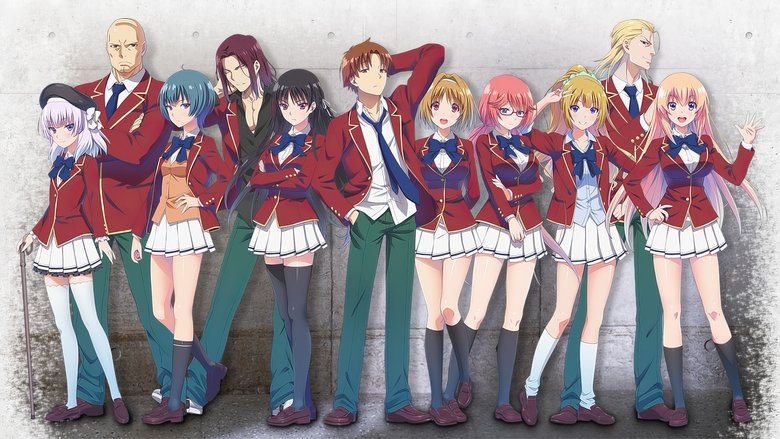

Classroom of the Elite
A psychological drama veiled in high school life, where intellectual warfare unfolds like a chilling, intricate chess game, leaving viewers questioning the very nature of merit and manipulation.
Classroom of the Elite

Classroom of the Elite

ようこそ実力至上主義の教室へ

12 July 2017 — 27 March 2024 Japan 4 season 39 episode Returning Series ⭐ 8.5 (721)
Cast: Shoya Chiba, Akari Kito, Ayana Taketatsu, Yurika Kubo, Mao Ichimichi
Drama Animation Mystery
Meritocracy and Social Darwinism Manipulation and Psychological Warfare The Nature of Equality Identity and The Mask of Conformity

Overview

"Classroom of the Elite" is set within the confines of the Tokyo Metropolitan Advanced Nurturing High School, a prestigious institution established by the Japanese government to cultivate the future leaders of the country. On the surface, it promises a perfect life with a 100% guarantee of employment or college admission, along with an incredible degree of freedom. However, this paradise is a facade for a ruthless meritocracy. Students are segregated into four classes, from A to D, in descending order of perceived merit. The story follows the unassuming but profoundly intelligent Kiyotaka Ayanokoji, who is placed in the lowest-ranked Class D, a dumping ground for the school's "defective" students.

Teaming up with the cold and ambitious Suzune Horikita and the seemingly friendly but two-faced Kikyo Kushida, Ayanokoji begins to operate from the shadows. The series chronicles Class D's struggle to climb the school's brutal social ladder. This involves a series of complex "Special Exams" that test not just academic knowledge but also psychological fortitude, strategic thinking, and the ability to manipulate peers and the system itself. Ayanokoji, hiding his true, formidable abilities, masterminds his class's victories while ensuring he remains an inconspicuous figure.

Across the seasons, the narrative expands beyond internal class struggles to intense rivalries with Class C's aggressive leader Kakeru Ryuen and Class A's intellectually superior Arisu Sakayanagi. The mysteries surrounding Ayanokoji's past in a secretive facility known as the "White Room" are slowly unraveled, revealing the source of his exceptional abilities and detached personality. The series is a continuous psychological battle where alliances are temporary, everyone has a hidden agenda, and the true meaning of winning is constantly questioned.


Core Meaning

The core meaning of "Classroom of the Elite" is a critical examination of the concepts of equality, meritocracy, and human nature within a highly competitive system. The series posits that true equality is a myth and that a society strictly based on merit can be brutal and dehumanizing. It explores the idea that a person's worth is not fixed but can be cultivated and proven through intellect, strategy, and even ruthless manipulation, questioning whether the ends justify the means. Through the protagonist, Kiyotaka Ayanokoji, the show delves into the 'nurture versus nature' debate, suggesting that an engineered, hyper-competitive environment can produce extraordinary—but emotionally detached—individuals. Ultimately, the series serves as a cynical allegory for real-world societal structures, arguing that in a world where winning is everything, people become mere tools for the ambitions of others.

Thematic DNA

Meritocracy and Social Darwinism 35%
Manipulation and Psychological Warfare 30%
The Nature of Equality 20%
Identity and The Mask of Conformity 15%

Meritocracy and Social Darwinism

The entire premise of the Advanced Nurturing High School is a grand experiment in meritocracy, where students' worth and privileges are dictated solely by their performance. The series relentlessly explores Social Darwinism, the idea of "survival of the fittest," through its class system and special exams. Class D is labeled as "defective," and its students must claw their way up by defeating other classes, demonstrating that in this system, the weak are exploited and discarded while the strong and cunning prevail. The point system, which equates to real-world money, reinforces the idea that everything, including success and status, can be bought and sold.

Manipulation and Psychological Warfare

At its heart, the series is a psychological thriller. The central conflicts are resolved not through physical strength but through intricate strategies, deception, and emotional manipulation. Ayanokoji is the master manipulator, viewing his classmates and even his teachers as tools to achieve his objectives while maintaining a facade of mediocrity. This theme is also explored through other characters like Ryuen, who uses fear and violence, and Sakayanagi, who uses intellectual dominance, creating a tense atmosphere where every interaction is a potential chess move.

The Nature of Equality

The series opens with Ayanokoji questioning the very concept of equality. The school's system is designed to prove that while students are given equal opportunities at the start, inherent differences in ability and determination will inevitably create a hierarchy. This theme is debated and explored throughout the series, challenging the idealistic notion that all humans are created equal. It suggests that inequality is a natural and perhaps necessary component of a competitive society.

Identity and The Mask of Conformity

Many characters wear social masks to hide their true selves and motivations. Kikyo Kushida is the prime example, presenting a cheerful and popular persona to conceal a deeply resentful and manipulative personality. Ayanokoji himself wears the most effective mask, feigning apathy and averageness to hide his prodigious talents. This theme explores the pressure to conform and the dual nature of identity in a society that judges individuals harshly, suggesting that one's public face is often a strategic tool for survival.

Character Analysis

Kiyotaka Ayanokoji

Shoya Chiba

Archetype: Antihero / The Mastermind
Key Trait: Cunning and Emotionally Detached

Motivation

His primary motivation is to live a normal, peaceful life away from his father and the White Room, the institution that made him who he is. However, a deeper motivation is to explore the world and understand human emotions, which he was never taught. He is also driven by a desire to win and prove that he is the ultimate masterpiece of the White Room, not for his father's sake, but to understand the meaning of his own existence and perhaps, to eventually be defeated.

Character Arc

Ayanokoji begins the series as a deliberately unremarkable and socially distant student, aiming for a peaceful school life. His arc is one of gradual revelation. Initially, he acts only to protect his quiet life, but as he is drawn into Class D's struggles, he reveals his true nature as a master manipulator forged in the 'White Room'. Across the seasons, his actions become more direct, culminating in a public display of his abilities during his confrontation with Ryuen. His goal evolves from simply experiencing a normal life to actively seeking to prove his father's ideology—that nurture can create perfection—is flawed, all while questioning if he can develop genuine human emotions.

Suzune Horikita

Akari Kito

Archetype: The Lancer / The Ambitious Loner
Key Trait: Intelligent and Independent

Motivation

Initially, her sole motivation is to reach Class A to earn recognition from her estranged older brother, the former Student Council President. As the series progresses, this motivation evolves. She develops a genuine sense of responsibility for Class D and a desire to prove their worth, not just for her own sake, but for the entire class. Her motivation shifts from a selfish ambition to a collective goal.

Character Arc

Suzune starts as a cold, arrogant, and isolated individual, obsessed with reaching Class A to gain the approval of her older brother, Manabu. She views her classmates as incompetent burdens. Her arc is a slow and arduous journey toward understanding the value of teamwork and trust. Initially a pawn in Ayanokoji's plans, she gradually grows into a true leader. She learns from her failures, begins to trust her classmates, and develops from a lone wolf into someone who can inspire and lead her class, stepping out of both her brother's and Ayanokoji's shadows.

Kikyo Kushida

Yurika Kubo

Archetype: The Shadow / The Two-Faced Friend
Key Trait: Deceptive and Popular

Motivation

Her core motivation is to maintain her popular and beloved public image at all costs. This stems from a traumatic past where her inability to keep secrets led to the destruction of her previous middle school class. She is driven by a deep-seated fear of her true, unpleasant personality being exposed and will do anything, including betraying her closest allies, to protect her facade.

Character Arc

Kushida presents herself as a universally loved, kind, and helpful girl whose dream is to be friends with everyone. However, this is a facade for a dark, manipulative, and hateful personality that despises being seen as anything less than perfect. Her arc revolves around her desperate attempts to get Horikita and Ayanokoji, who know her secret, expelled. She consistently betrays her class to achieve this goal. Her development is less about growth and more about the escalating consequences of her duplicity, showing how the obsession with maintaining a perfect image can lead to self-destruction.

Kei Karuizawa

Ayana Taketatsu

Archetype: The Damsel in Distress (initially) / The Confidante
Key Trait: Resilient and Loyal

Motivation

Her primary motivation at the start is survival and protecting herself from being bullied again. She clings to powerful classmates to ensure her safety. After Ayanokoji intervenes, her motivation shifts. She becomes fiercely loyal to him, driven by a desire to be useful to the person who saved her and gave her strength. This eventually evolves into genuine romantic love and a wish to stand by his side.

Character Arc

Kei is introduced as a superficial and somewhat arrogant girl, the leader of the girls in Class D. It is later revealed this persona is a defense mechanism to hide a past of severe bullying. Initially, she is a 'parasite' latched onto Hirata for protection. Ayanokoji systematically breaks down this defense, exposes her past, and then rebuilds her as his most loyal and important pawn, and later, his closest confidante. Her arc is one of the most significant, transforming from a fearful victim into a strong-willed individual who overcomes her trauma and develops genuine feelings for Ayanokoji, becoming the one person who truly understands him.

Symbols & Motifs

The White Room

Meaning:

The White Room symbolizes the pinnacle of the "nurture" argument in the nature vs. nurture debate. It represents an artificial, sterile environment designed to strip away all unnecessary humanity—emotions, leisure, social bonds—to create perfect, artificial geniuses. It is the source of Ayanokoji's immense abilities but also his profound emotional detachment, symbolizing a hollow form of perfection achieved at the cost of one's soul.

Context:

Initially hinted at through flashbacks and veiled conversations, the White Room becomes a central plot point in later seasons. It is revealed as a secret educational facility founded by Ayanokoji's father. Its existence explains Ayanokoji's superhuman intellect and physical prowess and serves as the primary motivation for his father's attempts to have him expelled and brought back. Characters like Arisu Sakayanagi have knowledge of it, creating a direct link between Ayanokoji's past and his present conflicts.

The Point System (S-System)

Meaning:

The point system, where class and personal points function as currency, symbolizes the commodification of merit and worth in a capitalist meritocracy. It represents the idea that in this society, anything and anyone can be bought, from test scores to the expulsion of a fellow student. It's a tangible measure of power and success, reducing complex human value to a simple numerical score.

Context:

The S-System is introduced in the very first episode when Class D discovers their initial 100,000 point allowance has dwindled to zero due to their poor behavior. Throughout the series, every special exam and conflict revolves around the acquisition or loss of these points, driving the students' actions and forcing them into morally ambiguous situations to secure their financial and social standing.

The School as a Chessboard

Meaning:

The school and its intricate rules are frequently depicted as a massive chessboard, with the students serving as pieces. This symbolizes the strategic and impersonal nature of the conflicts. It highlights Ayanokoji's worldview, where individuals are not people with feelings but "tools" or pawns to be moved and sacrificed for the ultimate goal of victory.

Context:

This metaphor is visually and thematically present throughout the series. Ayanokoji's internal monologues often frame his plans in terms of strategy and foresight, much like a chess grandmaster. The final exam of the third season, a direct one-on-one battle of wits between Ayanokoji and Sakayanagi, is explicitly referred to and structured like a chess match, solidifying this central symbol.

Memorable Quotes

All people are nothing but tools. It doesn't matter how it's done. It doesn't matter what needs to be sacrificed. In this world, winning is everything. As long as I win in the end... That's all that matters.

— Kiyotaka Ayanokoji

Context:

This is revealed at the very end of Season 1, Episode 12, after the conclusion of the island special exam. Ayanokoji, having masterminded Class D's victory from the shadows and given all the credit to Horikita, reflects on his actions and his core beliefs.

Meaning:

This quote, from an internal monologue, is the clearest and most shocking revelation of Ayanokoji's true philosophy. It confirms that his detached demeanor is not a quirk but the foundation of his worldview, shaped by the White Room. It establishes him as a true antihero and sets the cynical, pragmatic tone of the entire series.

Being alone is not synonymous with being lonely.

— Suzune Horikita

Context:

This is said in the early episodes of Season 1, during one of her initial conversations with Ayanokoji, where he questions her tendency to always be by herself and her refusal to make friends with her classmates.

Meaning:

This line perfectly encapsulates Suzune's early character. It is her justification for her self-imposed isolation. She sees solitude not as a weakness or a source of sadness, but as a state of independence and strength, free from the hindrance of others. It highlights her initial arrogance and belief that she can achieve everything by herself.

From where I stand, I'd say society is certainly not equal. Not one bit.

— Kiyotaka Ayanokoji

Context:

This is the very first line of the series, delivered by Ayanokoji as an internal monologue in Season 1, Episode 1, while he is on the bus heading to his new school.

Meaning:

This opening line of the series sets the central philosophical theme. It immediately challenges the common societal ideal of equality. It introduces the viewer to Ayanokoji's cynical and realistic perspective, framing the story that follows as an exploration of the inherent inequalities that define human competition and society.

Episode Highlights

What is evil? Whatever springs from weakness.

S1E3

This episode provides the first major plot twist of the series. While attempting to return her phone, Ayanokoji discovers Kikyo Kushida's true, hidden personality. He witnesses her drop her cheerful facade, revealing a vulgar and hateful side as she rants about Horikita. She then threatens to accuse him of assault to ensure his silence, revealing the dark undercurrents of the school.

Significance:

This episode is crucial as it shatters the illusion of a simple high school anime. It introduces the theme of hidden identities and manipulation, establishing that almost no character is what they seem. It marks the beginning of Ayanokoji's complex and cautious relationship with Kushida and highlights the potential dangers lurking beneath the surface of the school's social environment.

Genius lives only one story above madness.

S1E12

The climax of the island special exam. Class D appears to be in a losing position after Ibuki steals Horikita's leader card. Ayanokoji is forced to step up, manipulating events to secure victory by correctly guessing the leaders of all other classes. The episode ends with his iconic "All people are nothing but tools" monologue, revealing his true, cold-hearted nature to the audience for the first time.

Significance:

This episode fundamentally redefines the protagonist and the show's direction. It confirms that Ayanokoji is not a passive observer but the secret mastermind behind Class D's success. His final monologue is the series' most defining moment, establishing the core theme of manipulation and setting the stage for all future conflicts.

The greatest souls are capable of the greatest vices as well as of the greatest virtues.

S2E3

This episode focuses on the intense bullying of Kei Karuizawa by the girls from Class C. Ayanokoji watches impassively as the bullying escalates, using the situation to understand Kei's past trauma and psychological state. It's a difficult episode to watch, highlighting Ayanokoji's ruthless pragmatism as he allows someone to suffer for the sake of his long-term strategy.

Significance:

This is a pivotal moment for Kei's character arc and her relationship with Ayanokoji. It's the beginning of him breaking her down to rebuild her into a loyal ally. It showcases the moral ambiguity of Ayanokoji's methods in a stark and uncomfortable way, solidifying his antihero status.

Force without wisdom falls of its own weight.

S2E12

The long-awaited confrontation between Ayanokoji and Kakeru Ryuen. After Ryuen tortures Kei to lure out the mastermind, Ayanokoji appears on the rooftop. He single-handedly and brutally defeats Ryuen and his top lieutenants, revealing his immense physical prowess for the first time. He claims full responsibility for being the mastermind behind Class D's strategies, completely breaking Ryuen's spirit.

Significance:

Rated as one of the best episodes by fans, this is the climax of the first half of the series. Ayanokoji sheds his cover in a dramatic fashion, shifting the power dynamics of the school. It marks the end of his purely behind-the-scenes manipulations and establishes him as a known, formidable force, setting up new rivalries for the future.

The worst enemy you can meet will always be yourself.

S2E13

In the aftermath of the rooftop battle, Ayanokoji has a chance encounter with Class A's leader, Arisu Sakayanagi. In the post-credit scene, she reveals that she knows him from his past and refers to the "White Room," calling him its masterpiece. This conversation sets up their future intellectual rivalry.

Significance:

This episode officially introduces the mystery of the "White Room" into the main plot of the anime. It establishes Sakayanagi as a major antagonist who knows Ayanokoji's secrets, shifting the central conflict from a battle against Ryuen's brute force to a more intellectual and personal battle against Sakayanagi and Ayanokoji's own past.

Philosophical Questions

Are humans truly equal, or is inequality an inescapable fact of life?

The series constantly engages with this question. The school is a microcosm designed to prove that even with an equal starting point, differences in natural talent, ambition, and cunning will inevitably lead to a stratified hierarchy. Characters like Ayanokoji believe that equality is a comforting lie, while characters like Ichinose strive for a more cooperative and egalitarian existence, only to be challenged by the system's brutal realities.

Do the ends justify the means?

This is the central moral dilemma of the series. Ayanokoji operates on the principle that victory is the only thing that matters, justifying any and all manipulation, emotional cruelty, and sacrifice of his 'tools' (classmates) to achieve his goals. The series forces the audience to confront whether the success of the group (lifting Class D from failure) is worth the morally bankrupt methods employed to get there, leaving the question of whether Ayanokoji is a necessary evil or simply a monster unanswered.

What is the true measure of a person's worth?

The Advanced Nurturing High School attempts to quantify human worth through a point-based system derived from academic and strategic performance. However, the series challenges this by showing the limitations of such a metric. It explores whether worth comes from innate genius (like Sakayanagi), cultivated perfection (like Ayanokoji), collaborative spirit (like Ichinose), or the capacity for personal growth and overcoming flaws (like Horikita and Sudo).

Alternative Interpretations

One of the most debated aspects of the series is Ayanokoji's true nature and end goal. One interpretation is that he is a sociopath, a product of the dehumanizing White Room, who is incapable of genuine emotion and sees others only as tools for his amusement or objectives. Another perspective views him as a victim of profound psychological abuse who is secretly seeking connection and a way to become "human." His actions, in this light, are not purely malicious but a flawed attempt to understand the world he was denied.

Another area of interpretation is the series' message. Some see it as a critique of hyper-competitive, capitalist societies and flawed educational systems that prioritize results over well-being. Others interpret it as a more cynical, almost Nietzschean endorsement of individualism and the will to power, suggesting that true greatness requires transcending conventional morality. The ending of the anime's first year arc leaves it ambiguous whether Ayanokoji's ultimate goal is to validate his father's methods by winning, or to invalidate them by allowing himself to be defeated by a "natural" genius or a collective effort.

Cultural Impact

"Classroom of the Elite" has had a significant impact on the psychological thriller and "elite high school" genres within anime and light novels. Its release helped popularize narratives featuring hyper-intelligent, manipulative antihero protagonists who operate in morally grey areas. The series gained a substantial international following, particularly after its long-awaited second season, sparking widespread discussion on forums and social media about its complex themes and character psychologies.

Critically, the series is often praised for its intricate plotting and the character of Kiyotaka Ayanokoji, who stands in stark contrast to typical optimistic shonen protagonists. However, it has also drawn criticism for its cynical worldview and sometimes slow pacing, particularly in the first season. The audience reception has been largely positive, with viewers enjoying the strategic mind games and unpredictable plot twists. The series has contributed to a greater interest in light novels as source material and has solidified Studio Lerche's reputation for adapting psychological dramas. Its legacy lies in its challenging exploration of meritocracy and human nature, leaving a lasting impression on viewers who enjoy intellectually stimulating and morally ambiguous storytelling.

Audience Reception

The audience reception for "Classroom of the Elite" has been largely positive, though it evolved significantly over time. The first season was met with interest for its unique premise but was also criticized by some for its slow start and deviation from the light novel source material. The five-year gap between seasons created immense anticipation, and the release of Season 2 was met with widespread enthusiasm. Viewers praised the second and third seasons for their faster pace, higher stakes, and more faithful adaptation of the light novels, particularly the climactic confrontation between Ayanokoji and Ryuen. Ayanokoji is a consistently praised aspect of the series, with many fans captivated by his intelligence, ruthless nature, and mysterious past. Criticisms are often directed at the characterization of some female characters and the sometimes dense exposition of the special exam rules. Overall, the audience verdict is that it is a top-tier psychological thriller, with its popularity growing substantially with each new season.

Interesting Facts

  • The anime is based on a popular light novel series written by Shōgo Kinugasa and illustrated by Shunsaku Tomose.
  • The first season of the anime, which aired in 2017, was co-directed by Seiji Kishi and Hiroyuki Hashimoto, both known for their work on other popular anime.
  • There was a significant five-year gap between the release of Season 1 (2017) and Season 2 (2022), leading many fans to believe the anime would not continue.
  • The animation for all seasons has been handled by Studio Lerche.
  • Each episode title is a quote from a famous literary or philosophical work, such as those by Friedrich Nietzsche, François de La Rochefoucauld, and Dante Alighieri.
  • Due to controversial localization choices that omitted several paragraphs, the English publisher of the light novel, Seven Seas Entertainment, had to release a revised version of Volume 7.

⚠️ Spoiler Analysis

Click to reveal detailed analysis with spoilers

Frequently Asked Questions

Explore More About This Movie

Dive deeper into specific aspects of the movie with our detailed analysis pages

Comments (0)

Leave a comment

No comments yet. Be the first to share your thoughts!