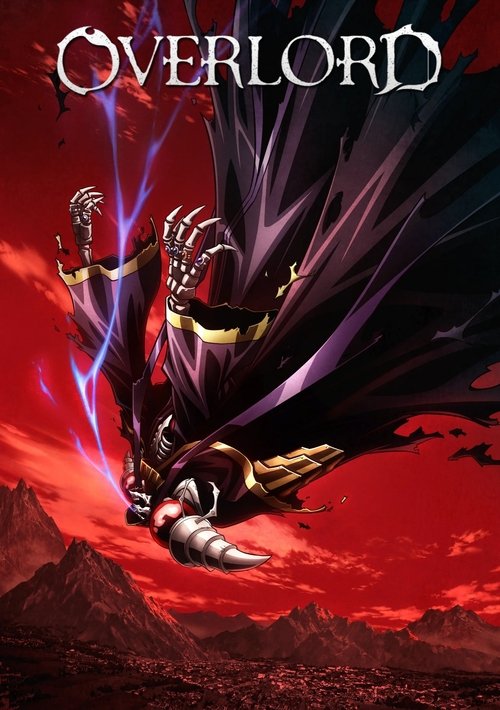
Overlord
オーバーロード
Overview
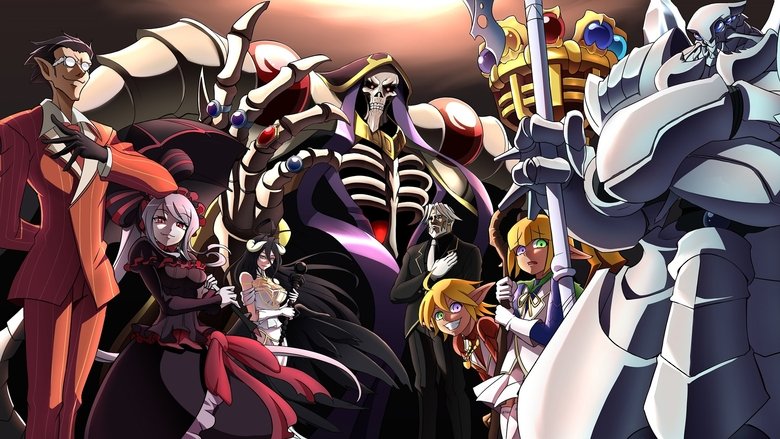
Overlord follows the story of a young salaryman, using the moniker Momonga, who is the guild master of Ainz Ooal Gown in the popular DMMO-RPG (Dive Massively Multiplayer Online Role Playing Game) Yggdrasil. On the day the game's servers are set to shut down permanently, he decides to stay logged in until the very end as a final farewell. However, when the clock strikes midnight, instead of being logged out, Momonga finds himself transported to a new reality that mirrors the game world. His guild's headquarters, the Great Tomb of Nazarick, and all its custom NPCs have come to life, viewing him as their supreme and infallible leader.
Adopting the name of his guild, Ainz Ooal Gown, to honor his former comrades and potentially find them if they too are in this world, he sets out to explore and understand this new reality. The series chronicles his journey from a cautious player trying to make sense of his situation to a powerful, calculating ruler. Across four seasons, Ainz navigates the complex politics of the new world, encountering kingdoms, adventurers, and powerful beings. He is forced to balance the human morality of his past self, Suzuki Satoru, with the emotion-suppressing nature of his undead avatar and the fanatical, often cruel, loyalty of his followers, leading him down a path of conquest and global domination that he never initially intended.
Core Meaning
The core meaning of "Overlord" revolves around an exploration of power, identity, and the loss of humanity. The series posits what happens when an ordinary person is granted absolute, god-like power without any genuine checks or balances. It examines how a person's morality and identity can shift and erode when they are placed in a position of supreme authority, surrounded by beings who worship them unconditionally. Ainz's journey is a tragicomedy; his internal monologue reveals a regular man struggling with imposter syndrome and loneliness, while his external actions, often born from misunderstandings by his powerful subordinates, lead to horrific acts of conquest and slaughter. Ultimately, the series serves as a dark satire on power fantasies and the isekai genre itself, suggesting that unchecked power doesn't lead to heroism but to an inescapable, lonely path of monstrous tyranny, driven by the simple desire to protect the memory of a cherished past.
Thematic DNA
The Nature and Corruption of Power
"Overlord" consistently explores how absolute power affects an individual and the world around them. Initially, Ainz uses his immense power cautiously, primarily for information gathering and self-preservation. As the series progresses and his subordinates push him towards grander ambitions, his use of power becomes more decisive and often brutal. The narrative questions whether power is inherently corrupting or if it simply reveals one's true nature. Ainz's actions, from saving a village to annihilating an entire army with a single spell, create a complex moral landscape where the ends often justify horrifying means in the eyes of his followers.
Loss of Humanity and Shifting Identity
A central theme is Ainz's gradual detachment from his human self, Suzuki Satoru. His undead nature includes an emotional suppression mechanic that nullifies strong feelings, pushing him towards cold, rational decision-making. This internal conflict is a constant throughout the series. He clings to memories of his human friends and guild, yet his actions become increasingly monstrous. The series suggests that identity is not static but is shaped by one's environment, form, and the expectations of others. Ainz is trapped between the man he was and the Overlord he has become.
Loneliness and the Search for Belonging
Despite being surrounded by fanatically loyal followers, Ainz is profoundly lonely. His subordinates, the NPCs, were created by his friends, and while they adore him, they cannot understand his human perspective or his deep sense of loss for his comrades. His entire quest to spread the name of Ainz Ooal Gown is rooted in the desperate hope of finding his old friends in this new world. This theme highlights the idea that one can be a supreme ruler and still feel utterly isolated, searching for a connection to a past that no longer exists.
Justice, Morality, and Perspective
The series consistently challenges traditional notions of good and evil. From the perspective of the inhabitants of the New World, Ainz and the forces of Nazarick are terrifying monsters bringing destruction. However, from Nazarick's viewpoint, their actions are justified to protect and elevate their supreme leader. Ainz himself grapples with moral dilemmas, but his undead nature and the influence of his amoral followers often lead him to commit acts that his human self would find abhorrent. The story presents a world where might makes right, and justice is merely the will of the strongest.
Character Analysis
Ainz Ooal Gown (Momonga)
Satoshi Hino
Motivation
Ainz's primary motivation is to find his former guildmates and protect the legacy they built together, the Great Tomb of Nazarick. This simple, nostalgic goal is misinterpreted by his followers as a desire for world conquest, a misunderstanding that Ainz feels pressured to fulfill. His motivation evolves from a personal quest into the burden of leading a rapidly expanding empire, all while trying not to disappoint his fanatically loyal 'children'.
Character Arc
Ainz's arc is one of transformation from a lonely, nostalgic gamer into a feared and worshipped ruler. In Season 1, he is cautious and reactive, primarily focused on understanding the new world. As the series progresses, he is forced by the expectations of his NPCs to adopt a more regal and decisive persona. He begins to strategically plan for conquest, though often his complex schemes are imagined by his much smarter subordinates like Demiurge and Albedo, and he is forced to play along. By Season 4, he has largely accepted his role as the Sorcerer King, capable of ordering the destruction of an entire kingdom with little outward emotional conflict, though his inner monologue reveals he is still just a man trying to live up to an impossible image.
Albedo
Yumi Hara
Motivation
Albedo's sole motivation is to serve and please Ainz Ooal Gown, whom she loves obsessively. Every action she takes, no matter how cruel or manipulative, is done with the belief that it is in Ainz's best interest and will further his glory. She also harbors a deep-seated hatred for the other Supreme Beings for 'abandoning' Ainz and Nazarick.
Character Arc
Albedo's arc is defined by her absolute, unwavering devotion to Ainz, a devotion born from a single line of altered text he input on a whim in the game's final moments. Initially, her character is defined by this obsessive love and her administrative role as the Guardian Overseer. Throughout the seasons, she develops into a cunning and ruthless political operative for Nazarick. She actively pushes the agenda of world domination and is utterly merciless to anyone who disrespects Ainz. Her arc shows her growing from a simple lovesick NPC into a primary driving force behind Nazarick's imperial ambitions.
Demiurge
Masayuki Katou
Motivation
Like Albedo, Demiurge is motivated by absolute loyalty to Ainz. However, his expression of this loyalty is through intellect and strategy. He believes Ainz to be an infallible super-genius and sees it as his duty to correctly interpret his master's 'grand plan' and bring it to fruition. He derives immense pleasure from seeing these complex, often cruel, plans succeed in the name of Ainz Ooal Gown.
Character Arc
Demiurge begins as one of Nazarick's most intelligent and cruel guardians. His arc doesn't involve personal change so much as the escalating scale of his schemes. He consistently misinterprets Ainz's simple, often accidental, comments as gestures of profound, galaxy-brain genius. This leads him to create elaborate, often horrific, plans for world domination that he believes are Ainz's true will. From orchestrating the demon invasion of the Re-Estize Kingdom in Season 2 to masterminding the subjugation of the Holy Kingdom, Demiurge's role expands as the primary architect of Nazarick's brutal expansion.
Shalltear Bloodfallen
Sumire Uesaka
Motivation
Shalltear is motivated by a desire to serve Ainz and a competitive drive to be seen as his most useful and beloved guardian. Her romantic feelings for Ainz create a rivalry with Albedo. After the brainwashing incident, her motivation is heavily colored by a need for redemption and to erase the shame of her failure, making her even more zealous in her duties.
Character Arc
Shalltear's primary arc occurs in Season 1. As one of the most powerful Floor Guardians, her initial role is to demonstrate the sheer strength of Nazarick's forces. Her arc takes a dramatic turn when she is brainwashed by a World Class Item from the Slane Theocracy. This forces Ainz into a life-or-death battle against his own 'child', a fight that deeply impacts him and shapes his future cautiousness. After her resurrection, she is plagued by guilt and a desperate need to prove her loyalty, adding a layer of tragic depth to her otherwise proud and flirtatious character.
Symbols & Motifs
The Name and Flag of Ainz Ooal Gown
The guild name and its flag symbolize Ainz's past, his connection to his friends, and his sole remaining purpose. It represents a legacy he feels compelled to uphold and a beacon in the dark, a desperate hope that by making the name famous, he might reunite with other players from Yggdrasil.
Ainz discards his original name, Momonga, and adopts the guild's name in Season 1. This act signifies his acceptance of his new role and his primary motivation. The flag is raised in conquered territories, not just as a symbol of domination, but as a constant, public call to any of his former friends who might be in this world.
The Great Tomb of Nazarick
Nazarick is more than just a fortress; it is a physical manifestation of the guild's collective effort and creativity. It symbolizes home, legacy, and the last remnant of the world Ainz lost. It is the one place where the memory of his friends feels tangible and alive through their creations, the NPCs.
Throughout the series, Ainz's top priority is the protection and preservation of Nazarick. His most extreme and violent actions are often motivated by perceived threats to the tomb or its inhabitants, such as the invasion by the workers in Season 3, which triggers his cold, unforgiving wrath.
Ainz's Undead Form (Skeleton)
His skeletal form symbolizes the death of his human self, Suzuki Satoru, and his emotional detachment. It's a constant visual reminder of his monstrous nature and his inability to feel strong emotions, which both helps and hinders his rule. It represents the ultimate loss of his humanity.
Ainz's physical form dictates many of his actions and interactions. His emotional suppression skill is frequently triggered, forcing him into a state of calm rationality even in moments of rage or potential panic. This is a recurring element from the very first episode when he realizes he is trapped.
Memorable Quotes
拍手喝采を、万雷の拍手を。我が至高なる力に喝采を
— Ainz Ooal Gown
Context:
This is said in Season 1, Episode 4, after Ainz effortlessly defeats the Sunlight Scripture using a super-tier magic spell, "Fallen Down." It is a chilling moment that demonstrates the insurmountable gap in power between Nazarick and the New World.
Meaning:
"Applause, a thunderous applause. Applaud my supreme power." This quote perfectly encapsulates Ainz's public persona as the Overlord. It's a declaration of absolute dominance and confidence that he must project to his followers and enemies, even if he internally feels insecure. It marks a moment of him fully embracing the role of the supreme being.
アインズ・ウール・ゴウンに敗北はない。あるいは、あってはならないのだ
— Ainz Ooal Gown
Context:
Ainz says this to himself during his intense battle with the brainwashed Shalltear at the end of Season 1 (Episode 13). He understands that losing, even once, could shatter the faith his guardians have in him as a Supreme Being.
Meaning:
"Ainz Ooal Gown does not know defeat. Or rather, it must not know defeat." This highlights the immense pressure Ainz is under. The name of his guild has become a symbol of absolute power, and he feels he must uphold this image at all costs, not for his own ego, but for the sake of his followers and the memory of his friends.
死は万人に与えられた救済だ。そして、その救済を与えるのが、この私だ
— Ainz Ooal Gown
Context:
This quote is from his confrontation with the worker group Foresight in the Tomb of Nazarick during Season 3, Episode 8 ("A Handful of Hope"). He says this before mercilessly dispatching them for trespassing, framing their deaths as a form of mercy in an unfair world.
Meaning:
"Death is salvation for all. And I am the one who grants that salvation." This quote reveals the darker, more philosophical side of Ainz's undead nature. In a world of inequality and suffering, he posits death as the ultimate equalizer. It reflects his detachment from human morality and his acceptance of his role as a god of death.
Episode Highlights
End and Beginning
The inaugural episode establishes the entire premise of the series. It introduces Momonga in the final moments of the Yggdrasil game, his loneliness, and his deep attachment to his guild. The moment the shutdown fails and the NPCs come to life is a masterclass in setting a tone of wonder mixed with underlying dread. Ainz's first interactions with the sentient Albedo and Sebas Tian set the stage for the power dynamics and misunderstandings that will drive the plot.
This episode is the cornerstone of the entire series. It lays the foundation for Ainz's character, his motivations, the fanatical loyalty of the NPCs, and the central mystery of how and why they were transported to the New World. It perfectly sets up the isekai genre subversion that defines 'Overlord'.
The Dark Warrior
Posing as the adventurer Momon, Ainz confronts the sadistic assassin Clementine. The episode showcases Ainz's tactical mind as he analyzes his opponent, but it culminates in a brutal display of his true power when he crushes her to death in a hug. This act solidifies his anti-hero status, demonstrating both his capacity for calculated violence and his growing detachment from human aversion to cruelty.
This episode is pivotal for establishing Ainz's dual identity and the moral ambiguity of his character. It shows that while he may be playing the part of a hero, he is fundamentally an undead monster with little empathy for those who threaten him or his goals.
Player VS Non Player Character
The finale of the first season features the climactic duel between Ainz and the brainwashed Shalltear. It's a highly strategic battle that pushes Ainz to his absolute limits, forcing him to use all his knowledge, cash shop items, and intellect to defeat a foe who is statistically his superior in a one-on-one fight. The fight is a spectacle of high-tier magic and tactics.
This fight is crucial for establishing the stakes of the series. It proves that despite his power, Ainz is not invincible and that threats exist which can challenge him. His victory, achieved through wit and preparation rather than raw power alone, reinforces his character as a strategist and solidifies the fanatical loyalty of the guardians who witness his 'wisdom' firsthand.
A Handful of Hope
Considered one of the darkest and best episodes, it follows a group of 'workers' (treasure-hunting mercenaries) who are tricked into raiding the Tomb of Nazarick. The episode builds empathy for the workers, only to have them brutally and systematically slaughtered by Nazarick's guardians. It culminates in Ainz's chilling confrontation with the last surviving group, where he delivers his iconic speech about death as the ultimate equalizer.
This episode is a turning point that fully cements Nazarick as a villainous force from an outside perspective. It removes any lingering doubts about the cruelty Ainz and his followers are capable of and serves as a brutal lesson about the new world order they intend to establish. It's a powerful showcase of the show's dark fantasy themes.
Massacre
This episode depicts the infamous Katze Plains battle between the forces of the Re-Estize Kingdom and the Baharuth Empire, with Ainz fighting for the Empire. After allowing 70,000 soldiers to gather, Ainz casts a single super-tier spell that summons five giant, eldritch goat-like beasts, which then proceed to slaughter the kingdom's army. The scene is one of pure, unadulterated horror and despair.
"Massacre" is the ultimate demonstration of Ainz's overwhelming power on a global scale. It's the moment he truly reveals himself to the world as a god-like being capable of apocalyptic destruction. This single act shatters the balance of power in the New World and paves the way for the establishment of his own nation, the Sorcerer Kingdom.
The Last King
This episode focuses on the human perspective of facing Ainz's wrath, specifically through the eyes of Prince Zanac of the Re-Estize Kingdom. Realizing the utter hopelessness of his kingdom's situation, Zanac chooses to meet with Ainz directly. Their conversation is a highlight, as Zanac's courage and pragmatism earn him Ainz's genuine respect. Zanac's subsequent assassination by his own nobles, who foolishly believe they can beg for mercy, enrages Ainz, who promises them a fate of suffering for their disrespect.
This episode is a masterclass in character development for a minor character and reinforces Ainz's core values. He respects strength and conviction, even in his enemies. Zanac's death is a tragic turning point that removes any chance of a merciful end for the Re-Estize Kingdom and shows that Ainz's anger is now directed not just at the kingdom, but at the 'weakness' of those who betray their own convictions.
Philosophical Questions
Does absolute power inevitably corrupt?
The series explores this question through its protagonist, Ainz. Initially, he is a regular person with a human conscience. However, his god-like power and the unconditional adoration of his followers slowly erode his human morality. His undead nature literally suppresses strong emotions, making it easier for him to commit atrocities. The series doesn't provide a definitive answer but suggests that power, combined with a loss of human connection and emotional capacity, creates a path where monstrous actions become logical and even necessary steps to achieve one's goals.
What defines 'humanity' or 'sentience'?
"Overlord" presents the NPCs of Nazarick, who were once simple game data, as fully sentient beings with complex emotions, ambitions, and unwavering loyalty. Ainz grapples with this, viewing them as the children of his lost friends. The series forces the audience to consider what makes a person 'real'. Are the NPCs less 'human' than the inhabitants of the New World, even though they are often more complex and driven? It blurs the line between artificial and natural life, suggesting that consciousness and emotion are the true markers of being, regardless of origin.
Is there such a thing as objective morality?
The narrative constantly shifts perspectives, showing that 'good' and 'evil' are often subjective. To the Lizardmen or the people of the Re-Estize Kingdom, Ainz is a force of pure evil. To the denizens of Nazarick, he is a benevolent, wise god, and their actions are righteous. The series avoids casting a final judgment, instead presenting a world where morality is defined by the powerful, and justice is simply the enforcement of their will.
Alternative Interpretations
One of the most popular alternative interpretations revolves around the true nature of Ainz Ooal Gown. One theory posits that the Ainz we follow is not the original player, Suzuki Satoru, but a perfect copy created by the game or a world-class item, complete with Satoru's memories. This would mean the real Satoru simply logged off and returned to his bleak life, making the entire story a tragedy of a copy who believes he is the original, forever cut off from a home that no longer exists for him. This interpretation adds another layer of existential dread to his character's loneliness.
Another common point of debate is whether Ainz is truly a villain or a tragic anti-hero. While his actions lead to mass death and suffering, they are often not born of malice but of ignorance, misunderstandings, and the pressure to live up to the persona his followers expect. This perspective frames him not as an evil overlord, but as a victim of circumstance, an ordinary man trapped in the role of a monster, making his story a dark comedy of errors with catastrophic consequences.
Cultural Impact
"Overlord" made a significant impact on the isekai (another world) genre of anime. Premiering in 2015, it came at a time when the genre was saturated with stories about heroic protagonists gaining immense power. "Overlord" subverted this trope by presenting a protagonist who is not a hero but an anti-hero or an outright villain from the perspective of the new world's inhabitants. This dark fantasy approach, focusing on world-building from the conqueror's point of view, was a refreshing change that influenced subsequent isekai series to explore more morally ambiguous or villainous protagonists.
Critically, the series has been praised for its detailed world-building, strategic depth, and exploration of complex themes like power and morality. However, it has also faced criticism, particularly in later seasons, for its reliance on CGI for large army battles, which some viewers found jarring compared to the traditional animation. Audience reception has been largely positive, with a strong and dedicated fanbase. Each season was highly anticipated, and the show's popularity helped to significantly boost sales of the original light novels. The series stands out by showing the brutal and logical consequences of a supremely powerful being's actions, resonating with viewers who appreciate a more mature and less idealistic narrative. Its legacy is that of a genre-defining isekai that demonstrated the appeal of a dark, morally complex narrative focused on conquest rather than heroism.
Audience Reception
"Overlord" has been met with widespread popularity and a generally positive reception from audiences since its debut in 2015. Viewers have consistently praised its unique premise, which subverts traditional isekai tropes by focusing on a powerful, non-human protagonist and his perspective as a conqueror. The intricate world-building and the strategic elements of Ainz's plans are often cited as major strengths. Season 1 was highly acclaimed for setting the stage and introducing the complex dynamics within Nazarick. Seasons 2 and 3 were also well-received for expanding the world, though they drew some criticism for shifting focus to side characters in the New World, which some viewers felt slowed the pacing. Season 3's dark and brutal episodes, particularly "A Handful of Hope" and "Massacre," are often regarded as highlights of the entire series for their unflinching depiction of Nazarick's power. The primary point of criticism throughout the series has been the quality of the CGI animation, especially for large armies and monsters, which fans felt did not live up to the standards of Studio Madhouse. Despite this, the audience's opinion has remained largely favorable across all four seasons, with fans appreciating the series' consistent tone, dark humor, and mature storytelling.
Interesting Facts
- The author, Kugane Maruyama, originally began writing 'Overlord' as a web novel in 2010 on the Japanese novel-hosting website Arcadia.
- Maruyama is a known fan of tabletop role-playing games like Dungeons & Dragons, which heavily influenced the world-building, class systems, and magic in Overlord.
- The anime is produced by the renowned studio Madhouse, famous for other acclaimed series like 'Death Note', 'One-Punch Man', and 'Hunter x Hunter' (2011).
- The author once expressed frustration over illegal fan translations, stating that it drained his motivation and made him consider ending the light novel series earlier than originally planned, at volume 17 instead of 18.
- The musical artists OxT and Myth & Roid have provided the opening and ending themes for all four seasons of the anime, creating a consistent musical identity for the series.
⚠️ Spoiler Analysis
Click to reveal detailed analysis with spoilers
Frequently Asked Questions
Explore More About This Movie
Dive deeper into specific aspects of the movie with our detailed analysis pages
Comments (0)
No comments yet. Be the first to share your thoughts!