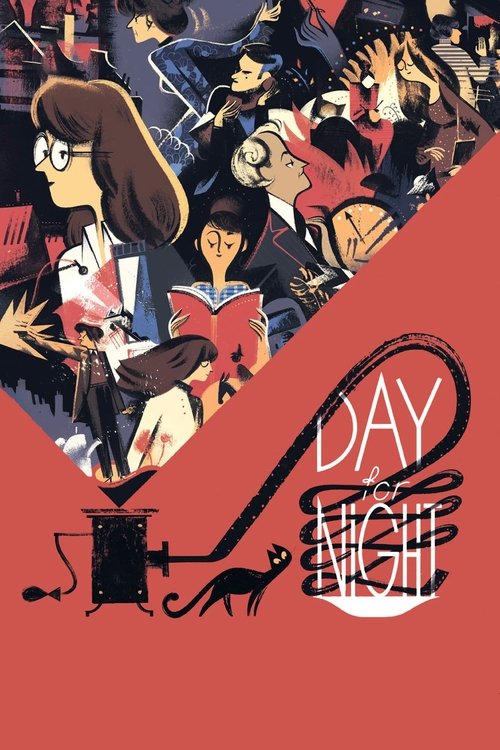
Day for Night
A radiant love letter to the chaos and magic of filmmaking. It captures the ephemeral family of a movie set, blending the agony of creation with the joy of illusion through a lens of affectionate realism.
Day for Night

Day for Night

La Nuit américaine

"A movie for people who love movies."

24 May 1973 France 116 min ⭐ 7.8 (637)
Director: François Truffaut
Cast: Jacqueline Bisset, Valentina Cortese, Dani, Alexandra Stewart, Jean-Pierre Aumont
Drama Comedy
Cinema vs. Reality The Film Crew as a Temporary Family The Fragility of Creation Obsession and Sacrifice
Budget: $700,000
Box Office: $850,000

Overview

Day for Night (La Nuit américaine) chronicles the turbulent production of a melodramatic film titled Je vous présente Paméla (Meet Pamela) at the Victorine Studios in Nice. The story unfolds through the eyes of the director, Ferrand, who must navigate a myriad of personal and professional crises to keep the production afloat. From an aging diva who forgets her lines to a heartbroken young lead actor threatening to quit, the film exposes the fragile machinery behind the glossy facade of cinema.

As the shooting schedule progresses, the lines between the actors' real lives and their on-screen roles begin to blur. Affairs ignite, secrets are revealed, and a tragedy strikes the cast, forcing the crew to scramble for creative solutions. Through it all, the temporary community of the film set functions as a dysfunctional but tightly knit family, united by the singular, driving obsession to finish the movie before time and money run out.
Core Meaning

At its heart, Day for Night is an exploration of the dichotomy between art and life. Truffaut posits that for filmmakers, the creation of cinema is often more vivid, structured, and manageable than the messy reality of existence. The film serves as a defense of the "family" of the crew and the collective effort required to create illusions. It argues that while movies may be artificial (like the "Day for Night" technique itself), the emotions and dedication poured into them are profoundly real.

Thematic DNA

Cinema vs. Reality 30%
The Film Crew as a Temporary Family 25%
The Fragility of Creation 25%
Obsession and Sacrifice 20%

Cinema vs. Reality

The film constantly contrasts the controlled environment of the movie set with the chaotic personal lives of the cast. Ferrand famously states, "Movies go along like trains in the night," suggesting that filmmaking offers a direction and purpose that life often lacks.

The Film Crew as a Temporary Family

Truffaut depicts the intense, ephemeral bond that forms among a cast and crew. They live, eat, and sleep together, sharing intimate moments and crises, only to disperse completely once the production wraps, highlighting the transient nature of these intense relationships.

The Fragility of Creation

The plot emphasizes how easily a film can fall apart due to technical failures, emotional breakdowns, or death. It demystifies the artistic process, showing it not as a stroke of genius, but as a series of solved problems and compromises.

Obsession and Sacrifice

Characters like Joëlle and Ferrand prioritize the film above all else. This theme is encapsulated in the sentiment that personal happiness is secondary to the work, asking the question of what is sacrificed for the sake of art.

Character Analysis

Ferrand

François Truffaut

Archetype: The Orchestrator / The Alter Ego
Key Trait: Calm under pressure

Motivation

To finish the film Je vous présente Paméla at all costs and to serve the art form he loves.

Character Arc

Ferrand remains the stable center of the storm. He starts with a vision, navigates the endless stream of questions and crises, and successfully steers the "ship" to port. His journey is one of endurance rather than transformation.

Julie Baker

Jacqueline Bisset

Archetype: The Fragile Star
Key Trait: Vulnerable beauty

Motivation

To prove she can still work and to maintain her professional reputation despite her personal instability.

Character Arc

She arrives fragile and recovering from a breakdown, carrying the weight of the production's success. She navigates a complex emotional landscape, including a compassionate tryst with Alphonse, and finishes the film stronger and more grounded.

Alphonse

Jean-Pierre Léaud

Archetype: The Man-Child / The Romantic
Key Trait: Impulsive emotionality

Motivation

To be loved and to find romantic validation, often blurring his real feelings with his dramatic roles.

Character Arc

Alphonse is driven by his volatile emotions. He goes from being heartbroken over a breakup to infatuated with Julie, threatening the production with his immaturity. He ends the film somewhat matured but still essentially a child of the cinema.

Séverine

Valentina Cortese

Archetype: The Fading Diva
Key Trait: Dramatic insecurity

Motivation

To remain relevant and to hide her insecurities and fading memory.

Character Arc

She struggles with aging, alcoholism, and forgetting her lines, representing the tragedy of a star past her prime. She finds dignity in her performance despite her chaotic methods.

Alexandre

Jean-Pierre Aumont

Archetype: The Veteran Mentor
Key Trait: Professional grace

Motivation

To be the consummate professional and protect his private life (implied closeted homosexuality).

Character Arc

He serves as the grounding force and reliable professional. His arc is tragic; he dies in a car accident before the film is finished, forcing the narrative to adapt to his absence.

Symbols & Motifs

The "Day for Night" Filter

Meaning:

It symbolizes the illusion of cinema. Just as a filter can turn bright daylight into artificial darkness, filmmaking transforms the mundane reality of actors and sets into a cohesive, emotional narrative.

Context:

The title itself refers to this technique (nuit américaine). It is explicitly explained during a scene where a car crash is filmed in broad daylight but will appear as night on screen.

The Recurring Dream

Meaning:

Represents the pure, childhood obsession with cinema. It connects the adult director's professional struggles with his original, innocent love for the medium.

Context:

Ferrand has a recurring black-and-white dream where, as a young boy, he steals publicity stills of Citizen Kane from a movie theater grate.

The Vase of Flowers

Meaning:

Symbolizes continuity and the persistence of the filmic reality over actual time. It shows the meticulous attention to detail required to maintain the illusion.

Context:

A prop vase is moved from one spot to another to match a shot filmed days or weeks earlier, highlighting the disjointed nature of shooting schedules.

The Cat

Meaning:

Represents the uncontrollable nature of reality that directors try to tame. It serves as a humorous counterpoint to the director's desire for total control.

Context:

A scene requires a kitten to eat from a tray, but the cat refuses to cooperate, forcing the crew to try multiple cats until one finally performs the "role" correctly.

Memorable Quotes

Movies go along like trains in the night.

— Ferrand

Context:

Ferrand is consoling Alphonse, explaining why people like them are only happy in their work and how life is full of "traffic jams" unlike movies.

Meaning:

This quote encapsulates the film's central philosophy: cinema has a momentum and destiny of its own, often smoother and more logical than the chaos of real life.

I'd drop a guy for a film. I'd never drop a film for a guy.

— Joëlle

Context:

Joëlle says this after the script girl, Liliane, runs off with a stuntman, abandoning the production.

Meaning:

Highlights the intense dedication and skewed priorities of the film crew. For the "techs," the work is sacred and takes precedence over personal relationships.

Shooting a movie is like a stagecoach ride in the old west. When you start, you are hoping for a pleasant trip. By the halfway point, you just hope to survive.

— Ferrand

Context:

Ferrand's voiceover narration reflecting on the mounting difficulties of the production.

Meaning:

A perfect metaphor for the filmmaking process, moving from artistic ambition to pure survival instinct as problems pile up.

Are women magic?

— Alphonse

Context:

Alphonse asks this repeatedly, specifically to Ferrand, seeking an answer to his romantic woes.

Meaning:

Reveals Alphonse's naive and romanticized view of women, underscoring his immaturity and confusion about real-world relationships.

In 80 movies I've died 24 times; electrocuted twice, hanged twice... but never a natural death.

— Alexandre

Context:

Alexandre discussing his career and the nature of screen acting with fellow cast members.

Meaning:

A meta-commentary on the dramatic nature of film roles versus the banality of real death, foreshadowing his own accidental death later in the film.

Philosophical Questions

Is art more important than life?

The film asks whether the sacrifice of personal relationships and stability is worth the creation of a fleeting illusion. Characters repeatedly choose the film over their personal well-being, suggesting a worldview where art is the only ordering principle in a chaotic universe.

What is the nature of truth in cinema?

Through the 'Day for Night' technique and the constant faking of doors, snow, and views, the film explores how 'truth' in art is constructed entirely of lies. It questions whether the emotional truth of a scene validates the artificial means used to create it.

Alternative Interpretations

While most view the film as a loving tribute, a Marxist/Godardian interpretation sees it as a deceptive fantasy. Critics like Godard argued that Truffaut hid the class struggle of the set—the conflict between the investors, the director, and the lowly crew members—presenting instead a false 'happy family' narrative.

Another reading focuses on Ferrand as a tragic figure. While he succeeds in making the film, he is portrayed as a man who can only connect with others through the medium of cinema, unable to function in the 'real world' without a script or a camera to mediate his existence. The film Je vous présente Paméla itself is often interpreted as deliberately mediocre, suggesting that the process of making art is more noble than the potentially kitschy result.

Cultural Impact

Day for Night is widely considered the definitive film about filmmaking. Upon its release, it was a critical and commercial success, winning the Oscar for Best Foreign Language Film and the BAFTA for Best Film. It solidified Truffaut's reputation in the US as the face of French cinema.

However, its most significant cultural footprint is the destruction of the friendship between Truffaut and Jean-Luc Godard. Godard viewed the film as a bourgeois lie that ignored the political and economic realities of cinema, marking the symbolic end of the unified French New Wave. Despite this, the film has influenced generations of filmmakers, with echoes seen in movies like Boogie Nights, Living in Oblivion, and Ed Wood, establishing the 'mockumentary' style of behind-the-scenes drama.

Audience Reception

Audience reception has been overwhelmingly positive for decades. Viewers praise the film's warmth, humor, and accessibility, often citing it as the perfect entry point into French cinema. The character of Séverine is frequently singled out as a highlight.

Criticism is rare but usually aligns with the Godardian view: some modern viewers find the film too sentimental or the film-within-a-film (Je vous présente Paméla) too melodramatic and dated to be taken seriously as a 'high stakes' project. However, the consensus remains that it is a masterpiece of meta-cinema.

Interesting Facts

  • The film caused a permanent rift between François Truffaut and Jean-Luc Godard; Godard wrote a letter calling Truffaut a liar and a sellout, leading Truffaut to never speak to him again.
  • François Truffaut plays the director Ferrand, effectively directing a film within a film while directing the actual film.
  • The film is dedicated to silent screen legends Lillian and Dorothy Gish.
  • The character of Séverine (Valentina Cortese) was based on Cortese's own behavior during the filming, including her drinking and improvisation.
  • It won the Academy Award for Best Foreign Language Film in 1974.
  • The insurance company in the film is real; Truffaut used the actual concerns of insurers regarding the cast's health.
  • Graham Greene has a cameo as an insurance agent, though he is uncredited and allegedly Truffaut didn't realize it was him at the time.
  • The film was shot at the Victorine Studios in Nice, the same location where 'Children of Paradise' was filmed.

Easter Eggs

Citizen Kane Stills

In Ferrand's dream, he steals photos of Citizen Kane. This references Truffaut's own deep admiration for Orson Welles and the film that inspired him to become a director.

Book Package

Ferrand receives a package of books about directors like Hitchcock, Godard, Buñuel, and Bresson. This is a direct nod to the 'Cahiers du Cinéma' critics and Truffaut's own roots as a critic.

Séverine's 'Numbers' Technique

Séverine suggests counting numbers instead of saying lines, referencing Federico Fellini's method (specifically in ), acknowledging the different styles of European filmmaking.

Jeanne Moreau Reference

A character mentions that Jeanne Moreau has asked for the script. Moreau starred in Truffaut's masterpiece Jules and Jim, linking the fictional world back to Truffaut's real filmography.

⚠️ Spoiler Analysis

Click to reveal detailed analysis with spoilers

Frequently Asked Questions

Explore More About This Movie

Dive deeper into specific aspects of the movie with our detailed analysis pages

Comments (0)

Leave a comment

No comments yet. Be the first to share your thoughts!