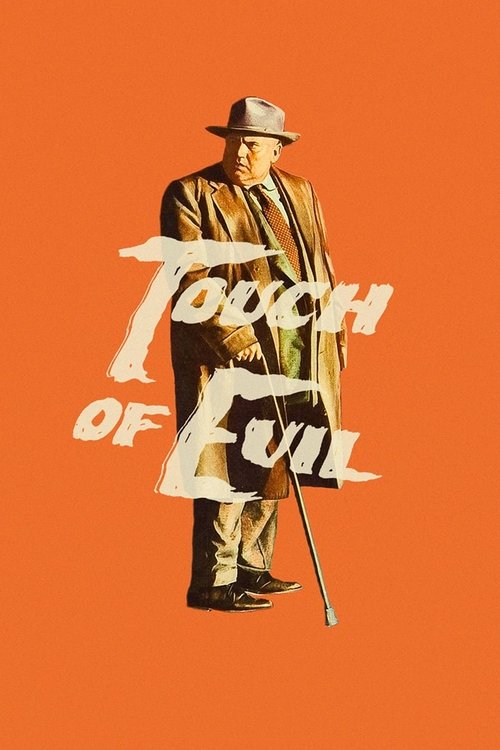
Touch of Evil
"The strangest vengeance ever planned!"
Overview
In a seedy town straddling the U.S.-Mexico border, a car bomb kills a wealthy American businessman, igniting a tense jurisdictional clash. Mexican narcotics agent Mike Vargas, on his honeymoon with his American wife Susie, finds himself pitted against the local police captain, Hank Quinlan. Quinlan is a celebrated, hulking figure with a reputation for intuition, but Vargas suspects his methods rely on planting evidence to secure convictions.
As Vargas delves deeper into Quinlan's past to expose his corruption, Quinlan retaliates by conspiring with a local crime family to frame Susie for drug use and murder. The investigation descends into a labyrinth of betrayal and moral decay, culminating in a tragic confrontation where loyalties are shattered and the line between the law and true justice is irrevocably blurred.
Core Meaning
The Death of the Old World: Touch of Evil functions as a tombstone for the classic film noir era. Orson Welles presents a world where the romanticized, intuitive "hero" cop (Quinlan) is revealed to be a corrupt monster, yet he possesses a tragic humanity that the righteous, modern bureaucrat (Vargas) lacks. The film questions whether the cold letter of the law is superior to a flawed human instinct, ultimately concluding that corruption, no matter how effective, poisons everything it touches.
Thematic DNA
Justice vs. The Law
The film presents a dialectical conflict between Quinlan's result-oriented policing (planting evidence to convict the "guilty") and Vargas's strict adherence to procedural law. It asks whether a guilty man deserves to be framed to ensure he is punished, and the corrosive cost of such vigilante justice.
Corruption and Moral Decay
Corruption is not just a plot point but a physical presence in the film, embodied by the rotting garbage, the grimy streets, and Quinlan's own decaying, bloated body. It spreads like a virus, infecting even the innocent (Susie) and the loyal (Menzies).
Racism and Border Politics
The U.S.-Mexico border serves as a metaphor for moral ambiguity. The film starkly depicts the casual racism directed at Vargas and the Mexican citizenry by the American police force, highlighting the power dynamics and prejudices inherent in the borderland setting.
Obsession and Hubris
Both protagonists are driven by obsession: Vargas by his need for absolute truth and vindication, and Quinlan by his need to maintain his infallible reputation and control. This mutual obsession leads to the destruction of those around them.
Character Analysis
Hank Quinlan
Orson Welles
Motivation
To punish the guilty at any cost, driven by the unresolved trauma of his wife's murder years ago, which left him with a pathological need to ensure no criminal escapes.
Character Arc
A celebrated captain who falls from power as his corrupt methods are exposed. He moves from being the town's unchallenged patriarch to a desperate, lonely murderer, ultimately killed by his best friend.
Mike Vargas
Charlton Heston
Motivation
To uphold the rule of law and protect his reputation and wife from the corrupt machinery of the local police.
Character Arc
A righteous government agent who starts as an observer but becomes a vengeful obsessionist. While he vindicates the law, he loses his composure and nearly his wife in the process.
Pete Menzies
Joseph Calleia
Motivation
Loyalty to Quinlan, which is eventually superseded by a realization of Quinlan's true monstrosity.
Character Arc
Quinlan's fiercely loyal partner who faces a crisis of conscience. He tragically evolves from a blind follower to the instrument of Quinlan's destruction, sacrificing his life for the truth.
Tanya
Marlene Dietrich
Motivation
To survive in the shadows and speak the hard truths that others ignore.
Character Arc
A static observer who provides the emotional epitaph for Quinlan. She represents a bygone era and sees through Quinlan's bluster to his tragic end.
Symbols & Motifs
The Ticking Bomb
Symbolizes inevitable doom and the destabilization of order. It represents the explosive consequences of corruption that lurk beneath the surface of the town.
Used in the famous opening tracking shot, the bomb's ticking creates immediate tension and sets the fatalistic tone for the entire narrative.
Quinlan's Cane
Represents Quinlan's power and his crutch—both physical and psychological. It is a phallic symbol of authority that he leaves behind at the scene of his crime, ultimately implicating him.
Quinlan forgets his cane in the hotel room where he murders Uncle Joe Grandi, a slip that allows Menzies to realize his mentor's guilt.
The Audio Recorder
Symbolizes the objective truth and modern surveillance technology that dismantles Quinlan's old-world intuition and lies.
Vargas uses the wire on Menzies to capture Quinlan's confession during the final stalking sequence across the bridge.
The Border
A liminal space where jurisdictions and moralities blur. It represents the arbitrary lines men draw to define 'us' vs. 'them' and 'good' vs. 'evil'.
The characters constantly cross the physical border between the U.S. and Mexico, mirroring their crossing of moral lines.
Memorable Quotes
He was some kind of a man. What does it matter what you say about people?
— Tanya
Context:
Spoken by Tanya to Schwartz after Quinlan's body is found in the polluted river.
Meaning:
The film's final line, serving as a complex eulogy. It acknowledges Quinlan's humanity and flawed greatness without excusing his crimes. It suggests that human existence is too complex for simple moral labels.
Your future is all used up.
— Tanya
Context:
Quinlan asks Tanya to read his fortune/cards when he visits her brothel, seeking comfort.
Meaning:
A fatalistic prediction that highlights the theme of inevitable doom. Quinlan belongs to a past era of policing and has no place in the modern world.
I don't speak Mexican.
— Hank Quinlan
Context:
Said dismissively to Vargas during their first confrontation at the scene of the bombing.
Meaning:
Illustrates Quinlan's overt racism and dismissal of Vargas, establishing the cultural conflict immediately.
A policeman's job is only easy in a police state.
— Mike Vargas
Context:
Vargas lecturing Quinlan on the importance of evidence and procedure.
Meaning:
The film's thesis statement on democracy and law. It underscores the difficulty and necessity of due process over convenient tyranny.
Philosophical Questions
Do the ends justify the means?
The film challenges the viewer with the fact that Quinlan framed a man who actually committed the crime. Does the fact that the 'bad guy' was caught excuse the corruption used to catch him? Welles suggests that the process of justice is as important as the outcome.
Can authority exist without corruption?
Quinlan believes that honest police work is impossible in a chaotic world ('easy only in a police state'). The film explores whether absolute power inevitably rots the holder, physically and morally.
Alternative Interpretations
Quinlan as the Tragic Hero: While ostensibly the villain, some critics view Quinlan as the film's true protagonist—a tragic figure whose 'intuition' was actually a supernatural talent for spotting guilt. The irony that he framed a guilty man suggests his instincts were correct, even if his methods were criminal.
The Failure of Modern Law: Another reading suggests the film is cynical about modern justice (represented by Vargas). Vargas's intervention destroys the town's equilibrium and leads to multiple deaths, whereas Quinlan's corrupt order kept the peace. In this view, Vargas is an agent of sterile chaos.
Cultural Impact
Touch of Evil is widely considered the epitaph of the classic film noir era. Upon its release, it was ignored in America but celebrated by French critics at Cahiers du Cinéma (including Truffaut and Godard), who hailed Welles's visual inventiveness. It influenced the French New Wave with its handheld camerawork and fluid long takes. Today, it is studied for its mastery of deep focus, its complex sound design (overlapping dialogue), and its preservation in the National Film Registry. The 1998 'Restored Version' serves as a landmark case study in film preservation and the importance of directorial vision.
Audience Reception
Classic Status: Modern audiences and critics universally praise the film as a masterpiece, citing the cinematography, Welles's performance, and the atmosphere as highlights. It holds a very high rating on aggregators like Rotten Tomatoes.
Criticisms: Some modern viewers critique the casting of Charlton Heston as a Mexican character ('brownface') as dated and distracting. The plot is sometimes described as convoluted or hard to follow in the theatrical cut.
Verdict: A definitive classic that requires viewing the 1998 restored version to be fully appreciated.
Interesting Facts
- The famous opening tracking shot lasts 3 minutes and 20 seconds and was the last shot of the night; dawn was actually breaking in the background.
- Charlton Heston was responsible for Orson Welles directing the film; he told the studio he would only star if Welles (who was already cast as the villain) also directed.
- Janet Leigh had a broken arm during much of the filming, which Welles cleverly hid using camera angles and props.
- Orson Welles wrote a furious 58-page memo to Universal Studios detailing how they had butchered his edit; this memo was used in 1998 to restore the film.
- The film was a box office failure in the US and was released as a B-movie double feature, but it won the top prize at the 1958 Brussels World Film Festival.
- Orson Welles wore a padded suit and heavy makeup to look older and heavier, adding 60 pounds to his frame to play the bloated Quinlan.
- The character of the 'Night Man' at the motel was improvised by actor Dennis Weaver and Welles on set.
- Henry Mancini composed the score, which was one of the first movie scores to use rock and roll and Latin jazz influences to create a 'source music' feel.
Easter Eggs
Joseph Cotten's Cameo
Orson Welles's longtime friend and collaborator (from Citizen Kane) appears uncredited as the detective/coroner in the opening bombing scene.
Mercedes McCambridge as a Hoodlum
The Oscar-winning actress plays a bizarre, uncredited role as a leather-jacketed gang member who taunts Janet Leigh, shouting 'I wanna watch!'
Zsa Zsa Gabor's Appearance
Famous socialite Zsa Zsa Gabor appears briefly as the owner of the strip club, sharing a 'Guest Star' credit with Marlene Dietrich despite having only a few seconds of screen time.
Venice, California as Mexico
The film was shot in Venice, California. The 'Bridge of Sighs' seen in the film is a real location there, used to stand in for the border town's architecture.
⚠️ Spoiler Analysis
Click to reveal detailed analysis with spoilers
Frequently Asked Questions
Explore More About This Movie
Dive deeper into specific aspects of the movie with our detailed analysis pages
Comments (0)
No comments yet. Be the first to share your thoughts!