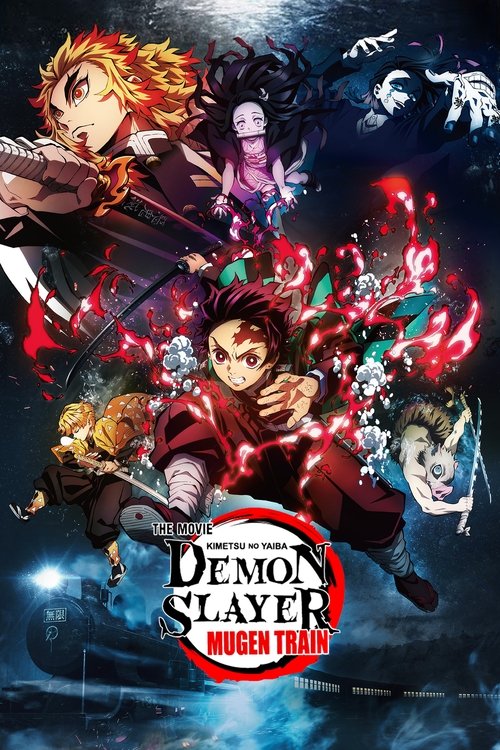
Demon Slayer -Kimetsu no Yaiba- The Movie: Mugen Train
A heart-pounding action epic where the vibrant agony of dreams bleeds into a high-speed battle for the soul, all illuminated by a fleeting, brilliant flame.
Demon Slayer -Kimetsu no Yaiba- The Movie: Mugen Train

Demon Slayer -Kimetsu no Yaiba- The Movie: Mugen Train

劇場版「鬼滅の刃」無限列車編

"With your blade, bring an end to the nightmare."

16 October 2020 Japan 117 min ⭐ 8.2 (4,262)
Director: Haruo Sotozaki
Cast: Natsuki Hanae, Akari Kito, Hiro Shimono, Yoshitsugu Matsuoka, Satoshi Hino
Animation Fantasy Action Thriller
The Strength of the Human Spirit The Acceptance of Mortality Duty and Sacrifice Coming to Terms with Loss
Budget: $15,700,000
Box Office: $523,542,183

Overview

Following the events of the first season of the anime, Tanjiro Kamado, his demon sister Nezuko, and his comrades Zenitsu Agatsuma and Inosuke Hashibira board the Mugen Train. Their mission is to assist one of the most powerful members of the Demon Slayer Corps, the Flame Hashira Kyojuro Rengoku, in investigating a series of mysterious disappearances that have plagued the train.

Soon after embarking, the group falls into a deep slumber, manipulated by Enmu, the Lower Rank One of the Twelve Kizuki, who can control dreams. Each slayer is trapped within an idealized version of their past or desires, designed to break their spirit. Tanjiro finds himself reunited with his deceased family, a peaceful existence he must tragically reject to face reality. With Nezuko's help, the slayers must awaken and fight back, not only against Enmu's psychological warfare but against the demon who has physically fused himself with the entire train, turning it into a monstrous deathtrap for its 200 passengers.


Core Meaning

The core message of "Mugen Train" revolves around the profound strength of the human will and the beautiful, tragic impermanence of life. The film posits that true strength lies not in physical power or immortality, but in the unwavering resolve to protect others and uphold one's duty, even in the face of insurmountable odds and certain death. It explores the idea that the very finiteness of human life—the fact that we age and die—is what makes it precious and noble. Kyojuro Rengoku's character arc is the primary vessel for this message, as he chooses his mortal duty over the temptation of demonic immortality, leaving a lasting legacy that inspires the younger generation to "set their hearts ablaze" and persevere through loss.

Thematic DNA

The Strength of the Human Spirit 35%
The Acceptance of Mortality 30%
Duty and Sacrifice 25%
Coming to Terms with Loss 10%

The Strength of the Human Spirit

The film consistently emphasizes that a human's will is their greatest weapon, something demons can never truly crush. This is shown through Tanjiro's painful but necessary decision to escape his perfect dream by repeatedly killing himself within it, and Kyojuro's refusal to yield to Akaza despite fatal injuries. The Demon Slayer Corps itself, as stated by their leader Kagaya Ubuyashiki, will always rise to fight again, no matter how battered they become, embodying the theme of relentless perseverance.

The Acceptance of Mortality

The central philosophical conflict of the film is presented during the final battle between Rengoku and Akaza. Akaza, a demon, argues for the perfection of immortality, seeing the decay of the human body as a weakness. Rengoku powerfully refutes this, stating that growing old and dying are integral parts of the beauty of humanity. He argues that life's ephemeral nature is what makes it “unbearably precious and noble,” a belief he upholds with his final sacrifice.

Duty and Sacrifice

As a Hashira, Kyojuro Rengoku embodies the theme of duty. His actions are dictated by a moral code instilled by his mother: that his strength should be used to protect the weak. He fulfills this duty to the very end, ensuring not a single passenger on the train dies at the hands of demons. His sacrifice is not portrayed as a failure, but as the ultimate fulfillment of his purpose, demonstrating that the highest honor is to lay down one's life for others.

Coming to Terms with Loss

The dream sequences engineered by Enmu force the characters to confront their deepest desires, which are rooted in past losses. Tanjiro must emotionally sever ties with his murdered family to return to his mission. The film's heartbreaking conclusion forces Tanjiro, Inosuke, and Zenitsu to process the immediate, shocking loss of their mentor, Rengoku. His final words encourage them not to be consumed by grief but to live with their heads held high, turning their loss into fuel for future growth.

Character Analysis

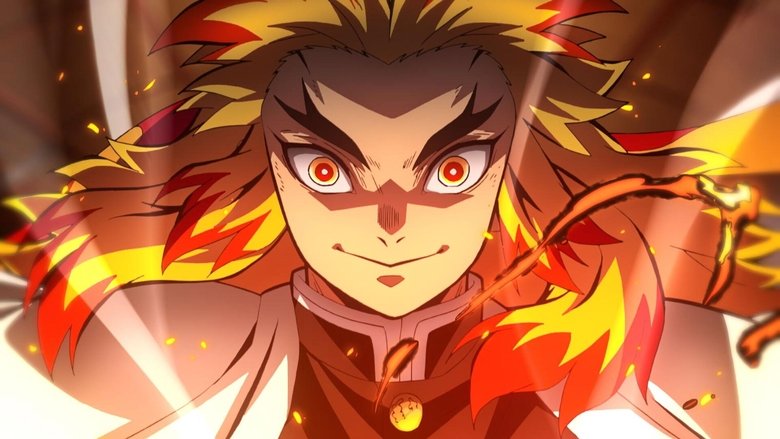
Kyojuro Rengoku

Satoshi Hino

Archetype: The Mentor / The Noble Hero
Key Trait: Infectiously Enthusiastic

Motivation

Rengoku's primary motivation is to fulfill the duty instilled in him by his late mother: to use his great strength to protect the weak and innocent. He is driven by a powerful sense of honor and responsibility, believing it is the natural role of the strong to shield the less fortunate, a belief he upholds until his final breath.

Character Arc

Rengoku begins as a charismatic, powerful, and slightly eccentric Hashira. He quickly establishes himself as a capable leader and a source of inspiration for Tanjiro and his friends. His arc is contained entirely within the film; he faces a psychological threat (Enmu's dreams) and a physical one (Akaza). Though he understands his family's struggles, particularly his father's apathy, he remains steadfast in his mother's teachings about protecting others. His arc culminates in his selfless sacrifice, where he fulfills his duty perfectly, cementing his legacy and passing his will onto the next generation.

Tanjiro Kamado

Natsuki Hanae

Archetype: The Hero
Key Trait: Unwavering Compassion

Motivation

Tanjiro's overarching motivation remains to find a cure for his sister, Nezuko, and to avenge his family by defeating the demon progenitor, Muzan Kibutsuji. In this film, his immediate motivation is to protect the passengers of the train and to learn from Rengoku, whom he quickly comes to admire.

Character Arc

Tanjiro enters the film having recently completed rehabilitation and training, eager to learn more about his father's Hinokami Kagura technique from a Flame Hashira. The film tests his resolve in a new way, forcing him to confront his deepest trauma and desire—the loss of his family—within Enmu's dream. His arc is one of hardening his will; he learns to sever his emotional attachments to a fabricated past to fight for the future. Witnessing Rengoku's heroic death profoundly impacts him, transforming his grief into rage and a strengthened conviction to defeat the Upper Rank demons.

Akaza

Akira Ishida

Archetype: The Noble Antagonist / The Shadow
Key Trait: Obsessed with Strength

Motivation

Akaza's motivation is the pursuit of ultimate strength and a Darwinian desire to fight and consume the powerful, whom he respects. He despises weakness and sees humanity as a fragile, temporary state. He seeks to elevate those he deems worthy, like Rengoku, to his level of existence through demonization so they can fight for eternity.

Character Arc

Akaza appears only in the film's final act as an abrupt and overwhelming threat. His arc is not contained within the movie but is established here. He is presented as a formidable warrior obsessed with strength and battling worthy opponents. He shows a form of respect for Rengoku's power, urging him to become a demon to perfect his skills. His character serves as a dark mirror to the Demon Slayers' philosophy, valuing personal power and immortality over the ephemeral strength of humanity. He retreats from the sun, establishing his demon limitations and setting up his role as a future antagonist.

Enmu

Daisuke Hirakawa

Archetype: The Trickster / The Sadist
Key Trait: Sadistic

Motivation

Enmu's motivation is purely sycophantic; he wishes to gain more power and favor from his master, Muzan Kibutsuji. He takes sadistic pleasure in tormenting humans by showing them happy dreams before turning them into nightmares, enjoying their suffering as a demonstration of his power.

Character Arc

Enmu, the last of the Lower Rank demons, is elevated by Muzan and tasked with killing a Hashira and Tanjiro. His arc is that of a primary antagonist seeking to prove his worth to his master. He utilizes cunning and psychological warfare over direct combat, manipulating desperate humans to do his bidding. He fuses his body with the train itself, becoming a unique and widespread threat. His arc concludes with his defeat at the hands of Tanjiro and Inosuke, marking the complete eradication of the Lower Ranks of the Twelve Kizuki.

Symbols & Motifs

The Mugen (Infinity) Train

Meaning:

The train itself symbolizes an endless journey, not just physically but also into the depths of the mind. Its name, "Mugen," translates to "Infinity," reflecting Enmu's power to trap his victims in endless, pleasant dreams. It represents a space where the boundaries between reality, dreams, and nightmares blur, and where the slayers must fight an internal battle before they can confront the external threat.

Context:

The entire first half of the film is set on the Mugen Train. The demon Enmu literally fuses with the train, making the setting and the antagonist one and the same. The train cars become extensions of his body, and the journey becomes a descent into the subconscious of the main characters.

Spiritual Core (Seishin no Kaku)

Meaning:

Represented in Tanjiro's dream as a warm, sun-like orb floating in a beautiful lake, the spiritual core symbolizes the essence of a person's being—their soul, will, and inner strength. It is depicted as a place of immense beauty and light, signifying Tanjiro's inherent kindness and purity. Its destruction would mean the death of the spirit.

Context:

Enmu tasks his human minions with entering the slayers' dreams to find and destroy their spiritual cores. The intruder who enters Tanjiro's subconscious is overwhelmed by its warmth and beauty, unable to carry out the evil act, which highlights Tanjiro's unwavering goodness.

Flame

Meaning:

Flame symbolizes passion, honor, and the bright, burning intensity of a life lived to its fullest potential, however short. It is intrinsically linked to Kyojuro Rengoku, the Flame Hashira. His final words, "Set your heart ablaze," transform the flame into a metaphor for enduring willpower and the legacy one passes on to others.

Context:

Rengoku's Flame Breathing techniques manifest as spectacular displays of fire, visually representing his power and personality. The symbol culminates in his final charge against Akaza and his parting words to Tanjiro, cementing the flame as a symbol of his indomitable spirit.

Tanjiro's Hanafuda Earrings

Meaning:

The Hanafuda earrings, depicting a rising sun, symbolize hope, legacy, and a connection to the powerful Sun Breathing technique. The sun is the ultimate weakness of demons, and thus the earrings represent the greatest threat to them and humanity's hope for victory. They also link Tanjiro to a powerful lineage of demon slayers, hinting at his hidden potential.

Context:

Tanjiro wears the earrings throughout the film. They are a constant visual reminder of the legacy passed down from his father. Muzan Kibutsuji, the demon king, has a particular hatred for these earrings, which is why he tasks Enmu with killing Tanjiro specifically.

Memorable Quotes

心を燃やせ (Kokoro wo moyase)

— Kyojuro Rengoku

Context:

Spoken in his final moments after being fatally wounded by Akaza. Rengoku uses his last words to inspire Tanjiro, Inosuke, and Zenitsu to not let his death dishearten them, but to use it as motivation to continue fighting and growing stronger.

Meaning:

"Set your heart ablaze." This is Rengoku's final, iconic command to Tanjiro. It's a powerful and poetic encapsulation of the film's central theme: to persevere with fiery passion and unwavering will, even in the face of weakness, despair, and devastating loss. It's a transfer of fighting spirit from a dying mentor to his student.

老いることも死ぬことも、人間という儚い生き物の美しさだ (Oiru koto mo shinu koto mo, ningen to iu hakanai ikimono no utsukushisa da)

— Kyojuro Rengoku

Context:

Said during his intense battle with the Upper Rank demon Akaza. Akaza, impressed by Rengoku's strength, offers him the chance to become a demon and transcend human limitations. Rengoku flatly rejects the offer with this profound statement on the nature of humanity.

Meaning:

"Growing old and dying are part of the beauty of being an ephemeral creature like a human." This line is a direct rebuttal to the demonic ideal of immortality and perfection. It argues that the finite nature of human life is precisely what gives it value, nobility, and meaning—a core philosophical statement of the film.

逃げるな卑怯者!(Nigeru na hikyōmono!)

— Tanjiro Kamado

Context:

Tanjiro screams this at Akaza as the demon retreats into the forest to escape the rising sun, leaving the mortally wounded Rengoku behind. Despite being severely injured himself, Tanjiro throws his sword in a futile but emotionally powerful act of defiance.

Meaning:

"Don't run away, you coward!" This quote is an explosion of pure, desperate rage and grief from Tanjiro. It redefines victory and defeat not by who survives, but by who upholds their principles. He declares that Akaza, who can only fight in the dark and flees the sun, is the true loser, while Rengoku, who fought to the end and protected everyone, is the true victor.

Philosophical Questions

What is the true meaning of strength?

The film explores this question through the dichotomy between Rengoku and Akaza. Akaza champions physical perfection, regeneration, and eternal life as the pinnacle of strength, viewing human frailty as pathetic. Rengoku, conversely, defines strength not by physical prowess alone but by moral fortitude and the will to protect others. He argues that the human condition, with its limitations and mortality, is the source of a different, more profound strength. His ultimate sacrifice, saving everyone at the cost of his own life, serves as the film's answer: true strength lies in fulfilling one's duty and protecting the preciousness of ephemeral life.

Is it better to live a short, meaningful life or a long, empty one?

The central conflict presents a choice between a finite human life filled with purpose and an infinite demonic existence centered on a hunger for power. Akaza's offer of immortality to Rengoku is a temptation to abandon human purpose for endless battle. Rengoku's emphatic rejection and subsequent heroic death champions the idea that a life's value is measured by its impact and the fulfillment of one's duties, not its duration. The legacy and inspiration he leaves behind in his short life are portrayed as being far more powerful than Akaza's countless years of existence.

Alternative Interpretations

While the film's narrative is quite direct, some interpretations delve into its deeper cultural and philosophical underpinnings. One perspective reads the story through the lens of Japanese spiritual traditions like Shinto and Buddhism. The demon slayers act as spiritual purifiers, cleansing the world of malevolent forces, akin to the Shinto ritual of 'harae'. Rengoku's character, with his acceptance of impermanence and focus on duty, can be seen as embodying Buddhist and Confucian values, respectively. Another interpretation focuses on the psychological aspect, particularly through a Freudian lens. The dream sequences can be analyzed as manifestations of the characters' unconscious desires and traumas. Tanjiro and Rengoku's dreams tap into a longing for family and validation, while Zenitsu and Inosuke's dreams reflect more primal desires for romance and dominance, showcasing the different facets of their psyches.

Cultural Impact

"Demon Slayer -Kimetsu no Yaiba- The Movie: Mugen Train" had an unprecedented cultural and economic impact, particularly in Japan. Released in October 2020 during the COVID-19 pandemic, its success was seen as a major revitalizing force for the struggling Japanese box office. It didn't just perform well; it became a social phenomenon, surpassing Hayao Miyazaki's "Spirited Away" to become the highest-grossing Japanese film in history. Worldwide, it became the highest-grossing film of 2020, a historic first for a Japanese anime film.

The film's success significantly boosted the popularity of the Demon Slayer franchise globally, turning it into a household name far beyond the typical anime fanbase. It demonstrated a new model for anime adaptations, proving that a canonical story arc, rather than a standalone side story, could achieve massive cinematic success, directly bridging seasons of a television series. This has led to discussions within the industry about the viability of theatrical releases for key story arcs of popular shows. The film's blend of stunning visuals by studio Ufotable, emotional storytelling, and spectacular action resonated with critics and a massive audience, receiving generally favorable reviews and high audience scores.

Audience Reception

Audience reception for "Mugen Train" was overwhelmingly positive. Viewers widely praised the film for its stunning, high-quality animation by studio Ufotable, especially during the breathtaking fight sequences between Rengoku and Akaza. The emotional weight of the story was a key point of acclaim, with many viewers finding the conclusion, particularly Rengoku's death and his final words to Tanjiro, to be profoundly moving and tear-jerking. Rengoku himself became a fan-favorite character due to his charismatic personality and heroic sacrifice. The film's pacing was generally considered effective, balancing moments of humor, heartfelt character interactions, and intense action. The primary criticism, often noted by reviewers, was that the film is not friendly to newcomers. As a direct continuation of the TV series, it offers little to no exposition, making it potentially confusing for anyone unfamiliar with the characters and plot. Some also pointed out that the main antagonist, Akaza, appears very abruptly in the third act with no prior setup within the film itself.

Interesting Facts

  • The film is a direct sequel to the first season of the anime series and adapts the "Mugen Train" arc from the original manga.
  • It shattered numerous box office records, becoming the highest-grossing film of all time in Japan, surpassing Studio Ghibli's "Spirited Away" which held the record for 19 years.
  • "Mugen Train" was the highest-grossing film of 2020 worldwide, making it the first time a non-Hollywood, non-American production topped the annual global box office.
  • In the U.S., it had the biggest opening weekend for a foreign-language film in the country's box office history.
  • The success of the film was attributed to several factors, including its release during a lull in the COVID-19 pandemic in Japan with less competition, and the immense popularity built up by the preceding manga and anime series.
  • A seven-episode TV anime arc was later released that recut the movie's footage and added a new first episode showing how Rengoku arrived on the train.

Easter Eggs

In Inosuke's dream, Tanjiro and Zenitsu appear as anthropomorphic animal sidekicks that resemble tanuki (raccoon dogs).

This is a potential nod to the 1994 Studio Ghibli film "Pom Poko," which features mythical, shapeshifting tanuki as its main characters. This reference grounds the film's fantasy elements in broader Japanese folklore and animation history.

⚠️ Spoiler Analysis

Click to reveal detailed analysis with spoilers

Frequently Asked Questions

Explore More About This Movie

Dive deeper into specific aspects of the movie with our detailed analysis pages

Comments (0)

Leave a comment

No comments yet. Be the first to share your thoughts!