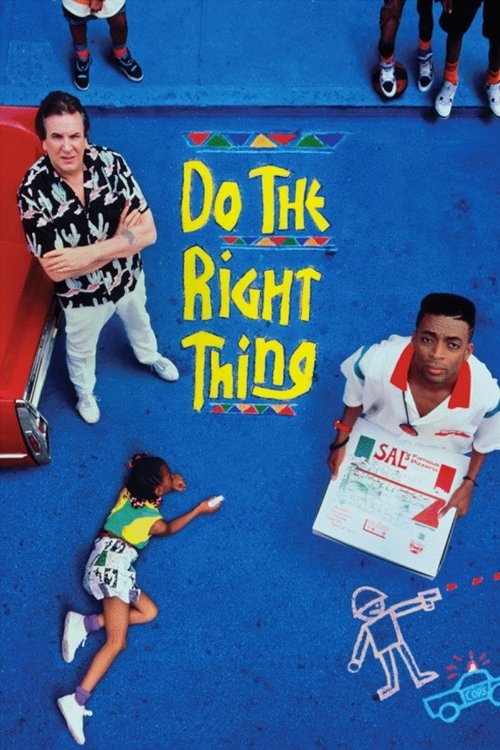
Do the Right Thing
A sweltering drama that simmers with kinetic energy and vibrant colors, capturing a Brooklyn neighborhood's racial tensions on the hottest day of the summer. It culminates in a tragic explosion of violence, challenging viewers with the complex moral ambiguity of justice and anger.
Do the Right Thing

Do the Right Thing

"It's the hottest day of the summer. You can do nothing, you can do something, or you can..."

14 June 1989 United States of America 120 min ⭐ 7.8 (1,922)
Director: Spike Lee
Cast: Danny Aiello, Ossie Davis, Ruby Dee, Richard Edson, Giancarlo Esposito
Drama
Racism and Intolerance Police Brutality and Justice Heat as a Catalyst Community vs. Individualism Gentrification and Economic Power
Budget: $6,500,000
Box Office: $37,300,000

Overview

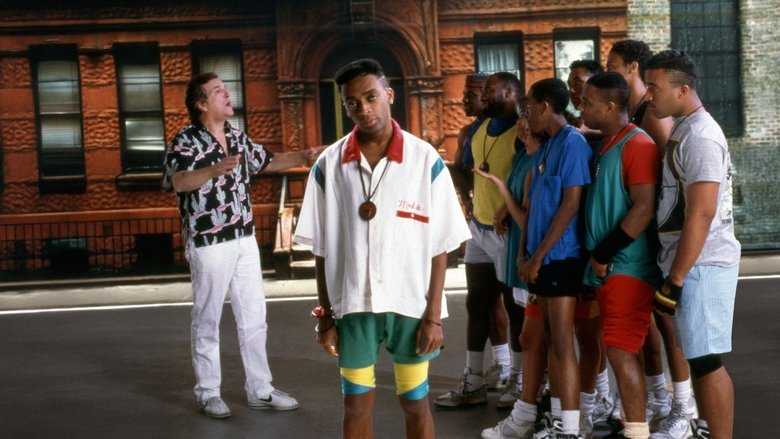
Set in the Bed-Stuy neighborhood of Brooklyn on the hottest day of the year, the film follows the daily interactions of a diverse community. The story centers on Mookie, a young Black man working as a delivery driver for Sal's Famous Pizzeria, a local institution owned by an Italian-American family. As the temperature rises, so do the tensions between the Black residents and the white business owners, particularly over the lack of Black representation on the pizzeria's "Wall of Fame."

The narrative weaves together various subplots involving colorful neighborhood characters, including the stuttering Smiley, the boombox-carrying Radio Raheem, and the neighborhood elder Da Mayor. Minor conflicts escalate into a confrontation at the pizzeria, which draws in the police and leads to a devastating act of brutality. The film ends with a chaotic riot that destroys the pizzeria, leaving the characters to reckon with the aftermath in the cooling morning air.
Core Meaning

At its heart, the film is a profound examination of racial tension and the systemic devaluation of Black lives in America. Spike Lee challenges the audience to confront the question of what it means to "do the right thing" in a society built on inequality. By juxtaposing the philosophies of Martin Luther King Jr. (non-violence) and Malcolm X (self-defense), the film refuses to offer a simple moral resolution, instead presenting violence as both a destructive force and a desperate expression of unheard grief.

Thematic DNA

Racism and Intolerance 30%
Police Brutality and Justice 25%
Heat as a Catalyst 20%
Community vs. Individualism 15%
Gentrification and Economic Power 10%

Racism and Intolerance

The film exposes both overt and subtle forms of racism. Pino represents aggressive, vocal bigotry, while Sal's racism is more complex and paternalistic, emerging violently when his authority is challenged. The racial slur montage breaks the fourth wall to show how every group holds prejudices against others.

Police Brutality and Justice

The climax of the film serves as a chilling indictment of excessive police force. The death of Radio Raheem mirrors real-life tragedies, illustrating how law enforcement can escalate neighborhood disputes into fatal encounters for Black men, valuing property and order over human life.

Heat as a Catalyst

The oppressive heat acts as a pressure cooker, physically manifesting the rising social and racial tensions. As the temperature climbs, patience wears thin and tempers flare, making the heat a character in itself that pushes the community toward the inevitable explosion.

Community vs. Individualism

The film portrays Bed-Stuy as a vibrant ecosystem where everyone knows everyone. Tensions arise between individual desires (Sal wanting to run his business his way) and community demands (Buggin' Out demanding representation). The riot is a collective reaction to an individual tragedy.

Gentrification and Economic Power

The economic disparity is stark: the Black residents are consumers, while the businesses (Sal's Pizzeria, the Korean grocery) are owned by outsiders. The character of the white Brownstone owner represents the early stages of gentrification and the friction it causes.

Character Analysis

Mookie

Spike Lee

Archetype: The Observer / Catalyst
Key Trait: Ambivalent

Motivation

To support his son and girlfriend while maintaining a delicate peace in the neighborhood.

Character Arc

He starts as a drifter trying to get paid and navigate between his Black friends and his Italian employers. In the end, he is forced to choose a side, shattering the window that initiates the destruction of the pizzeria.

Sal

Danny Aiello

Archetype: The Patriarch
Key Trait: Prideful

Motivation

To run his business successfully and pass it on to his sons.

Character Arc

Sal takes pride in feeding the neighborhood and sees himself as a benevolent figure, but his paternalism masks deep-seated racial biases that erupt violently under pressure.

Radio Raheem

Bill Nunn

Archetype: The Tragic Hero / Symbol
Key Trait: Imposing

Motivation

To spread his message of "Love" and "Hate" and demand respect through his music.

Character Arc

He is a constant, imposing but peaceful presence whose only demand is respect. His death transforms him from a neighborhood fixture into a martyr for the community's rage.

Da Mayor

Ossie Davis

Archetype: The Wise Fool / Peacemaker
Key Trait: Compassionate

Motivation

To maintain harmony and win the affection of Mother Sister.

Character Arc

Dismissed as a drunk by many, he consistently tries to keep the peace and offers wisdom. He saves a child from a car and tries to stop the mob, proving his worth to the community and Mother Sister.

Buggin' Out

Giancarlo Esposito

Archetype: The Agitator
Key Trait: Volatile

Motivation

To assert Black identity and challenge the status quo.

Character Arc

He is the spark that lights the fuse, constantly complaining and organizing the boycott. His aggressive pursuit of representation leads directly to the final tragedy.

Symbols & Motifs

Radio Raheem's Boombox

Meaning:

It symbolizes the Black voice and cultural identity demanding to be heard. By playing Public Enemy's "Fight the Power" on a loop, Raheem forces the neighborhood to acknowledge his presence. Its destruction by Sal is a symbolic silencing of that voice.

Context:

Raheem carries it everywhere. The conflict erupts when Sal screams for him to turn off the "jungle music" and smashes the radio with a baseball bat.

The Love and Hate Rings

Meaning:

A direct reference to The Night of the Hunter, these brass knuckles symbolize the eternal internal struggle within humanity and the community. The story Raheem tells suggests that while Hate may seem to win (the left hand), Love (the right hand) eventually conquers.

Context:

Radio Raheem wears them on his hands and delivers a monologue directly to the camera explaining the cosmic battle between the two forces.

Sal's Wall of Fame

Meaning:

Represents exclusion and the erasure of Black contributions. It is a shrine to Italian-American pride (Sinatra, Pacino, DiMaggio) in a space that profits entirely from Black patronage.

Context:

It is the focal point of Buggin' Out's boycott and the catalyst for the final confrontation when he demands Black heroes be added.

Air Jordans

Meaning:

They represent cultural pride, status, and the fragility of Black wealth. A scuffed sneaker becomes a major grievance, highlighting how much value is placed on these symbols of success.

Context:

Buggin' Out loses his mind when a white cyclist runs over his pristine Jordans, leading to a confrontation about gentrification.

Memorable Quotes

Always do the right thing.

— Da Mayor

Context:

Da Mayor stops Mookie on the street to give him this piece of advice early in the film.

Meaning:

The film's titular line, serving as a moral imperative that is deceptively simple. It hangs over the entire film, asking the audience to judge who, if anyone, actually follows this advice.

HATE! It was with this hand that Cane iced his brother. Love, Hate, it's the story of Right Hand, Left Hand. It's a tale of good and evil.

— Radio Raheem

Context:

Raheem speaks directly to the camera, showing off his brass knuckles.

Meaning:

A philosophical monologue explaining the duality of human nature. It foreshadows the conflict where love and hate battle for the soul of the neighborhood.

Burn it down! Burn it down!

— The Crowd / Mother Sister

Context:

Chanted by the mob after Mookie throws the trash can through the window.

Meaning:

Represents the breaking point of the community. Even the peaceful Mother Sister joins the chant, showing how deep the pain and rage runs after Raheem's death.

Fight the Power!

— Public Enemy (Lyrics)

Context:

Played during the opening credits dance sequence and throughout the film from Raheem's radio.

Meaning:

The anthem of the film. It is a call to resistance and action against systemic oppression, constantly playing from Raheem's boombox as a soundtrack to the community's struggle.

I'm just a struggling Black man trying to keep my dick hard in a cruel and harsh world.

— Buggin' Out

Context:

Buggin' Out explaining his frustrations to Mookie.

Meaning:

Highlights the emasculation and struggle for dignity that Black men face in a society that constantly undermines them.

Philosophical Questions

Is violence ever justified as a form of protest or self-defense?

The film juxtaposes the death of a Black man (violence against life) with the destruction of a pizzeria (violence against property). It asks the audience why society often reacts more strongly to the latter than the former.

What does it mean to 'do the right thing' in an unjust system?

Every character thinks they are doing the right thing from their perspective. The film questions whether moral absolutism is possible when survival and dignity are on the line.

Can a community truly coexist without mutual respect?

Sal wants the Black community's money but refuses to respect their culture (the Wall of Fame). The film explores the sustainability of economic relationships that lack social equity.

Alternative Interpretations

The most debated action is Mookie throwing the trash can.
1. The 'Safety Valve' Theory: Some interpret Mookie's action as a calculated move to save Sal and his sons. By directing the mob's anger toward the property (the window), he diverted them from attacking the people (Sal, Pino, Vito), potentially saving their lives.
2. The Act of Radicalization: Others see it as Mookie finally abandoning his neutral stance and joining his community in a rightful expression of rage against the system that killed Raheem.
3. The Malcolm X vs. King Dialectic: The film ends with quotes from both leaders. The ending suggests that while violence is not 'good' (King), it may be 'intelligent' in self-defense (Malcolm X), leaving the viewer to wrestle with the contradiction.

Cultural Impact

Do the Right Thing is considered a landmark of American cinema. Released in 1989, it brought the realities of racial tension and police brutality to the mainstream screen with a visceral urgency that had rarely been seen. The film was controversial upon release; many white critics feared it would spark race riots, a reaction Spike Lee called racist. It was snubbed for Best Picture and Best Director at the Oscars (losing to Driving Miss Daisy), a decision widely criticized in hindsight. In 2011, Roger Ebert wrote that he had only seen a few movies that "penetrate your soul," and this was one of them. It was selected for preservation in the National Film Registry in its first year of eligibility.

Audience Reception

The film received universal acclaim from critics for its direction, acting, and vibrant cinematography, though it polarized audiences along racial and political lines initially. Praised: The raw honesty, the 'heat' palpable on screen, the complex characters, and the refusal to provide a happy ending. Criticized: Early detractors (mostly white media) called it an incitement to violence. Verdict: It is now regarded as a masterpiece and one of the most important films about race relations ever made.

Interesting Facts

  • The film was shot entirely on a single block of Stuyvesant Avenue in Brooklyn, which has since been renamed 'Do the Right Thing Way'.
  • Barack Obama took Michelle Robinson to see this film on their first date.
  • Spike Lee wrote the script in just two weeks.
  • The character of Smiley was created for Roger Guenveur Smith after he badgered Spike Lee for a role; the stutter was Smith's idea.
  • The graffiti 'Tawana told the truth' refers to the Tawana Brawley case, a controversial alleged hate crime from 1987.
  • Spike Lee faced criticism that the film would incite riots, but no riots occurred; he famously noted that white critics never ask if Arnold Schwarzenegger movies will incite violence.
  • Danny Aiello ad-libbed much of the scene where he talks about his pride in his pizzeria and his food.

Easter Eggs

Night of the Hunter Homage

Radio Raheem's 'Love/Hate' monologue is a direct recreation of Robert Mitchum's speech in the 1955 film The Night of the Hunter, linking Raheem to a cinematic history of moral duality.

Rosie Perez's Debut

This film marked the acting debut of Rosie Perez (Tina). Spike Lee discovered her at a dance club in Los Angeles.

Frank Vincent Cameo

Frank Vincent, known for mob roles in Scorsese films, appears briefly as the driver who gets wet from the fire hydrant, reinforcing the Italian-American tension.

⚠️ Spoiler Analysis

Click to reveal detailed analysis with spoilers

Frequently Asked Questions

Explore More About This Movie

Dive deeper into specific aspects of the movie with our detailed analysis pages

Comments (0)

Leave a comment

No comments yet. Be the first to share your thoughts!