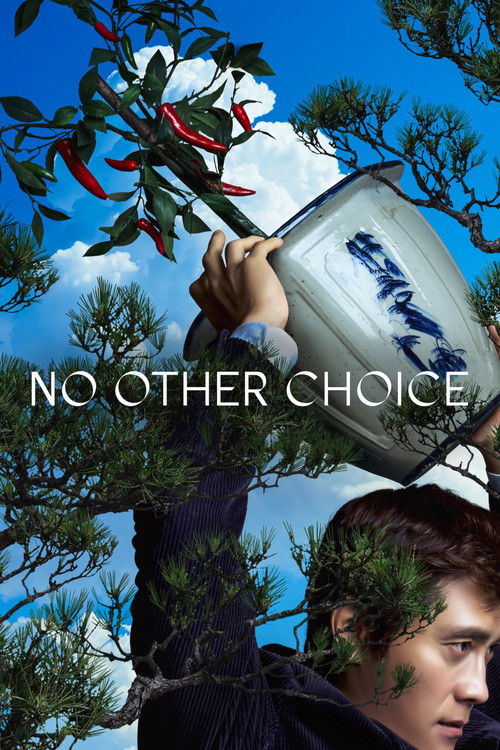
No Other Choice
A satirical thriller blending pitch-black comedy with social horror. Amidst the autumnal decay of a corporate career, a desperate father's descent into murder becomes a grotesque mirror of capitalist survival, where the only way up is to cut everyone else down.
No Other Choice

No Other Choice

어쩔수가없다

24 September 2025 South Korea 139 min ⭐ 7.8 (368)
Director: Park Chan-wook
Cast: Lee Byung-hun, Son Ye-jin, Park Hee-soon, Lee Sung-min, Yeom Hye-ran
Crime Thriller Comedy
The Violence of Capitalism Fragile Masculinity and Patriarchal Duty Complicity and Moral Decay Automation and Human Obsolescence
Budget: $12,200,000
Box Office: $25,343,108

Overview

Yoo Man-su (Lee Byung-hun) is a devoted family man and a paper industry veteran who believes he has "achieved it all"—a beautiful house, a loving wife, Mi-ri (Son Ye-jin), and two children. His world collapses when his company is acquired by American investors, and he is abruptly fired. After over a year of fruitless job hunting and facing the loss of his home, Man-su discovers a potential position at a rival firm, Moon Paper. Realizing the competition is fierce, he concocts a chilling plan: systematically eliminate the other qualified candidates to ensure he is the only choice left.

As Man-su executes his plan, the film oscillates between slapstick ineptitude and brutal violence. His targets include the depressed and alcoholic Goo Beom-mo (Lee Sung-min) and the charismatic influencer Choi Seon-chul (Park Hee-soon). Meanwhile, his wife Mi-ri, initially the moral anchor, becomes complicit in preserving their status, maintaining the facade of normalcy as the body count rises. The narrative spirals into a dark critique of a society where human worth is tied solely to employment, culminating in a hollow victory within a fully automated future.
Core Meaning

At its heart, No Other Choice is a scathing indictment of late-stage capitalism and the fragility of modern masculinity. Director Park Chan-wook uses the absurdity of a "murderous job search" to expose how corporate systems pit individuals against one another, turning ordinary people into monsters to maintain their social standing. The film suggests that in a world prioritizing efficiency and profit (symbolized by the looming threat of AI), human morality becomes an unaffordable luxury. Man-su's victory is ultimately ironic; he fights to become a cog in a machine that no longer needs him.

Thematic DNA

The Violence of Capitalism 30%
Fragile Masculinity and Patriarchal Duty 25%
Complicity and Moral Decay 25%
Automation and Human Obsolescence 20%

The Violence of Capitalism

The film portrays the job market as a literal battlefield. Man-su's transition from a mild-mannered salaryman to a serial killer serves as a metaphor for the cutthroat nature of corporate survival, where eliminating the competition is the only way to succeed.

Fragile Masculinity and Patriarchal Duty

Man-su is driven not just by financial need, but by his identity as a provider. His self-worth is entirely tethered to his ability to support his family and keep their house. The film critiques this patriarchal pressure, showing how it warps his morality and drives him to extremes to avoid the shame of failure.

Complicity and Moral Decay

While Man-su pulls the trigger, his family—especially his wife Mi-ri—becomes complicit by enjoying the fruits of his crimes and choosing silence. The film explores how the desire for comfort and status can lead decent people to turn a blind eye to atrocities.

Automation and Human Obsolescence

The looming specter of AI and automation permeates the film. Man-su fights to secure a job in a paper factory that is becoming increasingly automated, highlighting the tragic irony of human struggle in the face of technological replacement.

Character Analysis

Yoo Man-su

Lee Byung-hun

Archetype: Tragic Antihero / Everyman
Key Trait: Desperate Pragmatism

Motivation

To regain his job, save his house, and restore his status as the provider for his family.

Character Arc

Starts as a proud, successful father who loses everything. He descends from a desperate job seeker into a cold-blooded killer, shedding his morality to reclaim his status, ultimately ending up successful but spiritually hollow.

Lee Mi-ri

Son Ye-jin

Archetype: The Pragmatic Matriarch
Key Trait: Resilient Complicity

Motivation

To protect her children and maintain their standard of living.

Character Arc

Initially the supportive wife trying to hold the family together. She evolves into a silent accomplice who accepts the dark reality of their survival, prioritizing the family's stability over moral righteousness.

Choi Seon-chul

Park Hee-soon

Archetype: The Successful Rival
Key Trait: Arrogant Charisma

Motivation

To enjoy his success and status.

Character Arc

Serves as a foil to Man-su; he is charismatic, successful, and arrogant—everything Man-su wants to be but isn't.

Symbols & Motifs

The House

Meaning:

Symbolizes Man-su's status, success, and the trap of the middle-class dream. It is the physical manifestation of what he is killing to protect.

Context:

Man-su obsessively tends to the house and garden even while unemployed. The threat of selling it triggers his murderous plan.

The Toothache and Extraction

Meaning:

Represents guilt, festering inner conflict, and the painful shedding of humanity.

Context:

Man-su suffers from a toothache he refuses to treat professionally. In a pivotal scene, he extracts it himself with pliers, symbolizing his decision to rip out his conscience to become a killer.

The Eel

Meaning:

A symbol of false gratitude and the severance of ties. A "gift" that masks the brutality of his firing.

Context:

In the opening scene, the company sends him expensive eels just before firing him, turning a celebratory meal into a memory of betrayal.

The Automated Factory

Meaning:

Represents the cold, indifferent future where human effort is rendered meaningless.

Context:

The film ends with Man-su standing alone in a massive, noisy, fully automated factory, emphasizing his isolation and the hollowness of his "victory."

Notes on Hand

Meaning:

Symbolizes Man-su's anxiety, lack of confidence, and desperate need for control.

Context:

He writes interview answers and plans on his hand. By the end, he stops doing this, signaling his transformation into a cold, confident killer who no longer doubts himself.

Memorable Quotes

We're sorry. We have no other choice.

— Man-su's Employers

Context:

Spoken during the meeting where Man-su is fired after 25 years of service.

Meaning:

The inciting incident of the film. It highlights the corporate indifference that discards loyal employees, a phrase Man-su later internalizes to justify his own violence.

Do you know what I'm feeling right now? I have it all.

— Yoo Man-su

Context:

Opening scene, hugging his family at a barbecue before the news of his firing hits.

Meaning:

Establishes the height of his happiness and the fragility of his success just before it is taken away.

If you do something bad, it means I'm doing it too. Got it?

— Lee Mi-ri

Context:

A tense moment between Man-su and Mi-ri as she realizes the lengths he is going to.

Meaning:

Signifies her acceptance of his actions and their shared culpability. It bonds them in crime as much as in marriage.

Honey... I'm in the middle of a war right now.

— Yoo Man-su

Context:

Spoken to his wife while he is deep in his plan to eliminate competitors.

Meaning:

Reframes his job hunt and murders as a battle for survival, justifying his atrocities as necessary acts of war.

The problem isn't the unemployment itself. It's how you deal with it.

— Lee A-ra

Context:

Spoken by the wife of one of Man-su's victims, reflecting on her husband's decline.

Meaning:

Highlights the psychological toll of job loss and the different ways characters cope (or fail to cope) with their new reality.

Philosophical Questions

Is morality a luxury of the comfortable?

The film asks whether ethical behavior is possible when one's survival (or lifestyle) is threatened. Man-su abandons his morals the moment his security is breached, suggesting that civilization is a thin veneer over primal survival instincts.

Does the end justify the means if the system offers 'no other choice'?

Man-su rationalizes his murders as the only logical path to survival in a rigged game. The film challenges the audience to draw the line between desperate survival and monstrous selfishness.

What is the cost of efficiency?

Through the motif of automation and the 'culling' of candidates, the film explores the human cost of a society obsessed with efficiency, where people are treated as disposable inputs in an economic machine.

Alternative Interpretations

Some critics view the film not just as a critique of capitalism, but as a deconstruction of the 'good father' archetype. Man-su can be seen as a monster created by patriarchal expectations, where his violence is an expression of his fragile ego rather than pure necessity. The ending allows for a reading where Man-su has completely lost his soul; his solitude in the factory suggests he has become a machine himself. Others interpret the complicity of the wife, Mi-ri, as the true horror, suggesting that society as a whole quietly condones ruthlessness if it preserves comfort.

Cultural Impact

No Other Choice arrived at a time of global economic anxiety and rising fears about AI replacing human labor. By grounding its thriller elements in the universal fear of unemployment, it struck a chord with audiences worldwide, particularly in South Korea where the pressure to maintain social status is immense. Critics hailed it as a return to form for Park Chan-wook, blending the commercial appeal of a thriller with the biting social commentary of Parasite. It sparked conversations about the ethics of survival in late-stage capitalism and redefined the 'revenge' genre—not against a villain, but against the system itself.

Audience Reception

Audiences praised the film for its masterful blend of tension and dark humor, with Lee Byung-hun's performance receiving universal acclaim for its range—from pathetic desperation to terrifying resolve. Viewers found the premise relatable yet horrifying, often laughing at the absurdity before being hit by the grim reality. Some criticism was directed at the pacing in the second act and the extreme cynicism of the ending, which offered no easy redemption. However, the chemistry between the leads and the visual style were widely celebrated highlights.

Interesting Facts

  • Park Chan-wook wanted to adapt Donald Westlake's novel 'The Ax' for over 20 years, initially envisioning it as an English-language film set in the US.
  • The film is the second adaptation of the novel; the first was the 2005 French film 'The Axe' (Le Couperet) by Costa-Gavras.
  • The film is dedicated to Costa-Gavras in the closing credits.
  • This marks the first time superstars Lee Byung-hun and Son Ye-jin have played a married couple on screen.
  • Park Chan-wook reunited with Lee Byung-hun for the first time in 25 years since their collaboration on 'Joint Security Area' (2000).
  • The film won the Audience Award at the 2025 Toronto International Film Festival.
  • Lee Byung-hun performed the physical comedy and slapstick moments himself, a departure from his usual stoic roles.
  • The title 'No Other Choice' (어쩔수가없다) is a common Korean phrase often used to resign oneself to fate, here twisted to justify murder.

Easter Eggs

Joint Security Area Reunion

The casting of Lee Byung-hun reunites him with director Park Chan-wook, calling back to their breakout success in Joint Security Area. The dynamic of a man crossing a line into violence echoes their previous work.

Red Pepper Dragonfly

The song playing during a key scene references the name of the fake company Man-su creates to lure his victims, adding a layer of ironic musical commentary.

The 'Oldboy' Hammer

During a struggle, Man-su wields a tool that visually references the iconic hammer from Oldboy, acknowledging Park's history with stylized violence.

Bonsai and Greenhouse

Man-su's obsession with his bonsai trees mirrors his need to control and 'prune' his environment—and his competition—to fit his desired shape.

⚠️ Spoiler Analysis

Click to reveal detailed analysis with spoilers

Frequently Asked Questions

Explore More About This Movie

Dive deeper into specific aspects of the movie with our detailed analysis pages

Comments (0)

Leave a comment

No comments yet. Be the first to share your thoughts!