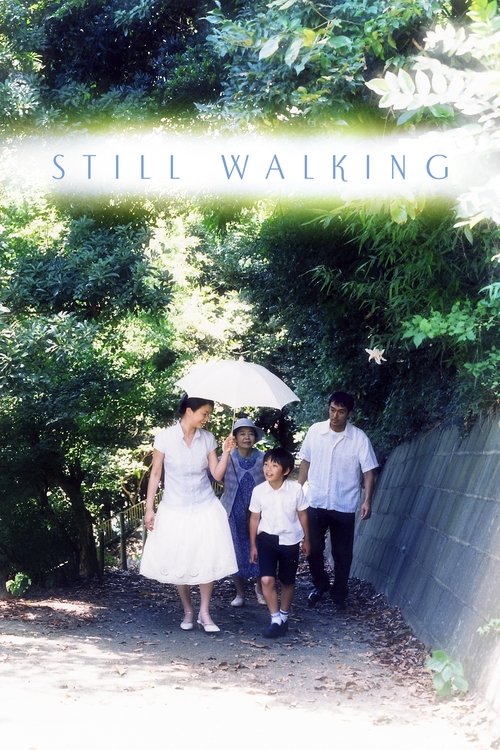
Still Walking
歩いても 歩いても
Overview
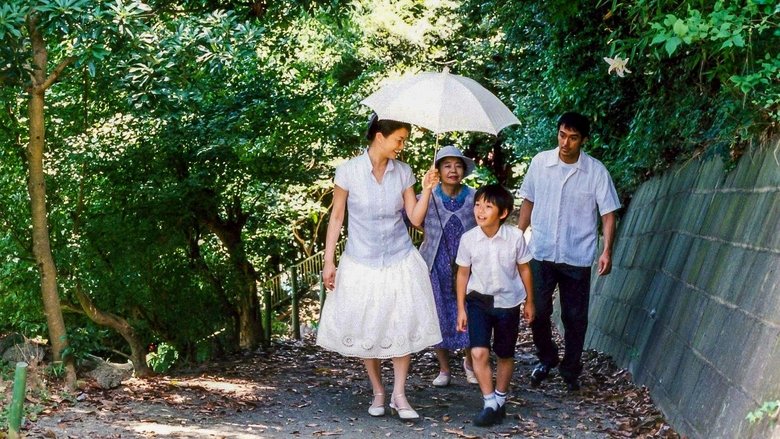
On a sweltering summer day, the Yokoyama family gathers at their parents' aging home to commemorate the fifteenth anniversary of the death of the eldest son, Junpei, who drowned saving a boy's life. Ryota, the surviving second son, arrives with his new wife Yukari, a widow, and her young son Atsushi, feeling the weight of his father's disappointment and his mother's subtle judgment.
Over the course of roughly 24 hours, the family shares meals, looks at old photos, and visits the grave. Beneath the polite chatter and domestic rituals, old wounds fester. The parents, Kyohei and Toshiko, cling to the memory of their lost heir, while Ryota struggles with his feelings of inferiority and the realization that he can never replace his brother. The film avoids melodramatic outbursts, instead revealing its emotional truths through small gestures, silences, and the specificities of family life.

Core Meaning
At its heart, Still Walking is a meditation on the impermanence of life and the inevitability of regret. Kore-eda explores how family members can love each other deeply yet remain fundamentally unable to communicate that love before it is too late.
The title refers to the lyrics of the song "Blue Light Yokohama," but metaphorically suggests that life continues its slow, steady march despite tragedy ("still walking"), and that we are often "still walking" toward understanding our parents when they are already gone. It captures the Japanese concept of mono no aware—a wistful awareness of the transience of things.
Thematic DNA
Grief and Loss
Grief is not presented as an event but as an atmosphere that permeates the house. The parents' refusal to move on from Junpei's death defines their existence, freezing them in a state of perpetual mourning that suffocates the living children.
Family Dysfunction and Secrecy
The film masterfully depicts the passive-aggressive nature of family dynamics. Resentments are voiced through backhanded compliments or complaints about food, and secrets (like the father's past affair) are weaponized in quiet, devastating ways.
The Passage of Time
Time is marked by physical changes—the aging parents, the growing children, the seasonal food. The film emphasizes that while people may not change their nature, time runs out on the opportunity to reconcile.
Tradition vs. Modernity
The tension between the traditional patriarchal expectations (represented by the father and the medical clinic) and Ryota's modern, less conventional life choices creates a silent friction that drives the narrative.
Character Analysis
Ryota Yokoyama
Hiroshi Abe
Motivation
To survive the family gathering without conflict and to hide his current unemployment from his critical father.
Character Arc
Ryota starts as a defensive son seeking validation but avoiding intimacy. He ends with a realization of his own missed opportunities to connect, ultimately repeating some of his parents' behaviors with his own family.
Toshiko Yokoyama
Kirin Kiki
Motivation
To keep the memory of her eldest son alive and to subtly punish those who she feels have wronged her (her husband, the boy who was saved).
Character Arc
She appears as a sweet, domestic grandmother but reveals layers of deep resentment, cruelty, and sharp intelligence. She remains static in her grief, refusing to let go of the past.
Kyohei Yokoyama
Yoshio Harada
Motivation
To maintain his dignity and authority in a house where he is becoming increasingly irrelevant.
Character Arc
A retired doctor who has lost his purpose. He remains stubborn and emotionally unavailable, only showing a flicker of softness towards his step-grandson, but ultimately dying before reconciling with Ryota.
Symbols & Motifs
The Yellow Butterfly
It represents the soul of the departed and the persistence of memory. For the mother, it is literally her son Junpei returning home.
A yellow butterfly enters the house at night. The mother frantically tries to catch it, claiming it is Junpei. Ryota dismisses this superstition, but in the future, he repeats the same story to his own daughter, showing how family myths are inherited.
Corn Tempura
A sensory trigger for memory and the continuity of family ritual. The specific sound of frying represents the comfort and sensory detail of home.
The mother makes corn tempura, a favorite of the deceased son. The preparation is shown in great detail, emphasizing the tactile nature of maternal love and how food bridges the gap between the living and the dead.
The Steep Slope/Stairs
The physical burden of aging and the difficulty of the journey home (both literal and metaphorical).
The aging parents struggle to climb the steep steps to the grave and their home. It visualizes their decline and the growing distance between them and the outside world.
Myrtle Tree
The father's displaced affection and obsession with legacy.
Kyohei cares more for the tree in the garden than for his grandchildren, warning them not to break it. It symbolizes his rigid control and misplaced priorities.
Memorable Quotes
That's why I invite him. So he doesn't forget. ... It's not enough for him just to be grateful. He has to suffer... just a little bit.
— Toshiko Yokoyama
Context:
Ryota asks why she keeps inviting the awkward young man (Yoshio) to the memorial, suggesting they should let him off the hook.
Meaning:
Reveals the shocking cruelty beneath the mother's polite exterior. She forces the young man Junpei saved to visit every year to ensure he carries the weight of the life he "took," showing that grief can curdle into malice.
You are always a little too late.
— Ryota Yokoyama (Voiceover)
Context:
The final monologue where Ryota reveals his parents died before he could fulfill his small promises to them.
Meaning:
The central thesis of the film. It speaks to the universal human experience of realizing what we should have done for our loved ones only after they are gone.
Even if you are not there, you are there.
— Yukari Yokoyama
Context:
Yukari speaking to Ryota about the overwhelming presence of his deceased brother in the house.
Meaning:
A comment on the lingering presence of the dead. Junpei is gone, but his absence dictates everything the family does.
Steps are slow, but I'm still walking.
— Song Lyrics (Blue Light Yokohama)
Context:
The song plays while the mother listens, recalling how she discovered her husband's infidelity.
Meaning:
Reflects the mother's endurance through a loveless marriage and the tragedy of losing a child. Life continues, however slowly.
Philosophical Questions
Does time truly heal all wounds?
The film suggests the answer is no. Fifteen years have passed, yet the parents' grief is as fresh as ever. The film posits that time may just calcify pain rather than resolve it, and that families often settle into a 'cold war' rather than finding true peace.
What do we owe the dead vs. the living?
The parents prioritize the memory of the dead son (Junpei) over the feelings of the living son (Ryota). The film asks whether honoring the dead justifies neglecting the living, and explores the toxicity of idealizing those who are gone.
Is honesty always the best policy in a family?
The family maintains harmony through 'polite lies' and silence. The mother hides her knowledge of the affair; Ryota hides his unemployment. The film explores whether these deceptions are necessary social lubricants that allow the family to function.
Alternative Interpretations
While generally seen as a realist drama, some critics interpret the film as a ghost story where the ghost (Junpei) never appears but haunts every frame. Another interpretation focuses on the cyclical nature of behavior: Ryota resents his father's distance, yet the flash-forward implies he may be repeating similar patterns with his own family, prioritizing his own life over his parents until it is too late. The mother's character is also debated: is she a sympathetic victim of grief, or a villainous figure who uses her pain to manipulate and torment others?
Cultural Impact
Still Walking solidified Hirokazu Kore-eda's status as the heir apparent to the great Japanese humanist directors like Yasujiro Ozu and Mikio Naruse. Globally, it is regarded as a masterpiece of the 'shomin-geki' genre (drama about ordinary people). It demonstrated that contemporary cinema could still be compelling without high-stakes melodrama, influencing a wave of 'slow cinema' focused on domestic realism. Critics worldwide praised it for its universality, proving that the specific cultural rituals of a Japanese family—the altar, the shoes at the door, the food—could translate into a shared human experience of grief.
Audience Reception
The film holds a rare 100% rating on Rotten Tomatoes and is universally acclaimed by critics and audiences alike. Viewers frequently praise the naturalistic acting (especially Kirin Kiki) and the relatability of the family dynamics. Many audience members report feeling like they were watching their own families, citing the uncomfortable silences and passive-aggressive comments as painfully real. A common point of praise is the food cinematography. There is virtually no criticism, though some viewers accustomed to fast-paced Western cinema may find the slow pacing and lack of dramatic resolution challenging.
Interesting Facts
- Director Hirokazu Kore-eda wrote the film as a response to his own mother's death, regretting that he didn't do more for her while she was alive.
- The role of the mother was written specifically for Kirin Kiki, who became a frequent collaborator with Kore-eda until her death in 2018.
- The food in the film was prepared based on Kore-eda's own childhood memories, and he was very specific about the sounds of cooking (chopping, frying).
- The film's original Japanese title 'Aruitemo Aruitemo' (Walking and Walking) comes from the lyrics of the song 'Blue Light Yokohama' featured in the movie.
- Despite the specific Japanese context, the film received a 100% rating on Rotten Tomatoes, praised for its universal depiction of family.
- The house used in the film was a real private residence in Kanagawa, not a studio set, which contributed to the authentic soundscape.
- Kore-eda deliberately avoided dramatic plot twists to focus on the 'premonitions and reverberations' of life.
Easter Eggs
Blue Light Yokohama
The song by Ayumi Ishida is not just background music; it is a narrative device. The mother bought the record after hearing her husband singing it at a mistress's house, making the song a secret symbol of her knowledge of his betrayal.
Ozu Homage
The film is often cited as a modern homage to Yasujiro Ozu's Tokyo Story. The low camera angles, static shots of tatami rooms, and the theme of generational disconnect are direct stylistic references to Ozu's 'shomin-geki' (common people drama) style.
White Butterfly Myth
The story about white butterflies surviving the winter to become yellow is a piece of folklore used to illustrate how family myths are passed down, even by skeptics like Ryota.
⚠️ Spoiler Analysis
Click to reveal detailed analysis with spoilers
Frequently Asked Questions
Explore More About This Movie
Dive deeper into specific aspects of the movie with our detailed analysis pages
Comments (0)
No comments yet. Be the first to share your thoughts!