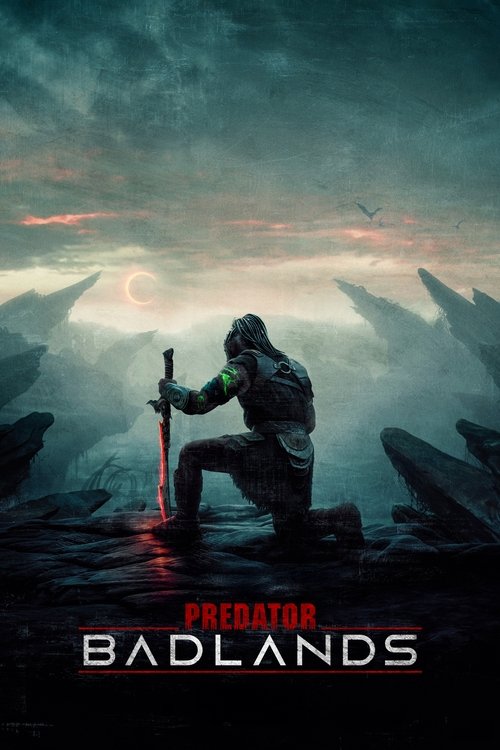
Predator: Badlands
"First hunt. Last chance."
Overview
In a franchise-altering shift, Predator: Badlands centers on Dek (Dimitrius Schuster-Koloamatangi), a young Yautja dismissed as a "runt" by his ruthless father and clan leader, Njohrr. After his brother Kwei sacrifices himself to save him from execution, Dek is exiled to the hostile planet Genna. His mission is to prove his worth by hunting the Kalisk, a legendary apex predator that regenerates instantly and has never been killed. However, Dek's journey takes an unexpected turn when he discovers a crashed Weyland-Yutani vessel and rescues Thia (Elle Fanning), a damaged synthetic abandoned by her own kind.
As Dek and Thia navigate the lethal flora and fauna of Genna, they uncover a Weyland-Yutani operation led by Thia's identical synthetic sister, Tessa (also Fanning), who aims to capture the Kalisk for bioweapons research. The film explores the deepening bond between the alien hunter and the android, challenging their programmed directives. The climax erupts into a three-way battle between the Predators, the corporate militia, and the forces of nature, culminating in a revelation about Dek's true potential and a defiance of his bloodline's brutal laws.

Core Meaning
At its heart, Predator: Badlands is a deconstruction of toxic legacy and the redefinition of strength. Director Dan Trachtenberg flips the script by making the "monster" the protagonist, using Dek's journey to critique the rigid, hyper-masculine expectations of Yautja culture. The film argues that empathy and adaptation—qualities often dismissed as weaknesses—are actually superior survival traits compared to brute force and dogma. By pairing a Predator with a synthetic, the film ultimately asks what it means to be "alive" and suggests that one's true family is found, not inherited.
Thematic DNA
The Burden of Legacy
Both Dek and Thia grapple with the roles designed for them by their creators/fathers. Dek fights against the Yautja caste system that deems him a "runt," while Thia rejects her programming as a disposable tool for Weyland-Yutani. Their arcs converge on the idea of breaking the cycle of abuse and forging a new identity independent of their origins.
Technological vs. Biological Evolution
The film contrasts the organic, regenerative power of the Kalisk and the Yautja's ritualistic hunting gear with the cold, industrial militarism of the Weyland-Yutani corporation. Tessa's reliance on heavy machinery (the power loader) vs. Dek's adaptation to the natural environment highlights the film's stance on the superiority of instinct over fabricated power.
Empathy as a Survival Skill
Unlike previous films where the Predator is a relentless killer, Dek succeeds because he learns to care. His alliance with Thia and his protection of Bud (the Kalisk's offspring) demonstrate that compassion is not a liability but a strategic advantage that allows for alliances the solitary "alpha" cannot form.
Inversion of the Monster
By placing the audience in the Predator's perspective, the film humanizes the "other." The true monsters are revealed to be the corporate entities (Tessa/Weyland-Yutani) and the rigid traditionalists (Njohrr), while the scary alien protagonist becomes the sympathetic hero.
Character Analysis
Dek
Dimitrius Schuster-Koloamatangi
Motivation
To prove he is a worthy hunter, and later, to avenge his brother and protect his new found family.
Character Arc
Starts as an insecure "runt" seeking his father's validation through violence. Through his bond with Thia and Bud, he evolves into a protector who rejects his clan's toxic dogma to forge his own path.
Thia
Elle Fanning
Motivation
Survival and the protection of Dek, whom she recognizes as a kindred spirit.
Character Arc
Begins as a damaged, discarded machine awaiting retrieval. She discovers her own agency and humanity through her friendship with Dek, ultimately choosing to fight against her own 'sister'.
Tessa
Elle Fanning
Motivation
To complete the Weyland-Yutani mission of capturing the Kalisk at any cost.
Character Arc
Functions as the foil to Thia; she is efficient, ruthless, and fully subservient to the corporate mission. She represents what Thia was built to be but chooses not to become.
Njohrr
Reuben de Jong
Motivation
Maintaining the purity and strength of the clan through eugenic violence.
Character Arc
Static antagonist representing the old ways of the Yautja. His refusal to see Dek's worth leads to his ultimate downfall at the hands of the son he rejected.
Symbols & Motifs
The Kalisk
Represents the unconquerable force of nature and the cycle of life/rebirth. Its regenerative ability mirrors the resilience required of Dek to survive his trauma.
The creature is hunted by all factions but is ultimately revealed to be a mother protecting its young, paralleling Dek's own hidden desire for connection.
Thia's Severed Legs
Symbolizes vulnerability and interdependence. Thia literally cannot move without Dek, forcing the solitary hunter to become a protector and partner.
For much of the second act, Dek carries Thia on his back, a visual metaphor for their symbiotic relationship and his burden of care.
Tessa's Power Loader
A callback to Aliens, representing the arrogance of human(oid) technology trying to dominate nature through brute force.
Tessa uses the mech suit to fight the organic Kalisk, visually contrasting industrial rigidness with organic fluidity.
Green Blood
Traditionally a sign of the enemy being wounded, here it becomes a symbol of the protagonist's mortality and humanity.
When Dek bleeds during his duel with his father, it evokes sympathy rather than triumph for the attacker.
Memorable Quotes
My mother.
— Dek
Context:
Spoken to Thia as they watch a massive, unique Predator ship descend from the sky after Dek has killed his father.
Meaning:
The final line of the film, revealing the source of the next threat and expanding the lore to include matriarchal Yautja dynamics. It signifies that Dek's family drama is far from over.
The alpha isn't the one who kills the most. It's the one who protects the pack.
— Thia
Context:
Thia explains the concept of wolves on Earth to Dek while they are resting in a cave.
Meaning:
This line redefines the film's central philosophy, shifting the definition of strength from predation to stewardship. It catalyzes Dek's transformation.
You are not the predator. You are the prey.
— Tessa
Context:
Tessa taunts Dek over the comms system as she hunts him with her synthetic kill squad.
Meaning:
A meta-commentary on the role reversal in the film. While meant as a threat, it ironically highlights Dek's underdog status which makes him the hero.
Philosophical Questions
Does heritage define destiny?
The film explores this through Dek, who is born a 'runt' and destined for execution or mediocrity. By rejecting his father's definition of a Yautja, he proves that individual choice and adaptation outweigh biological imperatives and cultural expectations.
What constitutes a 'monster'?
By making the terrifying Predator the hero and the human-looking synthetic the villain, the film challenges the audience's anthropocentric bias. It suggests that monstrosity is defined by actions (cruelty, greed) rather than appearance or species.
Alternative Interpretations
Some critics view the film as an allegory for colonialism and indigenous reclamation, with Dek representing an indigenous warrior reclaiming his identity from both toxic internal traditions (his father) and external corporate exploiters (Weyland-Yutani). Others interpret the Thia/Dek relationship as a commentary on AI ethics, suggesting that 'humanity' is a learned behavior accessible to any sentient being, biological or synthetic. The ending has also been debated: does Dek's killing of his father liberate the clan, or does it merely perpetuate the cycle of violence he sought to escape?
Cultural Impact
Predator: Badlands (2025) has been hailed as a revolutionary step for the long-running franchise. By shifting the perspective to the monster, it reinvigorated the series much like Prey (2022) did, but with even more narrative risk. Critics praised Elle Fanning's dual performance and the bold decision to humanize the Yautja, sparking debates about the nature of villainy in cinema. The film's success solidified Dan Trachtenberg as a premier sci-fi director and led to immediate interest in exploring the 'Yautja Matriarch' storyline teased in the ending. Culturally, it marked a shift in creature features towards more empathetic, character-driven storytelling.
Audience Reception
Audiences responded enthusiastically to the film, giving it high marks for its visual effects and emotional depth. The chemistry between the CGI-enhanced Dek and Elle Fanning was a standout, with many surprised by how much they cared for the alien protagonist. However, some purists criticized the extensive use of subtitles for the Yautja language and felt the 'humanization' of the Predator stripped away the mystery and fear factor that defined the original. The inclusion of Weyland-Yutani elements was divisive; some loved the universe-building, while others felt it was unnecessary fan service.
Interesting Facts
- This is the first film in the franchise to feature a Predator (Yautja) as the main protagonist with a dedicated emotional arc.
- Elle Fanning plays two characters, Thia and Tessa, requiring extensive use of split-screen and motion-control camera techniques for their shared scenes.
- A complete Yautja language was developed for the film by a professional linguist, featuring consistent grammar and syntax, unlike the gibberish used in previous films.
- The character of Dek was portrayed by Dimitrius Schuster-Koloamatangi in a practical suit, but his face was animated via CGI to allow for nuanced emotional expressions impossible with animatronics.
- Director Dan Trachtenberg cited 'Conan the Barbarian' and 'Mad Max' as key influences for Dek's stoic, physical performance.
- The planet 'Genna' is depicted as a 'death world' where the flora itself is hostile, a concept inspired by the original 1987 film's jungle but turned up to eleven.
- The 'Kalisk' creature design was kept secret until release; it is described as a regenerative beast that requires total cellular destruction to kill.
- The film officially canonizes the term 'Yautja' and 'Yautja Prime' from the expanded universe comics and novels into the film series.
Easter Eggs
Weyland-Yutani Corporation
The appearance of the 'Alien' franchise mega-corporation firmly ties this film into the shared universe, confirming the timelines are converging.
Power Loader Suit
Tessa pilots a yellow exosuit mech in the finale, a direct visual homage to Ripley's battle with the Alien Queen in Aliens (1986).
1987 Self-Destruct Timer
The Yautja numerical system used in the film is based on the countdown timer seen on the original Predator's wrist gauntlet in the first movie.
Bud the Blue Alien
Bud's design references the 'river ghost' creature from 2010's Predators, hinting at the biodiversity of the game preserve planets.
⚠️ Spoiler Analysis
Click to reveal detailed analysis with spoilers
Frequently Asked Questions
Explore More About This Movie
Dive deeper into specific aspects of the movie with our detailed analysis pages
Comments (0)
No comments yet. Be the first to share your thoughts!