Skip to content
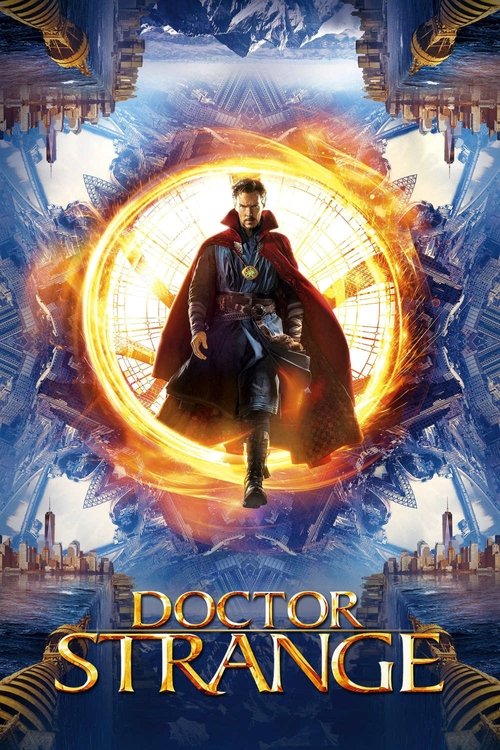
Doctor Strange
A kaleidoscopic metaphysical odyssey that plunges through existential grief into spiritual awakening. Mirrored skylines fracture and fold like origami under shimmering Mandalas of raw light, dissolving human vanity into the cosmic unknown.
Doctor Strange

Doctor Strange

"The impossibilities are endless."

25 October 2016 United States of America 115 min 7.4 (23,714)

Director: Scott Derrickson

Cast: Benedict Cumberbatch, Chiwetel Ejiofor, Rachel McAdams, Benedict Wong, Mads Mikkelsen

Fantasy Action Adventure Ego, Hubris, and Surrender of Control Time, Mortality, and Acceptance of Death Materialism vs. Mysticism / Science vs. Faith The Morality of Power and Broken Rules Redemption and Healing Beyond the Physical
Budget: $180,000,000
Box Office: $676,343,174

Overview

Doctor Strange (2016), directed by Scott Derrickson, introduces the mystical and interdimensional corners of the Marvel Cinematic Universe. The story centers on Dr. Stephen Strange, a world-renowned, brilliant, yet narcissistic New York neurosurgeon whose life and identity revolve entirely around his intellect and dexterous hands. When a horrific car crash shatters his hands and destroys his medical career, Strange exhausts his fortune pursuing experimental surgeries to restore his former life, alienating his closest confidante, Dr. Christine Palmer, in the process.

Desperate for a cure, Strange journeys to Kathmandu, Nepal, seeking Kamar-Taj—a mysterious enclave where a former paraplegic allegedly regained his mobility. There, he is taken in by the Ancient One, an enigmatic sorcerer who pulls back the veil on hidden dimensions, astral energy, and the mystic arts. Under the guidance of the Ancient One and fellow sorcerer Karl Mordo, the skeptical Strange is forced to surrender his strict scientific materialism and master spells, relics, and interdimensional travel.

However, Strange’s apprenticeship quickly thrusts him onto the front line of an occult war. Kaecilius, a former disciple of the Ancient One disillusioned by grief and mortality, leads a rogue sect of zealots intent on tearing down the mystical Sanctums protecting Earth. Strange must confront his own overwhelming arrogance and decide whether to use his newfound power solely to heal himself or sacrifice his desires to defend humanity against cataclysmic forces.
Core Meaning

The core thesis of Doctor Strange is articulated in the Ancient One’s pivotal lesson: "It’s not about you." Director Scott Derrickson frames Strange’s journey not merely as the acquisition of superpowers, but as the dismantling of Western rationalist ego and self-absorption.

The film argues that true strength arises from relinquishing absolute control and accepting vulnerability, mortality, and self-sacrifice. While science and medicine seek to master nature through control, the mystic path demands surrendering individual hubris to serve something greater than oneself. Derrickson uses eastern aesthetic motifs and interdimensional physics to demonstrate that humanity is merely a microscopic facet of an infinite multiverse, where obsessing over individual legacy is meaningless without ethical purpose.

Thematic DNA

Ego, Hubris, and Surrender of Control 30%
Time, Mortality, and Acceptance of Death 25%
Materialism vs. Mysticism / Science vs. Faith 20%
The Morality of Power and Broken Rules 15%
Redemption and Healing Beyond the Physical 10%

Ego, Hubris, and Surrender of Control

Strange’s entire identity is bound to his infallibility and self-importance. Only when he physically breaks and is abandoned on Mount Everest by the Ancient One does he realize that magic functions through surrender rather than sheer intellectual dominance. His ultimate triumph against Dormammu is not achieved through conquest, but through endless, agonizing self-sacrifice.

Time, Mortality, and Acceptance of Death

Time is personified as both a curse and a gift. Kaecilius views time as an enemy that destroys human happiness, driving his quest for immortal stagnation within the Dark Dimension. Conversely, the Ancient One teaches that death gives life meaning and texture. Stephen must accept the irreversible scars on his hands and the passage of time rather than trying to rewind reality into an idealized past.

Materialism vs. Mysticism / Science vs. Faith

Strange begins as a dogmatic empiricist who dismisses anything outside physical matter as fantasy. His "Magical Mystery Tour" through dimensions breaks his rigid paradigm, forcing him to accept that the laws of physics are merely one layer of reality. Magic is depicted not as fairy-tale whim, but as a discipline akin to spiritual and scientific code rewriting reality.

The Morality of Power and Broken Rules

The film explores moral dogmatism versus pragmatic compromise. Mordo believes cosmic laws must remain inviolable. In contrast, the Ancient One secretly draws energy from the Dark Dimension to safeguard Earth, and Strange breaks temporal continuity using the Eye of Agamotto. This highlights the ethical gray areas inherent in wielding immense power.

Redemption and Healing Beyond the Physical

Physical healing was Strange's original goal, yet the film redefines "healing" as emotional and spiritual maturity. Strange’s hands never stop shaking, but his soul and purpose are restored.

Character Analysis

Dr. Stephen Strange

Benedict Cumberbatch

Archetype: Reluctant Hero / Egocentric Genius Key Trait: Hyper-intellectual, arrogant, adaptive.

Motivation

Regain dexterity and surgical career; later, protect reality.

Character Arc

Falls from wealthy egoist to humbled seeker, ultimately sacrificing personal desires and enduring endless deaths to save humanity.

The Ancient One

Tilda Swinton

Archetype: Ambiguous Mentor / Zen Master Key Trait: Serene, enigmatic, morally pragmatic.

Motivation

Guard Earth against interdimensional threats and find a worthy successor.

Character Arc

Unveiled as secretly drawing vitality from the Dark Dimension; accepts her impending mortality to allow Strange to rise.

All 5 characters and cast

Symbols & Motifs

The Broken Jaeger-LeCoultre Watch

Meaning:

Symbolizes Strange’s fixation on lost control, his attachment to Christine Palmer, and his resistance to time.

Context:

Gifted by Christine with the inscription "Time will tell how much I love you," its shattered glass mirrors Strange’s broken psyche. Even at the end, he wears it broken, symbolizing his acceptance of his scars and of time itself.

Scarred / Trembling Hands

Meaning:

The loss of material identity, the human condition, and the necessity of looking beyond ego.

Context:

Close-up shots contrast his steady surgeon hands with the metal-pinned, trembling appendages post-crash. While Pangborn channeled magic simply to walk again, Strange learns to cast world-saving spells despite his tremors.

The Mirror Dimension and Kaleidoscopic Architecture

Meaning:

The malleability of human perception and the unseen, malleable dimensions framing existence.

Context:

Used by sorcerers to train and fight without harming the real world. The Escher-like folding cityscapes reflect the characters' shifting moral coordinates and internal distortions.

The Eye of Agamotto (Time Stone)

Meaning:

The burden of cosmic manipulation, destiny, and the inevitability of consequences.

Context:

Stephen uses it to experiment on an apple, reverse Hong Kong's destruction, and trap Dormammu in a temporal loop. It visually manifests as green runic dials turning around his hands.

The Cloak of Levitation

Meaning:

Acceptance of a higher calling and the externalization of protective grace.

Context:

Unlike typical costumes, the relic chooses Strange during the Sanctum battle, actively shielding him, wiping away his tears, and enabling him to transcend gravity.

Memorable Quotes

Arrogance and fear still keep you from learning the simplest and most significant lesson of all... It’s not about you.
— The Ancient One

Context

Spoken to Strange during their astral conversation as her physical body dies.

Meaning

It distills the overarching philosophical message of the film, confronting Strange with the core blind spot of his life.

Dormammu, I’ve come to bargain.
— Stephen Strange

Context

Repeated across dozens of iterations in the Dark Dimension time loop.

Meaning

It marks the climax where Strange uses wit, perseverance, and willingness to suffer eternal death to outplay a cosmic entity.

All 5 quotes

Philosophical Questions

Can ends justify the means in cosmic ethics?

The Ancient One channels forbidden dark energy to prolong her life for centuries to defend humanity, and Strange reverses time illegally. The film questions whether upholding absolute moral rules matters if it leads to total annihilation.

Is death a flaw to be overcome, or a necessary boundary?

Kaecilius seeks immortality to escape grief, yet entering an eternal, timeless realm renders human consciousness grotesque and stagnant. The film presents mortality as the essential frame giving meaning to every human choice.

What is the true limit of rational materialism?

Strange believes reality is purely neurochemical and physical. The Ancient One dismantles this reductionism, prompting viewers to consider how much of reality remains invisible to scientific tools.

Alternative Interpretations

The Allegory of Trauma and Chronic Disability: Rather than a fantasy adventure, some critics view the film as a psychological drama about coping with sudden, irreversible physical disability. Strange’s search for a magical "cure" transforms into an internal process of radical acceptance, realizing that healing does not mean erasing scars, but redefining purpose.

Full ending explanation

Cultural Impact

Released in November 2016 during Phase Three of the MCU, the film broadened the franchise beyond high-tech armor (Iron Man) and Norse science-fiction (Thor) into overt mysticism and multidimensional cosmology.

Scott Derrickson directly modeled the visual design of the Multiverse and Dark Dimension on Steve Ditko's iconic, trippy 1960s comic art, paying tribute to counterculture art styles. The film also achieved a philosophical synthesis by bridging Eastern concepts (chakras, energy projection, mindfulness) with Western philosophical concerns (Cartesian dualism, determinism, existentialism).

Grossing $677.8 million worldwide with a 90% Rotten Tomatoes approval score, it proved that mainstream audiences were ready for cerebral, surrealist visuals, earning an Academy Award nomination for Best Visual Effects. In addition, Strange’s "bargain" scene became a widely recognized meme and revolutionized standard superhero third-act showdowns by substituting a battle of attrition and wit for standard city-leveling explosions.

Audience Reception

The film received widespread praise from critics and audiences for its visual innovation, which combined Ditko-inspired, Escher-esque architecture with kaleidoscopic psychedelia. Benedict Cumberbatch’s magnetic lead performance, Michael Giacchino’s inventive score, and the subversive resolution of the third-act climax were highlighted as major strengths.

Conversely, criticisms centered on formulaic origin-story beats mirroring 2008's Iron Man, an underwritten antagonist in Kaecilius, and ill-timed MCU quips cutting into dramatic tension. Casting Tilda Swinton as the Ancient One—a character originally depicted as a Tibetan monk in the comics—also sparked controversy over Hollywood whitewashing, despite Marvel’s stated intention to avoid archaic Fu Manchu stereotypes.

Overall, Doctor Strange is regarded as one of Marvel's most visually daring and philosophically intriguing solo origin movies, successfully unlocking cosmic mysticism for future cinematic installments.

Interesting Facts

  • Scott Derrickson won the directing job by creating a comprehensive 90-minute pitch presentation (including storyboarded sequences and concept art), spending his own money to visualize the astral plane duel.
  • Before pursuing acting, Benedict Cumberbatch spent a gap year volunteering as an English teacher in a Tibetan Buddhist monastery in Darjeeling, India—an experience he drew heavily upon while filming in Nepal.
  • Marvel pushed back the film's entire production and release schedule from summer to autumn 2016 because Benedict Cumberbatch was committed to playing Hamlet on the London stage.
  • In addition to playing Strange, Cumberbatch provided the facial motion-capture and shared voice work for the cosmic entity Dormammu, emphasizing that Dormammu was an ultra-narcissistic reflection of Strange's own ego.
  • On the final day of filming in New York City, Cumberbatch walked into J&S Comics in full costume and makeup to buy a real Doctor Strange comic book, shocking customers and staff.
  • Rick and Morty and Community creator Dan Harmon was brought in during post-production to consult on additional scenes and punch up dialogue for the multidimensional sequences.
  • Giacchino composed a distinctive psychedelic, symphonic, and harpsichord-laden score, heavily influenced by 1960s and 1970s progressive rock.

Easter Eggs

Pink Floyd’s "Interstellar Overdrive"

The 1967 track plays in Strange’s Lamborghini immediately prior to the crash. In 1968, Pink Floyd featured art from Strange Tales #158 on the cover of their album A Saucerful of Secrets.

The Living Tribunal

During their sparring session, Mordo introduces his relic as the "Staff of the Living Tribunal," directly referencing one of the most powerful multiversal entities in Marvel lore.

Stan Lee’s Aldous Huxley Cameo

Stan Lee appears as a bus passenger oblivious to the reality-warping battle outside, reading Aldous Huxley’s psychedelic philosophical treatise The Doors of Perception.

Wand of Watoomb & Master Hamir

Master Hamir, the one-handed sorcerer Strange mistakes for the Ancient One, is Hamir the Hermit from the comics (father of Wong). Later, Wong wields the Wand of Watoomb during the Hong Kong battle.

The Book of Cagliostro

Kaecilius tears pages from the ancient Book of Cagliostro, an occult tome central to Marvel’s comic-book lore regarding time manipulation.

Distracted Driving PSA in Credits

In addition to post-credit teasers, the end credits close with an explicit public service announcement warning viewers about the mortal dangers of distracted driving.

Frequently Asked Questions

Explore More About This Movie

Dive deeper into specific aspects of the movie with our detailed analysis pages

Comments (0)

Leave a comment

No comments yet. Be the first to share your thoughts!

Similar Movies