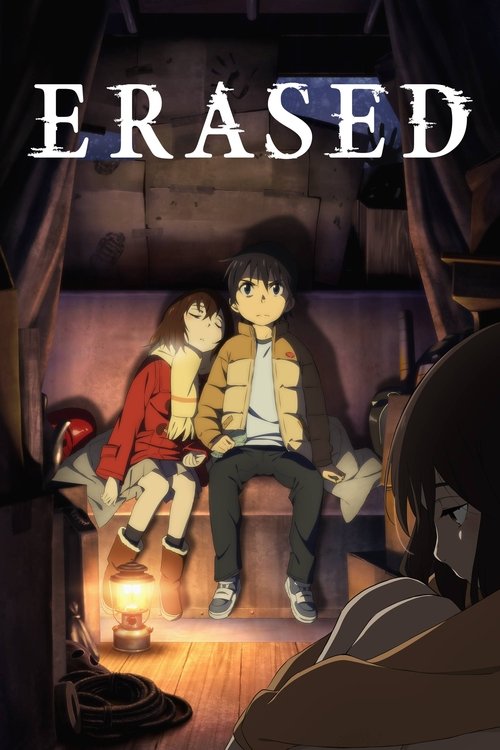
ERASED
A haunting psychological thriller where the chill of a snow-covered past bleeds into the present, carried on the wings of a desperate butterfly.
ERASED

ERASED

僕だけがいない街

08 January 2016 — 25 March 2016 Japan 1 season 12 episode Ended ⭐ 8.5 (1,165)
Cast: Shinnosuke Mitsushima, Tao Tsuchiya, Minami Takayama, Mitsuru Miyamoto, Aoi Yuuki
Drama Animation Mystery
Regret and Second Chances Trust and Human Connection The Butterfly Effect Child Abuse and Neglect

Overview

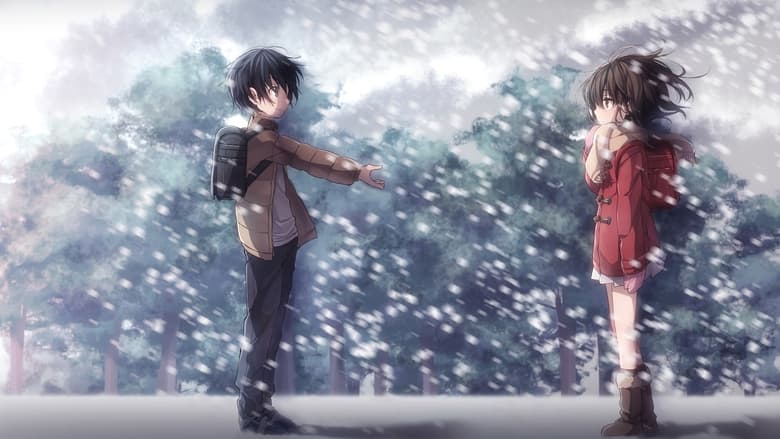
ERASED follows Satoru Fujinuma, a detached 29-year-old manga artist who experiences a strange phenomenon he calls "Revival." This ability involuntarily sends him back in time a few minutes to prevent life-threatening incidents. However, when his mother is murdered and he is framed for the crime, Revival sends him back 18 years to his elementary school days in 1988.

Realizing his mother's murder is linked to a serial kidnapping and murder case that took the lives of three of his childhood classmates, Satoru, now with the mind of an adult in a child's body, must navigate the complexities of his past. He desperately tries to change the tragic timeline, focusing his efforts on saving the first victim, the isolated and abused Kayo Hinazuki. Throughout his journey, he learns the true meaning of friendship, trust, and sacrifice, as he races against time to unmask a killer and protect the people he loves in both the past and the future.

Core Meaning

The core meaning of ERASED revolves around the profound impact of human connection and the courage to take action against past regrets. The series posits that one person's genuine effort and willingness to reach out can create a ripple effect, fundamentally altering the course of multiple lives. It's a message about filling the "blanks" in one's life not by wishing for a different past, but by actively engaging with the present to build a better future. It explores the idea that true heroism isn't about supernatural powers, but about empathy, observation, and the bravery to stand up for others, even when you're scared.

Thematic DNA

Regret and Second Chances 35%
Trust and Human Connection 30%
The Butterfly Effect 20%
Child Abuse and Neglect 15%

Regret and Second Chances

Satoru's entire journey is fueled by a deep-seated regret over his inaction and helplessness during the original 1988 kidnappings. His "Revival" ability is a literal manifestation of a second chance, forcing him to confront the past he had suppressed. The series explores how this opportunity transforms him from a passive, detached adult into a proactive and empathetic individual, determined to make things right. This theme underscores the idea that confronting painful memories, rather than erasing them, is the key to personal growth and healing.

Trust and Human Connection

Initially, Satoru tries to solve the mystery alone, reflecting his isolated adult life. However, his first attempt fails because he doesn't trust his friends with the truth. A major part of his character development is learning to rely on others—his friends like Kenya Kobayashi, and his mother, Sachiko. The series emphasizes that profound change is not achieved in isolation but through the strength of bonds, trust, and collective action. His connection with Kayo, built on empathy and protection, becomes the catalyst for altering the entire timeline.

The Butterfly Effect

The series is a compelling illustration of the butterfly effect, where small, seemingly insignificant actions have monumental consequences. Satoru inviting Kayo to his birthday party, standing up for her against bullies, or holding her hand creates ripples that change her fate and the fates of others. This theme is visually symbolized by the blue butterfly that often appears before a "Revival," signifying that a moment of potential change is at hand.

Child Abuse and Neglect

A dark and central theme is the harrowing reality of child abuse, primarily explored through Kayo Hinazuki's storyline. The series doesn't shy away from depicting the physical and emotional trauma she endures at the hands of her mother. It highlights how such abuse isolates a child, making them vulnerable. Satoru's intervention is not just about stopping a murder, but also about rescuing a child from a horrific home life, showing that the threats children face can be both external and domestic.

Character Analysis

Satoru Fujinuma

Shinnosuke Mitsushima (Adult), Tao Tsuchiya (Child)

Archetype: The Reluctant Hero
Key Trait: Observant

Motivation

Initially, his motivation is purely survival—to undo his mother's murder and clear his name. This quickly evolves into a powerful, selfless desire to protect his friends, especially Kayo, from a fate he feels responsible for. His ultimate motivation becomes the need to create a future where everyone he cares about is safe and happy, even at the cost of his own life.

Character Arc

Satoru begins as a disengaged 29-year-old, afraid of forming deep connections and haunted by a past he can't articulate. When thrown back into his 10-year-old body, he is initially clumsy and overwhelmed. Through his mission to save Kayo, he transforms from a passive observer into an active agent of change. He learns to trust his friends, express his emotions, and take responsibility. After waking from his 15-year coma, he has become a confident and empathetic person, no longer afraid of the future and having successfully filled the "hole" in his heart.

Kayo Hinazuki

Aoi Yuuki

Archetype: The Innocent Victim
Key Trait: Resilient

Motivation

Her primary motivation is survival and escapism. She writes a poem about wanting to go to an island with no people, no pain, and no mother, which reveals her deep desire to escape her abusive reality. As she befriends Satoru, her motivation shifts towards wanting to stay with him and her new friends, finding a reason to live rather than just endure.

Character Arc

Kayo is introduced as a solitary, withdrawn, and seemingly emotionless girl, a direct result of the severe abuse she suffers at home. She protects herself by putting up a wall and pretending not to care. Through Satoru's persistent friendship, her shell begins to crack. She learns to trust, to feel happiness, and to believe that she is not alone. Her arc is about finding her voice and escaping her tragic fate, eventually growing into a happy adult with a family of her own, a future Satoru's actions made possible.

Gaku Yashiro

Mitsuru Miyamoto

Archetype: The Shadow Self / The Wolf in Sheep's Clothing
Key Trait: Manipulative

Motivation

His motivation is rooted in a childhood trauma and a psychopathic worldview. He sees a hamster, "Spice," being sacrificed to save its siblings and develops a perverse desire to control life and death. He kills children whose "spider's threads" of life are visible to him, believing he is filling the hole in his own soul by severing theirs before they can fall into despair. Satoru becomes his new motivation, the ultimate challenge and the only person who truly understands and can fill his emptiness.

Character Arc

Yashiro is presented as a charismatic and supportive homeroom teacher, a father figure to Satoru. This persona is a meticulous mask for a cold, manipulative serial killer. His character does not have a traditional arc of growth but rather one of revelation. As the series progresses, his facade crumbles, revealing a psychopath obsessed with a twisted philosophy of severing "spider's threads." His obsession with Satoru, the one who continually thwarts him, becomes his sole purpose, leading to their final confrontation where his need for Satoru in his life proves to be his downfall.

Sachiko Fujinuma

Minami Takayama

Archetype: The Mentor / The Guardian
Key Trait: Perceptive

Motivation

Her motivation is simple and powerful: the unconditional love and protection of her son. She wants Satoru to live a full life, free from the regrets of the past. Her sharp eyes and instincts are always working to ensure his well-being, whether it's noticing a subtle change in his behavior or facing down Kayo's abusive mother.

Character Arc

Sachiko is Satoru's incredibly perceptive and supportive mother. In the original timeline, her sharp intuition gets her killed when she uncovers the killer's identity. In the past, she is Satoru's greatest ally, even without knowing about his time travel. She notices the changes in her son and implicitly trusts him, providing the support he needs to protect Kayo. Her arc is one of unwavering maternal love and strength; she spends 15 years caring for the comatose Satoru, never losing faith in him. She remains a constant pillar of strength and wisdom throughout the series.

Symbols & Motifs

Blue Butterfly

Meaning:

The blue butterfly symbolizes the "Revival" phenomenon and the opportunity for change. Its appearance heralds a moment where Satoru can alter fate, representing the delicate and transformative nature of his actions, akin to the butterfly effect.

Context:

It appears just before Satoru is sent back in time, both for the minor jumps in 2006 and the major leap back to 1988. It reappears in the final scene, suggesting that Satoru's and Airi's meeting is another pivotal, fate-altering moment.

Spider's Thread

Meaning:

This is a direct reference to a famous Japanese short story by Ryūnosuke Akutagawa. For the killer, Gaku Yashiro, it symbolizes a fragile opportunity for salvation or connection that he can grant or sever at will. He sees invisible threads above the heads of those he feels a connection to, which fuels his twisted desire to kill them before they "fall." For Satoru, overcoming the killer is like seizing his own thread to climb out of despair.

Context:

Yashiro explains his philosophy involving the spider's thread in the final episodes when he confronts Satoru. In the opening animation, threads can be seen dangling from the heads of Airi, Kayo, and Sachiko, symbolizing that they are all targets connected to the killer's web.

Film Reels and Widescreen Aspect Ratio

Meaning:

The cinematic presentation symbolizes Satoru's perspective as both an actor and a helpless viewer of his own past. The past is presented in a widescreen (2.35:1) aspect ratio, which creates a cinematic, movie-like feel, as if he is watching a film he cannot change. The film reel imagery in the opening credits reinforces this idea of re-watching and attempting to edit a pre-written story.

Context:

Throughout all the scenes set in 1988, the screen format shifts to widescreen, with black bars at the top and bottom. This visual cue immediately distinguishes the past from the present (which is shown in a standard 16:9 ratio) and enhances the feeling of being trapped in a memory.

The Color Red

Meaning:

Red is consistently used to symbolize danger, malice, and the presence of the killer. It is the color of the killer's eyes when his true nature is revealed, the color of his car, and is often associated with moments of intense threat or violence.

Context:

Gaku Yashiro's eyes glow red in moments of killer intent, a visual cue used to create suspense. His car, a key location in the series, is red. The color is also used starkly in scenes of violence, such as when Satoru discovers his mother's body, highlighting the blood and the horror of the moment.

Memorable Quotes

信じる」って言葉を使わないと、自分を保てない時ってあるだろ?俺は今がそれなんだよ。本当は怖いんだ。お前がいなくなるんじゃないかって。

— Satoru Fujinuma

Context:

This is said to Kayo Hinazuki in Episode 4, "Accomplishment." Satoru is trying to convince her to trust him and stay with him past the day she is supposed to disappear. It's a key moment in building their bond.

Meaning:

Translation: "There are times when you can't maintain yourself without using the word 'believe,' right? That's what it is for me right now. The truth is, I'm scared. Scared that you might disappear." This quote is pivotal for Satoru's development, as he admits his fear and vulnerability, moving beyond his detached persona to express genuine care and reliance on another person.

私がいなくなった街のことを思うと、ホッとする。遠くへ行きたい。

— Kayo Hinazuki

Context:

This is from an essay Satoru reads in Episode 2, "Palm of the Hand," which makes him realize the severity of Kayo's situation and strengthens his resolve to save her.

Meaning:

Translation: "When I think about the town without me, I feel a sense of relief. I want to go far, far away." This quote from her essay encapsulates the depth of Kayo's despair and suffering due to her abusive home life. It's a heartbreaking window into her desire to escape, not just the town, but her own existence.

未来は常に白紙だ。そこには無限の可能性がある。

— Gaku Yashiro

Context:

Yashiro says this to his class, including Satoru, during their time in elementary school. The line is repeated and re-contextualized throughout the series, especially during Satoru's internal monologues about changing fate.

Meaning:

Translation: "The future is always a blank sheet of paper. There are infinite possibilities." This quote is deeply ironic. While it sounds inspirational, coming from the main antagonist, it reflects his own belief in his ability to shape and control the future of others by ending their lives. For Satoru, however, it becomes a mantra to believe he can change the future for the better.

バカなの?

— Kayo Hinazuki

Context:

She says this to Satoru several times, most notably in Episode 3, "Birthmark," after he awkwardly tries to befriend her. Its repetition marks the progress of their relationship.

Meaning:

Translation: "Are you stupid?" This is Kayo's iconic, cynical line. Initially, she uses it as a defense mechanism to push people away. As she warms up to Satoru, the line takes on a more affectionate, teasing tone, symbolizing the thawing of her frozen emotions and the development of their friendship.

Episode Highlights

Flashing Before My Eyes

S1E1

This episode masterfully sets up the entire premise. It introduces Satoru, his detached life, his mysterious "Revival" ability, and the shocking murder of his mother that triggers the main plot, sending him 18 years into the past. The pacing is tense and immediately hooks the viewer.

Significance:

It establishes the central mystery, the stakes, and the unique time-travel mechanic. Satoru's transformation from a passive adult to a desperate child with a mission begins here, setting the emotional and narrative core for the rest of the series.

Birthmark

S1E3

Satoru makes his first real breakthrough in connecting with the isolated Kayo. He also witnesses the stark reality of her abuse firsthand when he finds her beaten in a shed. The episode balances moments of budding friendship with the dark reality of Kayo's life, culminating in Satoru standing up for her in class.

Significance:

This episode solidifies Satoru's resolve, shifting his mission from a vague idea to a deeply personal crusade to protect Kayo. It's where their crucial bond truly begins to form, making the stakes feel incredibly personal.

Accomplishment

S1E4

Satoru manages to prevent Kayo's disappearance on the first "X-Day" by taking her to the science center and celebrating their birthdays together. This episode is filled with heartwarming moments as Kayo experiences genuine friendship and happiness for the first time.

Significance:

It represents Satoru's first major victory and proves that the future is not immutable. The emotional peak of Kayo crying over her first proper birthday meal is a powerful testament to the impact of Satoru's efforts.

Spiral

S1E8

After his first failure, Satoru gets a second chance to return to the past. Armed with more knowledge, he acts more boldly. This episode features the incredibly emotional scene where Satoru brings Kayo home, and she breaks down in tears after Sachiko serves her a warm breakfast, a simple act of kindness she has never known.

Significance:

This episode is the emotional climax of Kayo's rescue. Her breakfast scene is one of the most memorable and powerful moments in the entire series, perfectly illustrating the themes of abuse and the profound impact of compassion.

Joy

S1E10

This episode contains the shocking plot twist. After successfully saving all the children, Satoru accepts a ride from his teacher, Gaku Yashiro, who is revealed to be the killer. Yashiro confronts Satoru, admitting his crimes before trapping him in a sinking car in a failed murder-suicide attempt.

Significance:

The reveal of the killer's identity is a pivotal turning point that shifts the series into its final act. Satoru's apparent death and plunge into a coma sets up the 15-year time skip and the final confrontation.

Treasure

S1E12

The series finale. Satoru, having woken from his 15-year coma with his memories intact, sets a final trap for Yashiro on the hospital roof. He outsmarts his former teacher, leading to Yashiro's arrest. The series concludes with Satoru as a successful manga artist, having created a better future for everyone, and a chance encounter reunites him with Airi.

Significance:

It provides a conclusive and emotionally satisfying end to the mystery. Satoru's journey comes full circle as he is no longer "erased" but is the author of his own, fulfilled life. The final scene offers a hopeful new beginning.

Philosophical Questions

To what extent can and should we alter the past?

The series dives into the classic time-travel dilemma. Satoru's interventions save lives, but they also come at great personal cost, including his 15-year coma. It raises the question of whether one has the right to rewrite history, even with the best intentions. The story suggests that changing the past is less about achieving a perfect outcome and more about the personal growth and moral courage gained from the attempt itself.

What is the nature of evil?

Through the antagonist, Gaku Yashiro, the series explores the psychology of a serial killer. Yashiro is not a one-dimensional villain; he has a complex (albeit twisted) philosophy that motivates his actions. The series questions whether evil is an inherent trait or something born from trauma and warped logic. Yashiro's strange attachment to Satoru further complicates this, suggesting a human need for connection even within a monstrous individual.

Does fate exist, or is the future a product of free will?

ERASED constantly plays with the tension between determinism and free will. Satoru is fighting against a pre-determined, tragic timeline. His small victories suggest that the future is malleable and can be shaped by individual choices and willpower. Yet, the immense struggle required to make these changes implies that there are powerful currents of fate that are difficult to divert. The series ultimately sides with the power of human will to create a better future.

Alternative Interpretations

One of the main areas for alternative interpretation is the nature of the "Revival" ability itself. The series never explicitly explains its origin. Is it a supernatural power, a psychological manifestation of Satoru's deep-seated guilt, or something else entirely? Some viewers interpret it metaphorically, as the mind's desperate attempt to process and overcome trauma by re-living it until a satisfactory conclusion is reached.

The ending also invites different readings. The reunion with Airi can be seen as a simple, happy coincidence or as a final, gentle push from the "Revival" phenomenon, rewarding Satoru for his sacrifices. The controversy surrounding Kayo ending up with Hiromi while Satoru was in a coma sparked much discussion. While some saw it as a heartbreaking but realistic outcome, others interpreted it as a thematic statement that Satoru's mission was never about romantic reward, but about selfless heroism and ensuring his friends had the chance to live full lives, even if that life didn't include him in the way he might have imagined.

Cultural Impact

ERASED was a critical and commercial success upon its release in 2016, praised for its tight, suspenseful narrative, emotional depth, and mature handling of dark themes like child abuse. It elevated the standard for short-form mystery/thriller anime, proving that a 12-episode series could tell a complete, impactful story. The series resonated with audiences worldwide for its exploration of universal themes like regret, the desire to right past wrongs, and the power of empathy. Its influence can be seen in subsequent anime that blend psychological thriller elements with emotional, character-driven stories. However, the anime's ending became a point of significant debate among fans, particularly those who had read the manga. Many felt the conclusion was rushed and simplified compared to the source material's more intricate final confrontation. Despite this controversy, ERASED remains a highly-regarded series and a gateway for many newcomers to the anime medium, remembered for its compelling mystery and powerful emotional core.

Audience Reception

ERASED received widespread acclaim from audiences upon its debut, with many praising its gripping mystery, strong character development, and high emotional stakes. The first ten episodes were lauded for their masterful pacing and suspense, keeping viewers on the edge of their seats. The relationship between Satoru and Kayo was a particular highlight, celebrated for its heartfelt and poignant depiction. However, the reception of the final two episodes was more divided. A significant portion of the audience, especially manga readers, found the ending to be rushed and a simplification of the source material's more detailed conclusion. The resolution of the final confrontation with Yashiro felt less earned to some, and the development of Kayo moving on while Satoru was in a coma became a major point of controversy and discussion. Despite these criticisms of the finale, the overall verdict remains overwhelmingly positive, and ERASED is consistently ranked as one of the best thriller anime of the 2010s.

Interesting Facts

  • The original manga was written and illustrated by Kei Sanbe. The anime adaptation by A-1 Pictures aired while the manga was still in its final stages of publication.
  • The anime director, Tomohiko Itō, made the decision to reveal the ending of the manga in the anime, even though the manga hadn't officially concluded yet.
  • The title, "Boku dake ga Inai Machi," translates to "The Town Where Only I Am Missing." This reflects Satoru's feelings of detachment at the start and the 15 years he literally goes missing while in a coma.
  • The anime's opening theme song is "Re:Re:" by the popular rock band Asian Kung-Fu Generation, which was actually a re-recording of a song they released in 2004, fitting the series' theme of revisiting the past.
  • The anime adaptation condenses the final arc of the manga, leading to a more streamlined but also controversial ending that differs in its execution from the source material.
  • In addition to the anime, ERASED has been adapted into a live-action film (2016) and a Netflix live-action drama series (2017), with the Netflix series being a more faithful adaptation of the manga's ending.

⚠️ Spoiler Analysis

Click to reveal detailed analysis with spoilers

Frequently Asked Questions

Explore More About This Movie

Dive deeper into specific aspects of the movie with our detailed analysis pages

Comments (0)

Leave a comment

No comments yet. Be the first to share your thoughts!