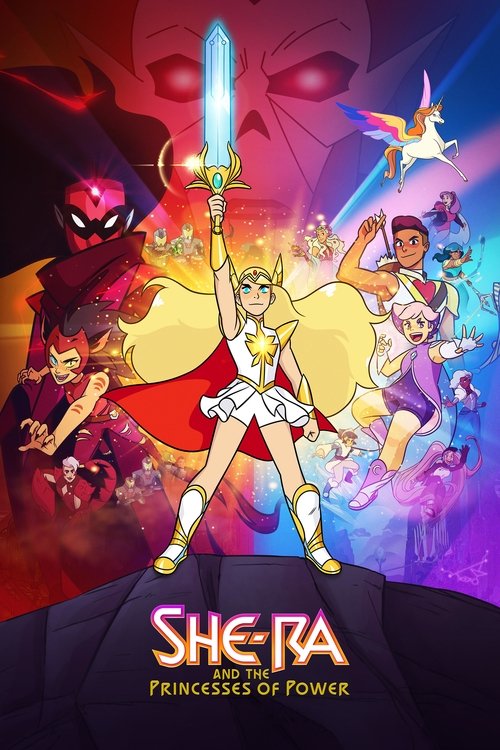
She-Ra and the Princesses of Power
"A hero will rise."
Overview
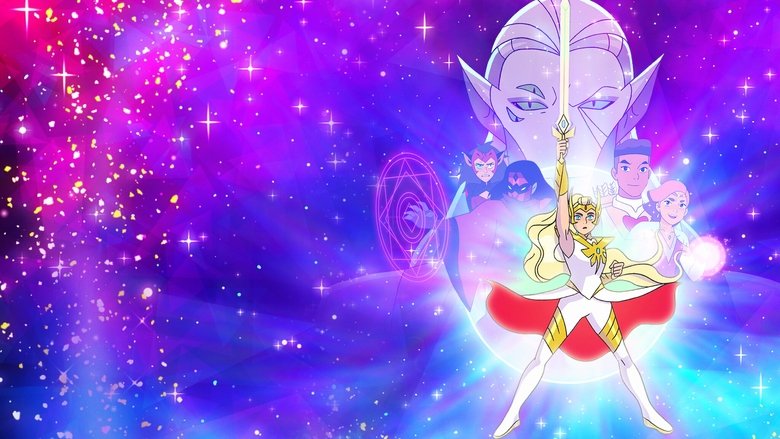
"She-Ra and the Princesses of Power" is a complete reimagining of the 1980s classic. The series follows Adora, an orphan raised by the tyrannical Horde. Her life changes forever when she discovers a magical sword that transforms her into the legendary warrior She-Ra, the Princess of Power. Upon realizing the Horde's evil, Adora defects and joins a fledgling rebellion formed by other magical princesses.
Across its five seasons, the series chronicles Adora's journey to unite the princesses of Etheria, master her powers, and lead the Great Rebellion against the Horde's forces, led by the menacing Hordak. The central conflict is deeply personal, focusing on Adora's fractured and complex relationship with her childhood best friend, Catra, who remains with the Horde and rises as her archenemy. The story expands from a planetary rebellion to a galactic war against the cosmic tyrant Horde Prime, forcing heroes and villains alike to confront their past traumas, forge unexpected alliances, and discover that their greatest strength lies in their bonds with each other.
Core Meaning
The core meaning of "She-Ra and the Princesses of Power" is that true strength is found not in destiny or innate power, but in the love, vulnerability, and connections we forge with others. The series deconstructs the traditional 'chosen one' narrative, arguing that heroism is a choice made every day. It powerfully asserts that no one is beyond redemption and that healing from trauma—both personal and generational—is possible through empathy and forgiveness. Ultimately, the show's message is one of radical optimism, championing the idea that love, in its many forms, is the most powerful force for change in the universe.
Thematic DNA
Love, Friendship, and Found Family
This is the central theme of the entire series. Adora's power as She-Ra is directly tied to her connections with her friends, Glimmer and Bow, who form the "Best Friend Squad." Their unwavering support is contrasted with Adora's toxic upbringing in the Horde. The series explores many forms of love, from the platonic bonds of the rebellion to the complicated, romantic, enemies-to-lovers arc between Adora and Catra, which forms the emotional backbone of the show. The ultimate victory is achieved not through brute force, but through an act of love that heals both Adora and the world.
Redemption and Forgiveness
The series presents a nuanced take on villainy, suggesting that people are products of their environment and trauma. Characters like Catra, Hordak, and Shadow Weaver are not simply evil; they are deeply wounded individuals whose harmful actions stem from abuse and a desperate need for validation. Catra's arc is a powerful exploration of the difficult, non-linear path to redemption, showing that it requires confronting one's mistakes and actively working to be better. Even Shadow Weaver, the abusive mother figure to Adora and Catra, makes a final sacrificial choice, complicating her legacy.
Destiny vs. Choice and Identity
Adora's journey is a constant struggle against a predetermined destiny. She is told she must be She-Ra and that her purpose is to be a weapon. A significant part of her arc involves rejecting this imposed role and defining her own identity and purpose outside of the sword and the expectations of others. The series champions the idea that individuals can forge their own paths, free from the weight of expectations or past mistakes. This theme is also explored through Catra, who spends much of the series defined by her reactive opposition to Adora before finally choosing her own path.
LGBTQ+ Representation and Normalization
The series is groundbreaking for its casual and comprehensive inclusion of LGBTQ+ characters and relationships. It features multiple queer couples, a non-binary character (Double Trouble) voiced by a non-binary actor, and a central romance between two female leads. Crucially, the world of Etheria is presented as one where queer identities are completely normalized; there are no coming-out narratives or moments of prejudice. This makes the show a landmark in children's animation, presenting a world where love and identity are accepted without question.
Character Analysis
Adora
Aimee Carrero
Motivation
Initially, Adora's motivation is a simple desire to do the right thing and protect people after seeing the Horde's cruelty. This evolves into a deeper, more personal motivation: protecting her found family—Bow, Glimmer, and the other princesses. Her most complex motivation is her fraught connection to Catra; a mix of guilt, hope, and love drives many of her actions, as she never truly gives up on the idea that Catra can be saved.
Character Arc
Adora begins as a loyal, indoctrinated Horde soldier, eager to please her abusive mother figure, Shadow Weaver. After finding the Sword of Protection, her arc becomes one of deprogramming and self-discovery. She struggles immensely with the weight of being She-Ra, believing her worth comes only from what she can do for others. Over the series, she learns to question authority, embrace her own choices, and understand that her true strength comes from her love for her friends. Her journey culminates in her shattering the sword, rejecting a pre-written destiny, and embracing a power born of love for Catra, becoming a hero on her own terms.
Catra
AJ Michalka
Motivation
Catra's primary motivation is to prove her worth, born from a lifetime of being told she was second-best to Adora by Shadow Weaver. She wants to be powerful so no one can ever hurt her again. This manifests as a desperate need to defeat Adora. As the series progresses, this destructive motivation slowly erodes, replaced by a desire to protect the few people she still cares about, culminating in her love for Adora becoming her reason to fight for something instead of against it.
Character Arc
Catra's arc is one of the most acclaimed in modern animation. Starting as Adora's bitter and abandoned best friend, she channels her pain and feelings of inadequacy into a ruthless ambition to climb the Horde's ranks and prove she is better than Adora. Her journey is a downward spiral fueled by trauma and self-sabotage; she pushes away everyone who cares for her (Scorpia, Entrapta) and makes increasingly destructive choices, nearly ending the world in Season 3. Her redemption begins in Season 5 after being captured by Horde Prime. She is forced to confront her actions and finally accepts vulnerability, sacrificing herself for Glimmer and eventually admitting her love for Adora, which ultimately saves the universe.
Glimmer
Karen Fukuhara
Motivation
Glimmer is driven by a desire to live up to her parents' legacy and protect her kingdom. She is fiercely dedicated to the Rebellion and wants to prove herself as a capable leader. After her mother's death, her motivation is clouded by grief and a desperate need to win the war at any cost, fearing she will fail as Queen. Her core motivation remains the protection of her loved ones, which eventually brings her back from her darker impulses.
Character Arc
Glimmer starts as the energetic but impulsive leader of the Rebellion, often clashing with her mother, Queen Angella, over strategy. She is defined by her fierce loyalty to her friends. After her mother's sacrifice at the end of Season 3, Glimmer is forced into the role of Queen and struggles under the immense pressure. This leads her down a darker path in Season 4, where her grief and desperation cause her to make reckless decisions, such as attempting to use the Heart of Etheria as a weapon, which alienates her from Adora and Bow. Her capture by Horde Prime in Season 5 forces a period of introspection, allowing her to reconcile with her friends and mature into a wiser, more compassionate leader.
Bow
Marcus Scribner
Motivation
Bow's motivation is simple and unwavering: to help people and keep his friends safe. He believes in the righteousness of the Rebellion and the power of friendship. He is driven by a deep sense of loyalty and a belief that any problem can be solved with teamwork, a well-placed arrow, and open communication. He wants to make the world a better place and ensure his found family stays together.
Character Arc
Bow is the steadfast heart of the Best Friend Squad. His arc is less about dramatic change and more about reaffirming his core values in the face of escalating conflict. He is the group's moral compass, tech expert, and emotional anchor. His main personal conflict involves revealing his life as a rebel to his historian fathers, who believe he is studying to follow in their footsteps. Throughout the series, Bow is the one who works hardest to keep the group together, mediating between Adora and Glimmer, and always advocating for trust and communication. In the final season, he steps up as a key strategist and leader for the Rebellion, inspiring the people of Etheria with a broadcasted speech.
Symbols & Motifs
The Sword of Protection
The sword initially symbolizes destiny, power, and the burden of being the hero. It is the conduit for Adora's transformation into She-Ra. However, it also represents a loss of self, as Adora fears she is nothing without it. Its destruction at the end of Season 4 is a pivotal moment, symbolizing Adora's need to find her own power, separate from the weapon and its predetermined purpose.
The sword is central to the first four seasons. Adora finds it in Season 1, transforming her life. Throughout the series, she learns about its history and the legacy of past She-Ras. When she shatters it to save Etheria from being turned into a superweapon, it forces her to find strength within herself and her relationships, leading to a more powerful, authentic version of She-Ra in the final season.
The Heart of Etheria
The Heart of Etheria symbolizes the planet's immense magical power, but also the danger of power that is exploited and controlled. It was a project by the First Ones to turn the entire planet into a weapon, representing a legacy of colonialism and abuse of nature. Its eventual release and healing symbolizes liberation and the restoration of balance.
The Heart of Etheria is a major plot point in the later seasons. The rebellion discovers that the planet itself is a superweapon that Hordak and later Horde Prime wish to control. Glimmer nearly activates it in a moment of desperation in Season 4. In the series finale, Adora must reach the Heart not to wield it as a weapon, but to release its magic, healing the planet.
Masks
Masks symbolize hidden identities, emotional armor, and the duality of characters. Shadow Weaver's mask hides her disfigured face and represents her turn from Light Spinner to a creature of darkness and manipulation. Catra's mask in the first three seasons signifies her role as a Horde soldier and her refusal to show vulnerability. Hordak's armor is a life-support system but also a mask for his physical frailty and deep-seated insecurity.
Shadow Weaver is almost never seen without her mask until her final moments, where she unmasks before sacrificing herself for Adora and Catra, signifying a moment of genuine, unveiled feeling. Catra discards her mask as she becomes more powerful and less reliant on the Horde's structure, though her emotional walls remain. Hordak's reliance on his armor decreases as he forms a connection with Entrapta, showing his true self more often.
Memorable Quotes
For the honor of Grayskull!
— Adora
Context:
Adora says this for the first time in Season 1, Episode 1, "The Sword Part 1," when she first transforms into She-Ra. She shouts it throughout the series whenever she transforms, and it becomes a rallying cry for the princesses.
Meaning:
This is Adora's transformation phrase, the iconic line from the original series. In this reboot, it represents her acceptance of her new identity and the legacy she has inherited. It's a call to arms and a symbol of hope for the Rebellion.
Hey, Adora.
— Catra
Context:
Catra says this in nearly every encounter with Adora across all five seasons. Its first notable use as a taunt is in Season 1, Episode 2, "The Sword Part 2." Its final, tender use is in Season 5, as they reconcile.
Meaning:
This simple greeting becomes laden with meaning throughout the series. Initially a casual, intimate phrase from their childhood, Catra turns it into a taunt, a verbal weapon filled with bitterness and rivalry. Its tone shifts with their relationship, eventually returning to a sign of affection in the final season, symbolizing the full circle of their bond.
You're worth more than what you can give to other people. You deserve love too.
— Mara (the previous She-Ra)
Context:
Adora hears this message from a recording of Mara in Season 4, Episode 9, "Hero." The message resonates deeply and becomes a breakthrough for Adora, helping her to finally start deconstructing her self-sacrificial complex. She recalls this lesson in the finale.
Meaning:
This line is the thematic core of Adora's personal journey. Spoken to her by her predecessor, Mara, it directly challenges Adora's deeply ingrained belief that her value is tied only to her utility as She-Ra. It's a powerful statement about self-worth, self-love, and the right to exist for oneself, not just for others.
Don't you get it? I love you! I always have. So please, just this once, stay.
— Catra
Context:
This is said in the series finale, Season 5, Episode 13, "Heart Part 2." Adora is dying after trying to activate the Heart of Etheria's failsafe. Catra's confession and their subsequent kiss triggers Adora's final, most powerful transformation into She-Ra.
Meaning:
This is the emotional climax of the entire series. It is the moment of ultimate vulnerability for Catra, who has spent five seasons building walls and hiding her true feelings behind anger and ambition. Her confession of love is what allows Adora to access her powers, heal herself, and save the universe, proving that love is the show's ultimate source of power.
Episode Highlights
Princess Prom
This episode is a fan favorite that establishes the deep, complicated dynamic between Adora and Catra. While infiltrating a formal ball for the princesses, Adora and Catra share a dance that is emotionally charged with their history and conflict. It solidifies their rivalry while also highlighting their undeniable chemistry and lays the groundwork for their future romantic arc. Creator ND Stevenson and his partner also make a cameo appearance.
"Princess Prom" was one of the first episodes to signal to the audience that the relationship between Adora and Catra was central to the show's emotional core and would be far more complex than a simple hero-villain dynamic.
The Portal
A devastating and pivotal episode. Catra, in a moment of spiteful rage, opens a portal that threatens to destroy reality. Queen Angella sacrifices herself to close it, a loss that profoundly impacts Glimmer and the rest of the series. Adora and Catra have a brutal, emotionally raw fight within the collapsing reality, seemingly destroying any hope of reconciliation.
This episode marks a point of no return for several characters. Angella's death forces Glimmer into a leadership role she isn't ready for, fueling her desperate actions in Season 4. It also marks the lowest point in Adora and Catra's relationship, solidifying Catra's role as a major villain.
Destiny (Part 2)
The Season 4 finale radically changes the show's status quo. To stop Light Hope from activating the Heart of Etheria superweapon, Adora shatters the Sword of Protection, seemingly losing her ability to transform into She-Ra. Meanwhile, Glimmer and Catra are captured by the galactic tyrant Horde Prime, setting up the final season's cosmic stakes.
This episode completely upends the central premise. By destroying the sword, Adora must find a new source of power. The arrival of Horde Prime elevates the conflict from a planetary war to a galactic threat, forcing an eventual, uneasy alliance between the heroes and a broken Catra.
Save the Cat
This episode is a turning point for Catra's redemption and the evolution of She-Ra. After Catra sacrifices herself to save Glimmer, Adora risks everything to rescue her from Horde Prime's ship. In her desperation to save Catra, Adora transforms into a new, more powerful She-Ra without the sword, fueled entirely by her love and protective instincts.
It's the first time Catra makes a truly selfless choice and the first time Adora's transformation is shown to be independent of the sword, tying her power directly to her love for Catra. This episode firmly places Catra on the path to redemption and redefines the source of She-Ra's power.
Heart (Part 1 & 2)
The two-part series finale brings all the character arcs and themes to a powerful conclusion. As Horde Prime attempts to use the Heart of Etheria to wipe out all magic, Adora must reach its core to activate a failsafe. The final confrontation is not a physical battle but an emotional one. Catra's confession of love for a dying Adora allows her to transform, heal, and release the magic of Etheria, defeating Horde Prime and restoring life to the planet.
The finale confirms the central romance between Adora and Catra, making it a landmark moment for LGBTQ+ representation in animation. It beautifully pays off five seasons of character development and thematic exploration, ending the series on a message of hope, love, and the power of found family.
Philosophical Questions
Are we defined by our past or by the choices we make?
The series explores this question through nearly every major character. Adora and Catra were both raised as child soldiers in an abusive environment. Adora chooses to leave and forge a new path, but is constantly haunted by her past with the Horde. Catra initially seems defined by her trauma, making choices based on anger and a fear of abandonment. Her entire arc is a struggle to see if she can choose a different future, culminating in her decision to save Glimmer and later join the fight against Horde Prime, proving that one's past does not have to be a life sentence.
What is the true nature of heroism?
"She-Ra" deconstructs the idea of a flawless, destined hero. Adora believes being She-Ra means being an infallible, self-sacrificing symbol. The show argues this is a toxic and unsustainable model of heroism. True heroism, the series suggests, lies in vulnerability, relying on others, admitting mistakes, and choosing to do good even when it's difficult. Mara, the previous She-Ra, teaches Adora that she is worth more than her utility as a hero, and the final victory is achieved not through sacrifice, but through an act of emotional honesty and love.
Can systems of oppression be fought without becoming like the oppressor?
This is explored most deeply in Season 4 through Glimmer. After her mother's death and her ascension to the throne, Glimmer becomes desperate to defeat the Horde. She begins to adopt more authoritarian and secretive methods, mirroring the control exerted by the Horde. She lies to her friends and makes a dangerous choice to activate the Heart of Etheria, believing the ends justify the means. Her arc serves as a cautionary tale, demonstrating how the pressures of war and power can corrupt even the most well-intentioned leaders.
Alternative Interpretations
While the series is widely celebrated, some critical interpretations have explored potential ambiguities. One perspective examines the show through an anti-authoritarian lens, questioning the nature of the Princess Alliance itself. This view suggests that while the Horde is explicitly tyrannical, the Rebellion is an inherited monarchy, and the show doesn't fully explore the power dynamics of a world ruled by a magical aristocracy. The ultimate goal is to restore a queen to power, not to dismantle a system of monarchy.
Another interpretation focuses on the ending, with some viewers finding Shadow Weaver's sacrificial redemption too neat. They argue that her final act, while heroic, doesn't fully reckon with the decades of psychological abuse she inflicted on Adora and Catra. Creator ND Stevenson himself has stated he views her sacrifice as a somewhat "selfish" act, as it allows her to exit the story as a hero without having to do the difficult, long-term work of atonement that Catra is forced to undertake.
Cultural Impact
"She-Ra and the Princesses of Power" had a significant cultural impact, particularly in the realm of children's animation and LGBTQ+ representation. Premiering in 2018, it arrived at a time when conversations about diversity in media were gaining momentum. The series was immediately praised for its deep and nuanced storytelling, character-driven plot, and for moving beyond the episodic, merchandise-driven formula of its 1980s predecessor.
Its most profound influence was its unapologetic and normalized portrayal of LGBTQ+ characters and themes. Unlike earlier shows that relegated queer representation to subtext or minor characters, "She-Ra" built its central emotional arc around the love story between its female protagonist, Adora, and female anti-villain, Catra. The series finale, which featured their love confession and kiss, was hailed as a watershed moment for queer representation in all-ages media. The show created a world where different sexualities and gender identities were accepted without comment, providing a powerful and affirming vision for young audiences.
Critics and audiences lauded the show's complex character arcs, particularly that of Catra, whose journey through trauma, villainy, and redemption was compared to iconic characters like Prince Zuko from "Avatar: The Last Airbender." The series also received acclaim for its diverse cast of characters, featuring a wide array of body types and ethnicities, breaking from the uniform designs often seen in older cartoons. While some long-time fans of the original were initially critical of the new character designs, the show quickly won over a large and passionate fanbase, proving the demand for inclusive and emotionally intelligent storytelling. Its legacy is one of pushing boundaries and setting a new, higher standard for representation in family entertainment.
Audience Reception
"She-Ra and the Princesses of Power" received critical acclaim throughout its run and cultivated a deeply passionate fanbase. Upon its debut, there was some initial backlash from a segment of original 1980s fans who disliked the redesigned, less sexualized character models and the more serialized, character-focused storytelling. However, this was largely overshadowed by overwhelmingly positive reviews from critics and new audiences.
Critics praised the series for its rich world-building, compelling character development, and sophisticated themes of trauma, abuse, and redemption. The complex, central relationship between Adora and Catra was frequently cited as the show's greatest strength. As the seasons progressed, praise grew, with the final two seasons being particularly lauded for their emotional depth and satisfying conclusions to long-running arcs. The fifth and final season holds the highest-rated episodes of the series on IMDb.
The audience reception was marked by intense online engagement and a thriving fan community. The show's groundbreaking LGBTQ+ representation was a major point of praise, with many viewers feeling seen and validated in a way they hadn't been by children's media before. The confirmation of Adora and Catra's romance in the finale was celebrated as a historic moment. While some viewers found the pacing of early seasons to be slow, the consensus is that the series provided a deeply emotional and thematically rich story that resonated with audiences of all ages.
Interesting Facts
- The series was developed by ND Stevenson, an acclaimed cartoonist known for works like "Nimona" and "Lumberjanes". He served as the showrunner and executive producer.
- The show has an all-female writers' room, and Marcus Scribner (Bow) was the only man in the regular voice cast.
- The character of Entrapta is widely interpreted by fans and creators as being on the autism spectrum. One of the show's storyboard artists, who is autistic himself, helped shape her mannerisms and acting.
- In the original 1985 series, Adora is He-Man's twin sister. The reboot deliberately removed He-Man from the story to allow She-Ra to stand entirely on her own as a hero.
- Double Trouble, a non-binary character introduced in Season 4, is voiced by non-binary actor and activist Jacob Tobia.
- Creator ND Stevenson and his partner, Molly Ostertag, have a brief animated cameo in the Season 1 episode "Princess Prom".
- There was a running joke among the show's staff that the bumbling Horde soldier Kyle was secretly He-Man but just never discovered his powers.
Easter Eggs
Adora's transformation phrase, "For the honor of Grayskull!", is a direct reference to the original 1985 series, where Castle Grayskull was a key location in the He-Man and She-Ra lore.
This is a nostalgic nod to the source material that honors the original series while being integrated into the new show's unique mythology. It connects the new generation of fans with the property's history.
A character named Madame Razz appears as a mysterious, time-displaced crone. She occasionally calls Adora by the name "Mara," foreshadowing the discovery of the previous She-Ra.
Madame Razz was a prominent comic-relief character in the original series. In the reboot, she is reimagined as a more tragic and pivotal figure whose confusing pronouncements are actually crucial clues to the show's deeper lore about the First Ones and She-Ra's legacy.
In Season 5, a creature named Melog is introduced, who can shapeshift and reflects Catra's emotions. The name 'Melog' is 'Golem' spelled backward.
In the original 1985 series, Melog was a magical mud creature who was essentially a clone of She-Ra. In the reboot, Melog is instead tied to Catra's story, acting as what the creator called a "therapy animal" to help her process her emotions.
⚠️ Spoiler Analysis
Click to reveal detailed analysis with spoilers
Frequently Asked Questions
Explore More About This Movie
Dive deeper into specific aspects of the movie with our detailed analysis pages
Comments (0)
No comments yet. Be the first to share your thoughts!