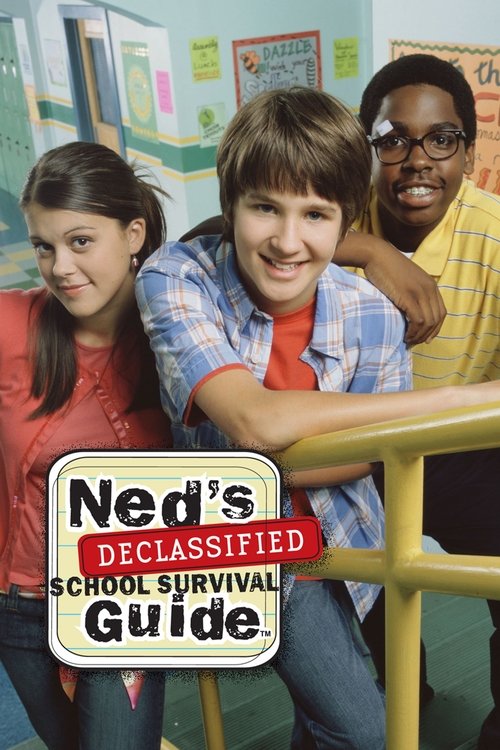
Ned's Declassified School Survival Guide
Overview
"Ned's Declassified School Survival Guide" chronicles the adventures of Ned Bigby and his best friends, Jennifer "Moze" Mosely and Simon "Cookie" Nelson-Cook, as they navigate the chaotic world of James K. Polk Middle School. To survive the daily challenges—from bullies and unfair teachers to embarrassing moments and first crushes—Ned creates a comprehensive survival guide filled with tips and tricks. Each episode tackles a specific school-related topic, like popularity, grades, or sports, with Ned breaking the fourth wall to share his hard-earned wisdom directly with the audience.
The series follows the trio from the first semester of seventh grade through their entire eighth-grade year. Ned's main goal is to help himself and his classmates cope with the universal struggles of adolescence. The show blends slapstick humor, surreal cutaways, and genuine heart, creating a unique, almost cartoonish live-action experience that explores the importance of friendship as the ultimate survival tool.
Core Meaning
The core meaning of "Ned's Declassified School Survival Guide" is that the often terrifying and confusing journey through adolescence can be successfully navigated with creativity, humor, and, most importantly, unwavering friendship. The series posits that no problem—whether it's a pop quiz, a social faux pas, or a tyrannical teacher—is insurmountable when faced with the support of loyal friends. It demystifies the middle school experience, suggesting that while there are no perfect answers, the act of trying, learning from mistakes, and sharing that knowledge is what truly matters. The "guide" itself becomes a metaphor for collaborative problem-solving and the idea that shared experience is the most valuable resource for growing up.
Thematic DNA
Friendship and Loyalty
This is the central theme of the series. The bond between Ned, Moze, and Cookie is the anchor in the chaotic sea of middle school. They consistently support each other through various schemes, failures, and triumphs. Their friendship is tested by shifting social dynamics, romantic interests, and individual pursuits, but it always proves resilient. The evolution of their dynamic, particularly the budding romance between Ned and Moze, is a key storyline that demonstrates how friendship can deepen and change over time without breaking.
Navigating Adolescence
The show is a literal guide to the trials of early teen years. It covers a wide array of topics central to this life stage: developing crushes, dealing with bullies (like the recurring antagonist Loomer), managing academic pressure, and struggling with self-identity. Each tip Ned offers is a direct acknowledgment of these universal anxieties, framing them as manageable obstacles rather than insurmountable fears. The series normalizes the awkwardness and uncertainty of this period, offering reassurance and comedic relief.
Problem-Solving and Ingenuity
Faced with middle school's absurd challenges, the trio consistently employs creative and often outlandish solutions. Cookie's technological gadgets, Moze's practicality and athletic prowess, and Ned's clever, fourth-wall-breaking strategies highlight a theme of resourcefulness. The show celebrates thinking outside the box, even when the plans go spectacularly wrong, suggesting that the effort and creativity are valuable in themselves.
Identity and Self-Discovery
Throughout the series, the main characters explore who they are and who they want to be. Moze struggles with being seen as a "tomboy" and tries to cultivate more female friendships and explore her femininity. Cookie often tries on different personas to be seen as "cool." Ned, as the everyman, is constantly trying to balance his own needs with his desire to help everyone else. Their journeys reflect the common adolescent search for an identity separate from their childhood selves and peer group.
Character Analysis
Ned Bigby
Devon Werkheiser
Motivation
Ned's primary motivation is to navigate the pitfalls of middle school without epic failure and to help his friends and classmates do the same. He is driven by a desire to deconstruct and understand the unwritten rules of school life. As the series progresses, his motivation also becomes more personal, particularly in his efforts to win the affection of his longtime crush, Suzie Crabgrass, and later, to sort out his feelings for Moze.
Character Arc
Initially, Ned is an average kid who is simply trying to survive seventh grade. His creation of the guide starts as a personal project but evolves into a school-wide mission. Across the seasons, he grows from a reactive problem-solver into a more confident and proactive leader. His arc is defined by his increasing understanding that the guide's tips are not rigid rules but flexible advice, and that true survival depends on friendship. His long-developing crush on Moze forces him to confront his own feelings and vulnerabilities, moving beyond being just a helpful friend to becoming a more mature young man who understands the complexities of relationships.
Jennifer 'Moze' Mosely
Lindsey Shaw
Motivation
Moze is motivated by a desire to excel, whether it's in sports (especially volleyball) or academics. She is also driven by a need to find her place socially, particularly in making female friends so she doesn't have to rely solely on Ned and Cookie. She seeks a balance between her competitive nature and her desire for a normal, less chaotic school experience.
Character Arc
In season one, Moze's primary struggle is her identity as a "tomboy" who is better friends with boys than girls. Her arc across the series is one of embracing her strengths while also exploring her femininity and building strong female friendships, notably with Suzie Crabgrass. She develops from being "one of the guys" into a well-rounded individual who is confident in both her athletic abilities and her social life. Her romantic journey, from crushes on jocks like Seth Powers to her eventual realization of her feelings for Ned, marks her growth in understanding emotional intimacy beyond simple friendship.
Simon 'Cookie' Nelson-Cook
Daniel Curtis Lee
Motivation
Cookie is motivated by his love for technology and his desire to use it to solve problems, though often with overly complicated and disastrous results. He is also driven by a deep-seated desire to be seen as "cool" and to win the affection of his crushes. His loyalty to Ned and Moze is unwavering, and he often uses his skills to help them with their schemes.
Character Arc
Cookie begins the series as a stereotypical tech nerd, relying heavily on his gadgets for almost every situation. His character arc involves him slowly learning to step out from behind his technology and engage with the world more directly. He becomes more confident, takes on various alter egos, and learns valuable, albeit often painful, lessons about social interaction and romance. His long-standing crush on the brainy Lisa Zemo, and their eventual relationship after she undergoes a makeover, shows his ability to see beyond superficiality (and his own social awkwardness).
Gordy
Daran Norris
Motivation
Gordy is primarily motivated by a desire to do as little work as possible and to capture the school weasel. However, he is also motivated by a hidden affection for the main trio, often stepping in to help them out of a jam, providing tools, advice, or a convenient distraction, before quickly returning to his slacking.
Character Arc
Gordy, the school's lazy janitor, does not have a traditional character arc of growth but rather serves as a consistent, albeit eccentric, source of support and comic relief for the trio. His development is less about personal change and more about the audience's deepening understanding of his character. He is revealed to be more than just a janitor; he is a confidant, a reluctant helper, and a surprisingly wise (in his own strange way) mentor figure who has given up on catching the school's elusive weasel. He remains a perpetual man-child, representing an adult who never quite escaped the middle school mindset.
Symbols & Motifs
The Guide
The survival guide itself symbolizes preparedness, shared wisdom, and the attempt to impose order on the chaos of adolescence. It represents the idea that knowledge and experience can be powerful tools for navigating life's challenges. It is also a manifestation of Ned's desire to help others and his own process of learning and growing.
The guide is the central framing device for the entire series. In every episode, Ned adds new tips based on his experiences. He directly addresses the audience, sharing these tips as he writes them. The physical notebook is often seen, and the tips frequently appear as on-screen text, making it a constant visual and narrative motif.
The Weasel
The recurring, often unseen weasel that roams the halls of James K. Polk Middle School symbolizes the unpredictable, chaotic, and absurd nature of their environment. It represents the wild, untamable elements of school life that defy rules and logic, often appearing at the most inconvenient times to disrupt the students' plans.
The weasel is a running gag throughout the series. It is blamed for various mishaps, gets elected to student council, and is often pursued by the janitor, Gordy. Its presence underscores the show's surreal and cartoonish tone, reminding the audience that not everything in middle school can be controlled or explained by a guide.
Coconut Head's Haircut
Coconut Head's iconic, unchanging, and ridiculous haircut symbolizes social awkwardness and the fear of being unable to change one's defining (and sometimes embarrassing) features during adolescence. He represents the quintessential kid who is stuck in a certain social standing, despite his friendly nature.
Coconut Head is a recurring background and supporting character. His haircut is his most prominent feature and the source of his nickname. He is part of the fabric of the school, a constant reminder of the social labels that can be hard to shake in the rigid hierarchy of middle school.
Memorable Quotes
During the first day: just relax, be yourself and don't panic! Try to make new friends and get to know your teachers for the year.
— Ned Bigby
Context:
This is a representative tip that reflects the advice given in many episodes, particularly those focused on new experiences like the first day of school (Season 1, Episode 1). Ned often delivers such lines directly to the camera, establishing the show's unique format.
Meaning:
This quote, an archetypal tip from the guide, encapsulates the show's core message: middle school is intimidating, but manageable. It's a direct piece of advice that is both practical and reassuring, setting the helpful and optimistic tone of the entire series.
Grades are important, but not the most important thing in life.
— Ned Bigby
Context:
This line is indicative of the advice Ned gives in academically-focused episodes, such as "Cheaters and Bullies" or "Tests." It speaks to the show's philosophy of balancing schoolwork with life's other lessons.
Meaning:
This quote provides a crucial perspective for the show's young audience, who are often under immense academic pressure. It reinforces the theme that personal growth, character, and well-being are ultimately more important than test scores, a comforting message for any student who has ever struggled in a class.
Everyone needs a best friend.
— Ned Bigby
Context:
A sentiment expressed throughout the series in various forms, this quote sums up the resolution of many episodes where the trio's bond is tested but ultimately triumphs. It's the unspoken moral of nearly every story.
Meaning:
This simple statement is the fundamental thesis of the series. It underscores the primary theme that friendship is the most essential tool for survival. It validates the central relationship between Ned, Moze, and Cookie and elevates their bond as the show's true heart.
Episode Highlights
First Day / Lockers
The series premiere perfectly establishes the show's premise, characters, and unique comedic style. Ned begins his guide on the chaotic first day of 7th grade, dealing with finding the right classes and a good locker. The episode introduces the core trio's dynamic: Ned's everyman struggles, Moze's desire to make girl friends, and Cookie's tech-heavy solutions.
This episode sets the tone for the entire series, introducing the fourth-wall-breaking format, the on-screen tips, and the blend of relatable middle school anxiety with surreal, cartoonish humor. It lays the groundwork for all future character arcs and the central concept of the guide.
Crushes / Dances
A quintessential episode focusing on two major middle school milestones. Ned tries to figure out how to approach his crush, Suzie Crabgrass, while Moze deals with her own crush on the athletic Seth Powers. The episode culminates in a school dance, a classic setting for social triumphs and disasters.
This episode is significant for establishing the primary romantic plotlines that will evolve throughout the series. It highlights the awkwardness and excitement of first crushes and serves as an early, key exploration of the show's romance themes.
Secrets / School Car Wash
Moze tells Ned a secret: she's tired of being known as "the girl who hangs with Ned and Cookie" and is considering trying out for cheerleading with Suzie. This causes a rift between the friends, as Ned feels betrayed. The B-plot involves a disastrous school car wash.
This episode marks a crucial point in Moze's character arc, directly addressing her internal conflict about her identity and friendships. It's a moment of significant growth for her and a test of the trio's bond, forcing them to confront how they are perceived as a group.
The New Kid / The Science Fair
As the gang enters eighth grade, Ned is mistaken for a bully on the first day. Meanwhile, Moze tries to befriend a new teacher who instructs via webcam, and Cookie discovers that Lisa Zemo has had a stunning makeover over the summer, instantly falling for her.
This episode kicks off the final season by showing how much the characters have and haven't changed. The transformation of Lisa Zemo and Cookie's subsequent infatuation becomes a major plotline for Season 3, signaling a shift towards more mature romantic storylines.
Field Trips, Permission Slips, Signs & Weasels
The one-hour series finale is set during the last week of eighth grade and a major field trip. The central plotlines of the entire series are resolved: the love triangle between Ned, Moze, and Suzie comes to a head, and Ned must finish the guide before leaving middle school forever.
This finale provides a deeply satisfying conclusion to the series. It resolves the long-running "will-they-won't-they" between Ned and Moze, gives closure to the other characters' arcs, and fulfills the show's premise as Ned finally completes and distributes the titular guide. It's a poignant and funny farewell to middle school.
Philosophical Questions
Can life's chaos be ordered by a set of rules?
The entire premise of the show revolves around this question. Ned attempts to create a definitive guide to navigating middle school, believing that with the right tip for every situation, survival is guaranteed. However, the series constantly demonstrates the limits of this approach. Ned's tips often backfire or are insufficient to handle the sheer unpredictability of human behavior and absurd events (like a rampaging weasel). The show ultimately suggests that while rules and guides can be helpful starting points, true wisdom comes from adaptability, improvisation, and understanding that some experiences are too chaotic to be 'declassified.' Friendship, not a rulebook, is the most reliable tool.
What is the relationship between identity and social labels?
The characters in "Ned's Declassified" are constantly grappling with the labels assigned to them. Moze is 'the jock' or 'the tomboy,' Cookie is 'the nerd,' and Loomer is 'the bully.' A significant portion of their character development involves either trying to escape these labels or learning to embrace them on their own terms. Moze's journey to make female friends and Cookie's attempts to be 'cool' are direct explorations of this conflict. The show asks whether we are defined by how others see us or if we can forge our own identities despite the social pressures of a rigid environment like middle school.
Alternative Interpretations
While the show is straightforward on the surface, some viewers have interpreted it through different lenses. One interpretation sees the entire series as a figment of Ned's imagination. In this view, the surreal events, cartoonish characters, and the guide itself are all part of an elaborate fantasy Ned has created to cope with the more mundane and harsh realities of middle school. The fourth-wall breaks are not just a narrative device but are literally Ned talking to himself, organizing his thoughts in a way that makes his world feel more manageable and heroic.
Another reading focuses on the show as a gentle satire of the self-help genre. Ned's tips, while often useful, sometimes lead to more chaos, and the most absurd situations are rarely solved by a simple list of rules. This suggests the show could be subtly mocking the idea that life's complex social problems can be solved with a simple guidebook. The true 'survival' comes from the messy, unpredictable process of trying, failing, and relying on friends—not from the declassified guide itself.
Cultural Impact
"Ned's Declassified School Survival Guide" premiered in 2004, during a peak era for live-action Nickelodeon sitcoms. It distinguished itself from contemporaries like "Drake & Josh" and "Zoey 101" with its unique fourth-wall-breaking format and its hyper-stylized, almost cartoonish aesthetic. Creator Scott Fellows' background in animation was evident in the show's frantic energy, quick cuts, and reliance on sound effects, which set it apart from the more traditional multi-cam sitcoms of the time.
Critically, the show was well-regarded for its cleverness and heart. The Los Angeles Times called it "one of the best series on television" upon its finale, praising its ability to creatively play with genre conventions. While it may not have achieved the same level of mainstream fame as some other Nickelodeon shows, it developed a devoted cult following. Audiences connected with its genuine and humorous approach to the anxieties of middle school. For many young viewers in the mid-2000s, the show's tips felt like legitimate, helpful advice for navigating their own lives.
The series' legacy endures through nostalgia, particularly for the millennial and older Gen Z audience that grew up with it. Its continued popularity on streaming platforms and the launch of the cast's rewatch podcast in 2023 are testaments to its lasting impact. "Ned's Declassified" remains a beloved piece of 2000s pop culture, remembered for its unique style, relatable characters, and its genuinely helpful, heartfelt message that with the right friends, you can survive anything.
Audience Reception
"Ned's Declassified School Survival Guide" has been overwhelmingly received with affection and nostalgia by its target audience. During its initial run, it was a solid performer for Nickelodeon, resonating with pre-teens who found its content highly relatable. Viewers praised the show for its unique and creative premise, its genuinely funny and often surreal humor, and its lovable cast of characters. Many fans appreciated that the tips, while presented comically, often contained kernels of legitimate advice for dealing with school life.
Points of praise consistently center on the strong chemistry of the three leads and the show's positive, heartfelt tone. Unlike some other teen sitcoms that relied more heavily on drama or romance, "Ned's" was celebrated for prioritizing friendship and clever, situational comedy. There is very little significant criticism or controversy associated with the series; it is widely regarded as a wholesome and entertaining show. The evolution of audience opinion has been one of deepening nostalgia, with many who grew up watching the show now considering it a classic of 2000s children's television. The recent success of the cast's rewatch podcast further highlights the enduring fondness the audience has for the series.
Interesting Facts
- The creator of the series, Scott Fellows, was also the head writer for the animated Nickelodeon show "The Fairly OddParents" and the creator of "Johnny Test" and "Big Time Rush".
- The show's visual style, with its fast pacing, sound effects, and exaggerated character reactions, was heavily influenced by cartoons, which was a deliberate choice by creator Scott Fellows, who had a background in animation.
- During the filming of the show, lead actor Devon Werkheiser (Ned) was the same age as his character, progressing from sixth to eighth grade in real life alongside the show's timeline.
- A spin-off series that would have followed Ned's adventures in high school was planned, but it never entered production because the main actors and the creator were busy with other projects.
- In 2023, the three main actors—Devon Werkheiser, Lindsey Shaw, and Daniel Curtis Lee—launched a podcast called "Ned's Declassified Podcast Survival Guide," where they rewatch episodes of the show and share behind-the-scenes stories.
- The school the characters attend, James K. Polk Middle School, is named after the 11th President of the United States.
Easter Eggs
In the episode "Guide To: Daydreaming," Ned daydreams for an answer to a problem and gets help from Cosmo and Wanda from "The Fairly OddParents."
This was a fun crossover moment that served as a nod to creator Scott Fellows' other major project at Nickelodeon at the time. It connected the two shows within a shared, quirky universe and was a treat for fans of both series.
⚠️ Spoiler Analysis
Click to reveal detailed analysis with spoilers
Frequently Asked Questions
Explore More About This Movie
Dive deeper into specific aspects of the movie with our detailed analysis pages
Comments (0)
No comments yet. Be the first to share your thoughts!