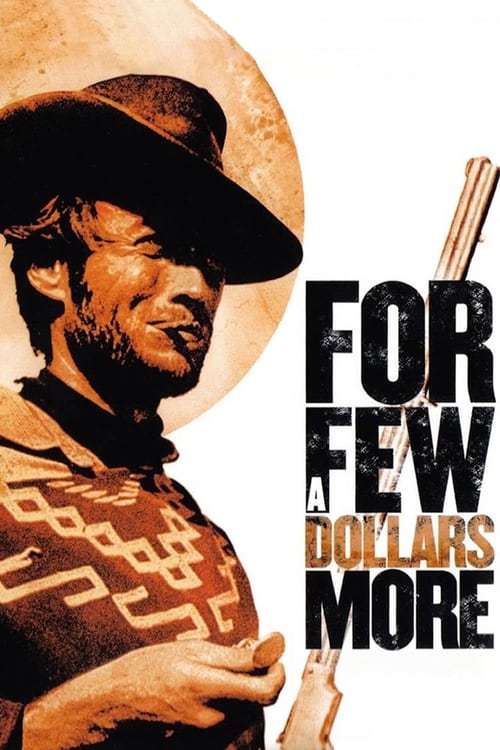
For a Few Dollars More
A dust-choked Spaghetti Western opera where greed and revenge waltz to the haunting chime of a pocket watch, painting a masterpiece of tense, sun-scorched showdowns.
For a Few Dollars More

For a Few Dollars More

Per qualche dollaro in più

"The man with no name is back... the man in black is waiting... a walking arsenal - he uncoils, strikes and kills!"

18 December 1965 Germany 132 min ⭐ 8.0 (4,229)
Director: Sergio Leone
Cast: Clint Eastwood, Lee Van Cleef, Gian Maria Volonté, Luigi Pistilli, Klaus Kinski
Western
Revenge vs. Professionalism The Nature of Greed The Burden of the Past The Blurred Lines of Morality
Budget: $600,000
Box Office: $15,000,000

Overview

For a Few Dollars More is the second installment in Sergio Leone's iconic "Dollars Trilogy." The film introduces two formidable bounty hunters: the swift, poncho-clad Manco (Clint Eastwood), and the methodical, older Colonel Douglas Mortimer (Lee Van Cleef). Both men are independently hunting the psychopathic bandit El Indio (Gian Maria Volonté), who has recently escaped from prison with his gang.

Realizing that El Indio's gang is too numerous for one man to handle, the two rivals, after a tense initial confrontation, form a reluctant and fragile alliance. Their plan involves Manco infiltrating the gang from the inside while Mortimer works from the outside, aiming to trap Indio and his men when they attempt to rob the heavily fortified Bank of El Paso. However, their partnership is constantly tested by mutual suspicion and the unpredictable brutality of their quarry, leading to a complex web of strategy and betrayal.
Core Meaning

At its heart, For a Few Dollars More explores the ambiguous nature of justice and the corrupting influence of both greed and revenge. Director Sergio Leone moves beyond the simpler narrative of its predecessor to contrast two different motivations for violence. Manco is driven by professionalism and profit, a cynical but relatively straightforward goal. In contrast, Colonel Mortimer is driven by a deeply personal vendetta, revealing that the pursuit of revenge can be just as obsessive and all-consuming as the pursuit of wealth. The film suggests that in the lawless West, the lines between hero and villain, lawman and outlaw, are dangerously blurred. Leone presents a world where morality is a luxury, and survival depends on skill, wit, and a clear understanding of one's own motivations, be they for money or for blood.

Thematic DNA

Revenge vs. Professionalism 35%
The Nature of Greed 25%
The Burden of the Past 25%
The Blurred Lines of Morality 15%

Revenge vs. Professionalism

The central dynamic of the film is the contrast between Colonel Mortimer's quest for personal revenge and Manco's professional, profit-driven approach to bounty hunting. Mortimer's entire demeanor, his specialized arsenal, and his relentless pursuit of El Indio are all fueled by the murder of his sister. Manco, on the other hand, views the bounty as a job. Their uneasy alliance forces these two philosophies to coexist, culminating in a finale where personal justice takes precedence, but the professional still gets paid.

The Nature of Greed

Greed is a powerful motivator for nearly every character, from the bounty hunters seeking their reward to El Indio's gang, whose desire for the bank's million dollars leads to infighting and betrayal. Leone portrays greed not just as a desire for wealth, but as a destructive force that erodes trust and loyalty. El Indio's plan to have his own men kill the bounty hunters so he can keep a larger share of the loot is a prime example of this theme.

The Burden of the Past

The past haunts the characters, particularly El Indio and Colonel Mortimer. El Indio is tormented by the memory of raping Mortimer's sister, an act that led to her suicide. He uses marijuana to cloud this memory, but the musical pocket watch constantly reminds him of his crime. For Mortimer, the past is a driving force, a wound that can only be healed by vengeance. The film demonstrates that in this harsh world, no one can truly escape their history.

The Blurred Lines of Morality

Leone's West is a place devoid of clear-cut heroes and villains. Manco and Mortimer are bounty killers, men who profit from death. While they hunt criminals, their methods are often just as ruthless. This moral ambiguity challenges the traditional Hollywood Western, where heroes were typically noble and law-abiding. The film suggests that in a lawless land, the distinction between right and wrong is often a matter of perspective.

Character Analysis

Manco ('The Man with No Name')

Clint Eastwood

Archetype: Antihero
Key Trait: Cynical Professionalism

Motivation

Manco's primary motivation is money. He is a professional bounty killer, and his actions are almost always guided by the potential for financial reward. He is pragmatic and self-interested, risking his life for the substantial sums offered for dangerous criminals.

Character Arc

Manco begins the film as a solitary, profit-driven bounty hunter. His arc is subtle but significant. Through his reluctant partnership with Colonel Mortimer, he is exposed to a motivation deeper than money: revenge. While he never abandons his professional cynicism, his decision to aid Mortimer in the final duel—ensuring a fair fight rather than just securing the bounty—shows a flicker of respect and perhaps a developing moral code. He ultimately collects the bounties, but only after helping Mortimer achieve personal justice.

Colonel Douglas Mortimer

Lee Van Cleef

Archetype: Avenger / Mentor
Key Trait: Methodical Determination

Motivation

Revenge. Years prior, El Indio drove Mortimer's sister to suicide after raping her. Every action he takes is a calculated step towards confronting and killing Indio to settle this personal score.

Character Arc

Colonel Mortimer is introduced as a highly skilled, older bounty hunter who appears to be Manco's rival. His arc is one of revelation. Initially seeming to be after the same bounty money, his true, all-consuming motivation is gradually unveiled: to avenge the death of his sister at the hands of El Indio. His journey is a straight line toward this singular goal. Once he kills Indio and fulfills his quest, he relinquishes his share of the bounty money, demonstrating that his purpose was never about profit but about retribution. His mission complete, he simply leaves.

El Indio

Gian Maria Volonté

Archetype: Villain (The Psychopath)
Key Trait: Haunted Brutality

Motivation

A combination of greed and a self-destructive impulse. He is driven to commit large-scale robberies for the money, but he is also compulsively drawn to re-enact the duel connected to his past trauma, suggesting a subconscious desire for his own punishment.

Character Arc

El Indio is a static but complex villain. He does not change, but the audience's understanding of him deepens. He is presented as a ruthless, intelligent, and brutal gang leader. However, his addiction to marijuana and the recurring flashbacks tied to his musical pocket watch reveal a man tormented by his past crimes. He is not a one-dimensional evil figure but a man haunted by a specific act of cruelty that has psychologically scarred him. His arc is a descent into paranoia and ultimately, his demise at the hands of the past he cannot escape.

Symbols & Motifs

The Musical Pocket Watch

Meaning:

The pocket watch is the film's most powerful symbol, representing memory, trauma, and the fateful connection between hunter and prey. For El Indio, it is a constant, haunting reminder of the woman he violated, triggering PTSD-like flashbacks. For Colonel Mortimer, the identical watch is a memento of his murdered sister and the catalyst for his revenge. The shared melody symbolizes their intertwined destinies, destined to conclude in a final, deadly duel orchestrated by its chimes.

Context:

El Indio uses his watch to time his duels, forcing his victims to listen to the chimes that represent his own traumatic past before he kills them. The existence of a second, identical watch is revealed late in the film, with Manco using it to even the odds in the final showdown between Mortimer and Indio, allowing vengeance to be served to the same tune that scored the original crime.

Colonel Mortimer's Arsenal

Meaning:

Colonel Mortimer's collection of specialized, long-range firearms symbolizes his methodical, patient, and strategic approach to revenge. Unlike Manco's quick-draw pistol, Mortimer's weapons require preparation and distance. They represent a more calculated, almost intellectual form of violence, reflecting his background as a former army officer and his single-minded, long-planned quest for vengeance.

Context:

Throughout the film, Mortimer utilizes a variety of guns from his saddlebag, each chosen for a specific purpose, from a long-barreled pistol to a rifle with a scope. This contrasts sharply with Manco's reliance on his standard Colt Peacemaker, highlighting their different philosophies as bounty hunters.

The Bank of El Paso

Meaning:

The Bank of El Paso symbolizes the ultimate prize of greed in the film. Its cleverly disguised safe, holding "almost a million dollars," is the target that unites the criminals and draws the attention of the bounty hunters. It represents a corrupting honeypot, a test of loyalty and a catalyst for the film's central conflict, proving that the allure of immense wealth is the force that sets all the violence in motion.

Context:

El Indio's entire plan revolves around robbing this bank. The heist sequence is a centerpiece of the film, and the subsequent plan to hide and later divide the money leads directly to the breakdown of the gang and the final confrontation.

Memorable Quotes

When the chimes end, pick up your gun. Try and shoot me, Colonel. Just try.

— El Indio

Context:

Said during the final showdown, after El Indio has disarmed Colonel Mortimer. He plays the watch, daring Mortimer to try and retrieve his weapon before the music stops, setting up a seemingly impossible duel that Manco's intervention ultimately balances.

Meaning:

This line encapsulates El Indio's sadistic ritual. He uses the musical watch, a symbol of his past trauma, to control the duel and psychologically torment his victims. It's not just a challenge; it's a performance of his own haunted past, turning his crime into a signature element of his villainy.

Tell me, Colonel... were you ever young?

— Manco

Context:

Spoken during a quiet moment as the two bounty hunters are tracking the gang. Mortimer responds, "Yup, and just as reckless as you. Then one day, something happened. It made life very precious to me." He refuses to elaborate further, deepening the intrigue around his backstory.

Meaning:

Manco asks this question after observing Mortimer's grim, single-minded focus. It's a moment of character insight, where the younger, more cynical bounty hunter probes the source of the older man's obsession. Mortimer's cryptic reply hints at the tragedy that defines him, adding a layer of mystery to his character.

I generally smoke just after I eat. Why don't you come back in about ten minutes?

— Colonel Douglas Mortimer

Context:

Mortimer says this in a saloon to the hunchbacked gang member, Wild (Klaus Kinski), who is trying to intimidate him. Wild tells him to light a match, and Mortimer's cool refusal enrages the hunchback and leads to a violent confrontation.

Meaning:

This quote perfectly illustrates Mortimer's calm, unflappable demeanor in the face of extreme danger. He uses polite, almost bureaucratic language to dismiss a thug's threat, showcasing his supreme confidence and control. It's a moment of dark humor that establishes him as an intimidating force.

Now we start.

— Manco

Context:

After Manco reveals he has Mortimer's identical pocket watch, he gives Mortimer his own pistol and gun belt, evening the odds against El Indio. He starts the music on the second watch, looks at Mortimer, and delivers this line to signal the start of a fair fight.

Meaning:

With these simple words, Manco completely turns the tables in the final duel. By providing Mortimer with his own gun belt and a second musical watch, he transforms an unfair execution into a true, honorable showdown. It signifies his respect for Mortimer and his decision to prioritize justice over a simple bounty. It's the moment their partnership is truly solidified.

Philosophical Questions

Can true justice be achieved through personal revenge?

The film contrasts two forms of justice: the state-sanctioned justice of bounties and the deeply personal justice of revenge. Colonel Mortimer's quest is entirely outside the law's concern for why El Indio is wanted; he seeks retribution for a personal tragedy. The film's climax validates his quest, allowing him to be the executioner in a ritualistic duel. However, after achieving his revenge, Mortimer simply leaves, taking no money. This raises the question of whether his act brought him peace or simply closure, and whether this form of personal vengeance can ever be considered true justice, or if it is merely a separate, more primal force.

What is the true cost of a life dedicated to violence?

Both Manco and Mortimer are masters of violence, but the film subtly explores its toll. Manco's detached professionalism suggests a man who has had to suppress his humanity to survive in his trade. Mortimer, on the other hand, has dedicated years of his life to a single, violent goal, his life defined by a past trauma. El Indio, the most violent character, is literally haunted by his actions, unable to escape the memory of his cruelty. The film suggests that while violence may be a necessary tool for survival or justice in this world, it inevitably scars and defines those who wield it.

Alternative Interpretations

While the film's narrative is relatively straightforward, some interpretations explore the relationship between Manco and Mortimer as more than a simple partnership. One reading views Mortimer as a mentor figure to Manco. The older, more experienced Colonel teaches the younger bounty hunter about motivations beyond money. Manco's final act of ensuring a fair fight for Mortimer can be seen as him having learned a lesson about honor and justice, graduating from a mere killer-for-hire to someone with a more nuanced code. His parting of ways at the end signifies his return to his own path, but as a more developed character.

Another perspective focuses on the idea that Manco and Mortimer represent two sides of the same coin: the new West and the old West. Mortimer, with his formal title, old-world manners, and motivation rooted in family honor, represents a dying era of gentlemen and codes. Manco, nameless and driven by capital, represents the pragmatic, cynical, and forward-looking spirit of a West being built on money rather than tradition. Their temporary alliance is thus a symbolic meeting of these two worlds, with the future (Manco) ultimately riding off with the cash while the past (Mortimer) settles its final accounts before fading away.

Cultural Impact

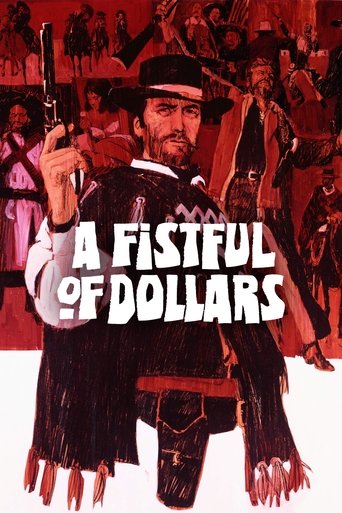
For a Few Dollars More was a critical step in cementing the global popularity of the Spaghetti Western, a genre that Sergio Leone had revolutionized with A Fistful of Dollars. Released in 1965, the film arrived when the traditional American Western was seen as stagnating. Leone's vision, characterized by moral ambiguity, stylized violence, operatic music, and a grittier, more cynical depiction of the Old West, offered a radical alternative. The film's massive success in Europe, and later in the U.S., confirmed that there was a huge audience for this new style of Western.

The movie solidified Clint Eastwood's status as an international superstar and resurrected the career of Lee Van Cleef, transforming him from a bit-part player into a leading man in European cinema. The dynamic between the young, cynical Manco and the older, vengeance-driven Mortimer created a template for the "uneasy alliance" trope that would be imitated in countless action films. Ennio Morricone's innovative score, which masterfully blended diegetic sound (the watch chimes) with non-diegetic music, became iconic and forever associated with the genre. The film's influence is still seen today in the works of directors like Quentin Tarantino, who openly homage Leone's use of extreme close-ups, tense standoffs, and morally complex antiheroes.

Audience Reception

Upon its release, For a Few Dollars More was an immense commercial success, surpassing its predecessor at the box office and becoming the highest-grossing film in Italy. Audience reception has been overwhelmingly positive over the decades, with many fans and critics considering it superior to A Fistful of Dollars. Viewers praise the introduction of Lee Van Cleef as Colonel Mortimer, whose gravitas and compelling backstory provide a perfect counterbalance to Eastwood's cool detachment. The complex villain, El Indio, is also frequently highlighted as a more emotionally resonant and formidable antagonist than the villains of the first film. Ennio Morricone's score is universally lauded as a masterpiece, particularly for its integration of the pocket watch theme into the narrative. The main points of criticism, particularly from contemporary reviewers, sometimes targeted the film's stylized violence and what was perceived as a cynical or amoral worldview. Some modern viewers find the pacing slow compared to current action films, but the overall verdict is that it is a masterfully directed, visually stunning, and emotionally complex western that stands as the strongest or most underrated entry in the Dollars Trilogy.

Interesting Facts

  • The film's budget was $600,000, a significant increase from 'A Fistful of Dollars,' and it went on to gross over $25 million worldwide.
  • Director Sergio Leone originally wanted Lee Marvin for the role of Colonel Mortimer. Other actors considered included Henry Fonda, Charles Bronson, and Robert Ryan. Lee Van Cleef, whose career had stalled, was cast after Leone saw his picture in a casting catalog.
  • Clint Eastwood was paid $50,000 for his role, more than triple his salary for the first film. Lee Van Cleef was paid $10,000.
  • Composer Ennio Morricone wrote the score before production began, and Leone would often play the music on set to help the actors get into character and to time the scenes.
  • The town of 'El Paso' was a set built in the Almería desert in Spain by production designer Carlo Simi. The set still exists as a tourist attraction called Mini Hollywood.
  • Gian Maria Volonté, who played El Indio, did not speak English and reportedly had to have his lines fed to him phonetically by a translator for the English-language version.
  • In the Italian and Spanish versions of the film, Manco's line "Now we start" during the final duel is replaced with the more sarcastic, "Indio, you already know the game".
  • Lee Van Cleef was allegedly faster on the draw than Clint Eastwood.

Easter Eggs

Clint Eastwood wears the same poncho as in 'A Fistful of Dollars,' but it is reversed. The bullet holes from the climax of the first film are visibly mended and now sit on his right shoulder blade instead of his left breast.

This detail provides a subtle continuity link between the first two films of the trilogy, even though an Italian court ruled that the character Manco was legally distinct from 'Joe' in the first film. It's a nod for attentive fans, reinforcing the iconic image of the character.

Mario Brega, who plays Niño (a member of Indio's gang), appears in all three 'Dollars Trilogy' films.

Leone frequently reused character actors, creating a familiar troupe across his films. Brega's presence is a small signature of the director. In each film, his character meets a violent end, becoming a recurring, if unlucky, face in Leone's West.

⚠️ Spoiler Analysis

Click to reveal detailed analysis with spoilers

Frequently Asked Questions

Explore More About This Movie

Dive deeper into specific aspects of the movie with our detailed analysis pages

Comments (0)

Leave a comment

No comments yet. Be the first to share your thoughts!