
Gabriel's Inferno: Part III
Overview
In Gabriel's Inferno: Part III, the passionate and tumultuous relationship between Professor Gabriel Emerson and his graduate student, Julia Mitchell, reaches a critical juncture. Picking up where Part II left off, this installment sees the couple navigating the complexities of their deepening bond while contending with threats from their pasts.
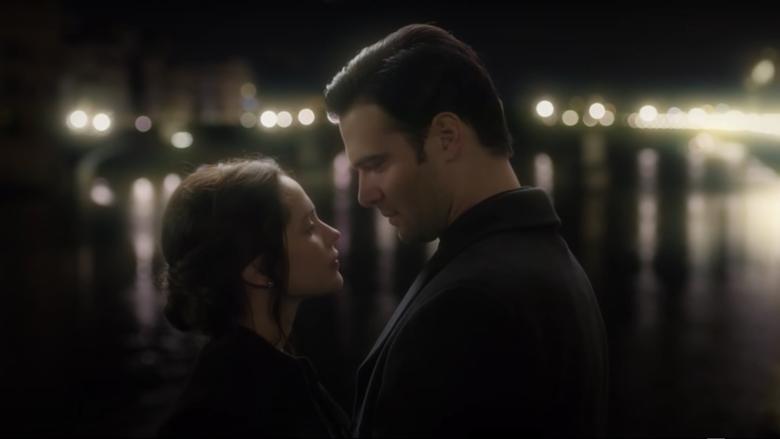
A dark figure from Julia’s past, her abusive ex-boyfriend Simon, reappears with malicious intentions, forcing Julia to confront her trauma and Gabriel to grapple with his protective instincts. Simultaneously, Gabriel must find the courage to reveal his own devastating secrets, particularly the truth behind a mysterious tattoo on his chest, fearing that his past actions will drive Julia away forever. Their journey of healing and trust culminates in a trip to Florence, a city steeped in the history of Dante and Beatrice, where they hope their love can finally find its paradise.

Core Meaning
The core meaning of Gabriel's Inferno: Part III revolves around the profound and transformative power of love, forgiveness, and redemption. The film posits that true love requires absolute honesty and vulnerability, and that confronting one's past, no matter how painful, is essential for personal healing and building a future with another. Director Tosca Musk emphasizes that even those who feel unworthy of happiness can find salvation and atonement through a compassionate and unwavering love. The narrative champions the idea that love is not about finding perfection, but about accepting a person's scars and helping them heal, mirroring the journey of Dante being guided from his personal hell by the grace of Beatrice.
Thematic DNA
Redemption and Forgiveness
This is the central theme of the film. Gabriel, a man haunted by his past of addiction and the tragic loss of his unborn child, sees his relationship with Julia as his only path to salvation. He constantly battles feelings of unworthiness and believes he is a 'murderer' for his role in his daughter Maya's death. Julia, in turn, must forgive Gabriel for his initial cruelty and learn to trust him, while also forgiving herself for past traumas. The film explores whether individuals can truly atone for their past and if they are deserving of forgiveness and happiness.
Confronting Past Trauma
Both protagonists are forced to confront demons from their past. Julia's abusive ex-boyfriend, Simon, physically and emotionally threatens her, triggering past trauma. Gabriel must finally confess the most painful secret of his life: the story of his unborn daughter, Maya, who was miscarried by her mother while he was passed out from drugs and alcohol. The film suggests that secrets are a poison to intimacy and that only by sharing their deepest wounds can Julia and Gabriel truly move forward together.
The Duality of Sacred and Profane Love
The film constantly intertwines intellectual, almost spiritual love with intense physical passion. Gabriel, a Dante scholar, frames his love for Julia through the lens of Dante's adoration for Beatrice—a pure, guiding force. This is contrasted with their intense sexual tension and the physical culmination of their relationship. The journey to Florence, a city of art and history, serves as the backdrop for their first sexual encounter, merging the sacred (the art, the history, the symbolism of Dante and Beatrice) with the profane (their erotic love).
Character Analysis
Gabriel Emerson
Giulio Berruti
Motivation
His primary motivation is to prove himself worthy of Julia's love, which he sees as his sole chance for salvation. He is driven by a profound fear that his past actions make him irredeemable and that revealing his secrets will cause him to lose her, the one pure thing in his life.
Character Arc
In Part III, Gabriel transitions from a tormented and often cruel professor to a vulnerable man desperate for redemption. His arc is defined by his struggle to overcome his past. Initially, he is protective but still secretive. After Julia is attacked, he is pushed to finally confess his darkest secret about his unborn daughter, Maya. This confession is his ultimate act of surrender, allowing him to accept Julia's love and forgiveness fully, completing his journey out of his personal 'inferno'.
Julia Mitchell
Melanie Zanetti
Motivation
Julia is motivated by an unwavering, almost fated love for Gabriel that she has held since she was seventeen. She seeks to understand the man she loves, to break through his cold exterior, and to build a life with him based on honesty and mutual love, believing in his inherent goodness despite his flaws.
Character Arc
Julia's arc in this part is about finding her strength and voice. While she begins as a somewhat meek and forgiving character, the confrontation with her abusive ex, Simon, forces her to face her past trauma directly. Her journey is about learning to trust Gabriel completely, while also asserting her own agency. By accepting Gabriel's confession without judgment, she transitions into the role of a healer and his 'atonement,' solidifying her position as the moral compass of the story.
Simon Talbot
Rhett Wellington Ramirez
Motivation
Simon is motivated by a possessive and controlling obsession with Julia. Having been left by her, his actions are driven by a desire to reassert power and hurt her for rejecting him. He uses intimidation and threats to try and get what he wants.
Character Arc
Simon's arc is short and serves purely as a catalyst for the protagonists' development. He appears as a direct threat from Julia's past, embodying the abuse she endured. His role is to create a crisis that forces Gabriel into a protective role and compels Julia to share the secrets of her past relationship, thereby deepening her bond with Gabriel. He is quickly neutralized and disappears from the narrative.
Symbols & Motifs
Dante and Beatrice
This is the primary literary and symbolic framework for the entire story. Gabriel sees himself as Dante, a man lost in his own personal 'Inferno' of guilt and self-loathing. He views Julia as his Beatrice, a symbol of divine grace, purity, and salvation who can guide him toward 'Paradise'. Her goodness and love are the forces he believes can redeem him.
The comparison is explicit throughout the film series. Gabriel is a Dante specialist, and their conversations are filled with references to 'The Divine Comedy'. Julia's appearance in his life is seen as a moment of divine intervention. The trip to Florence, Dante's city, is the culmination of this metaphor, where he hopes to find his 'Paradise' with her.
Florence
Florence symbolizes a paradise found and the ultimate destination for their love. As the historical home of Dante and Beatrice, the city represents a place where Gabriel and Julia's idealized romance can become a physical and emotional reality. It is a place of beauty, art, and history, standing in stark contrast to the darkness of their past traumas.
Gabriel promises to take Julia to Florence to make their first time together memorable and romantic. The city's famous landmarks, such as the Duomo and the Uffizi Gallery, serve as the backdrop for the consummation of their relationship, elevating it beyond a mere physical act into something historic and beautiful.
The Apple Orchard
The orchard represents the genesis of their connection, a moment of innocent, pre-lapsarian purity before the complications of their adult lives. It is a memory of a 'chaste, magical night' where Gabriel first called Julia his Beatrice, even though he was drunk and later forgot the encounter.
In Part III, Gabriel and Julia revisit the orchard. This return signifies a full-circle moment, reclaiming the purity of their initial meeting and contrasting it with the mature, complicated, and passionate relationship they have now. It's a way of integrating their past with their present.
Maya's Tattoo
The tattoo of the name 'Maya' on Gabriel's chest is a physical manifestation of his guilt and a secret he keeps hidden. It symbolizes the 'innocent life' he believes he 'took,' representing his deepest shame and the source of his self-destructive behavior and feelings of unworthiness.
Julia discovers the tattoo, which creates tension and mystery. Gabriel's confession in Part III about Maya—his unborn daughter who died in a miscarriage he blames on his drug use—is the climax of his character arc. Sharing this secret is the ultimate act of vulnerability and trust in Julia.
Memorable Quotes
I'm a murderer. I took an innocent life. Her name was Maya. She was my daughter.
— Gabriel Emerson
Context:
After Julia has revealed her own painful past with Simon, she comforts a distraught Gabriel. He finally breaks down and tells her the devastating secret he has been hiding, which explains the tattoo on his chest and his belief that he is unworthy of love.
Meaning:
This is the emotional climax of the film and the core of Gabriel's confession. It reveals the source of his profound guilt and self-hatred, re-framing his entire character. It is the ultimate act of vulnerability and the turning point that allows for his redemption through Julia's acceptance.
We both have scars. But I am your atonement.
— Julia Mitchell
Context:
This is said in response to Gabriel's confession about Maya. Instead of recoiling in horror, Julia offers him unconditional love and forgiveness, solidifying her role as the guiding force leading him out of his personal hell.
Meaning:
This line encapsulates Julia's role in the narrative as Gabriel's 'Beatrice' or savior. She acknowledges their shared pain and brokenness but positions herself as the agent of his healing and redemption. It signifies her complete acceptance of his past and her commitment to his salvation through her love.
I'll move heaven and earth to protect you. I promise you that.
— Gabriel Emerson
Context:
Gabriel says this to Julia after she is threatened and assaulted by her ex-boyfriend, Simon. It is a declaration of his commitment to her safety and well-being, marking a pivotal moment where he steps up to be her guardian.
Meaning:
This quote showcases Gabriel's fierce, protective love for Julia. It highlights his transformation from a man who once hurt her with his words to one who would do anything to shield her from harm, demonstrating the depth of his devotion.
It's always been you, Gabriel.
— Julia Mitchell
Context:
This is a recurring sentiment from Julia, often said during moments of intimacy and emotional honesty. It serves to reassure Gabriel of her devotion, especially when he is feeling insecure about his worthiness.
Meaning:
A simple but powerful declaration of Julia's unwavering love. This line confirms the fated nature of their relationship, emphasizing that her feelings for him have been constant since they first met, despite his flaws and their difficult circumstances.
Philosophical Questions
Can a person truly atone for their past sins, or are some actions unforgivable?
The film explores this through Gabriel's character. He considers himself a 'murderer' and is trapped in a self-made hell of guilt over the death of his unborn child. His journey poses the question of whether redemption comes from self-punishment or from accepting forgiveness from another. The film argues for the latter, suggesting that love and compassion from another person (Julia as Beatrice) can provide the grace necessary to forgive oneself and escape one's personal inferno.
What is the nature of true love: is it an idealized, spiritual connection or an acceptance of flawed humanity?
The film presents both aspects of love. Gabriel initially idealizes Julia, calling her his 'Beatrice' and seeing her as a perfect, angelic figure who can save him. However, the relationship only truly deepens when this idealization is replaced by raw honesty. They must reveal their 'scars' and ugliest secrets to one another. The film concludes that true love is not the worship of a perfect ideal, but the messy, compassionate work of accepting and healing each other's deepest wounds.
Alternative Interpretations
While the dominant interpretation of the film is a straightforward romantic tale of redemption, a critical alternative reading could focus on the problematic power dynamics inherent in the narrative. The relationship begins as a professor-student romance, an ethical gray area that the film largely romanticizes. Gabriel's initial treatment of Julia is verbally and emotionally harsh, and his later possessiveness could be interpreted not as romantic passion, but as a continuation of controlling behavior. From this perspective, the narrative could be seen as a fantasy that glosses over serious ethical concerns and reinforces tropes of a troubled, older man 'saving' a younger, innocent woman, rather than a healthy, balanced partnership.
Cultural Impact
Gabriel's Inferno: Part III is a product of a specific subculture: the passionate and highly engaged online community of romance novel readers. Its primary impact is not on mainstream cinema but within this dedicated fanbase. The film, and the Passionflix platform it represents, signifies a successful 'for fans, by fans' model of production. By choosing to serialize a single book into three feature-length parts, director Tosca Musk catered directly to the desires of readers who often feel mainstream adaptations cut too much content. This method has been praised by the book's fans for its faithfulness.
Critically, the film series received limited mainstream attention. When it was reviewed, it was often criticized for melodramatic dialogue and pacing that felt slow to viewers unfamiliar with the book. However, this criticism matters little to its target audience. The film's success demonstrates the viability of niche streaming services and the power of adapting popular literary works with the direct involvement and approval of the author and fanbase. It reinforces a trend in screen adaptations where loyalty to the source material is the most prized attribute.
Audience Reception
The audience reception for Gabriel's Inferno: Part III is largely divided between fans of the source novel and more casual viewers. Fans of Sylvain Reynard's books have overwhelmingly praised the film, specifically lauding its faithfulness to the book, the casting of Giulio Berruti and Melanie Zanetti, and the palpable chemistry between the two leads. They appreciate that the three-part structure allows for a detailed adaptation without omitting beloved scenes.
Conversely, some viewers and critics who are not pre-invested in the story have found the film to be slow-paced and the dialogue to be overly dramatic or 'cheesy'. The sex scenes, a major point of anticipation, were described by at least one reviewer as feeling 'choreographed' and boring. The general consensus is that it is an adaptation made specifically for the fans, who are its most ardent defenders and for whom it succeeds beautifully.
Interesting Facts
- The entire three-part film adaptation of the first book, 'Gabriel's Inferno,' was filmed in approximately five weeks, a remarkably short shooting schedule for over six hours of content.
- Director Tosca Musk is known for her extreme faithfulness to the source material. The production team refers to the book as 'the Bible' on set, ensuring that details, dialogue, and even physical actions match the novel as closely as possible.
- The film was produced for and released on Passionflix, a streaming service co-founded by director Tosca Musk, which specializes in adapting romance novels into films and series.
- Some of the filming for the 'Gabriel's Inferno' series took place on location in Florence, Italy, adding an authentic backdrop to the Dante and Beatrice-inspired love story. The crew filmed at key locations like the Uffizi Gallery.
- The source novel, 'Gabriel's Inferno,' originated as 'Twilight' fan fiction, similar to the 'Fifty Shades of Grey' series.
⚠️ Spoiler Analysis
Click to reveal detailed analysis with spoilers
Frequently Asked Questions
Explore More About This Movie
Dive deeper into specific aspects of the movie with our detailed analysis pages
Comments (0)
No comments yet. Be the first to share your thoughts!