Skip to content
Golden Kamuy
A blood-spattered frontier adventure that swings from belly laughs to grief, as a scarred soldier and an Ainu huntress cross a snowbound Hokkaido where gold glints like a wolf's eye in the dark.
Golden Kamuy

Golden Kamuy

ゴールデンカムイ

09 April 2018 — 30 March 2026 Japan 5 season 62 episode Returning Series 7.6 (100)

Cast: Chikahiro Kobayashi, Haruka Shiraishi, Takayuki Sugo, Kentaro Ito, Yoshimasa Hosoya

Animation Action & Adventure Comedy Found family and fellowship Ainu culture and survival War trauma, guilt and penance Greed versus purpose Tonal clash of life and death

Overview

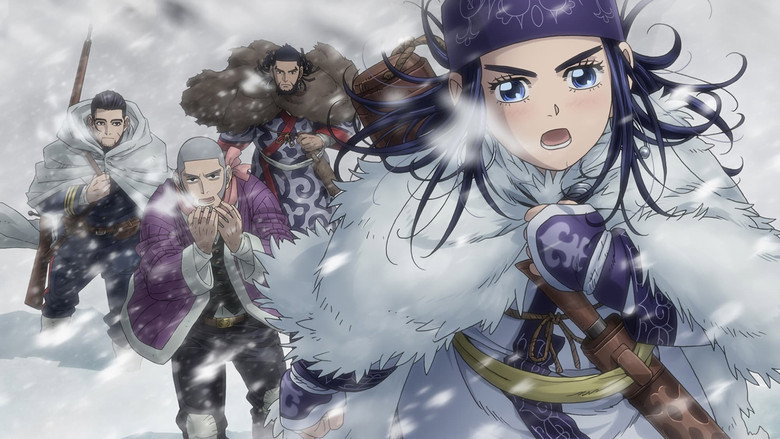
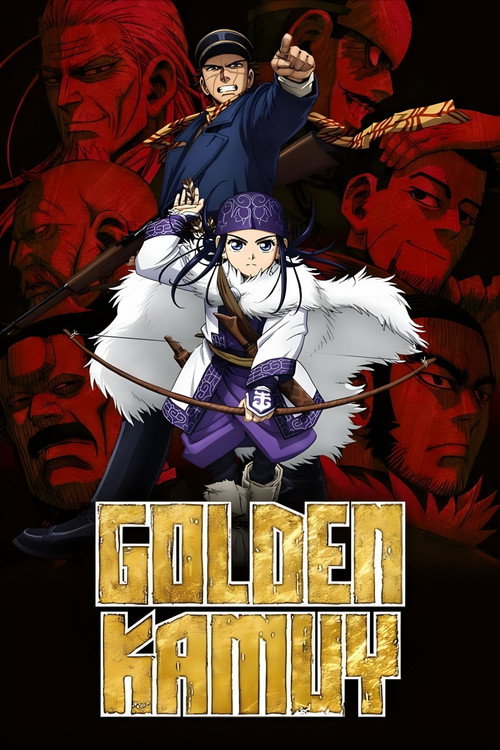
Golden Kamuy is set in early-1900s Hokkaido, just after the Russo-Japanese War. Saichi Sugimoto, a veteran nicknamed "the Immortal," is scraping by in the postwar gold rush when he hears of a hoard of Ainu gold. A bear attacks him, and a young Ainu huntress named Asirpa saves him. She wants no part of the treasure but wants justice for her father, who was killed in the betrayal that hid it. The two agree to hunt the gold together.

The gold's location was tattooed onto the skin of escaped convicts, and each man carries a fragment of the map. The pair travel across Hokkaido, collecting tattooed prisoners and facing rival factions as they go. Those rivals include the obsessive 7th Division under Lieutenant Tsurumi and the veteran swordsman Hijikata Toshizo's band. The series mixes treasure-hunt thriller, survival story, war drama and gross-out slapstick. A lesson in hunting and respect for the animal can sit right next to body-horror comedy.

Across five seasons, Geno Studio made the first three and Brain's Base took over from season four. The story widens from a simple race for riches into a story about memory, identity and what the Ainu will keep as their world changes. Every faction wants the gold for a different reason. Some want power, some revenge, some a home they can return to without shame.

Core Meaning

The gold works as a MacGuffin, and the series is really about what people carry out of war and what they owe the living and the dead. Sugimoto, Asirpa and their rivals are all shaped by loss. The story asks whether people can live with their past honorably, make amends for it, or must try to erase it.

The series also insists on the dignity of Ainu culture. It shows the language, food, hunting ethics and the belief in kamuy (spirits or gods) as living practice, not museum material. Asirpa's growing awareness that cultures do not last forever drives much of the story's emotional weight. Humor is not a contradiction of the story's darkness. It is part of how the show portrays survival, since people keep eating, joking and living in the middle of atrocity.

Thematic DNA

Ainu culture and survival 30%
War trauma, guilt and penance 25%
Greed versus purpose 20%
Found family and fellowship 15%
Tonal clash of life and death 10%

Ainu culture and survival

Hunting, food, language and spiritual belief are treated with respect from the first season. Later seasons turn this into a question of preservation: Asirpa records traditional stories on film and asks what the future holds for her people.

War trauma, guilt and penance

Sugimoto, Tsurumi, Hijikata and many others are veterans or relics of past conflicts. Each deals with survivor's guilt, honor and atonement in a different way, and the show treats these as moral dilemmas without easy answers.

Greed versus purpose

Everyone chases the gold, but the prize means different things to different factions. The series gradually shows it is less about wealth than about power, revenge, belonging and rewriting history.

Found family and fellowship

Sugimoto, Asirpa and Shiraishi, with others joining over time, grow from a business arrangement into a close-knit group. The bond between Sugimoto and Asirpa anchors every season.

Tonal clash of life and death

Comedy, gore, food and tenderness coexist in the same scene. This gives violence weight and makes the quiet moments more affecting, especially as the story nears its end.

Character Analysis

Saichi Sugimoto

Chikahiro Kobayashi

Archetype: Scarred antihero Key Trait: Relentless survivor with a murderous protective streak

Motivation

First money, then loyalty to Asirpa and the people who have helped him. He is haunted by the lives he has taken and says he already has a ticket to hell.

Character Arc

He begins as a veteran chasing gold for a personal reason, and he is willing to kill without hesitation. Over time he becomes protective of Asirpa and increasingly committed to her cause. He comes to see the Ainu future as something worth fighting for and says he has found a place where he can be happy in Hokkaido. By season 5 he is leading the group against some of the story's most dangerous opponents.

Asirpa

Haruka Shiraishi

Archetype: Heroine and guide Key Trait: Principled, practical, and tied to Ainu tradition

Motivation

Justice for her father, then the safeguarding of her people's culture and future.

Character Arc

She starts as a skilled hunter seeking justice for her father. Through the seasons she learns what the gold really represents and her father's hopes that she would lead the Ainu. In season 4 she realizes that nothing lasts forever and faces what the future holds for her culture. She becomes an increasingly active leader and decision-maker.

All 4 characters and cast

Symbols & Motifs

The tattooed map

Meaning: The way a people's treasure and history are literally written onto desperate men's bodies, and how the past is carried in flesh.
Context: The convicts' tattoos are the engine of the plot from season 1. Collecting them forces Sugimoto and Asirpa into violent encounters across Hokkaido.

The gold

Meaning: Ambition, and the way a stolen legacy is corrupted by the people who chase it.
Context: Different factions want it for different reasons. In season 5, Tsurumi's explanation of what the title "Golden Kamuy" means gives the gold's origin a tragic backstory of infighting among those who tried to build something for their people.

Food and the shared meal

Meaning: Respect for life, and a bond across cultures.
Context: Asirpa's cooking, including her famous insistence on the raw squirrel brains, and Sugimoto's miso (osoma) are recurring gags that also show how the two build trust.

The bear and the wolf (Retar)

Meaning: The kamuy, nature as powerful and sacred, and the thin line between respect and danger.
Context: A bear opens the story. Retar, Asirpa's Hokkaido wolf companion, helps save Sugimoto. Bears are treated as both game and gods throughout.

Sugimoto's scars and the title "the Immortal"

Meaning: Survival at a cost, and the weight carried by those who keep returning from death.
Context: Asirpa explains that Sugimoto survives because he walks near death without being consumed by it.

Memorable Quotes

俺は不死身の杉元だ! (I'm Sugimoto the Immortal!)
— Saichi Sugimoto

Context

Repeated throughout the series, including during his fights.

Meaning

His catchphrase and self-image: he survives against all odds, and it is both a boast and a vow.
Take it, Sugimoto.
— Asirpa

Context

Season 1, episode 1, as Asirpa rescues him from the bear.

Meaning

One of her earliest lines, it marks the start of her trust in him as a partner.
All 5 quotes

Episode Highlights

Season 1 opening episodes: the bear and the gold

S1E1
Sugimoto learns of the tattooed map, is attacked by a bear and is saved by Asirpa and her wolf Retar. She reveals her father was among the Ainu killed.
Significance: Sets up the partnership and the central mystery of the whole series.

Kamuy Mosir

S1E3
Sugimoto and Asirpa are pursued by the 7th Division and take a baby bear to Asirpa's village, where they meet her grandmother.
Significance: Introduces the Ainu community and the first major threat from the 7th Division.

Kamuy Hopunire

S2E7
A locust swarm separates Asirpa and Inkarmat from the group, where Asirpa questions Inkarmat about her father.
Significance: Part of the season 2 build-up toward revelations about Asirpa's father and his intentions.

Season 2 revelation about Wilk

S2E10
Sugimoto is told that Asirpa's father wanted to raise her to lead an Ainu guerrilla movement and that he did not kill the Ainu to get the gold.
Significance: Reframes Asirpa's quest and her father's legacy.

Season 4: Asirpa's film project and her question about the future

S4E10
Inspired by film footage, Asirpa acts out traditional Ainu stories for posterity. She then asks Sugimoto what the future holds, and he tells her what her father said about her.
Significance: The emotional center of the story's meditation on cultural preservation.

Season 5, episode 6: the meaning of the title

S5E6
Tsurumi explains what Golden Kamuy means, describing a group who set out to build something for their people and were destroyed by infighting.
Significance: Reframes the gold's history and the series title.

Season 5 finale

S5E13
Factions converge on Sapporo around the last tattoos and the escaped prisoner Uechi. The season ends on an abrupt cliffhanger.
Significance: The latest aired point in the story; it is a pause rather than a conclusion.

Philosophical Questions

Can a culture survive modernization without being frozen or erased?

Asirpa's film project and her question about the future show that preservation and change pull against each other. The series does not offer a simple answer.

Can a person who has killed make amends?

Sugimoto knows he has taken many lives, and the show treats penance and virtue as ongoing choices instead of a simple redemption story.

What is the value of a treasure?

The gold turns out to be about revenge, power, belonging and history more than money, and its backstory is a tragedy of infighting.

How It Ends

Alternative Interpretations

Some viewers read the story as an anti-imperial narrative that affirms Ainu resilience. Others see it first as an adventure about bonds between survivors. Some focus on the villains and read the series as a study of obsession and what people will do to rewrite history. The season 5 ending is an abrupt cliffhanger that leaves the story paused, so any reading of the ultimate outcome is open.

Full ending explanation

Cultural Impact

Golden Kamuy is built on the aftermath of the Russo-Japanese War and gives sustained attention to the Ainu people, their language, and the respectful way they use natural resources. That is rare for a mainstream action series. A reviewer at the time of season 1 noted that the Ainu and their shameful treatment by the Japanese is a rich source of historical drama.

The manga won wide acclaim and has sold more than 18 million copies. Critics describe the anime as one of the most distinctive of its decade, praising its craftsmanship across studio and staff changes. Season 4 was seen as a step down from earlier seasons but still strong, and critics said the final season shows how rare long-form, multi-threaded storytelling can be in anime. Its blend of seinen violence, comedy and cultural depth has made it a reference point for historical anime.

Audience Reception

Audiences and critics have generally praised the series for its tone, characters and treatment of Ainu culture. The animation was called excellent in the Geno Studio seasons and was held at the same quality after the move to Brain's Base. Season 4 was seen as leaning more toward comedy and slightly weaker than earlier seasons, though still high compared with other titles. Season 5 was praised for being increasingly character-driven, with Tsurumi stealing scenes, though some felt his survival stretched plausibility. The main criticism is that the season ends on an abrupt cliffhanger and feels like setup instead of a true finale. The overall verdict is that this is one of the most distinctive anime of recent years.

Interesting Facts

  • The anime was announced by Weekly Young Jump in July 2017 and produced by Geno Studio, a Twin Engine subsidiary.
  • The first three seasons were directed by Hitoshi Nanba with series composition by Noboru Takagi and character design by Kenichi Ohnuki.
  • Season 1 premiered in April 2018, season 2 on October 8, 2018, season 3 on October 5, 2020, and the fifth season on January 5, 2026.
  • Production moved to Brain's Base for season 4, with Shizutaka Sugahara as chief director and Takumi Yamakawa on character design.
  • Season 4 aired from October 2022 to June 2023, and its broadcast was postponed from episode 7 after the unexpected death of a main production staff member.
  • Season 5 was announced in June 2023, and its Sapporo Beer Factory arc was released in cinemas as a two-part film before the TV run.
  • The original manga by Satoru Noda ran in Weekly Young Jump from 2014 to 2022 and has sold more than 18 million copies.
  • Season 1 opened with Winding Road by MAN WITH A MISSION, and season 4 with Grey by Formare.
  • Season 5's opening themes were performed by Awich x ALI, with Ken Yokoyama performing the ending.

Easter Eggs

During a stenka fight with Russians, Sugimoto screams a drawn-out version of his catchphrase in the style of Jotaro Kujo's stand rush.

A parody of JoJo's Bizarre Adventure's famous battle cry, showing the series' pop-culture humor.

The wilderness scenes include monologues about eating raw squirrel brains and other Ainu delicacies, played for comedy.

A running gag that doubles as an honest look at Ainu cuisine.

Frequently Asked Questions

Explore More About This Series

Dive deeper into specific aspects of the series with our detailed analysis pages

Comments (0)

Leave a comment

No comments yet. Be the first to share your thoughts!

Similar Movies