Guardians of the Galaxy Vol. 3
"Once more with feeling."
Overview
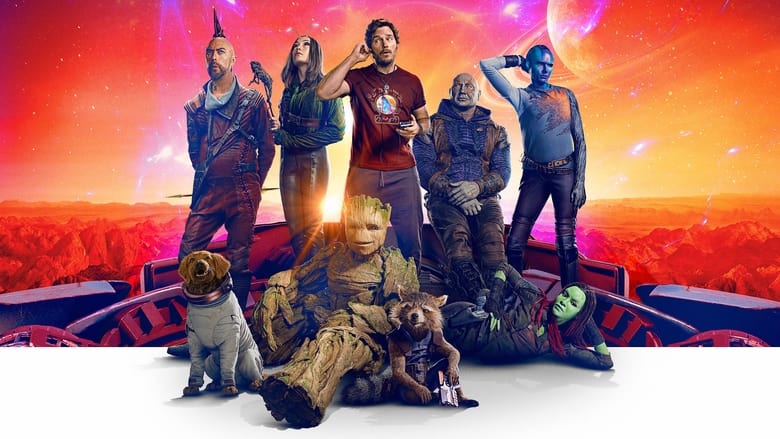
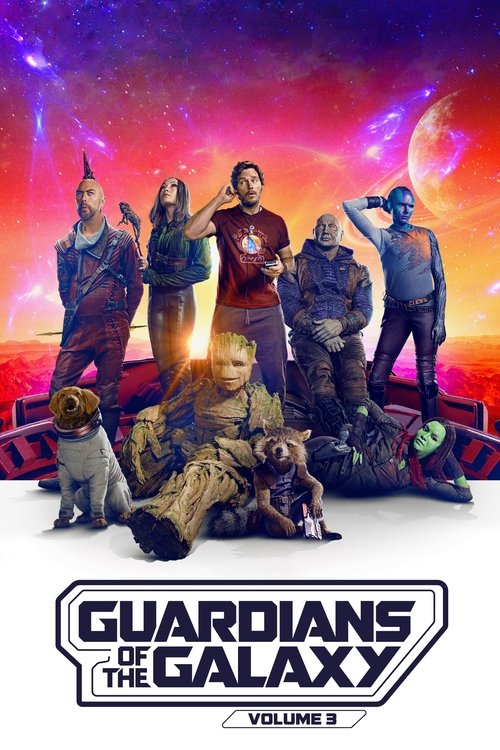
In Guardians of the Galaxy Vol. 3, the final installment of James Gunn's trilogy, the Guardians have established a new headquarters on Knowhere. However, their relative peace is shattered by a brutal attack from Adam Warlock (Will Poulter), a powerful Sovereign warrior, who leaves Rocket critically injured. The team discovers that Rocket's life is tied to a kill switch embedded by his creator, the tyrannical High Evolutionary (Chukwudi Iwuji), and standard medical procedures will kill him.
Reeling from the loss of the original Gamora, a depressed Peter Quill / Star-Lord (Chris Pratt) must rally the grieving team for their most personal mission yet. They embark on a desperate journey to the Orgoscope, the headquarters of the High Evolutionary's corporation, to find an override code and save their friend's life. The mission forces them to confront Rocket's harrowing past, which is revealed through a series of painful flashbacks, and face a villain obsessed with creating a "perfect" society at any cost.
Core Meaning
The core meaning of Guardians of the Galaxy Vol. 3 revolves around healing, self-acceptance, and the profound power of found family. Director James Gunn has stated that while the first film was about the mother and the second was about the father, this film is about the self. It argues that one's past, no matter how traumatic, does not have to define their future. The film champions the idea that life's imperfections and scars are not flaws to be eliminated but are integral parts of what makes someone who they are.
The central message is a powerful critique of the dangerous pursuit of perfection, as embodied by the High Evolutionary's ruthless eugenics. In contrast, the Guardians, a group of flawed and broken individuals, find strength, purpose, and unconditional love in their acceptance of one another's imperfections. The film posits that true growth comes from confronting personal trauma, embracing one's identity (as Rocket finally accepts he is a raccoon), and realizing that family is not about shared blood but about shared bonds of loyalty and love.
Thematic DNA
Healing from Past Trauma
This is the central theme of the film, explored most deeply through Rocket's origin story. His traumatic past as a laboratory experiment has fueled his cynicism and reluctance to form close bonds. The film forces him, and the audience, to confront the cruelty he endured. Each Guardian is also dealing with their own trauma: Peter with the loss of Gamora, Nebula with the abuse from Thanos, and Drax with the memory of his family. The entire narrative is a journey towards healing, with each character finding a way to move forward by the end, not by erasing their pain, but by integrating it into a new sense of purpose.
The Found Family
The trilogy has always centered on the concept of a found family, and this film serves as its emotional culmination. The Guardians' fierce loyalty to Rocket, risking everything to save him, demonstrates that their bond is stronger than any biological tie. The film concludes with the dissolution of the original team, but not the family itself. Each member leaves to pursue their own path, a decision made possible by the strength and self-worth they found within the group. Gamora finds her family with the Ravagers, Drax and Nebula create a home for the rescued children on Knowhere, and Peter returns to his biological grandfather, completing his journey of finding home.
The Fallacy of Perfection
The film's antagonist, the High Evolutionary, is singularly obsessed with creating a "perfect society." He is a personification of the dangers of utopianism, willing to commit genocide and horrific acts of cruelty in his pursuit of an idealized, flawless world. The film contrasts his sterile, ruthless ambition with the messy, chaotic, but ultimately beautiful imperfection of the Guardians and their community on Knowhere. The narrative argues that flaws, mistakes, and even pain are essential components of life, and that true strength lies in embracing imperfection, not eradicating it.
Kindness and Second Chances
A recurring idea in the film is that everyone deserves a second chance. This is most clearly stated by Drax when Groot saves Adam Warlock, who had been trying to kill them throughout the movie. This act of kindness is paid forward when Adam, in turn, saves Peter Quill's life. The theme also applies to Nebula, who completes her transformation from villain to a compassionate leader, and even Rocket, who chooses to spare the High Evolutionary, breaking the cycle of violence and proving he is better than his creator.
Character Analysis
Rocket
Bradley Cooper (voice)
Motivation
Initially, his motivation is survival. After being injured, his arc is largely passive as his friends fight for him. In the flashbacks, his motivation is to escape with his friends to the "forever and beautiful sky." In the climax, his motivation is to save all the other captive creatures from suffering the same fate as his original friends, showing his growth from selfishness to profound empathy.
Character Arc
Rocket's arc is the emotional core of the film. Previously depicted as a cynical, wise-cracking mercenary, the film delves into his traumatic past as a product of the High Evolutionary's cruel experiments. His journey is one of confronting this immense pain and the loss of his first friends. By the end, he stops running from his past, embraces his identity by declaring, "The name's Rocket. Rocket Raccoon," and accepts his capacity for leadership. He transforms from a self-proclaimed loner into the compassionate captain of the new Guardians, finally fulfilling the dream of flying into the sky with his friends.
Peter Quill / Star-Lord
Chris Pratt
Motivation
His primary motivation is to save Rocket, who he views as his best friend. He is also driven by a desperate need to keep his found family together, as it's the only one he feels he has left. This evolves into a desire for genuine closure and to rediscover his own identity outside of being "Star-Lord."
Character Arc
Peter begins the film in a state of depression and alcoholism, unable to move past the loss of the original Gamora. His insistence on trying to make the new variant of Gamora remember their past is a manifestation of his inability to let go. Throughout the mission to save Rocket, he is forced to step up as a leader again. His arc concludes with the realization that he has been running his whole life, ever since his mother's death. He finally accepts that the past is gone and makes the profound decision to return to Earth and reconnect with his grandfather, choosing to confront his origins rather than flee them.
Nebula
Karen Gillan
Motivation
Her motivation is an unwavering loyalty to her new family, particularly Rocket. She is driven by a deep-seated empathy for fellow survivors of extreme trauma. By the end, she is motivated by the desire to build a better future and a stable community on Knowhere.
Character Arc
Nebula's arc, which began in the first film, reaches its powerful conclusion here. Having moved beyond the shadow of her abusive father, Thanos, she has become a core and fiercely loyal member of the Guardians. Her desperation to save Rocket stems from her own experience with trauma and recovery. Her journey in this film is about finding her place not as a warrior, but as a leader and builder. She chooses to stay on Knowhere, not to fight, but to create a safe home for the rescued children, providing them with the stability she never had. It is a transition from destroyer to creator.
Drax the Destroyer
Dave Bautista
Motivation
Drax is motivated by his fierce loyalty to his friends. Though he often misunderstands situations, his core intent is always to protect his family. His arc reveals a deeper, subconscious motivation: to once again be a father.
Character Arc
Drax's journey concludes by revealing his true purpose. While often serving as comic relief due to his literal-mindedness, the film shows this is not his defining trait. His arc has been defined by the loss of his family. In a key moment, he connects with and pacifies the frightened, captive children on the High Evolutionary's ship, not through force, but through gentle understanding. Nebula helps him realize he wasn't born to be a Destroyer, but a dad. He finds peace and a new purpose by choosing to stay on Knowhere to help raise the children, finally healing the wound that has driven him for years.
Symbols & Motifs
Music / The Zune
Music symbolizes connection, memory, and emotional expression throughout the trilogy. It is the primary way Peter Quill connects with his late mother and his past on Earth. The Zune, gifted to him by Yondu, represents the expansion of his family and his emotional world. The film's soundtrack is not merely background noise but an integral part of the narrative, with carefully chosen songs reflecting the characters' journeys and the scenes' emotional tones. The final scene, with the new Guardians team selecting Redbone's "Come and Get Your Love"—the song that started the first film—symbolizes a full-circle moment and the enduring legacy of the team.
Peter Quill's Zune is a constant presence. The film opens with an acoustic version of Radiohead's "Creep" to establish the melancholic tone. An epic, single-shot hallway fight scene is choreographed to the Beastie Boys' "No Sleep Till Brooklyn." The film concludes with the team dancing to "Dog Days Are Over" by Florence + The Machine, a moment of pure, collective joy.
Dancing
Dancing represents freedom, emotional release, and the found family's unique bond. In the first film, Peter's dancing disarms a powerful villain. In this film, it becomes a symbol of healing and belonging. Drax, who has steadfastly maintained that "Only idiots dance," finally lets go of his rigid self-seriousness and joins in the celebration on Knowhere. His participation signifies his emotional healing and his acceptance of his new role as a father figure. The collective dance is a moment of catharsis for the entire team.
The most prominent use of this symbol is in the final sequence on Knowhere, where nearly every main character, including the previously stoic Drax and Nebula, participates in a joyous dance to Florence + The Machine's "Dog Days Are Over."
The "Forever and Beautiful Sky"
The "forever and beautiful sky" is a powerful symbol of freedom, hope, and the afterlife. It is the dream that Rocket and his fellow experiments—Lylla, Teefs, and Floor—share while imprisoned. It represents an escape from their pain and confinement to a place of peace and togetherness. For Rocket, it becomes a driving purpose and a poignant memory of the friends he lost. His ultimate survival and leadership of the new Guardians is a fulfillment of this dream in a way he never expected.
This phrase is repeated in the heart-wrenching flashbacks of Rocket's origin. He and his friends name themselves and share their dream of flying away together. The idea is revisited when Rocket has a near-death experience, where Lylla tells him his time has not yet come. The final shot of the new Guardians flying off into space brings the symbol full circle.
Memorable Quotes
The name's Rocket. Rocket Raccoon.
— Rocket
Context:
During the final fight, the High Evolutionary dismissively screams, "I can't wait to dissect you all! Especially you, 89P13!" Rocket, having finally embraced his past and his true self, defiantly responds with this line before incapacitating his tormentor.
Meaning:
This is a pivotal moment of self-acceptance. Throughout the trilogy, he has rejected being called a raccoon, seeing it as a label for a lesser creature. By claiming the name himself during his final confrontation with his creator, he is taking ownership of his identity, both the animal he was and the hero he has become.
We'll all fly away together, one last time… into the forever and beautiful sky.
— Lylla the Otter
Context:
In a flashback, after the four friends decide on their names, they huddle together in their cage and share their dream of a future where they are free. Lylla says this line, solidifying their bond and their shared hope.
Meaning:
This quote encapsulates the hope and tragedy of Rocket's origin. It is the shared dream of the captive animals, a promise of freedom and peace that was brutally denied to them. The line is tragically poignant, as Lylla, Teefs, and Floor are killed before they can escape. It becomes the emotional anchor for Rocket's entire journey.
He didn't want to make things perfect. He just hated things the way they are.
— Theel (High Evolutionary's subordinate)
Context:
After the High Evolutionary orders the destruction of Counter-Earth because of minor societal flaws, a horrified Theel says this to his fellow crew members, sparking a mutiny against their fanatical leader.
Meaning:
This line reveals the true nature of the High Evolutionary's philosophy. It's not born from a genuine desire to create beauty or a better world, but from a deep-seated narcissism and disgust for natural life. It exposes his utopian vision as a destructive and hateful ideology, repositioning him from a misguided scientist to a purely malevolent villain.
You were born to be a dad.
— Nebula
Context:
At the end of the film, as the Guardians are going their separate ways, Mantis invites Drax to join her. Nebula interjects, telling Drax he needs to stay on Knowhere because the rescued children need him, delivering this heartfelt line.
Meaning:
This is the culmination of Drax's character arc. For three films, he has been defined by his grief and his title, "The Destroyer." This line from Nebula reframes his entire identity, acknowledging that his true nature is not one of violence, but of care and fatherhood. It gives him a new, peaceful purpose that honors the memory of his original family.
I love you guys.
— Groot
Context:
As the original Guardians team shares one last group hug before parting ways, Groot emotionally utters this line. Gamora, who previously couldn't understand him, now can, and the audience hears it as a clear declaration of his love for his family.
Meaning:
For the entire trilogy, the audience (and most characters) have only heard Groot say "I am Groot." In this final scene with the original team, the audience hears him speak in plain English. Director James Gunn has confirmed this is not Groot suddenly learning a new language, but rather that the audience, having spent so much time with the characters, is now part of the family and can finally understand him. It's a subtle, fourth-wall-breaking moment that makes the audience part of the Guardians' family.
Philosophical Questions
What is the true definition of a 'perfect' society, and is its pursuit inherently destructive?
The film explores this question through its antagonist, the High Evolutionary. His stated mission is to create a perfect society, but his methods involve eugenics, cruelty, and the immediate annihilation of anything he deems flawed. The film presents his utopia, Counter-Earth, as a sterile replica of Earth that is ultimately a failure in his eyes. Through his actions, the film argues that the very concept of perfection is a dangerous fallacy because it requires the eradication of individuality, struggle, and natural evolution. The Guardians' chaotic but loving community on Knowhere is presented as a superior alternative, suggesting that a truly good society is one that embraces imperfection and accepts all.
Does immense suffering justify a monstrous nature, or does it create a greater responsibility for compassion?
This question is at the heart of Rocket's character. He endured horrific torture and abuse that shaped him into a cynical and emotionally guarded individual. The film asks whether these experiences give him the right to be selfish and cruel. The High Evolutionary is a dark mirror of Rocket—a being who, in his own mind, has a noble goal but uses it to justify monstrous acts. Rocket's ultimate choice to spare his creator, despite everything he suffered, provides the film's answer. He chooses not to perpetuate the cycle of violence, demonstrating that overcoming trauma can lead to profound empathy and a responsibility to be better than those who harmed you.
What constitutes a 'soul' or 'sentience' and what moral obligations do creators have to their creations?
The High Evolutionary creates entire species and views them as property, to be disposed of when they no longer serve his purpose. He denies the personhood of Rocket and his friends, referring to them by serial numbers. However, the flashbacks clearly show Rocket and his friends exhibiting complex emotions, creativity, love, and the capacity to dream—all hallmarks of sentience. The film powerfully argues that life has inherent value, regardless of its origin. It posits that a creator's responsibility is not one of ownership, but of care, a moral obligation that the High Evolutionary fails spectacularly, making him the ultimate villain.
Alternative Interpretations
While the film's narrative is largely straightforward, a few elements are open to interpretation. One key point of discussion is the High Evolutionary's final fate. Though he is left defeated on his exploding ship, his death is never explicitly shown on screen. Actor Chukwudi Iwuji has mentioned that an alternate ending was filmed, and he believes that in the world of Marvel, unless you see a character die, they haven't necessarily died. This leaves the door open for his potential return, interpreting his defeat not as an end but as a temporary removal from the board.
Another point of interpretation is the moment Groot says, "I love you guys," in clear English. The primary interpretation, supported by James Gunn, is that the audience has become part of the Guardians' family and can now understand him. An alternative reading is that Groot has simply evolved to a point where he can speak more words, just as he grew from a sapling into a massive "Swole Groot." This would signify his own character growth and maturity, independent of the audience's relationship to the team.
Cultural Impact
Guardians of the Galaxy Vol. 3 was received by critics and audiences as a deeply emotional and satisfying conclusion to one of the MCU's most beloved trilogies. Coming at a time when the broader Marvel Cinematic Universe was facing criticism for a perceived dip in quality and narrative cohesion, the film was hailed as a return to form, praised for its character-driven storytelling, emotional weight, and distinctive directorial vision. It stands as James Gunn's swan song to Marvel before taking over as co-CEO of rival DC Studios, making its themes of closure and moving on feel particularly meta.
The movie's unflinching depiction of animal cruelty, central to Rocket's backstory, sparked considerable discussion among viewers, with many finding the scenes powerful yet difficult to watch. This narrative choice was widely seen as a bold and mature step for a blockbuster superhero film, adding a layer of thematic gravity rarely seen in the genre. Culturally, the film solidified the Guardians' legacy not just as quippy space adventurers, but as a complex found family defined by their shared trauma and profound loyalty, leaving a lasting impact on how character-focused stories can be told within the MCU framework.
Audience Reception
Audience reception for Guardians of the Galaxy Vol. 3 was overwhelmingly positive, with many viewers calling it a heartfelt and emotionally resonant conclusion to the trilogy. The film was frequently praised for its focus on character arcs, particularly the exploration of Rocket's tragic backstory, which was cited as the movie's powerful emotional core. Many fans found it to be one of the strongest MCU films since Avengers: Endgame, appreciating its sincerity and the satisfying closure it provided for each member of the original team.
The main points of criticism, when they arose, often centered on the film's tonal whiplash, with some viewers finding the shifts between goofy humor and graphic, disturbing scenes of animal cruelty to be jarring. The villain, the High Evolutionary, was lauded for being genuinely menacing and hateful, but some critics felt the plot was occasionally overstuffed with too many set pieces and characters. Overall, however, the consensus was that the film delivered a rare, truly definitive ending for its heroes, and its emotional impact was its greatest strength.
Interesting Facts
- Director James Gunn has said that Rocket's story was the primary reason he returned to complete the trilogy, as he feels a deep personal connection to the character and felt he was the only one who could tell his story properly.
- This film marks the first use of the word "f***" in the Marvel Cinematic Universe, spoken by Peter Quill out of frustration.
- James Gunn was briefly fired by Disney from directing the film in 2018 after controversial old tweets resurfaced, but was reinstated in 2019 after widespread support from the cast and public.
- Many of the High Evolutionary's animal-human hybrid creations, known in the comics as the New Men, appear on Counter-Earth.
- The colorful spacesuits the Guardians wear to infiltrate the Orgoscope are a direct homage to the spacesuits from Stanley Kubrick's 1968 film, 2001: A Space Odyssey.
- The new Guardians ship is named 'The Bowie,' a tribute to the late musician David Bowie.
- Chukwudi Iwuji, who plays the High Evolutionary, compared the character's persona to a mix of Dr. Moreau, Dr. Frankenstein, a James Bond villain, and Thanos, with a Shakespearean tragic flaw.
- Cinematographer Henry Braham shot the film using RED V-Raptor cameras, aiming for a fluid, dynamic style inspired by martial arts movies for the fight scenes.
Easter Eggs
Howard the Duck Cameo
Howard the Duck, voiced by Seth Green, makes another cameo appearance. He can be seen playing a card game on Knowhere with Kraglin, Cosmo, and others. Howard has appeared in all three Guardians of the Galaxy films.
Kevin Bacon Newspaper Headline
In the final post-credits scene, Peter Quill's grandfather is reading a newspaper with the headline "Alien Abduction: Kevin Bacon Tells All." This is a direct and humorous reference to the events of The Guardians of the Galaxy Holiday Special, where Mantis and Drax kidnapped the actor as a gift for Peter.
Introduction of Phyla-Vell
One of the super-powered children rescued from the High Evolutionary is named Phyla. In the mid-credits scene, she is shown as a member of the new Guardians team. This is Phyla-Vell, a major cosmic hero from Marvel Comics who has been a member of the Guardians and has held the mantle of Quasar and Captain Marvel.
Lylla's Name in First Film
While Lylla the otter is formally introduced in this film's flashbacks, her name appeared as an Easter egg in the first Guardians of the Galaxy (2014). When the Guardians are being processed by the Nova Corps, Rocket's file lists his known associates as Groot and "Lylla."
Familiar Voices and Faces
Several actors from other James Gunn projects and MCU properties have voice or brief physical cameos. Linda Cardellini (Laura Barton in the MCU) voices Lylla, Judy Greer (Maggie Lang in Ant-Man) voices War Pig, and Pete Davidson (from Gunn's The Suicide Squad) voices an alien named Phlektik.
⚠️ Spoiler Analysis
Click to reveal detailed analysis with spoilers
Frequently Asked Questions
Explore More About This Movie
Dive deeper into specific aspects of the movie with our detailed analysis pages
Comments (0)
No comments yet. Be the first to share your thoughts!