
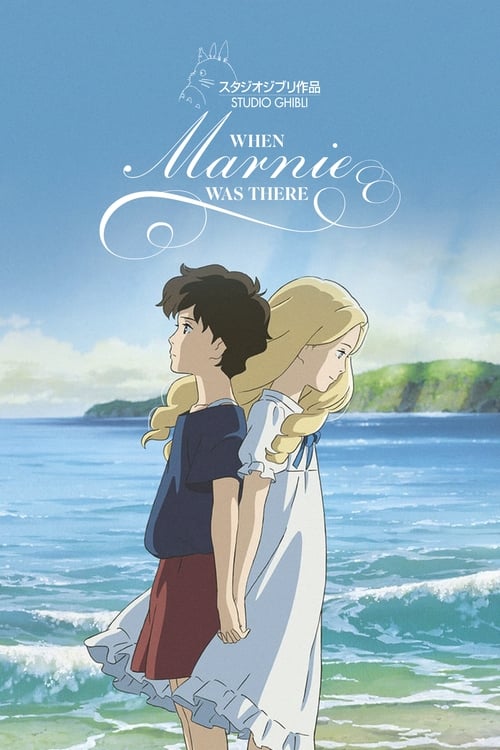
When Marnie Was There
思い出のマーニー
"Promise we'll remain a secret, forever."
Overview
"When Marnie Was There" follows Anna Sasaki, a shy, artistic 12-year-old girl who feels detached from her peers and her loving foster parents. Suffering from asthma and debilitating self-doubt, she is sent to spend the summer with relatives in a quiet seaside town to improve her health.
There, she becomes fascinated by an old, abandoned mansion across the salt marsh. She soon meets Marnie, a mysterious and cheerful blonde girl who appears to live in the house. The two form an immediate, secret friendship. Their encounters have a dreamlike quality, and Anna begins to question if Marnie is real, a ghost, or a figment of her imagination. As Anna's summer unfolds, she delves deeper into the mystery of Marnie and the mansion, uncovering long-hidden secrets that are profoundly connected to her own past and identity.
Core Meaning
The core meaning of "When Marnie Was There" revolves around the journey of self-discovery and healing through understanding one's roots. The director, Hiromasa Yonebayashi, wanted to convey a message of hope for young people who feel lonely and isolated, suggesting that connecting with the past is essential for self-acceptance and moving forward. The film posits that family is not just about blood ties but about love, forgiveness, and the memories that connect generations. By solving the mystery of her own life, Anna learns to love herself and accept the love offered by others, breaking free from her self-imposed isolation.
Thematic DNA
Identity and Self-Worth
Anna's journey is fundamentally a search for identity. She feels like an outsider, calling herself 'outside the magic circle' where everyone else belongs. Her status as a foster child fuels her insecurity and her belief that she is unlovable, especially after discovering her foster parents receive money to care for her. Her friendship with Marnie, who sees and appreciates her, is the catalyst for her to confront these feelings. Ultimately, by discovering her direct lineage to Marnie, she finds a concrete sense of belonging and the self-worth she desperately needed.
Loneliness and Friendship
The film is a poignant exploration of loneliness. Both Anna and Marnie are deeply lonely characters, albeit for different reasons. Anna is socially withdrawn and struggles to connect with peers, while Marnie, despite her cheerful demeanor, suffers from neglect and abuse from her parents and nannies. Their secret friendship becomes a sanctuary for both, a space where they find unconditional acceptance and emotional support. This central relationship highlights how profound connection can be a powerful antidote to isolation.
Memory and the Past
The narrative intricately weaves the past into the present. Anna's experiences with Marnie are not simple ghostly encounters but are manifestations of deeply buried memories. Marnie had told a very young Anna stories of her own childhood, which Anna's subconscious later reconstructs as dreamlike encounters. The film suggests that the past is never truly gone and that understanding our family's history and their traumas is crucial to understanding ourselves. The discovery of Marnie's diary and the stories from Hisako bridge the gap between memory and reality.
Forgiveness and Healing
Healing is a central outcome of the story, achieved through forgiveness. Anna must forgive Marnie (and by extension, her entire biological family) for 'abandoning' her through death, which she perceives as a betrayal. The climactic scene where Anna tearfully forgives a ghostly Marnie is symbolic of her letting go of the resentment that has fueled her self-hatred. This act allows Anna to also accept the love of her foster mother, Yoriko, and to finally heal from her emotional trauma.
Character Analysis
Anna Sasaki
Sara Takatsuki
Motivation
Anna's primary motivation is to find a sense of belonging and to understand why she feels so disconnected from everyone else. She craves a genuine connection with someone who understands her, a role that Marnie initially fills. Subconsciously, she is driven to uncover the truth about her past and resolve her feelings of being unwanted.
Character Arc
Anna begins the film as a deeply insecure and introverted girl, consumed by self-hatred and a feeling of being an outsider. Her journey is one of profound internal change. Through her connection with Marnie, she explores her repressed family history, confronts her abandonment issues, and learns the truth of her lineage. This knowledge empowers her to forgive the past, accept the love of her foster family, and form genuine friendships. She transforms from a closed-off, lonely child into an open, happier young person who finally sees herself as part of the 'magic circle'.
Marnie
Kasumi Arimura
Motivation
As a spirit or memory, Marnie's motivation is to guide Anna towards the truth and help her heal. She seeks forgiveness for the generational trauma that began with her and for ultimately 'leaving' Anna by dying. She provides Anna with the love and acceptance she needs to begin her journey of self-discovery.
Character Arc
Marnie, as encountered by Anna, is a blend of a real historical figure and a spiritual guide. Her own story is one of tragedy; she was a wealthy but neglected child who endured abuse from her caretakers. Her life was marked by loss, including the death of her husband Kazuhiko and a strained relationship with her daughter, Emily. Through her connection with Anna, her granddaughter, Marnie's spirit finds peace. The 'arc' is for her memory and story to be understood and for her to receive the forgiveness from Anna that she couldn't get from her own daughter, thus bringing closure to her troubled life.
Yoriko Sasaki
Nanako Matsushima
Motivation
Yoriko's motivation is simple and powerful: she wants her daughter to be happy and healthy. She is driven by a deep, unwavering maternal love for Anna, even when that love is not returned. She struggles to understand Anna's pain but never stops trying to provide her with a loving home.
Character Arc
Yoriko is Anna's loving foster mother who is deeply concerned about Anna's emotional distance and health. Her arc involves learning to bridge the gap that has grown between her and Anna. Initially, she is hurt by Anna's coldness and doesn't know how to reach her. The turning point is when she reveals the truth about the government subsidies but reassures Anna of her unconditional love. By the end of the film, their relationship is healed, and Anna is able to call her 'mother' for the first time, signifying a new beginning for their family.
Symbols & Motifs
The Marsh House
The Marsh House symbolizes the past, memory, and Anna's own subconscious. It is a container of forgotten histories and repressed emotions. Its state reflects Anna's connection to her past; it appears vibrant and full of life when she connects with Marnie's memories, but dilapidated and empty in the present day. The house acts as a bridge between generations, physically linking Anna to her grandmother's story.
The house is the central location of the film. Anna is drawn to it immediately upon her arrival. The changing tides that grant or deny access to the house mirror Anna's fluctuating ability to access her own memories and connect with Marnie. The house was specifically designed to be like 'another character who watches over Anna'.
The Silo
The abandoned silo represents trauma, fear, and abandonment. For Marnie, it was a place of terror where she was locked by her abusive maids. For Anna, it becomes the place where she experiences the peak of her fear of being left behind when Marnie disappears during a thunderstorm. Conquering the silo is a necessary step for both characters to face and overcome their deepest fears.
Anna takes Marnie to the silo to help her confront her fear. Later, Anna gets trapped there during a storm while looking for Marnie, reliving a sense of profound abandonment. This traumatic event directly precedes the climax where Anna finally offers forgiveness, turning a place of fear into a site of catharsis and resolution.
Marnie's Diary
Marnie's diary serves as a tangible link between the past and the present. It provides the first concrete evidence that Marnie was a real person, validating Anna's experiences. The diary represents the objective truth of history, contrasting with the subjective, dreamlike nature of Anna's encounters. It is a key that helps unlock the mystery.
Sayaka, the new resident of the Marsh House, finds the diary hidden in a drawer. She shares its contents with Anna, and the events described in the diary align perfectly with what Anna has been experiencing with Marnie, helping them piece together the truth.
Sketching
Anna's passion for sketching is her primary mode of expression and connection to the world when she cannot verbalize her feelings. It is how she processes her emotions and observes the world from a safe distance. Her art is a reflection of her inner state; initially, she keeps it private, but as she opens up, she is able to share it.
Anna is constantly seen with her sketchbook. It's a source of solace for her. Her sketch of Marnie is a pivotal object in the story, a physical manifestation of her connection to her mysterious friend. Her growth is shown at the end when she is happily sketching alongside Hisako, a local painter, and is able to share her work openly.
Memorable Quotes
In this world, there's an invisible magic circle. There's an inside and an outside. Those people are inside. And I'm outside.
— Anna Sasaki
Context:
Anna thinks this to herself while observing her classmates at school. It's a moment of internal monologue that gives the audience a direct view into her painful isolation and self-perception.
Meaning:
This quote perfectly encapsulates Anna's profound sense of alienation and loneliness at the beginning of the film. It establishes her core psychological conflict: the belief that she is fundamentally different and excluded from the normal happiness and social connections that others enjoy.
I hate myself.
— Anna Sasaki
Context:
Anna says this early in the film, revealing the depth of her depression and unhappiness to the audience. It's a raw confession that sets the emotional stakes of the story.
Meaning:
A blunt and powerful expression of Anna's deep-seated self-loathing. This feeling is the root of her inability to accept love from her foster parents and connect with others. Her journey in the film is ultimately about overcoming this intense self-hatred.
I promise I'll never forget you, Marnie. Never!
— Anna Sasaki
Context:
Anna shouts this to a disappearing Marnie after their final, emotional encounter near the silo. She has just forgiven Marnie for leaving her, and this promise is her final, tearful farewell.
Meaning:
This is a declaration of love and forgiveness. It signifies the climax of Anna's emotional journey. By promising to remember Marnie, she is embracing her family history, accepting her past, and healing the wounds of abandonment. It is in this moment she solidifies their eternal bond and finds closure.
Please, forgive me!
— Marnie
Context:
This is said during Marnie's last appearance to Anna, after Anna has been rescued from the silo. It is the emotional peak of the film, where the past and present fully collide and find resolution.
Meaning:
Marnie's plea for forgiveness is multi-layered. On the surface, she is asking for forgiveness for leaving Anna in the silo. Symbolically, however, she is asking for forgiveness for the entire chain of events that led to Anna's feeling of abandonment: for her own death, for her daughter Emily's death, and for the generational trauma. It's a moment of catharsis for both characters.
Philosophical Questions
How does our ancestral past shape our present identity?
The film delves into the idea that we are products of our family history, whether we are conscious of it or not. Anna's feelings of loneliness and abandonment are not just products of her immediate circumstances but are echoes of the trauma and loss experienced by her mother and grandmother. The story suggests that true self-understanding is incomplete without acknowledging and reconciling with the lives of those who came before us. Anna only finds peace when she understands she is part of a longer, albeit tragic, story.
What is the nature of reality when filtered through memory and emotion?
"When Marnie Was There" constantly blurs the line between reality, dreams, and memories. Anna's encounters with Marnie are intensely real to her, yet they defy logical explanation. The film explores how strong emotions and buried memories can manifest in ways that feel tangible. It questions whether the 'reality' of an experience is more about its emotional impact and its power to transform us than its objective, physical truth. For Anna, whether Marnie is a ghost or a memory is less important than the fact that their relationship saved her.
Can we truly heal from trauma without forgiveness?
Forgiveness is presented as the final, crucial step in Anna's healing process. Her anger and resentment towards the family that 'abandoned' her is the source of her self-hatred. The film posits that holding onto this pain only perpetuates the trauma. It is only when Anna is able to genuinely forgive Marnie—for dying, for leaving, for the entire sad history—that the cycle is broken, and she is able to accept love and move forward into a healthier emotional state.
Alternative Interpretations
The most prominent alternative interpretation of "When Marnie Was There" centers on the relationship between Anna and Marnie as a queer love story. Despite the film's ultimate revelation that their bond is that of grandmother and granddaughter, many viewers and critics read their intense, immediate, and deeply romantic-coded connection as a subtle exploration of a first love between two girls. Their secret meetings, declarations of love, and the way Marnie helps Anna find self-worth are all hallmarks of a classic romance narrative. This reading suggests that the genealogical twist serves as a 'safe' way to conclude a story that was, at its heart, about queer love, making it palatable for a broader audience.
Another interpretation focuses on the nature of Anna's experiences. While the film implies a supernatural or spiritual connection, it can also be interpreted as a purely psychological event. In this view, Marnie is not a ghost but a complex hallucination or a series of vivid dreams, constructed by Anna's subconscious from the stories her grandmother told her as a baby. This reading frames the film as a deep dive into Anna's psyche as she works through her trauma, with the entire 'Marnie' experience being a sophisticated coping mechanism that her mind creates to heal itself.
Cultural Impact
Released in 2014, "When Marnie Was There" came at a transitional moment for Studio Ghibli, following the announced retirements of Hayao Miyazaki and Isao Takahata, and was widely seen at the time as potentially the studio's final feature film before a hiatus. This context gave its themes of memory, loss, and saying goodbye an added layer of poignancy for fans.
Critically, the film was very well-received, earning praise for its stunning hand-drawn animation, emotionally complex story, and sensitive handling of themes like depression and identity. It stands as one of the most successful Ghibli films not directed by Miyazaki or Takahata. While more understated than Ghibli's fantasy epics, its focus on psychological drama and mystery set it apart. The film has been discussed for its potential queer undertones in the intense, loving relationship between Anna and Marnie, although the canonical explanation is familial. This ambiguity has led to its embrace by some in the LGBTQ+ community as a powerful story of female intimacy and connection. It remains a beloved, if quieter, entry in the Ghibli canon, celebrated for its emotional depth and breathtaking artistry.
Audience Reception
Audience reception for "When Marnie Was There" has been largely positive. Viewers frequently praise the film for its stunning, classic Ghibli animation, describing the visuals as breathtaking and mesmerizing. The emotional depth of the story is another point of high praise, with many viewers finding the exploration of loneliness, depression, and family connection to be deeply moving and relatable. The mysterious, atmospheric tone and the compelling relationship between Anna and Marnie are often highlighted as the film's greatest strengths.
Points of criticism are less common but tend to focus on the pacing, which some viewers find to be slow. A few have also described the main character, Anna, as unlikable or difficult to connect with at the beginning of the film due to her sullenness. The final plot twist revealing the familial connection has been a point of discussion; while many find it poignant and satisfying, some who interpreted the central relationship as a burgeoning romance have expressed disappointment with the conclusion.
Interesting Facts
- The film is based on the 1967 British novel of the same name by Joan G. Robinson. Director Hayao Miyazaki had cited it as one of his favorite children's novels.
- This was the final film directed by Hiromasa Yonebayashi for Studio Ghibli before he left to co-found Studio Ponoc.
- The setting of the story was changed from the Norfolk coast in England to the wetlands of Hokkaido, Japan.
- "When Marnie Was There" was nominated for the Academy Award for Best Animated Feature Film at the 88th Academy Awards, ultimately losing to "Inside Out".
- It was the final film for veteran Studio Ghibli animator Makiko Futaki, who passed away in 2016.
- The director, Hiromasa Yonebayashi, initially turned down the project because he felt the story, which takes place largely inside the main character's head, would be too difficult to adapt into an animated film.
⚠️ Spoiler Analysis
Click to reveal detailed analysis with spoilers
Frequently Asked Questions
Explore More About This Movie
Dive deeper into specific aspects of the movie with our detailed analysis pages
Comments (0)
No comments yet. Be the first to share your thoughts!