Skip to content
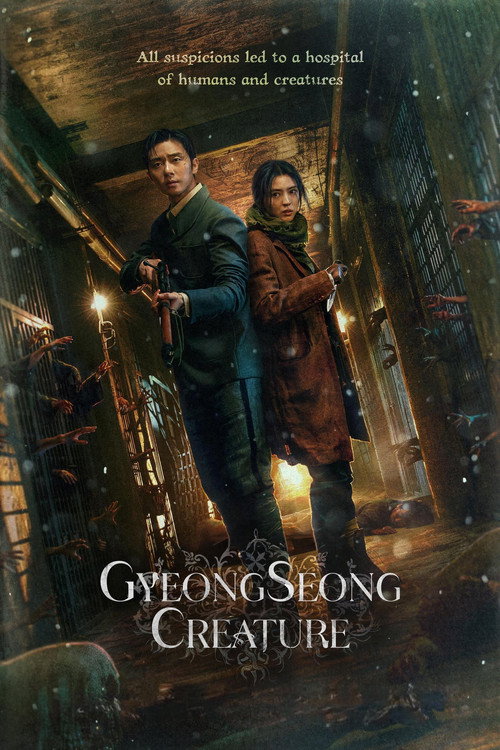
Gyeongseong Creature
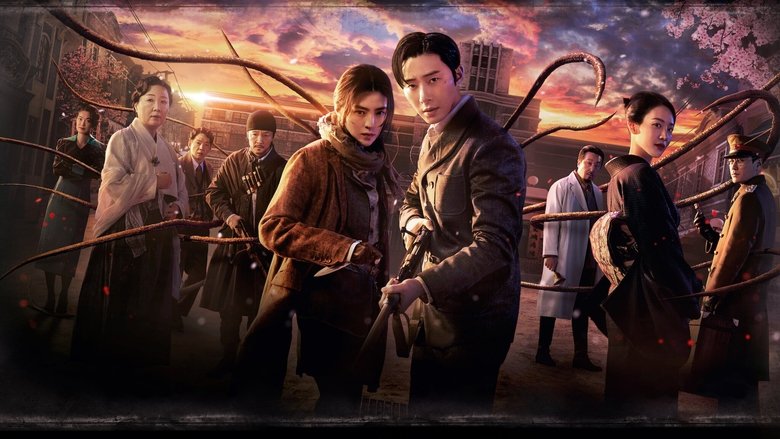
A dark, romantic historical-sci-fi thriller where blood-stained colonial trauma bleeds into sleek modern shadows, echoing like a tragic lullaby beneath cherry blossom petals floating on tainted water.
Gyeongseong Creature

Gyeongseong Creature

경성크리처

"Behold, the powers of destiny. Beware, the powers of karma."

22 December 2023 — 27 September 2024 South Korea 2 season 17 episode Ended 7.9 (325)

Cast: Park Seo-jun, Han So-hee, Kim Hae-sook, Choi Young-jun, Claudia Kim

Drama Sci-Fi & Fantasy Action & Adventure Mystery Imperialism, Colonial Trauma, and Institutional Greed Monstrosity vs. Humanity Love, Memory, and Eternal Devotion Survival, Moral Awakening, and Resistance

Overview

Gyeongseong Creature is a two-season genre-bending narrative that spans nearly eight decades of Korean history, weaving historical horror, romantic melodrama, and modern action-sci-fi. Written by Kang Eun-kyung (Dr. Romantic) and directed by Chung Dong-yoon (It's Okay to Not Be Okay), the saga begins in the spring of 1945 during the final months of the Japanese colonial occupation of Gyeongseong (now Seoul). The plot initially follows an opulent pawnshop owner who values self-preservation above all else, forced into a desperate mission alongside a hardened, nomadic tracker searching for her missing mother. Their investigation leads them deep into Ongseong Hospital, a secret military research facility conducting inhuman biological experiments that give birth to a terrifying, parasitic creature born from pure human greed and suffering.

As the lovers uncover the dark apparatus behind the experiments, their fight for survival escalates into an explosive clash against imperialist oppressors, secret societies, and the monster itself. However, the story does not end with the fall of the empire. Moving forward 79 years into 2024 modern Seoul, the second season reinterprets the central mystery in a contemporary metropolis. The shadow of the colonial past resurfaces through a powerful biotechnology conglomerate built upon the literal and figurative ashes of the old hospital. Reunited under drastically altered circumstances—amidst immortality, lost memories, and mutated super-soldiers—the protagonists must face the eternal persistence of human cruelty and determine whether true humanity can triumph over monstrous desire.

Core Meaning

The core thesis of Gyeongseong Creature across both seasons is that true monstrosity is not born from terrifying biological mutations, but from unchecked human greed, institutionalized cruelty, and colonial exploitation. The parasitic Najin parasite serves as a literal catalyst that exposes the inner nature of whoever it infects or touches. While military oppressors and corporate oligarchs attempt to weaponize human bodies for dominance under the guise of scientific progress or national glory, the series argues that empathy, self-sacrifice, and love are the only forces capable of preserving human dignity against systematic oppression.

Furthermore, the show's temporal jump from 1945 to 2024 asserts that unaddressed historical atrocities do not simply vanish when war ends; they rebrand themselves. Colonial violence and biological exploitation transform into corporate medical tyranny and black-market power structures in the modern era. The show delivers a poignant message about memory, historical continuity, and love: forgetting past horrors leaves society vulnerable to their recurrence, but enduring devotion can breach even the boundaries of time, trauma, and death.

Thematic DNA

Imperialism, Colonial Trauma, and Institutional Greed 30%
Monstrosity vs. Humanity 25%
Love, Memory, and Eternal Devotion 25%
Survival, Moral Awakening, and Resistance 20%

Imperialism, Colonial Trauma, and Institutional Greed

Revealed in Season 1 through the depiction of Imperial Japanese military force Unit 731-inspired experiments at Ongseong Hospital, treating Korean civilians as disposable test subjects (maruta). In Season 2, this theme evolves into corporate exploitation, as Jeonseung Biotech carries forward the same unethical experiments under the banner of modern pharmaceuticals and private power.

Monstrosity vs. Humanity

The show continuously contrasts biological monsters with human monsters. Season 1 shows the mother-turned-creature retaining a protective maternal instinct despite horrific physical mutation, while her human captors display cold-blooded brutality. Season 2 explores how "matured" Najin hosts retain human form while battling internal parasitic hunger, questioning whether remaining human is a physical state or a moral choice.

Love, Memory, and Eternal Devotion

The emotional spine across all 17 episodes is the relationship between Tae-sang and Chae-ok. In Season 1, love transforms a cynical opportunist into a selfless hero. In Season 2, love survives memory loss, temporal distance, and physical transformation, culminating in the willingness to relinquish immortality to live and die together as mortal human beings.

Survival, Moral Awakening, and Resistance

Explores how ordinary individuals react under oppressive regimes. Initially, Tae-sang claims his sole goal is to survive day-by-day in turbulent times. As the series progresses, both seasons prove that passive neutrality in the face of atrocity is impossible, and true survival requires standing up for others.

Character Analysis

Jang Tae-sang / Jang Ho-jae

Park Seo-jun

Archetype: Reluctant Hero / Rogue turned Selfless Leader Key Trait: Sharp resourcefulness, resilience, and unshakeable loyalty

Motivation

Evolves from material wealth and personal self-preservation to protecting Yoon Chae-ok and upholding human dignity.

Character Arc

Starts in 1945 as a flamboyant, wealthy pawnshop owner in Bukchon who avoids politics to stay alive. After meeting Chae-ok and witnessing Ongseong Hospital's atrocities, he risks his fortune and life for the resistance. In Season 2, living in 2024 under the identity "Ho-jae" with wiped memories and Najin-enhanced abilities, he recovers his past through love and ultimately sacrifices his powers to save Chae-ok.

Yoon Chae-ok / "Silverbill"

Han So-hee

Archetype: Tragic Warrior / Relentless Sleuth Key Trait: Lethal combat proficiency, stoicism masking deep emotional tenderness

Motivation

Initially to find her lost mother; later to survive her endless, lonely immortality until she can reunite with Tae-sang.

Character Arc

Spends ten years tracking missing people across Manchuria and Gyeongseong to find her mother. After discovering her mother was turned into the creature, Chae-ok receives the Najin from her mother upon death to save her life. She lives 79 years into modern Seoul as an immortal, solitary sleuth carrying the burden of monster-like hunger until Tae-sang helps her regain her mortality.

All 4 characters and cast

Symbols & Motifs

The Najin Parasite

Meaning:

Symbolizes the infectious nature of human greed, power hunger, and the loss of human identity when ambition overrides empathy.

Context:

A mysterious aquatic organism discovered in China's icy regions, used in laboratory experiments to transform hosts.

Cherry Blossoms (Sakura)

Meaning:

Symbolizes the delicate, beautiful facade covering imperialistic violence, class elitism, and the fleeting nature of unnatural power.

Context:

Frequently associated with Lady Yukiko Maeda throughout the series.

Water and Submerged Tanks

Meaning:

Water is the medium through which the Najin enters and operates, but large water tanks also serve as instruments of torture, preservation, and ultimate purification. In the finale, submergence and breaking the tank symbolize baptism, cleansing of the parasite, and returning to mortal human life.

Context:

Used during biological infection procedures, containment, and in the series finale resolution.

House of Golden Treasure (Geumokdang)

Meaning:

Symbolizes materialism, trade, and practical survival in Season 1, evolving into a repository of memories and a secret sanctuary that bridges 1945 Gyeongseong and 2024 Seoul.

Context:

Jang Tae-sang's opulent pawnshop in Bukchon.

The Neck Scar

Meaning:

Symbolizes hidden trauma, suppressed memory, and the physical line between human consciousness and super-powered monstrosity.

Context:

The physical scar left on Tae-sang/Ho-jae's neck where the Najin was extracted and inserted.

Memorable Quotes

원래 해가 뜨기 전이 가장 어두운 법입니다.
— Jang Tae-sang

Context

Tae-sang says this line in Season 1, Episode 1.

Meaning

Captures both the bleakness of 1945 colonial occupation and foreshadows the immense trial his people face before liberation.

나는 그저 살아남기로 작정한 사람일 뿐이오.
— Jang Tae-sang

Context

Spoken by Jang Tae-sang in Season 1, Episode 1.

Meaning

Establishes Tae-sang's initial self-interested philosophy before his moral awakening drives him to risk everything for others.

All 6 quotes

Episode Highlights

Najin

S1E1

Establishes the 1945 Gyeongseong setting, introduces the main characters, and reveals the underground laboratory in Ongseong Hospital where Japanese scientists infect test subjects.

Significance:

Sets the series plot into motion by linking Tae-sang's personal survival to Chae-ok's search for her mother.

Imprinting

S1E4

Tae-sang and Chae-ok infiltrate Ongseong Hospital. Chae-ok comes face-to-face with the fully mutated tentacled creature, unknowingly encountering her own mother, Choi Seong-sim.

Significance:

Shifts the series from a period heist-mystery into intense biological survival horror.

Awakening

S1E8

Follows the aftermath of the hospital escape. Reveals that Akiko/Myeong-ja was also infected with Najin, creating a second, human-shaped threat in Gyeongseong.

Significance:

Expands the scale of the outbreak outside hospital walls and deepens Tae-sang's commitment to the resistance movement.

Tear

S1E10

Ongseong Hospital is bombed. In a desperate battle against Japanese troops and the creature, Chae-ok is mortally wounded shielding Tae-sang. The creature mother transfers the Najin to Chae-ok underwater. The episode concludes with a shocking post-credits time-jump to modern Seoul.

Significance:

Completely redefines the scope of the show, laying the foundation for Season 2.

Ho-jae

S2E1

Premieres the 2024 setting. Introduces Yoon Chae-ok as an immortal detective in modern Seoul and Jang Ho-jae, a man with Tae-sang's face who suffers from severe amnesia after a mysterious trauma.

Significance:

Successfully re-establishes the core dynamic within a modern urban noir framework.

Kuroko

S2E4

Reveals how Ongseong Hospital morphed into Jeonseung Biotech. Details the creation of the Kuroko black-ops group and confirms that Lady Maeda survived into modern times.

Significance:

Bridges the historical lore of Season 1 directly with the corporate sci-fi conspiracy of Season 2.

Chae-ok

S2E7

High-stakes showdown at Jeonseung Biotech. Tae-sang regains his memories and breaks the water tank holding Chae-ok, neutralizing the Najin and restoring her mortality so they can live as humans.

Significance:

Closes the 80-year emotional journey of the protagonists while delivering a chilling post-credits warning of a potential mass outbreak.

Philosophical Questions

What constitutes true humanity—the physical body or moral consciousness?

Explored through characters like Seung-jo and Chae-ok, who possess parasitic monsters inside them yet retain human emotion, contrasted against cold human oppressors who possess no empathy.

Is immortality a divine gift or a tormenting curse?

Examined through Chae-ok's 79-year loneliness, demonstrating that living forever without loved ones strips existence of meaning and joy.

Can love and moral integrity survive when personal survival is at stake?

Demonstrated by Tae-sang's evolution from a self-interested businessman into someone willing to die for others.

Alternative Interpretations

  • Allegory for Inherited Generational Trauma: The Najin parasite, passed from mother to daughter and surviving into 2024, can be interpreted as a physical metaphor for generational trauma caused by war and occupation. Even decades after physical liberation, the internal damage and memories continue to haunt subsequent generations until actively confronted and healed.
  • The Cynical Capitalist Critique: A secondary reading views Tae-sang's journey not just as a nationalist awakening, but as a critique of modern capitalism. Tae-sang's initial belief that "money conquers all" is shattered when he realizes that imperial state power and corporate biotech see human life purely as capital or test material.
  • The Monster as Victim: The primary creature (Choi Seong-sim) is not an evil entity, but the ultimate victim of human malice. Her destructive rampage is driven entirely by pain and protective maternal instinct, making her a tragic avatar of suffering humanity lashing out against its tormentors.

Full ending explanation

Cultural Impact

Historical Context: The series tackles a painful chapter in East Asian history: the Japanese colonial rule over Korea (1910–1945) and human experimentation by Unit 731. Upon release, the show sparked significant discussions online regarding wartime history, human rights violations, and historical memory across Asian media.

Reception & Evolution: Season 1 received widespread viewership, rapidly climbing into Netflix's Global Top 10 Non-English TV list. Critics praised its production design, acting, and historical atmosphere, though some felt the mid-season pacing was drawn out. Season 2 divided audiences: while fans praised the fast-paced superhero-esque action, sleek cinematography, and romantic payoff, purists missed the rich 1945 period aesthetic and subtle gothic horror of the first season.

Legacy: Gyeongseong Creature solidified the viability of high-concept, multi-genre period horror-sci-fi blockbusters out of South Korea, showcasing how streaming platforms can bridge local historical drama with global genre storytelling.

Audience Reception

Season 1 Reception: Season 1 was celebrated for its evocative world-building, romantic chemistry between Park Seo-jun and Han So-hee, and haunting monster design. Viewers commended its brave historical commentary regarding colonial atrocities. Minor criticism was directed at occasional tonal shifts between lighthearted pawnshop antics and dark biological gore.

Season 2 Reception: Season 2 polarized viewers. Audiences who enjoyed fast-paced modern action, superhero-like combat, and the resolution of the lead romance rated it highly. However, viewers who fell in love with the 1945 historical setting felt the time jump into modern Seoul stripped the show of its unique period charm, turning it into a more conventional corporate sci-fi action thriller.

Overall Verdict: Despite narrative debates surrounding the Season 2 time jump, Gyeongseong Creature is widely regarded as an ambitious, visually stunning, and emotionally resonant epic that successfully pushed the boundaries of Korean television production.

Interesting Facts

  • The series had a production budget of approximately ₩70 billion (over $50 million USD), making it one of the most expensive South Korean television productions in history.
  • The storyline of human biological testing in Ongseong Hospital was explicitly inspired by the real-life atrocities committed by Unit 731, a secret biological and chemical warfare research unit of the Imperial Japanese Army during World War II.
  • During an intense action sequence in August 2022, lead actress Han So-hee suffered a facial injury near her eye that required emergency medical treatment and briefly halted filming.
  • Actors Park Seo-jun, Han So-hee, and Claudia Kim underwent extensive linguistic training to seamlessly deliver dialogue in both archaic 1945 Korean and period-accurate Japanese.
  • Production designers constructed an enormous, meticulous physical set recreating 1945 Street-level Bukchon and the complex subterranean tunnels of Ongseong Hospital in South Korea to minimize green-screen dependency for non-monster scenes.
  • Seasons 1 and 2 were largely planned and conceptualized together, allowing the production team to maintain narrative continuity when transitioning from historical period sets to modern Seoul architecture.

Easter Eggs

Name Alias "Silverbill" (은제비)

Chae-ok's detective alias in Season 2 is Silverbill. In Korean folklore, silver swallows/birds are messengers of hope and return, referencing her decades-long wait to be reunited with Tae-sang.

Jeonseung Biotech's Name

The corporate name Jeonseung (전승) translates literally to "Total Victory" or "Inherited Victory," directly referencing the military ethos of the Imperial Army that founded its underground roots.

The "Kuroko" Moniker

Lady Maeda's specialized strike force in Season 2 is named Kuroko (黒子). In traditional Japanese Kabuki theater, Kuroko are stagehands dressed entirely in black who manipulate props from the shadows while remaining "invisible" to the audience.

Historical Date Detail

Season 1 is specifically set in the spring of 1945, months before August 15, 1945 (Gwangbokjeol - National Liberation Day of Korea). The impending sense of historical doom felt by the Japanese forces in the show directly parallels historical military anxiety right before Japan's surrender.

Frequently Asked Questions

Explore More About This Movie

Dive deeper into specific aspects of the movie with our detailed analysis pages

Comments (0)

Leave a comment

No comments yet. Be the first to share your thoughts!

Similar Movies