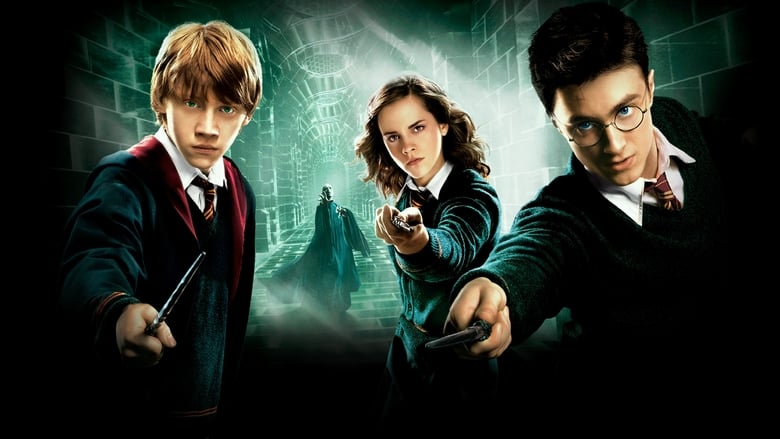
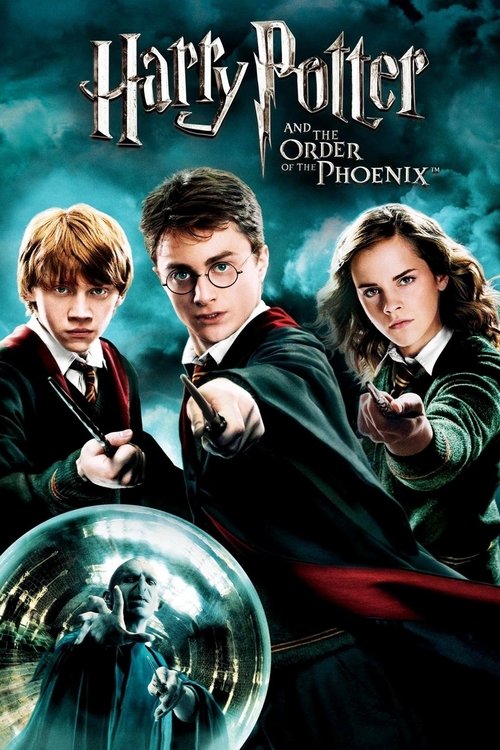
Harry Potter and the Order of the Phoenix
A dark, psychological thriller cloaked in fantasy, where the oppressive weight of bureaucratic tyranny meets the raw isolation of teenage trauma. It is a visual symphony of shadows and resistance, capturing the silent scream of a boy forced to become a soldier.
Harry Potter and the Order of the Phoenix

Harry Potter and the Order of the Phoenix

"The rebellion begins."

08 July 2007 United Kingdom 138 min ⭐ 7.7 (20,477)
Director: David Yates
Cast: Daniel Radcliffe, Rupert Grint, Emma Watson, Imelda Staunton, Helena Bonham Carter
Fantasy Adventure
Institutional Oppression and Corruption Isolation and Trauma Rebellion and Choice Media Manipulation
Budget: $150,000,000
Box Office: $938,212,738

Overview

Harry Potter returns for his fifth year at Hogwarts School of Witchcraft and Wizardry, only to find the wizarding world in a state of dangerous denial. Fearing the return of Lord Voldemort, the Ministry of Magic launches a smear campaign against Harry and Albus Dumbledore, installing the sadistic bureaucrat Dolores Umbridge as the new Defense Against the Dark Arts teacher to monitor the school.

As Umbridge systematically strips away the students' freedoms and refuses to teach practical defensive magic, Harry takes matters into his own hands. He secretly forms "Dumbledore's Army," a resistance group where he trains his peers for the inevitable war ahead. The film navigates Harry's increasing isolation, his disturbing mental connection to the Dark Lord, and the political machinations that threaten to destroy Hogwarts from within.
Core Meaning

At its heart, the film is a study of resistance against institutional corruption and the necessity of finding strength in unity when the world tries to isolate you. It posits that the greatest weapon against tyranny—and the darkness within oneself—is not just magical ability, but the capacity for love, friendship, and the choice to do what is right rather than what is easy.

Thematic DNA

Institutional Oppression and Corruption 30%
Isolation and Trauma 25%
Rebellion and Choice 25%
Media Manipulation 20%

Institutional Oppression and Corruption

The film brilliantly illustrates how evil can manifest through bureaucracy and order. Dolores Umbridge represents a lawful evil, using educational decrees and government authority to silence truth and enforce conformity, contrasting Voldemort's chaotic evil.

Isolation and Trauma

Harry suffers from PTSD and feels profoundly alone, believing no one understands his burden. The film visually isolates him in frames and uses his angry outbursts to depict the psychological toll of his past trauma and the pressure of the prophecy.

Rebellion and Choice

The formation of Dumbledore's Army serves as a literal and metaphorical rebellion. The narrative emphasizes that true morality involves active resistance against unjust rules, embodying the idea that one must choose "between what is right and what is easy."

Media Manipulation

The Daily Prophet is depicted as a propaganda tool for the Ministry, showing how media can be weaponized to shape public perception, discredit truth-tellers, and maintain a false sense of security among the populace.

Character Analysis

Harry Potter

Daniel Radcliffe

Archetype: The Tortured Hero / Leader
Key Trait: Resilience

Motivation

To protect his friends and expose the truth about Voldemort's return, despite the world calling him a liar.

Character Arc

Harry transitions from a reactive, isolated victim of trauma to a proactive leader. He channels his anger into teaching others, ultimately learning that his ability to love and feel grief is what separates him from Voldemort.

Dolores Umbridge

Imelda Staunton

Archetype: The Bureaucratic Tyrant
Key Trait: Sadism masquerading as order

Motivation

To maintain order and Ministry control at any cost, suppressing any dissent or "disorderly" truth.

Character Arc

She begins as an intrusive observer and ascends to total dictator of Hogwarts. Her arc is one of escalating control and cruelty until her hubris leads her to underestimate the "half-breeds" (centaurs) she despises.

Sirius Black

Gary Oldman

Archetype: The Tragic Mentor / Father Figure
Key Trait: Reckless loyalty

Motivation

To fight the Order's war and protect Harry, often conflating Harry with his father James.

Character Arc

Stifled by his confinement in his childhood home, he struggles between being a responsible guardian and a reckless friend to Harry. His death marks the severing of Harry's last link to his parents' past.

Luna Lovegood

Evanna Lynch

Archetype: The Wise Outcast
Key Trait: Unapologetic authenticity

Motivation

To support her friends and stay true to her own eccentric truth.

Character Arc

She remains static in her personality but becomes vital to Harry's arc. She provides the emotional clarity he lacks, validating his sanity and offering a unique perspective on loss.

Symbols & Motifs

Thestrals

Meaning:

They represent the acceptance of death and grief. Only those who have witnessed and emotionally processed death can see them.

Context:

Harry sees them pulling the carriages for the first time after Cedric's death. Luna Lovegood explains their nature to him, creating a bond of shared trauma.

Dolores Umbridge's Pink Cardigans

Meaning:

A visual juxtaposition where soft, feminine, and childish imagery masks cruelty and fascism.

Context:

As Umbridge gains more power and her rule becomes more tyrannical, the shade of pink she wears becomes deeper and more saturated, and her office becomes more cluttered with decorative plates.

The Breaking of the Prophecy Orb

Meaning:

Symbolizes the loss of certainty and the burden of free will.

Context:

During the battle in the Department of Mysteries, the prophecy is physically destroyed, leaving Harry with the knowledge of his burden but without the physical record the Death Eaters sought.

Occlumency

Meaning:

Represents emotional repression and vulnerability.

Context:

Snape's lessons force Harry to confront his own mind. His inability to master it highlights his reliance on emotion—which ultimately becomes his strength against Voldemort's possession.

Memorable Quotes

I must not tell lies.

— Harry Potter

Context:

First etched into Harry's hand during detention; later repeated by Harry to Umbridge in the Forbidden Forest.

Meaning:

Originally a punishment forced upon Harry by Umbridge to suppress the truth, Harry reclaims this line as an act of defiance when Umbridge is captured by centaurs.

You're not a bad person. You're a very good person, who bad things have happened to.

— Sirius Black

Context:

Spoken to Harry at Grimmauld Place when Harry confesses he feels angry all the time.

Meaning:

A pivotal moment of reassurance for Harry, who fears he is becoming like Voldemort. It emphasizes that our choices define us, not our circumstances or impulses.

Things we lose have a way of coming back to us in the end, if not always in the way we expect.

— Luna Lovegood

Context:

Spoken to Harry as she pins up notices for her lost possessions at the end of the school year.

Meaning:

Encapsulates the film's theme of grief and acceptance. It offers Harry comfort regarding Sirius's death and the loss of his parents.

You're the weak one. And you'll never know love, or friendship. And I feel sorry for you.

— Harry Potter

Context:

Internal monologue/speech to Voldemort while being possessed in the Ministry Atrium.

Meaning:

Harry's victory over Voldemort's possession isn't through magic, but through pity and the strength of his emotional connections.

Philosophical Questions

Is safety worth the sacrifice of freedom?

Through Umbridge's educational decrees, the film asks whether a secure environment (or the illusion of one) justifies the complete removal of student agency, privacy, and practical learning.

Does trauma define identity?

Harry and Voldemort share similar traumatic pasts and a psychic connection. The film explores whether our scars dictate our future or if, as Dumbledore suggests, our choices in response to that trauma define who we are.

What is the nature of true authority?

The film contrasts the authority of title (Fudge/Umbridge) with the authority of respect and competence (Dumbledore/Harry), questioning why we follow leaders and when it is moral to disobey them.

Alternative Interpretations

The Political Allegory: Many critics view the film as a critique of the War on Terror, with the Ministry's denial representing government refusal to acknowledge inconvenient truths and the use of "security" measures (Educational Decrees) to strip away civil liberties.

Harry's Mental State: The film can be interpreted as a metaphor for adolescence and mental illness. Harry's isolation, anger, and the literal "voice in his head" (Voldemort) serve as a powerful allegory for depression and the feeling of being misunderstood by the adult world.

Cultural Impact

Released in 2007, the film resonated strongly with the post-9/11 political climate. Critics and scholars noted its mature exploration of government surveillance, denial of truth, and the use of fear to control a population. It marked a turning point in the franchise, moving firmly from children's adventure to a darker, young adult political thriller. Imelda Staunton's performance as Umbridge is widely regarded as one of the most effective cinematic portrayals of villainy, becoming a cultural shorthand for bureaucratic evil. The film solidified the series' ability to grow with its audience, tackling complex psychological themes like PTSD and corruption.

Audience Reception

The film received generally positive reviews, holding a strong rating on aggregation sites. Praised aspects included the darker, more mature tone, the visual effects (particularly the Dumbledore/Voldemort duel), and the performances—especially Imelda Staunton, who was universally acclaimed for making the audience hate her. Criticism largely focused on the pacing and the screenplay's need to condense the longest book in the series into the shortest film (at the time), leading to the omission of beloved subplots like Quidditch and St. Mungo's Hospital. Some viewers felt the montage sequences, while stylish, rushed the emotional development of secondary characters.

Interesting Facts

  • Evanna Lynch beat 15,000 other girls for the role of Luna Lovegood after writing a letter to J.K. Rowling about her eating disorder.
  • The Ministry of Magic set was the largest built for any of the films; the atrium required over 30,000 tiles, which were actually made of cardboard.
  • Alan Rickman (Snape) was the only cast member who knew his character's ultimate fate, having been told by J.K. Rowling years in advance.
  • The Black family tapestry at Grimmauld Place included names and details provided specifically by J.K. Rowling for the film that were not in the books.
  • This was the first Harry Potter film directed by David Yates, who went on to direct the remaining three films and the *Fantastic Beasts* series.
  • The 'Department of Mysteries' shelves were entirely CGI because building thousands of glass prophecy orbs was impractical and dangerous for the actors.

Easter Eggs

6-2-4-4-2

When Mr. Weasley takes Harry to the Ministry of Magic via the telephone booth, he dials 6-2-4-4-2. On a standard telephone keypad, these numbers spell out M-A-G-I-C.

Crumple-Horned Snorkack

In the scene where the students are on the train to Hogwarts, Luna is reading The Quibbler upside down. The cover features a drawing of a Crumple-Horned Snorkack, a creature she and her father believe in but Hermione insists doesn't exist.

Gilderoy Lockhart's Portrait

In the scene at Grimmauld Place, a portrait of Gilderoy Lockhart (from Chamber of Secrets) can be briefly seen, referencing his fall from grace.

Anthony McPartlin Cameo

A portrait in the Room of Requirement features the likeness of the film's set decorator, creating a hidden cameo for the crew.

⚠️ Spoiler Analysis

Click to reveal detailed analysis with spoilers

Frequently Asked Questions

Explore More About This Movie

Dive deeper into specific aspects of the movie with our detailed analysis pages

Comments (0)

Leave a comment

No comments yet. Be the first to share your thoughts!