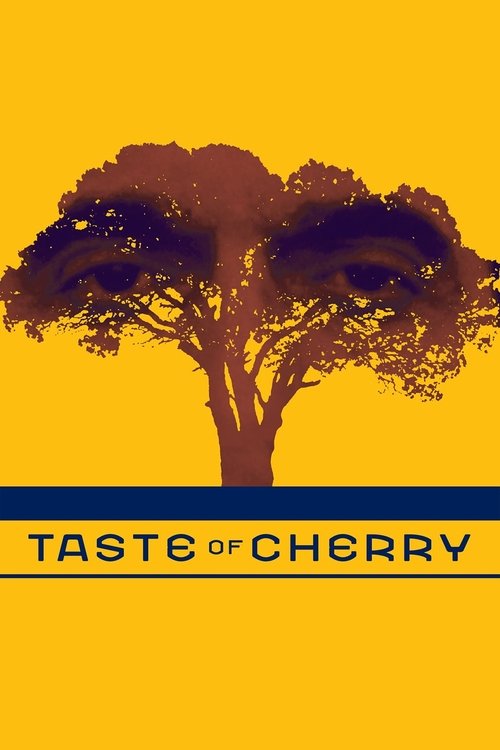
Taste of Cherry
طعم گيلاس
Overview
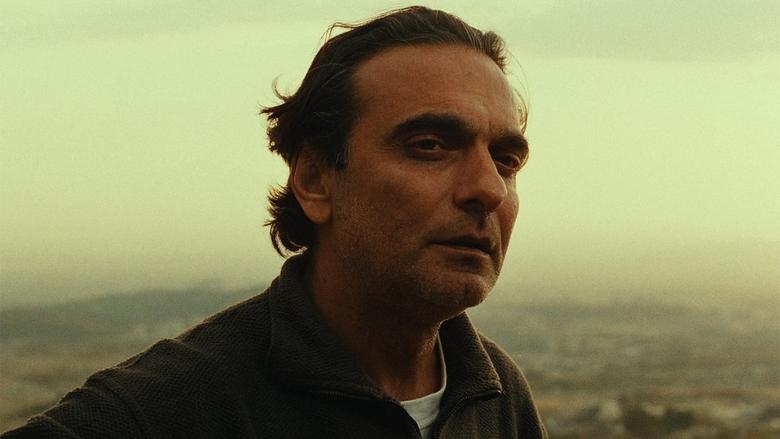
Mr. Badii, a middle-aged man with a weary expression, drives his Range Rover through the arid, hilly construction sites surrounding Tehran. He is on a grim quest: to find someone who will agree to a specific job for a high price. He has dug a hole in the ground and intends to commit suicide by taking sleeping pills that night. His request is simple yet horrifying: the person must go to the hole the next morning, call his name, and if he doesn't answer, shovel earth over his body.
Over the course of the film, Badii picks up three passengers from different backgrounds: a young Kurdish soldier, an Afghan seminarist, and an elderly Azeri taxidermist. The first two are frightened or morally opposed to the task, reacting with fear and religious objection. However, the third passenger, Mr. Bagheri, agrees to the job out of financial necessity but uses the drive to share a personal story about how the simple taste of mulberries once saved him from his own suicide attempt, offering Badii a new perspective on the beauty of existence.
Core Meaning
The Affirmation of Life Through Death
Taste of Cherry is not a film about the despair of suicide, but rather a contemplation on the choice to live. Kiarostami removes the why of Badii's suicide to focus entirely on the how of his connection to the world. The film suggests that life's meaning is found not in grand narratives, but in immediate sensory experiences—the color of the sky, the warmth of the sun, and the taste of fruit. By juxtaposing Badii's isolation in his car with the expansive, living world outside, the film argues that the beauty of existence is always present, waiting to be tasted, even at the edge of the grave.
Thematic DNA
Suicide and Choice
The film tackles the taboo subject of suicide in Islamic culture, but frames it as an exercise in autonomy. Badii's search is technically for an executioner, but thematically for a witness to his choice. The film remains neutral, neither condemning nor romanticizing the act, treating it as a prism to refract the values of the living characters he encounters.
Isolation vs. Connection
Badii is visually and emotionally sealed within his car, a metal box that separates him from the environment. His interactions with passengers break this seal. The car serves as a mobile confessional where the barrier between the self and the other is tested. The windshield frames the world, highlighting Badii's detachment from the life teeming outside.
The Sensory Experience of Nature
Nature is a silent character, represented by the dusty hills, the changing light, and the vegetation. Bagheri's monologue shifts the focus from intellectual arguments against suicide to sensory ones: the taste of mulberries, the sight of the moon. The film posits that nature's simple, recurring gifts are the ultimate counter-argument to nihilism.
The Fluidity of Identity
The passengers represent the diverse ethnic tapestry of Iran (Kurdish, Afghan, Azeri), emphasizing the universal nature of the human condition. Their differing reactions—fear, religious duty, and pragmatic compassion—map out a spectrum of human responses to mortality.
Character Analysis
Mr. Badii
Homayoun Ershadi
Motivation
To end his suffering (the cause of which is never revealed) and to find a compassionate witness to bury him, ensuring he does not remain unburied.
Character Arc
He begins as a man resolute in his desire to die, viewing others only as tools to achieve his end. Through his conversations, particularly with Bagheri, his resolve encounters the resistance of life's beauty. He moves from stoic detachment to a moment of vulnerability lying in the grave, watching the thunderstorm.
Mr. Bagheri
Abdolrahman Bagheri
Motivation
To earn money for his sick child, but primarily to share his wisdom and perhaps prevent Badii from making a mistake he almost made himself.
Character Arc
He enters as a simple taxidermist but reveals himself to be a survivor of suicide. He agrees to the job not out of greed, but compassion, hoping his words might save Badii.
The Soldier
Safar Ali Moradi
Motivation
To return to his barracks and avoid trouble.
Character Arc
A young Kurdish conscript who represents the instinctual fear of death. He flees Badii's car, unable to comprehend the request.
Symbols & Motifs
The Range Rover
It symbolizes Badii's isolation and his modern, detached existence. It acts as both a protective shell and a moving coffin, cutting him off from the dust and reality of the world outside.
Almost the entire film takes place inside or around this vehicle as Badii drives in circles through the construction site.
The Taste of Cherry / Mulberry
Represents the small, sensory pleasures that make life worth living. It is the antidote to existential despair—a reminder that happiness is often physical and immediate rather than abstract.
Mr. Bagheri recounts how he planned to hang himself but stopped to eat mulberries from the tree he intended to die on, which changed his mind.
The Grave / The Hole
A return to the earth and the womb. It represents the finality of death but also the connection to the soil and nature.
Badii frequently visits the hole he has dug, sitting by it or lying in it, testing the physical reality of his death.
Dust and Earth
Symbolizes the cycle of life and death, the raw material of creation, and the inevitability of returning to the ground. It creates a visual landscape that is both barren and pregnant with potential.
The construction site is dominated by earth-moving machines and clouds of dust, constantly reshaping the landscape.
Memorable Quotes
You want to give up the taste of cherries?
— Mr. Bagheri
Context:
Spoken during the drive as Bagheri tries to convince Badii that life's beauty is found in small things.
Meaning:
The central philosophical query of the film. It challenges Badii to consider if the permanent cessation of consciousness is worth losing the simple, exquisite sensations of being alive.
I left to kill myself, and I came back with mulberries.
— Mr. Bagheri
Context:
Bagheri recounting his own suicide attempt in 1960.
Meaning:
Summarizes the absurdity and miracle of life. The intent for death was interrupted by the sudden, undeniable pleasure of eating fruit, shifting the character's entire worldview.
It is not 'help'. It is work. I pay well.
— Mr. Badii
Context:
Badii speaking to the soldier, trying to bribe him into agreeing to the task.
Meaning:
Shows Badii's attempt to transactionalize human connection and death, trying to remove the emotional weight from the favor he is asking.
You can't feel what I feel.
— Mr. Badii
Context:
Badii responding to Bagheri's attempts to understand his pain.
Meaning:
Highlights the fundamental isolation of pain. Badii rejects empathy because he believes his internal suffering is incommunicable.
Philosophical Questions
Is suicide a valid exercise of personal autonomy?
The film presents suicide not as a tragedy but as a choice. Badii claims the right to end his life as a fundamental freedom, challenging religious and social constraints that view life as a duty.
Can one human truly understand another's pain?
Badii repeatedly tells his passengers, 'You can't feel what I feel,' suggesting an unbridgeable gap of subjectivity. The film asks if empathy is enough to save someone, or if we are ultimately alone in our experience of the world.
Does nature provide an objective reason to live?
Through Bagheri's monologue, the film proposes that the sensory experience of the natural world (fruit, sunrise, seasons) provides an intrinsic value to existence that transcends intellectual suffering.
Alternative Interpretations
The Dream / Purgatory Theory: Some critics interpret the cyclical driving and the barren landscape as a form of purgatory where Badii is already dead or trapped in a loop, seeking a release he cannot find.
The Political Allegory: The interactions with the soldier, the seminarist, and the taxidermist can be read as a commentary on the institutions of Iran—the Military, Religion, and the secular/pragmatic working class—and their inability or ability to address individual suffering.
The Cinema as Life: The ending suggests that 'Mr. Badii' doesn't die because he is a fictional character; the 'resurrection' is the revelation of the actor. This implies that cinema allows us to rehearse death but ultimately returns us to the vitality of life.
Cultural Impact
Taste of Cherry is a landmark in world cinema, pivotal in bringing Iranian cinema to the global forefront. Its win of the Palme d'Or at the 1997 Cannes Film Festival (shared with The Eel) solidified Abbas Kiarostami's status as a master of minimal, poetic realism. Culturally, it sparked intense debate within Iran due to its non-judgmental depiction of suicide, a subject strictly taboo in Islamic society. Philosophically, it influenced a generation of filmmakers to explore existentialism through a minimalist lens, proving that high drama could be achieved with a car, two actors, and a conversation. It is cited as a prime example of 'slow cinema' that demands active viewer participation.
Audience Reception
Critical Acclaim: The film is widely regarded as a masterpiece of 90s cinema, praised for its humanism, visual poetry, and Kiarostami's direction. It holds high ratings on review aggregators like Rotten Tomatoes and Metacritic.
Divisive Elements: The pacing is deliberately slow and repetitive, which alienates some mainstream viewers. The ending is the most controversial aspect; Roger Ebert notoriously gave the film a scathing review (1 star), calling it 'excruciatingly boring' and detesting the fourth-wall break, while other critics hailed the ending as a stroke of genius that reframes the entire narrative.
Verdict: A polarized classic—viewers either find it a life-changing meditation or a tedious exercise in frustration.
Interesting Facts
- The film was the first Iranian movie to win the Palme d'Or at the Cannes Film Festival.
- Director Abbas Kiarostami often sat in the passenger seat during filming, so the actors were talking to him rather than to the actor playing Badii.
- The ending scene was shot on a handheld camcorder and features the film crew, deliberately breaking the fourth wall.
- The actor playing Mr. Badii, Homayoun Ershadi, was not a professional actor but an architect whom Kiarostami found sitting in traffic.
- The dialogue was largely improvised based on Kiarostami's guidance, as there was no traditional script.
- Kiarostami filmed the driver and passenger separately in many scenes, which is why they are rarely seen in the same frame.
- The song playing over the final credits is a trumpet version of 'St. James Infirmary Blues' by Louis Armstrong.
- The film faced censorship challenges in Iran due to its subject matter of suicide, which is considered a grave sin in Islam.
Easter Eggs
Kiarostami's Cameo / Crew Reveal
In the final sequence, the director Abbas Kiarostami is seen holding a walkie-talkie, and the crew is visible filming. This meta-cinematic moment reminds the audience that they are watching a constructed reality, distancing them from the tragedy.
The Green Hillside
In the camcorder footage at the end, the previously arid brown hills are suddenly green and lush, and soldiers are seen resting and holding flowers. This visual shift symbolizes a change in perspective from death (winter/arid) to life (spring/green).
⚠️ Spoiler Analysis
Click to reveal detailed analysis with spoilers
Frequently Asked Questions
Explore More About This Movie
Dive deeper into specific aspects of the movie with our detailed analysis pages
Comments (0)
No comments yet. Be the first to share your thoughts!