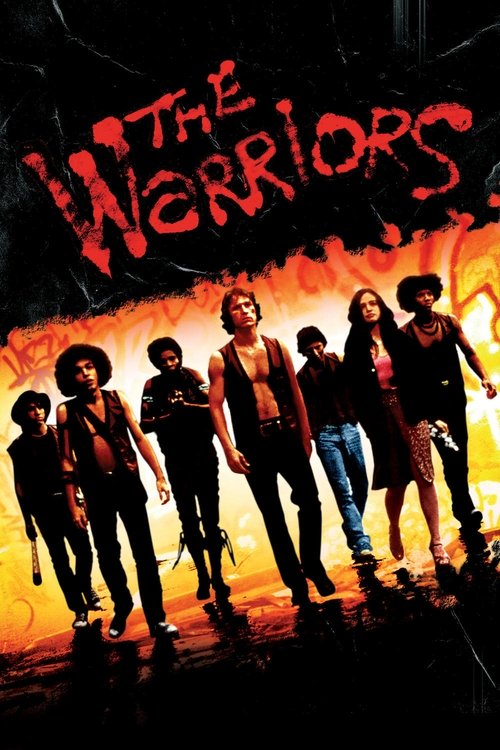
The Warriors
"These are the armies of the night. They are 100,000 strong. They outnumber the cops five to one. They could run New York City. Tonight they're all out to get the Warriors."
Overview
In a dystopian 1979 New York City, hundreds of street gangs gather in the Bronx for a midnight summit called by Cyrus, the visionary leader of the Gramercy Riffs. Cyrus proposes a city-wide truce to unite all gangs into a single army that could outnumber the police and rule the city. However, the meeting descends into chaos when Luther, the psychotic leader of the Rogues, shoots Cyrus and frames the Warriors, a gang from Coney Island, for the assassination.
With the truce broken and a hit out on them, the Warriors must travel 30 miles from the Bronx back to their home turf in Coney Island. Unarmed and pursued by both the police and rival gangs—including the skinhead Turnbull ACs, the baseball-wielding Furies, and the all-female Lizzies—the group faces a desperate fight for survival. Led by the stoic War Chief Swan, they must navigate the hostile underground subway network and the dangerous streets above, shedding members along the way.
The film is a stylized action-thriller that functions less as a realistic depiction of gang life and more as a modern fable. It strips away the social commentary typical of the genre, focusing instead on the kinetic energy of movement, the codes of tribal loyalty, and the visceral struggle to return home against overwhelming odds.
Core Meaning
At its heart, The Warriors is a modern retelling of Xenophon's Anabasis, transplanting the story of Greek mercenaries trapped behind Persian lines to a hyper-real New York City. Director Walter Hill intended to strip the gang genre of its sociological baggage—avoiding the "why are they poor?" narrative—to create a pure mythological hero's journey.
The film explores the concept of tribalism as a fundamental human instinct. It posits that in the absence of societal order, people will naturally fracture into tribes with their own uniforms, codes of honor, and territories. The "message" is one of survival and existential perseverance: the struggle is not to change the world, but simply to survive the night and return to where you belong.
Thematic DNA
Survival and The Odyssey
The driving force of the film is the primal need to get home. The narrative is a linear obstacle course (or "gauntlet") where the destination, Coney Island, represents safety and peace. This mirrors the epic structure of The Odyssey, where the journey itself tests the character and resolve of the heroes.
Tribalism and Identity
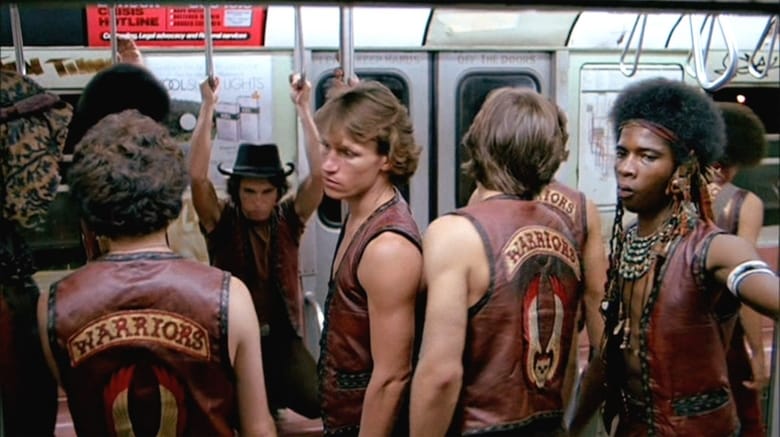
Identity is defined entirely by the group. The characters wear "colors" (vests) that act as both uniform and armor. Removing the vest is seen as a loss of self. The film presents a world where belonging to a tribe is the only way to validate one's existence in a chaotic urban landscape.
Loyalty and Brotherhood
Internal conflict arises when individual ego (Ajax) clashes with collective survival (Swan). The film ultimately champions stoic loyalty over individual bravado. The Warriors survive because they (mostly) stick together, while gangs that lack discipline or honor (like the Rogues) are portrayed as chaotic and treacherous.
Anti-Establishment / Anarchy
The film presents a world virtually devoid of "normal" civilians or effective government. The police are viewed merely as another rival gang, but one with more power. Cyrus's dream of a united underground army reflects a potent, albeit terrifying, revolutionary fantasy of the disenfranchised rising up against the establishment.
Character Analysis
Swan
Michael Beck
Motivation
To get his "family" back to Coney Island alive and clear their name.
Character Arc
Thrust into leadership after Cleon's death, Swan must navigate the gang through the night. He evolves from a closed-off soldier who views women as distractions into a leader who accepts vulnerability, eventually forming a bond with Mercy. He represents discipline and strategy over brute force.
Ajax
James Remar
Motivation
To prove his dominance and masculinity through fighting and sex.
Character Arc
Ajax refuses to adapt or temper his impulses. His arc is a cautionary tale of hubris; his inability to control his sexual and violent urges leads to his capture by an undercover cop, removing him from the group before the finale.
Mercy
Deborah Van Valkenburgh
Motivation
To escape the boredom and mediocrity of her life with the Orphans.
Character Arc
Initially a bored thrill-seeker looking for a "strong man" to attach herself to, Mercy proves her toughness and agency throughout the night. She sheds her superficial desire for excitement in exchange for genuine connection and self-respect, mirroring Swan's journey.
Luther
David Patrick Kelly
Motivation
Pure chaos and enjoyment of violence ("I like doing things like that").
Character Arc
Luther remains static as the embodiment of senseless violence. He kills Cyrus for "no reason" and pursues the Warriors simply because he enjoys the chaos. He is the antithesis of the Warriors' code of honor.
Cyrus
Roger Hill
Motivation
To unite the gangs into a single, unstoppable force to rule the city.
Character Arc
Though he dies early, his shadow looms over the entire film. He represents the potential for order and revolution, a "King" figure whose death plunges the kingdom into anarchy.
Symbols & Motifs
The Warriors' Vests
The reddish-brown leather vests with the winged skull logo symbolize identity, armor, and tribal belonging. They are the characters' flag and skin; without them, they are "nobodies."
When Mercy asks for a vest, she is asking for protection and status. When the group is forced to take off their vests to hide on the train, they feel naked and vulnerable, physically stripping away their power.
The Subway
The subway system represents the River Styx or a perilous underworld passage. It is the artery connecting the different "kingdoms" (neighborhoods) and the primary battleground.
The characters are constantly seeking the safety of the train. The stations serve as checkpoints or levels in their video-game-like journey. The silence and graffiti of the subway reinforce the dystopian atmosphere.
The Radio DJ
The unseen DJ (only her lips and microphone are shown) acts as the Greek Chorus. She narrates the action, comments on the plot, and signals the movements of the antagonist forces.
Throughout the night, she broadcasts updates to the "boppers," dedicating songs to the Warriors that ironically signal the next wave of attacks, turning the city against them.
The Wonder Wheel
The Coney Island Ferris wheel represents Home and Ithaca. It is the beacon of safety they are striving to reach throughout the endless night.
It appears in the opening and closing shots. Seeing the lights of the Wonder Wheel at dawn signifies the end of their ordeal and the successful completion of their odyssey.
Memorable Quotes
Warriors, come out to play-ay-ay!
— Luther
Context:
Luther chants this repetitively while driving slowly in a hearse, taunting the Warriors who are hiding under the boardwalk at Coney Island for the final showdown.
Meaning:
This taunt, improvised by actor David Patrick Kelly clinking three beer bottles together, distills the film's essence: gang warfare as a twisted playground game. It is chilling, playful, and iconic.
Can you dig it?
— Cyrus
Context:
Cyrus shouts this to the gathered crowd of thousands of gang members during the summit in the Bronx, whipping them into a frenzy of agreement.
Meaning:
A call for unity and understanding. It represents the height of the film's utopian possibility—that these violent groups could understand their collective power.
I'll shove that bat up your ass and turn you into a popsicle.
— Ajax
Context:
Ajax yells this at the Baseball Furies during the standoff in the park, right before the brawl begins.
Meaning:
Demonstrates Ajax's hyper-aggressive, crude masculinity and his reliance on intimidation. It highlights the stylized, almost comic-book dialogue of the film.
This is what we fought all night to get back to?
— Swan
Context:
Spoken by Swan as they ride the subway into Coney Island at dawn, looking out at the dilapidated neighborhood.
Meaning:
A moment of existential realization. After surviving a hellish night, the "paradise" of home is revealed to be just a run-down, gray boardwalk. It questions the value of the struggle.
Philosophical Questions
Is order preferable to liberty?
Cyrus proposes a totalitarian-style unification of gangs to rule the city. While this would end inter-gang warfare, it suggests a new form of tyranny. The film asks whether the chaotic freedom of independent tribes is better than a unified, powerful regime.
What constitutes a 'family'?
The film deconstructs the traditional family unit. For these young men, the gang is not just a criminal enterprise but a surrogate family providing structure, protection, and identity in a world that has abandoned them.
Does nature or nurture drive violence?
Luther claims he kills for "no reason," suggesting an inherent evil or chaos in human nature. In contrast, the Warriors use violence as a tool for survival, suggesting their brutality is a product of their environment.
Alternative Interpretations
The Homoerotic Subtext: Critics have noted the film's intense focus on male bodies, leather, and phallic imagery (bats, knives), alongside Ajax's aggressive hyper-heterosexuality, suggesting a latent homoerotic tension within the gang dynamic.
The Socialist Allegory: Some readings view Cyrus as a socialist revolutionary trying to unite the "proletariat" (the gangs) against the "state" (the police/mafia). His assassination by Luther represents the sabotage of working-class solidarity by chaotic, reactionary forces.
The Pacifist Message: Despite the violence, the Warriors rarely instigate fights; they only defend themselves. The film can be read as a critique of senseless violence, rewarding those who seek only to return home rather than those who seek conquest.
Cultural Impact
The Warriors had a tumultuous birth but achieved immortality. Upon release in 1979, it was controversial due to outbreaks of violence at screenings, leading to a media panic and pulled ads. However, its unique visual style—blending comic book aesthetics with neon-noir realism—influenced decades of pop culture.
It revolutionized the depiction of street gangs, moving away from the musical theater of West Side Story to a grittier, yet stylized, urban fantasy. The film's aesthetic influenced hip-hop fashion, music videos, and the cyberpunk genre. Its structure became a blueprint for "point A to point B" survival movies. Today, it is revered as a cult classic, with the "Warriors, come out to play" chant remaining one of the most recognizable quotes in cinema history.
Audience Reception
Original 1979 Reception: Critics were largely dismissive, calling it wooden and devoid of character depth. Pauline Kael famously panned it. Audiences were polarized; young urban viewers loved it, but the reports of violence at theaters terrified the general public.
Modern Reception: The film has undergone a massive critical reappraisal. It holds a high score on Rotten Tomatoes (around 88%). Modern audiences praise its atmosphere, synth soundtrack, pacing, and visual flair. It is now viewed as a masterclass in economic storytelling and atmospheric world-building.
Interesting Facts
- The iconic line 'Warriors, come out to play-ay-ay!' was completely improvised by David Patrick Kelly. He gathered three beer bottles from under the boardwalk and tapped them together to create the rhythm.
- The film is based on Sol Yurick's 1965 novel, which was itself a loose adaptation of Xenophon's 'Anabasis', an ancient Greek text about mercenaries fighting their way home from Persia.
- Real gang members were used as extras for the summit scene in the Bronx. To prevent violence, the production crew kept rival gangs separated and had undercover police officers in the crowd.
- Actor Thomas G. Waites, who played Fox, was fired mid-production for being difficult. As a result, his character was unceremoniously killed off by being thrown in front of a train; the stunt double was used for the shot, and he was uncredited.
- President Ronald Reagan was a fan of the film and even called lead actor Michael Beck to tell him he enjoyed screening it at Camp David.
- The 'Baseball Furies' gang makeup and style were influenced by the band KISS and Director Walter Hill's love of baseball.
- The production trucks were protected by a real gang called 'The Mongrels' for $500 a day to ensure safety in certain neighborhoods.
- The film sparked real-life violence and vandalism at theaters upon its release, leading Paramount to halt advertising and offer to pay theaters to stop showing it.
Easter Eggs
Xenophon's Anabasis Parallels
The plot points mirror the ancient Greek history: Cyrus (the Greek leader) is killed, leaving the mercenaries (The Warriors) leaderless in hostile territory. The character 'Swan' parallels the historical Xenophon who takes command.
Orion's Belt
The opening shot of the Wonder Wheel features lights that resemble the constellation Orion. In mythology, Orion is a hunter, fitting for a film where the characters are hunted.
Video Game Connection
The 2005 Rockstar Games video game adaptation features the original cast returning to voice their characters, and it expands the lore significantly, becoming a cult classic in its own right.
⚠️ Spoiler Analysis
Click to reveal detailed analysis with spoilers
Frequently Asked Questions
Explore More About This Movie
Dive deeper into specific aspects of the movie with our detailed analysis pages
Comments (0)
No comments yet. Be the first to share your thoughts!