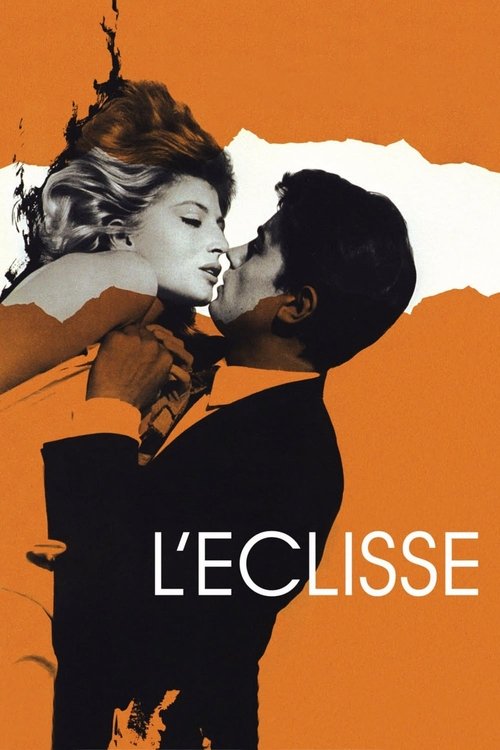
L'Eclisse
A haunting masterpiece of modernist cinema where love dissolves into the architecture of Rome. Amidst the noise of the stock market and the silence of empty streets, Antonioni captures the eclipse of human feeling in the atomic age.
L'Eclisse

L'Eclisse

L'eclisse

"… the ache and ecstasy of love…"

13 April 1962 France 126 min ⭐ 7.7 (522)
Director: Michelangelo Antonioni
Cast: Alain Delon, Monica Vitti, Francisco Rabal, Lilla Brignone, Rossana Rory
Drama Romance
Incommunicability and Alienation Materialism vs. Spirituality The Atomic Threat Modernity and Architecture

Overview

L'Eclisse (The Eclipse) is the final film in Michelangelo Antonioni's informal trilogy on modern malaise, following L'Avventura and La Notte. The story begins with Vittoria (Monica Vitti) ending a long, exhausted relationship with her intellectual lover, Riccardo, in his apartment. Drifting through her life as a translator in Rome's EUR district, she seeks her mother at the chaotic Rome Stock Exchange.

Amidst the shouting and financial frenzy, Vittoria meets Piero (Alain Delon), a young, energetic, and materialistic stockbroker. They begin a tentative, playful, yet emotionally detached affair. Their relationship is marked by a series of meetings where physical attraction struggles against an underlying inability to truly connect or understand one another.

The film famously concludes not with a dramatic resolution for the couple, but with a seven-minute montage of the street corner where they agreed to meet. Neither Vittoria nor Piero shows up. Instead, the camera lingers on architectural details, passersby, and shifting light, suggesting the erasure of the protagonists and the indifference of the material world.
Core Meaning

L'Eclisse explores the eclipse of human emotion in a modernized, capitalist society. Antonioni suggests that in a world dominated by objects, money, and atomic anxiety, traditional human connections like love have become obsolete or impossible. The film posits that modern architecture and the frenzy of the marketplace have displaced the human soul, leaving individuals alienated and adrift in a "landscape of absence."

Thematic DNA

Incommunicability and Alienation 35%
Materialism vs. Spirituality 25%
The Atomic Threat 20%
Modernity and Architecture 20%

Incommunicability and Alienation

The central theme of the trilogy reaches its peak here. Characters talk but do not communicate; their conversations are often silenced by the noise of the stock market or the vast silence of the suburbs. Vittoria explicitly questions the need for understanding in love, suggesting that true connection is a relic of the past.

Materialism vs. Spirituality

The frenetic Rome Stock Exchange serves as a temple of modern capitalism, where time is money and human worth is measured in lire. This is contrasted with Vittoria's aimless, almost spiritual searching and the silence of the EUR district. The film critiques how material obsession (represented by Piero and Vittoria's mother) eclipses emotional depth.

The Atomic Threat

A subtle but pervasive anxiety about nuclear annihilation hangs over the film. From the mushroom-shaped water tower to the newspaper headline "La Gara Atomica" (The Atomic Race), the fragility of existence in the Cold War era underscores the futility of the characters' personal struggles.

Modernity and Architecture

The film uses the stark, rationalist architecture of Rome's EUR district to mirror the characters' inner emptiness. Buildings, windows, and streetlamps are given as much weight as the actors, suggesting a world where the environment has overpowered the human element.

Character Analysis

Vittoria

Monica Vitti

Archetype: The Wanderer / The Seeker
Key Trait: Existential ennui

Motivation

To find authenticity or feeling in a numb world. She seeks something indefinable that is missing from her life, often looking for it in nature or silence.

Character Arc

She moves from a suffocating relationship to a tentative new one, only to withdraw from both. Her journey is not one of growth but of dissolution; she gradually detaches herself from emotional commitments to become a passive observer of the world.

Piero

Alain Delon

Archetype: The Materialist / The Modern Man
Key Trait: Vitality

Motivation

Accumulation of wealth and professional success. He views life and relationships as transactions to be managed efficiently.

Character Arc

Piero remains largely static, defined by his energy and ambition. He is momentarily intrigued by Vittoria's elusiveness but is ultimately too consumed by the game of money to offer the deep connection she needs.

Riccardo

Francisco Rabal

Archetype: The Intellectual
Key Trait: Passivity

Motivation

To analyze and rationalize, which fails him in the face of Vittoria's emotional withdrawal.

Character Arc

He represents the failure of the intellectual class to engage with the modern world. He is left behind in the opening scene, unable to understand why Vittoria is leaving him.

Symbols & Motifs

The Mushroom Water Tower

Meaning:

A visual metaphor for the atomic bomb and the looming threat of nuclear annihilation. It dominates the skyline of the EUR district, casting a shadow of existential dread over Vittoria's life.

Context:

Seen through the window of Riccardo's apartment and looming over the final montage sequence.

The Stock Exchange (La Borsa)

Meaning:

Represents the chaotic, dehumanizing force of capitalism. It is a place of pure noise and motion where human emotions are reduced to numbers and transactions.

Context:

The setting for several long sequences where Vittoria observes the traders and meets Piero. The "moment of silence" for a deceased colleague is ironically brief before the shouting resumes.

The Eclipse

Meaning:

Symbolizes the blocking of light and feeling. Just as the moon blocks the sun, material concerns and modern alienation block the warmth of human connection.

Context:

Referenced in the title, the visual darkness of the final scene, and the sudden harsh light of the streetlamp that ends the film.

Windows and Frames

Meaning:

Symbolize separation and imprisonment. Characters are frequently shot through glass or framed by doorways, highlighting their isolation even when they are together.

Context:

Vittoria kissing Piero through a glass pane; Vittoria arranging objects inside an empty picture frame in the opening scene.

African Artifacts & Dance

Meaning:

Represents a yearning for the primitive and vital in contrast to the sterile modern world. However, Vittoria's "blackface" dance also reveals a superficial, exoticized understanding of "nature."

Context:

Vittoria visits her neighbor Marta (a colonialist from Kenya), dresses in African garb, and performs a dance, momentarily escaping her repressed existence.

Memorable Quotes

Due persone non dovrebbero conoscersi troppo se vogliono innamorarsi. Ma forse non dovrebbero innamorarsi affatto.

— Vittoria

Context:

Spoken to Piero during one of their intimate moments, highlighting her hesitation to fully commit.

Meaning:

Expresses the film's cynical view on relationships: that mystery is required for attraction, but connection ultimately leads to pain or boredom.

Non bisogna che capirci per volerci bene? E allora non occorre che ci capiamo affatto.

— Vittoria

Context:

Vittoria discussing the nature of their relationship with Piero.

Meaning:

Translated as: "Must we understand each other to love? Then we don't need to understand each other at all." It underscores the theme of incommunicability—love exists separately from intellectual understanding.

Vorrei non amarti o amarti molto di più.

— Vittoria

Context:

A moment of vulnerability where she admits her inability to feel with the intensity she desires.

Meaning:

"I wish I didn't love you, or loved you a lot more." A perfect summation of her ambivalence and the "lukewarm" nature of modern affections.

Ci sono dei giorni in cui avere in mano una stoffa, un ago, un libro, un uomo, è la stessa cosa.

— Vittoria

Context:

Vittoria explaining her sense of detachment and alienation.

Meaning:

"There are days when holding a fabric, a needle, a book, or a man, is the same thing." Highlights the reification of people—men are just objects among other objects.

Philosophical Questions

Is authentic connection possible in a capitalist society?

The film contrasts the Stock Exchange (pure capitalism) with Vittoria's room (private sphere). It asks if the transactional nature of modern life has infected human relationships, turning people into commodities to be traded or discarded.

Does the material world exist independently of our perception?

By removing the protagonists from the final sequence, Antonioni forces the audience to confront the world without a human subject to observe it. It questions the existentialist idea that existence precedes essence, showing a world that is indifferent to human presence.

What is the meaning of silence?

Antonioni uses silence not as emptiness, but as a presence. The film asks if silence (the eclipse of noise/talk) is where truth resides, or if it is merely a void of nothingness and death.

Alternative Interpretations

The Ending as Apocalypse: Many critics interpret the final montage not just as a breakup, but as a metaphor for the end of the world. The empty streets and the "atomic" newspaper headline suggest that humanity has been wiped out, leaving only objects behind.

The Triumph of Things: Another reading is that the film depicts the transition from a human-centered world to an object-centered world. The characters don't die; they simply become irrelevant, replaced by the permanence of architecture and material goods.

A New Beginning: A minority view suggests the ending is a liberation. Vittoria has successfully detached herself from unsatisfactory relationships, and the final shots represent a pure, objective way of seeing the world, free from messy emotional entanglements.

Cultural Impact

L'Eclisse is considered a cornerstone of European modernist cinema. Upon its release, it polarized audiences but won the Special Jury Prize at the 1962 Cannes Film Festival. It solidified Antonioni's reputation as the master of "ennui" and visual storytelling.

The film's radical ending influenced a generation of filmmakers, including Martin Scorsese and Wim Wenders, by demonstrating that cinema could prioritize atmosphere and space over plot. It captured the specific anxiety of the Cold War/Economic Miracle era in Italy, visualizing the hollow core of the "economic boom." In pop culture, its aesthetic of urban alienation remains a touchstone for visual artists and photographers.

Audience Reception

Critical Acclaim: Critics generally regard it as a masterpiece of visual composition and mood. The cinematography by Gianni Di Venanzo is frequently cited as some of the best in black-and-white cinema.

Audience Confusion: General audiences in 1962 were often baffled or bored by the slow pace and the lack of a traditional resolution. The ending was famously booed at some screenings.

Modern Verdict: Today, it is rated highly (87% on Rotten Tomatoes) and is seen as the most aesthetically perfect of Antonioni's trilogy, praised for its boldness in discarding narrative conventions.

Interesting Facts

  • Michelangelo Antonioni was inspired to make the film after witnessing a solar eclipse in Florence, noting that even the birds fell silent.
  • The final 7-minute sequence features no main characters, a radical departure from narrative cinema that confused many projectionists and audiences.
  • Martin Scorsese described L'Eclisse as the boldest film in Antonioni's trilogy.
  • Some American theater owners cut the final 'abstract' montage, feeling it was a mistake or boring, which completely ruined the director's intended message.
  • The film was shot on location in the EUR district of Rome, a neighborhood built by Mussolini for a World's Fair that never happened, chosen for its stark, metaphysical architecture.
  • Alain Delon was cast as Piero to represent a new kind of 'dynamic' Italian man, contrasting with the intellectual types in Antonioni's previous films.

Easter Eggs

Newspaper Headline 'La Gara Atomica'

In the final montage, a newspaper is seen with the headline "La Gara Atomica" (The Atomic Race) and "Peace is Weak". This hidden detail confirms the subtext of nuclear anxiety that permeates the film's atmosphere of doom.

The 'Eclisse Twist'

The opening credits feature a lively pop song, the "Eclisse Twist" by the famous Italian singer Mina. It creates a jarring contrast with the discordant, atonal score by Giovanni Fusco that follows, symbolizing the clash between superficial modern distractions and deep existential dread.

The Fossil

Vittoria keeps a fossil of a branch in her room. It serves as a subtle reminder of deep time and the permanence of nature, contrasting with the fleeting, frantic nature of the stock market scenes.

⚠️ Spoiler Analysis

Click to reveal detailed analysis with spoilers

Frequently Asked Questions

Explore More About This Movie

Dive deeper into specific aspects of the movie with our detailed analysis pages

Comments (0)

Leave a comment

No comments yet. Be the first to share your thoughts!