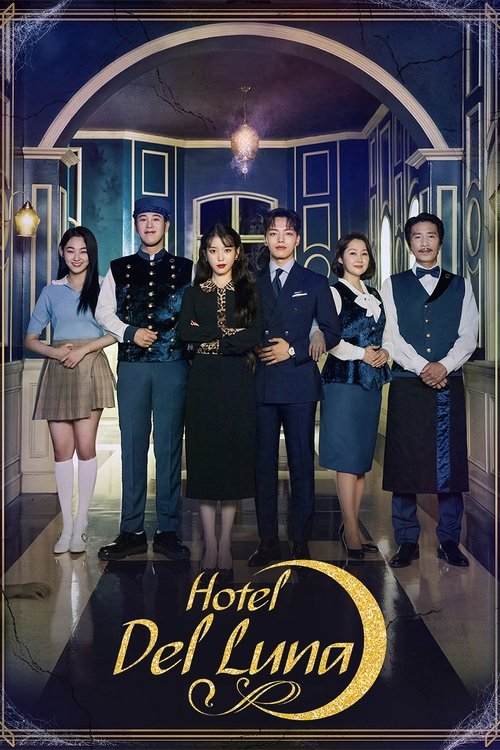
Hotel Del Luna
호텔 델루나
"I don't care if this place is a prison or a fence to you. I'll be here with you."
Overview
"Hotel Del Luna" follows the story of Jang Man-wol (IU), the beautiful but ill-tempered owner of a peculiar hotel that caters only to ghosts. For over a millennium, she has been cursed to manage this establishment as penance for a great sin she committed in her past. The hotel, invisible to most humans, serves as a liminal space for souls with unfinished business, helping them resolve their lingering regrets before they can proceed to the afterlife.
Her stagnant existence is disrupted by the arrival of Gu Chan-sung (Yeo Jin-goo), a principled and compassionate Harvard MBA graduate. Due to a deal his father made with Man-wol decades ago, Chan-sung is forced to become the hotel's new human manager. As he navigates the supernatural world of ghost clientele and eccentric staff, he begins to unravel the mysteries surrounding Man-wol's tragic past and the curse that binds her to the hotel, slowly melting her cynical and guarded heart.

Core Meaning
"Hotel Del Luna" explores the profound human need for closure and the healing power of forgiveness. The series posits that resentment, regret, and unresolved emotions are chains that bind souls to the past, preventing them from moving forward. Through the stories of its ghostly guests and the central arc of its cursed protagonist, the show suggests that letting go of past grievances is not an act of forgetting, but a necessary step towards peace and redemption. It emphasizes that love and compassion are the keys to severing these chains, allowing both the living and the dead to finally find solace and continue their journey.
Thematic DNA
Forgiveness and Redemption
This is the central theme of the series, embodied by Jang Man-wol's 1,300-year penance. Her journey is about atoning for the lives she took and, more importantly, learning to forgive herself and those who betrayed her. Each ghost's story is a small-scale exploration of this theme, as they must resolve their resentments to move on. Gu Chan-sung acts as a catalyst, guiding Man-wol toward empathy and ultimately, her own redemption. The finale hinges on her choice to forgive and let go, thus breaking her curse.
Letting Go and Moving On
The hotel itself is a symbol of transition, a place for souls who cannot let go of their mortal lives. The series consistently portrays the pain that comes from clinging to the past, whether it's the staff's centuries-old grudges or the guests' more recent attachments. The most poignant arc is between Man-wol and Chan-sung, as he, a living being, must learn to let go of her, a soul destined for the afterlife. Their bittersweet farewell underscores the message that letting go, while painful, is a profound act of love.
Love and Sacrifice
Love is depicted as a powerful, transformative force, capable of transcending time and even death. Chan-sung's love for Man-wol melts her frozen heart, while her love for him motivates her to finally face her past. The series also explores sacrificial love, particularly through the character of Go Chung-myung, who spends a millennium by Man-wol's side as a firefly, silently protecting her as an act of penance and devotion. Their story reveals that true love often involves immense personal sacrifice for the well-being of another.
The Weight of Grudges
Each ghost that checks into the Hotel Del Luna carries a heavy grudge that anchors them to the mortal world. The show visually and narratively demonstrates how these resentments poison the soul, preventing peace. The stories of the hotel staff—Choi Seo-hee's quest for her family's vindication and Kim Seon-bi's desire to clear his name—highlight how deeply a single injustice can root itself. The series argues that holding onto such bitterness is a self-imposed prison, and freedom only comes from releasing it.
Character Analysis
Jang Man-wol
IU (Lee Ji-eun)
Motivation
Initially, her motivation is purely survival and hedonism—enjoying the luxuries of the world while waiting for a sinner worse than herself to take her place. As the series progresses, her motivation shifts to protecting Gu Chan-sung and resolving the lingering threads of her past, especially her complicated relationship with Go Chung-myung and Princess Song-hwa. Ultimately, her goal becomes finding peace and ensuring those she cares for can live happily after she's gone.
Character Arc
Jang Man-wol begins as a cynical, greedy, and emotionally detached immortal, burdened by a 1,300-year-old curse. Her lavish spending and cold demeanor are defense mechanisms hiding deep-seated guilt and heartbreak from a past filled with betrayal and violence. The arrival of Gu Chan-sung slowly dismantles her walls. Through him, she rediscovers empathy, vulnerability, and the capacity to love and trust again. Her arc is a journey from being a resentful soul trapped in time to a woman who confronts her sins, forgives her enemies, and ultimately accepts her fate, choosing to move on to the afterlife rather than cling to a borrowed existence.
Gu Chan-sung
Yeo Jin-goo
Motivation
His primary motivation is his sense of duty and his inability to turn a blind eye to suffering. At first, he is motivated by the promise made by his father and a desire to protect himself. This quickly evolves into a deep-seated affection and love for Jang Man-wol. His ultimate motivation becomes helping her find peace and resolve her ancient grudge, even at the cost of his own happiness.
Character Arc
Gu Chan-sung starts as a rational, pragmatic, and slightly cowardly hotelier who is terrified of ghosts. Forced into managing the Hotel Del Luna, he initially tries to escape his fate. However, his inherent compassion and strong moral compass compel him to help the ghostly guests. His arc is one of courage and acceptance. He evolves from a man who fears the supernatural world to one who embraces it, becoming a compassionate guide for both the dead and for Man-wol. He learns to see beyond Man-wol's harsh exterior and becomes the key to her salvation, even though it means he must eventually let her go.
Go Chung-myung
Lee Do-hyun
Motivation
His sole motivation for 1,300 years has been to atone for his past and protect Jang Man-wol. He endures an eternity of loneliness out of love and a sense of responsibility for her suffering, waiting for the day she can finally forgive him and be free from her curse.
Character Arc
Introduced in flashbacks as the Captain of the Guard who betrays Man-wol, Chung-myung is initially seen as the source of her long-held grudge. However, his arc reveals a tragic story of sacrifice. To save Man-wol's life, he made a deal that forced him to be seen as a traitor. Instead of moving on to the afterlife, he chose to remain by her side for over a millennium, transformed into a firefly, silently watching over her. His arc is a revelation of his unwavering love and guilt, culminating in his final act of guiding her across the bridge to the afterlife, achieving his own peace in the process.
Symbols & Motifs
The Moon Tree (Wolryeongsu)
The ancient, withered Moon Tree symbolizes Jang Man-wol's soul, time, and emotional state. For centuries, it has been barren, representing her stagnant, cursed existence and frozen heart. Its condition reflects her spiritual well-being.
Located in the hotel's courtyard, the tree is the physical manifestation of Man-wol's curse. When Gu Chan-sung arrives, leaves begin to sprout, and eventually, flowers bloom, signifying the return of life, emotion, and love into her heart. The shedding of its flowers and leaves later in the series marks the progression of her time and her imminent departure to the afterlife.
Hotel Del Luna / Guest House of the Moon
The hotel itself symbolizes purgatory or a liminal space between the world of the living and the afterlife. It is a place of healing and resolution, where souls can unburden themselves of their worldly attachments before crossing over.
Visible only to ghosts and certain humans under special circumstances, the hotel serves as the primary setting. Its lavish, opulent interiors, which change with Man-wol's whims, represent a beautiful facade hiding deep sorrow and unfinished business. Its transient nature, only appearing majestic at night, reinforces its otherworldly purpose.
The Sanzu River Bridge
The bridge represents the final transition from the mortal realm to the afterlife. Crossing it signifies acceptance, the shedding of past memories and regrets, and the soul's journey towards reincarnation. It is the point of no return.
The hotel staff's primary mission is to guide souls to this bridge. Several key moments occur here, including Man-wol's emotional confrontation with Go Chung-myung and her final, heartbreaking farewell to Chan-sung. Her ability to finally cross the bridge symbolizes the completion of her redemption arc.
Memorable Quotes
You're the one who must send me off. Tell me that you'll be okay. If you don't, then I'll be too scared.
— Jang Man-wol
Context:
Spoken to Gu Chan-sung in one of the final episodes (Episode 16) as her time at the hotel comes to an end and she prepares to go to the afterlife.
Meaning:
This quote reveals Man-wol's vulnerability and her deep love for Chan-sung. After centuries of projecting strength and indifference, she admits her fear of the unknown journey to the afterlife. Her peace is contingent on his, showing that her final act of letting go is intertwined with ensuring he can move on without her.
I'm not dead. I still haven't died. I'm just here.
— Jang Man-wol
Context:
Man-wol says this early in the series (Episode 1) to Gu Chan-sung, explaining her strange existence and her connection to the Hotel Del Luna.
Meaning:
This line encapsulates Man-wol's cursed state. She is not truly living, nor is she truly dead. She is trapped in a state of purgatory, bound to the hotel and her past. It highlights the profound loneliness and stagnation that has defined her existence for over a thousand years.
Don't be afraid when you leave me behind. What I'm doing now is an act of love by a fragile human with all of his heart.
— Gu Chan-sung
Context:
Said to Jang Man-wol in the latter half of the series (Episode 13) as she grows fearful of her impending departure and the pain it will cause him.
Meaning:
Chan-sung's declaration redefines his role. He is not just a manager but Man-wol's guide to salvation. He accepts the pain of their inevitable separation as his burden to bear, framing his act of letting her go not as abandonment, but as the ultimate expression of his love for her.
Greed and resentment hold people back. Letting go is the only way to find peace.
— Kim Yoo-na
Context:
Kim Yoo-na says this to Jang Man-wol, reflecting on the lessons learned from observing the various ghosts that pass through the hotel.
Meaning:
This quote succinctly states one of the series' core themes. Spoken by one of the younger characters, it reflects the wisdom that all the souls at the hotel must learn. It emphasizes that worldly attachments, especially negative ones like grudges, are the true barriers to moving on.
Episode Highlights
Welcome to Hotel Del Luna
The first episode masterfully establishes the series' unique premise, introducing the mystical hotel, its cursed owner Jang Man-wol, and the unfortunate human manager, Gu Chan-sung. It sets up the central conflict of Chan-sung being bound to the hotel due to his father's deal and showcases the show's blend of fantasy, horror, and comedy.
This episode lays the entire groundwork for the series, introducing the main characters, the rules of the supernatural world, and the core mystery of Man-wol's past. It effectively hooks the audience with its stunning visuals and intriguing plot.
Man Weol and Princess Song Hwa
This episode delves deep into Man-wol's past, revealing the tragic betrayal by her first love, Go Chung-myung, and Princess Song-hwa that led to the death of her friend Yeon-woo and her band of thieves. In the present, Chan-sung encounters Lee Mi-ra, the reincarnation of Princess Song-hwa, creating immense tension.
A crucial turning point that fully contextualizes Man-wol's immense pain and thousand-year grudge. The reveal of Song-hwa's reincarnation in the present day raises the stakes for Man-wol's redemption arc and tests her growth.
Lunar Eclipse
During a lunar eclipse, the Hotel Del Luna becomes visible to humans, leading to chaos. A significant portion of Man-wol's backstory is unveiled, casting doubt on whether Chung-myung was truly a traitor. The episode ends with the shocking revelation that the firefly that has been hovering around Man-wol for centuries is Chung-myung's spirit.
This episode fundamentally shifts the audience's understanding of the central tragedy in Man-wol's past. It transforms Chung-myung from a villain into a tragic figure of sacrifice, deepening the emotional complexity of the story.
Seo Hee's Resentment
As the flowers on the Moon Tree begin to wither, the hotel staff prepare for their departure. The focus shifts to Choi Seo-hee, the hotel's housekeeper, who finally gets the chance to resolve her centuries-old grudge against the family that wronged her. Man-wol comforts her and helps her find peace.
This episode highlights the theme of forgiveness and moving on through a supporting character's arc, showing Man-wol's growth as she guides others toward the peace she seeks herself. It marks the beginning of the end for the hotel's long-standing family.
Time to Say Goodbye
In the series finale, each member of the hotel staff resolves their final regrets and departs for the afterlife. Man-wol and Chan-sung share a heartbreaking but beautiful farewell before she crosses the Sanzu River Bridge. The epilogue shows Chan-sung living his life, with an ambiguous final scene suggesting their eventual reunion in a future life.
The finale provides a poignant and emotionally satisfying conclusion to all character arcs. It reinforces the core theme that letting go is an act of love and offers a hopeful, albeit bittersweet, resolution to the central romance, leaving a lasting impact on the audience.
Philosophical Questions
What is the true nature of closure, and why is it essential for the soul?
The series explores this question through every ghost that enters the hotel. Each soul is trapped by an unresolved issue—betrayal, unfulfilled dreams, injustice, or unspoken feelings. The hotel functions as a therapeutic space where these spirits are given the opportunity to confront their pasts. The show posits that closure isn't about changing the past but about changing one's perspective on it. It requires forgiveness (of others and oneself), acceptance, and the act of letting go. Without this emotional and spiritual resolution, the series suggests a soul cannot achieve peace and is destined to wander, weighed down by its own history.
Can a life lived for centuries, defined by punishment, be redeemed by a single act of love?
Jang Man-wol's entire existence is a penance for her past sins. For 1,300 years, she remains unchanged, trapped by her own bitterness. The arrival of Gu Chan-sung introduces genuine, selfless love into her life for the first time since her betrayal. His compassion becomes the catalyst for her transformation. The series suggests that time alone does not bring redemption; rather, it is the profound human connection and the choice to open one's heart that allows for true change. Her final, peaceful departure implies that the love she experienced with Chan-sung was powerful enough to heal a millennium of hatred and allow her soul to be saved.
Alternative Interpretations
The series' ending is deliberately open to interpretation, particularly the final scene where Gu Chan-sung sits on a park bench and is approached by a reincarnated Jang Man-wol.
- A Dream or Imagination: One popular interpretation is that this scene is not reality, but rather Chan-sung's hopeful imagination of a future reunion. The writers, the Hong Sisters, have suggested this view, stating they see it as Chan-sung envisioning the best possible future. This interpretation provides a bittersweet, realistic conclusion, emphasizing that their time in that lifetime was truly over.
- A Future Reality: Another interpretation posits that the scene is a time jump to a future life. In this view, after Chan-sung lives out his natural life, he and Man-wol are reincarnated and find each other again, fulfilling their promise. This reading offers a more classically romantic and hopeful 'fated lovers' conclusion, suggesting their bond transcends a single lifetime. One theory supporting this is that because a petal from Man-wol's tree remained with Chan-sung, she was able to retain her memories in her next life.
Cultural Impact
"Hotel Del Luna" was a massive commercial and critical success in 2019, becoming one of the highest-rated Korean dramas in cable television history. Its popularity had a significant impact on pop culture, particularly in fashion; IU's vintage and extravagant outfits as Jang Man-wol became iconic, sparking trends and numerous articles analyzing her style. The show's original soundtrack was also immensely popular, with several tracks topping music charts in South Korea.
The series masterfully blended Korean folklore and shamanistic beliefs about the afterlife, gods (like Mago), and ghosts with a modern, stylish aesthetic. It introduced international audiences to concepts like the Sanzu River and the idea of resolving 'han' (a deep-seated grudge or sorrow) before moving on. Its success reinforced the global appeal of the fantasy-romance genre in K-dramas, following in the footsteps of shows like "Goblin." The series was so successful that it prompted an American remake adaptation to be put into development by Skydance Television.
Audience Reception
"Hotel Del Luna" received overwhelmingly positive reviews from audiences and critics alike, celebrated for its unique plot, stunning visuals, and strong performances, particularly by lead actress IU. Viewers praised the drama's perfect blend of fantasy, romance, horror, and comedy, noting that it could shift from frightening to laugh-out-loud funny to deeply emotional in a single episode. IU's portrayal of the fashionable, complex antiheroine Jang Man-wol was a highlight for many, often cited as a career-defining performance.
The chemistry between the two leads, IU and Yeo Jin-goo, was also widely praised. While some episodes were noted for focusing more on standalone ghost-of-the-week stories, the overarching narrative of Man-wol's past and her developing relationship with Chan-sung kept viewers consistently engaged. The finale was lauded for being poignant and cathartic, providing a satisfying, albeit bittersweet, conclusion to the characters' journeys. It is widely regarded as one of the best K-dramas of 2019 and a must-watch for fans of the fantasy genre.
Interesting Facts
- The initial concept for "Hotel Del Luna" was an early draft for the 2013 drama "Master's Sun," which was also written by the Hong Sisters.
- IU, who plays Jang Man-wol, created and personally managed an Instagram account for her character during the show's run, posting behind-the-scenes photos and food pictures as Man-wol would. The account gained nearly 900,000 followers.
- The exterior of the magnificent hotel was filmed at the Mokpo Modern History Museum No. 1, one of the oldest buildings in the city of Mokpo. The magical forest scenes were shot at Byeokchoji Botanical Garden.
- The series was one of the highest-rated Korean dramas in cable television history at the time of its airing and was the most-viewed tvN drama of 2019.
- Actor Kim Soo-hyun makes a cameo appearance in the finale's epilogue as the new owner of the 'Hotel Blue Moon', sparking speculation about a potential sequel.
- During filming, Yeo Jin-goo joked that his character was "the most frail character in Korean drama history," referencing his previous role as a king in "The Crowned Clown."
Easter Eggs
Lee Joon-gi makes a cameo appearance as a priest in Episode 3.
This was a highly anticipated reunion for fans of the 2016 drama "Moon Lovers: Scarlet Heart Ryeo," which starred both IU and Lee Joon-gi in the lead roles. Their brief on-screen interaction was a nod to their previous, tragic K-drama romance.
Kim Soo-hyun appears in the epilogue as the new owner of the hotel, now named 'Hotel Blue Moon'.
This cameo was a major surprise and a treat for fans. Kim Soo-hyun had previously worked with director Oh Choong-hwan on "My Love from the Star" and with IU on "The Producers." His appearance teased the possibility of a second season with a new lead.
Sulli makes a brief cameo appearance in Episode 10 as a wealthy hotel guest.
This special appearance was made out of her friendship with lead actress IU. Sadly, it was one of Sulli's last on-screen appearances before her passing, making the scene especially poignant for fans in retrospect.
⚠️ Spoiler Analysis
Click to reveal detailed analysis with spoilers
Frequently Asked Questions
Explore More About This Movie
Dive deeper into specific aspects of the movie with our detailed analysis pages
Comments (0)
No comments yet. Be the first to share your thoughts!