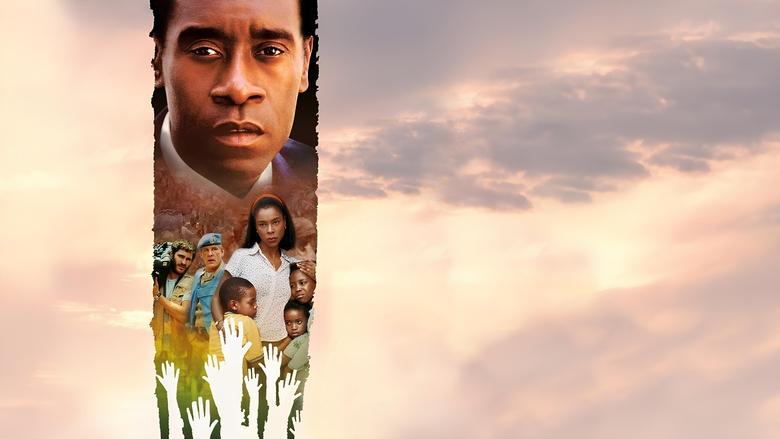
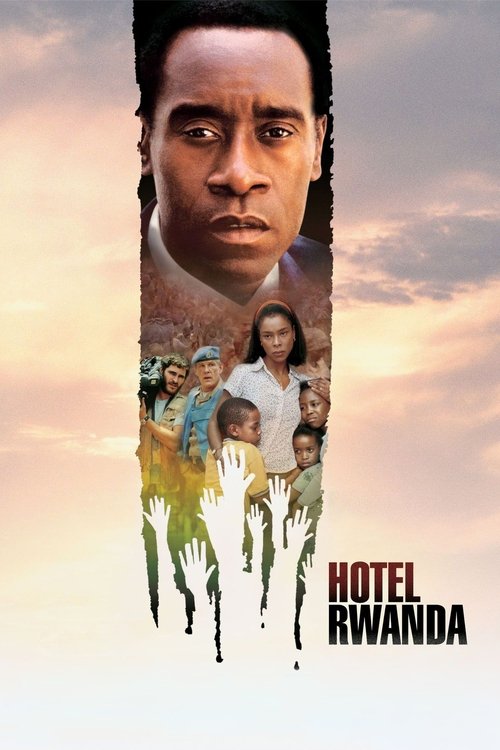
Hotel Rwanda
Historical War Drama + Deep Despair & Quiet Heroism + The Hotel as a Fragile Lifeboat. A harrowing yet restrained portrait of a man maintaining a facade of civilized order while a sea of madness and blood rises outside his gates.
Hotel Rwanda

Hotel Rwanda

"When the world closed its eyes, he opened his arms."

22 December 2004 Italy 122 min ⭐ 7.7 (3,073)
Director: Terry George
Cast: Don Cheadle, Sophie Okonedo, Nick Nolte, Fana Mokoena, Desmond Dube
Drama War History
Western Apathy & International Failure The Banality of Heroism Ethnic Hatred & Colonial Legacy The Fragility of Civilization
Budget: $17,500,000
Box Office: $38,000,000

Overview

Based on true events, the film tells the story of Paul Rusesabagina (Don Cheadle), the manager of the luxury Hôtel des Mille Collines in Kigali, Rwanda. As the country descends into genocide in 1994, with Hutu extremists slaughtering the Tutsi minority, Paul uses his influence, bribery, and wits to turn his hotel into a sanctuary.

While the world turns a blind eye and UN peacekeepers are rendered powerless, Paul navigates a deadly game of diplomacy with corrupt generals and violent militias. He shelters over 1,200 refugees, risking his life to protect his family and neighbors in an island of precarious safety amidst an ocean of slaughter.

Core Meaning

The film serves as a scathing critique of Western apathy and the international community's failure to value African lives. It argues that in the absence of global intervention, ordinary individual heroism becomes the last line of defense against evil. It poses the uncomfortable truth that geopolitical interests often outweigh humanitarian moral obligations.

Thematic DNA

Western Apathy & International Failure 30%
The Banality of Heroism 25%
Ethnic Hatred & Colonial Legacy 25%
The Fragility of Civilization 20%

Western Apathy & International Failure

The film ruthlessly exposes the indifference of the West. The UN is depicted as toothless, forbidden from intervening. The character of Colonel Oliver represents the frustration of those who want to help but are shackled by bureaucracy, while the journalist Jack Daglish articulates the cynical view that the world will watch the horror and then 'go back to eating their dinners.'

The Banality of Heroism

Paul is not a soldier or a revolutionary; he is a hotel manager. His heroism stems from his ability to use his ordinary skills—flattery, bribery, organization, and charm—to save lives. The film suggests that resistance to evil often looks like mundane negotiation rather than dramatic combat.

Ethnic Hatred & Colonial Legacy

The film touches on the arbitrary nature of the Hutu-Tutsi divide, explaining it as a legacy of Belgian colonialism based on nose width and skin tone. It shows how this manufactured division was weaponized into a genocidal ideology of 'clearing the brush' and crushing 'cockroaches.'

The Fragility of Civilization

The hotel maintains a surreal standard of service—waiters in bow ties, lobster dinners—while bodies pile up outside. This contrast highlights how thin the veneer of civilization is and how quickly societal norms can evaporate into chaos.

Character Analysis

Paul Rusesabagina

Don Cheadle

Archetype: The Everyman Hero / The Trickster
Key Trait: Diplomatic Cunning

Motivation

Initially to save his wife and children; later, a moral refusal to abandon the helpless people who look to him for leadership.

Character Arc

Starts as a pragmatic businessman focused on his career and family, believing legalism and connections will save him. He evolves into a selfless protector, realizing that his status means nothing if he does not use it to save his community.

Tatiana Rusesabagina

Sophie Okonedo

Archetype: The Moral Anchor
Key Trait: Resilience

Motivation

Survival of her family and the preservation of their humanity.

Character Arc

She pushes Paul to look beyond his own family and helps him see the moral necessity of saving their neighbors. She represents the emotional toll of the genocide, constantly fearing for her children and her Tutsi family.

Colonel Oliver

Nick Nolte

Archetype: The Tragic Enforcer
Key Trait: Impotent Rage

Motivation

To follow orders while desperately trying to interpret them in a way that allows him to save lives.

Character Arc

Based on Roméo Dallaire. He begins with a sense of duty but is progressively broken by his superiors' orders to not intervene. He becomes the voice of the film's anger against the West.

Symbols & Motifs

The Fog

Meaning:

Symbolizes the obscurity of truth and the overwhelming scale of the horror that is initially hidden. It represents the psychological inability to process the magnitude of the genocide.

Context:

In a pivotal scene, Paul and his staff drive on a bumpy road in heavy fog. When the fog lifts, they realize the 'bumps' were hundreds of bodies, forcing Paul to physically confront the reality he has been trying to bribe away.

Cuban Cigars & Scotch

Meaning:

They represent corruption and the currency of survival. They are the tools Paul uses to buy time and life, reducing human worth to a transaction of luxury goods.

Context:

Paul constantly gifts these items to General Bizimungu. The luxury goods serve as a stark contrast to the death surrounding them, highlighting the general's greed over his humanity.

The Hotel

Meaning:

A metaphor for a Western oasis. It is a bubble of privilege and safety that is respected only because of its European ownership, underlining the film's theme that only things valued by the West are deemed worth protecting.

Context:

The militia initially hesitates to attack the hotel not out of morality, but because of its connection to Sabena (the Belgian airline) and the potential diplomatic fallout.

Memorable Quotes

I think if people see this footage, they'll say 'Oh, my God, that's horrible.' And then they'll go on eating their dinners.

— Jack Daglish (Joaquin Phoenix)

Context:

Spoken to Paul after he thanks the journalist for capturing footage of the massacres, hoping it will bring intervention.

Meaning:

A defining line of the film that encapsulates the apathy of the global audience. It predicts the viewer's own reaction—momentary shock followed by a return to comfort.

You're dirt. We think you're dirt, Paul. ... You're not even a n*****r. You're an African.

— Colonel Oliver

Context:

The Colonel tells this to Paul at the hotel bar after learning the UN is pulling out rather than reinforcing.

Meaning:

A brutal exposition of Western geopolitics and racism. It explains why no troops are coming: in the eyes of the world powers, African lives have zero strategic or human value.

We must shame them into sending help.

— Paul Rusesabagina

Context:

Paul instructing the refugees to call their influential friends abroad to say goodbye, hoping to trigger a moral response.

Meaning:

Shows Paul's transition from bribery to using the media and guilt as a weapon. He realizes their only hope is to make the West feel embarrassed by their inaction.

Philosophical Questions

Does the value of a human life depend on geography?

The film ruthlessly explores the concept of the 'hierarchy of death.' It asks why the world mobilized for conflicts in Europe or the Middle East but ignored 800,000 deaths in Rwanda. It forces the viewer to confront their own subconscious bias regarding the worth of African lives.

Is bribery moral if it saves lives?

Paul engages in 'immoral' acts—bribing murderers with alcohol and money—to achieve a moral good. The film questions the purity of ethics in extreme survival situations, suggesting that utilitarianism (doing whatever works to save the most lives) supersedes deontological ethics (following rules).

Alternative Interpretations

The Hero vs. The Opportunist: While the film presents Paul as an altruistic hero, an alternative reading—fueled by later real-life allegations—suggests a more cynical interpretation where Paul was a businessman who charged refugees for rooms and protected them primarily to maintain his own status and safety. The film can thus be viewed either as a straightforward hagiography or, inadvertently, as a portrait of how capitalism and corruption were the only languages the militia understood.

Cultural Impact

Hotel Rwanda is often called the 'African Schindler's List.' It was instrumental in educating a global audience about the 1994 genocide, which had been largely ignored by Western media at the time. It triggered a wave of humanitarian interest in the region. However, it also sparked a complex debate about historical accuracy. While praised for its message, it has been criticized by some survivors and the Rwandan government (led by Paul Kagame) for oversimplifying the conflict and exaggerating Rusesabagina's heroism, labeled by some as a 'Hollywood fabrication' that ignored the role of others.

Audience Reception

The film received universal critical acclaim upon release, holding high ratings on Rotten Tomatoes and IMDB. Audiences were deeply moved by the emotional weight and Cheadle's performance. However, reception in Rwanda was mixed to negative, with many locals feeling it was a 'foreigner's movie' that simplified their tragedy. Over time, the reception has become more complicated due to the political controversies surrounding the real Paul Rusesabagina.

Interesting Facts

  • The film was shot primarily in South Africa, not Rwanda, due to infrastructure needs and lingering tensions.
  • Don Cheadle was Director Terry George's first choice for the role, despite studio pressure to cast a bigger box-office star like Denzel Washington or Will Smith.
  • The character of Colonel Oliver is a fictional composite, but he is heavily based on Lieutenant-General Roméo Dallaire, who led the UNAMIR mission.
  • The real Paul Rusesabagina and his wife Tatiana were consultants on the film.
  • There is no post-credits scene, emphasizing the somber reality of the subject matter.
  • The film sparked controversy in later years when the real Paul Rusesabagina was arrested by the Rwandan government on terrorism charges, with officials claiming the film's depiction of him was inaccurate.

Easter Eggs

RTLM Radio Broadcasts

The radio station heard throughout the film, RTLM (Radio Télévision Libre des Mille Collines), is historically accurate. The broadcasters essentially directed the genocide, using code phrases like 'cut the tall trees' and referring to Tutsis as 'cockroaches' (inyenzi).

Clinton Administration Reference

The film subtly references the US refusal to use the word 'genocide.' This is a historical nod to the Clinton administration's policy, where legal teams advised against the term to avoid the legal obligation to intervene under the UN Genocide Convention.

General Bizimungu

The character is based on Augustin Bizimungu. In real life, he was sentenced to 30 years in prison by the International Criminal Tribunal for Rwanda, confirming the film's portrayal of his complicity.

⚠️ Spoiler Analysis

Click to reveal detailed analysis with spoilers

Frequently Asked Questions

Explore More About This Movie

Dive deeper into specific aspects of the movie with our detailed analysis pages

Comments (0)

Leave a comment

No comments yet. Be the first to share your thoughts!