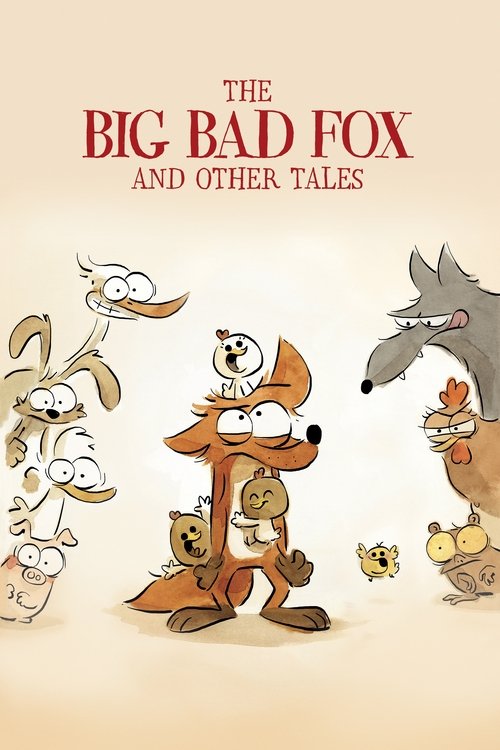
The Big Bad Fox and Other Tales
Le Grand Méchant Renard et autres contes...
Overview
The Big Bad Fox and Other Tales is an animated anthology film presented as a theatrical performance by a troupe of animal actors. The film is divided into three distinct segments, bookended by a fourth-breaking stage manager Fox who struggles to keep the show on track. The first tale, "A Baby to Deliver", follows a responsible Pig, a dimwitted Duck, and a reckless Rabbit who are forced to deliver a human baby to Avignon after a lazy Stork fakes an injury. Their journey is a chaotic road trip involving a catapult, a delivery truck, and a plane crash.
The centerpiece story, "The Big Bad Fox", focuses on a weakling Fox who fails to scare anyone on the farm. On the advice of a manipulative Wolf, he steals three hen's eggs to raise the chicks as a future dinner. However, when they hatch, the chicks imprint on him, calling him "Mommy" and believing themselves to be fierce foxes. The Fox is torn between his predator instinct and his growing paternal love, leading to a confrontation with the Wolf.
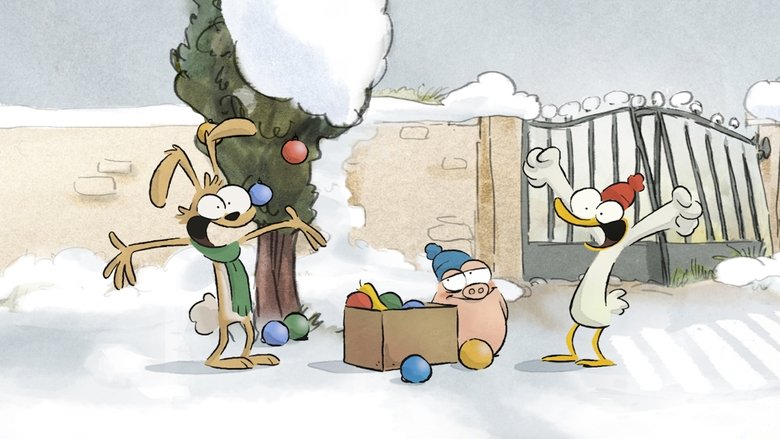
The final segment, "Saving Christmas", sees Duck and Rabbit convinced they have accidentally killed Santa Claus (who was actually a plastic decoration). Determined to save the holiday, they drag the reluctant Pig into a misguided mission to replace Santa and deliver presents to all the children of the world, resulting in more slapstick disaster before a heartwarming conclusion.
Core Meaning
At its heart, the film deconstructs the idea of biological determinism and social roles. The director, Benjamin Renner, uses the "Big Bad Wolf" fairy tale tropes to ask: Are we defined by what nature says we are, or by the choices we make? The Fox is born a predator but chooses to be a mother; the chicks are born prey but act like predators. The film suggests that love and nurture override nature, and that true family is built on affection rather than blood. It champions the incompetent but well-meaning underdog, showing that even the clumsiest efforts, if driven by love, can lead to success.
Thematic DNA
Nature vs. Nurture
This is the central theme of the titular segment. The Fox tries to fight his "soft" nature to become a "hard" predator, while the chicks fight their prey nature to become predators. The resolution proves that nurture (how they are raised and who loves them) is stronger than their biological instincts.
The Redefinition of Family
Across all stories, family is shown as a choice. Pig becomes a surrogate guardian to Duck and Rabbit; Fox becomes a mother to chickens; the farm animals form a dysfunctional but tight-knit community. The film posits that family bonds are forged through shared struggle and care, not just DNA.
Appearance vs. Reality
Characters are rarely what they seem. The Stork looks majestic but is a lazy fraud; the Fox looks like a villain but is a softie; the Wolf looks polite but is the true monster. The film teaches viewers to look past archetypes and reputations to see the true character underneath.
Incompetence and Innocence
Duck and Rabbit represent pure, chaotic incompetence. Yet, the film treats them with tenderness rather than judgment. Their innocence protects them, and their chaotic methods—while disastrous—often ironically lead to the correct solution, suggesting a celebration of childlike naivety.
Character Analysis
The Fox
Giles New (English) / Guillaume Darnault (French)
Motivation
Initially: To be feared and respected as a predator.
Later: To protect his adopted children from the real predator.
Character Arc
Starts as a pathetic figure trying to emulate the Wolf's cruelty to gain respect. Through raising the chicks, he learns that being a "mother" requires more strength than being a "monster." He eventually rejects the Wolf's toxic masculinity to embrace his nurturing side.
The Pig
Justin Edwards (English) / Damien Witecka (French)
Motivation
To maintain order and keep the farm (and his friends) safe.
Character Arc
He serves as the responsible anchor for the chaos of others. While he often resists the adventures (delivering the baby, saving Christmas), his moral compass forces him to step in and save Duck and Rabbit from themselves. He learns to accept (somewhat) the chaos of his friends.
Duck & Rabbit
Bill Bailey & Adrian Edmondson (English)
Motivation
To help (despite having absolutely no skills to do so).
Character Arc
They remain static characters representing pure chaotic energy. They do not learn lessons; rather, they force the world to adapt to their logic. They are the catalysts for adventure in the first and third stories.
The Wolf
Matthew Goode (English) / Boris Rehlinger (French)
Motivation
To eat and to enforce the natural order of predator/prey.
Character Arc
He acts as the Fox's dark mentor, teaching him to be cruel. When the Fox rejects this path, the Wolf becomes the antagonist. He represents the unyielding, cruel law of nature that the Fox transcends.
Symbols & Motifs
The Theater Stage
Symbolizes the performativity of social roles. The animals are "actors" putting on a show, just as the Fox is "acting" big and bad. It suggests that the identities we present to the world are often just costumes we can take off.
Used as the framing device before and after each segment. We see the backstage chaos, the Fox talking to the audience, and the animals preparing their props, breaking the fourth wall.
The Eggs / Chicks
They represent pure potential and the blank slate of childhood. They are not born fearful; they learn fear (or lack thereof) from their parent. They symbolize the transformative power of parenthood to change the parent as much as the child.
Central to the second story. The Fox steals them as objects (food) but they transform into subjects (children) who fundamentally alter his identity.
The Radishes
Symbolize the Fox's failure as a predator and his vegetarian reality. They are his shame but also his connection to the Pig (civilization/farming) rather than the Wolf (wild/hunting).
The Fox is constantly forced to eat radishes provided by the Pig because he cannot catch chickens. He tries to feed them to the chicks, who reject them for meat.
Memorable Quotes
Dinner time, Mommy!
— The Chicks
Context:
Said by the newly hatched chicks immediately upon seeing the Fox, who is looming over them preparing to eat them.
Meaning:
This line cements the ironic reversal of the predator/prey dynamic. The chicks see the predator as a parent, and by calling him "Mommy," they unconsciously force him into a protective role, destroying his plan to eat them.
I am not your mommy! I am a big bad fox! And you are... dinner!
— The Fox
Context:
The Fox trying to scare the chicks right after they hatch, but failing miserably as they hug him.
Meaning:
Highlights the Fox's identity crisis. He is verbally asserting his social role (predator) while physically failing to enact it, as the chicks simply cuddle him in response.
You look like a fox, but you smell like a chicken.
— The Wolf
Context:
The Wolf sniffing the Fox after the Fox has been living in the coop disguised as a hen.
Meaning:
Symbolizes the Fox's transition. He has spent so much time caring for the chickens that he has lost his "scent" as a predator. It signifies that he has effectively switched sides in the nature war.
Philosophical Questions
Does biology dictate identity?
The film explores this through the chicks who identify as foxes and the Fox who identifies as a mother. It suggests existentialism—existence precedes essence. We are what we do, not what we are born as.
What defines a parent?
Through the Fox's struggle, the film argues that parenthood is defined by sacrifice and protection, not biology. The Fox becomes a parent the moment he chooses to protect the chicks from the Wolf, overriding his own survival instincts.
Alternative Interpretations
The Feminist Reading: Some critics interpret the 'Big Bad Fox' segment as a subversion of traditional gender roles. The Fox (a male character) takes on the 'Mother' role, while the Hen is portrayed as a tough, military-like protector. This flips the script on the passive mother/aggressive father stereotypes found in classic fables.
The Meta-Narrative on Anxiety: The 'Theater' framing device can be read as a representation of social anxiety. The Fox acting as the 'host' is constantly nervous, apologizing for mistakes and terrified of the audience's judgment, mirroring his anxiety in the story about not being a 'good enough' predator.
Cultural Impact
The Big Bad Fox and Other Tales was a critical darling that helped revitalize 2D hand-drawn animation in an era dominated by 3D CGI. It was celebrated for proving that digital tools (Flash) could recreate the warmth of traditional watercolors. Culturally, it sits in the lineage of French animation that values visual poetry and gentle humanism (like The King and the Mockingbird) over the frenetic pacing of American cartoons. However, it also bridged the gap by incorporating Tex Avery-style slapstick (Looney Tunes), making it accessible to international audiences. It won the César Award for Best Animated Film, solidifying Benjamin Renner's status as a major voice in European animation.
Audience Reception
The film received near-universal acclaim, holding a 97% on Rotten Tomatoes. Praised: Critics and audiences adored the watercolor visual style, the clever slapstick humor, and the emotional depth of the Fox's storyline. The English dub was particularly highlighted for its excellent voice acting. Criticized: Some reviews felt the 'Saving Christmas' segment was weaker and more generic than the first two. A few adult viewers felt the framing device was unnecessary padding. Verdict: It is widely considered a modern classic of European animation, suitable for all ages but possessing a wit that appeals specifically to adults.
Interesting Facts
- The film is adapted from Benjamin Renner's own graphic novels: Le Grand Méchant Renard and Un bébé à livrer.
- The animation technique is described as 'tradigital'—it was drawn on tablets (Cintiq) using Flash software but designed to look like watercolor and ink on paper, lacking perfect outlines.
- Originally, the three segments were produced as separate half-hour TV specials for French television before being stitched together into a theatrical film.
- Benjamin Renner originally voiced the Fox in the pilot test but was replaced by professional actor Guillaume Darnault for the final French release.
- The character of the Fox was inspired by Renner's own childhood fears and his fascination with the 'ogre' myth—the idea of a parent figure who could also destroy you.
- The English dub features a reunion of British comedy legends, including Adrian Edmondson (from The Young Ones) and Bill Bailey (Black Books).
- There are no outlines on the background art, only on the characters, a stylistic choice to make the characters pop against the watercolor scenery.
Easter Eggs
Ernest & Celestine Visuals
The visual style is nearly identical to Renner's previous Oscar-nominated film Ernest & Celestine. While not a direct narrative sequel, the aesthetic continuity places them in the same artistic universe of watercolor minimalism.
The 'End' Curtain Call
At the end of the film, all characters, including the villains (the Wolf), come on stage to bow. This breaks the fourth wall and reinforces the film's meta-narrative that the 'scary' parts were just a performance, comforting younger viewers.
The Fox's Disguise
When the Fox disguises himself as a hen to live in the coop, he wears a red glove on his head as a comb. This is a visual gag referencing the makeshift nature of children's costumes, fitting the 'theater play' theme.
⚠️ Spoiler Analysis
Click to reveal detailed analysis with spoilers
Frequently Asked Questions
Explore More About This Movie
Dive deeper into specific aspects of the movie with our detailed analysis pages
Comments (0)
No comments yet. Be the first to share your thoughts!