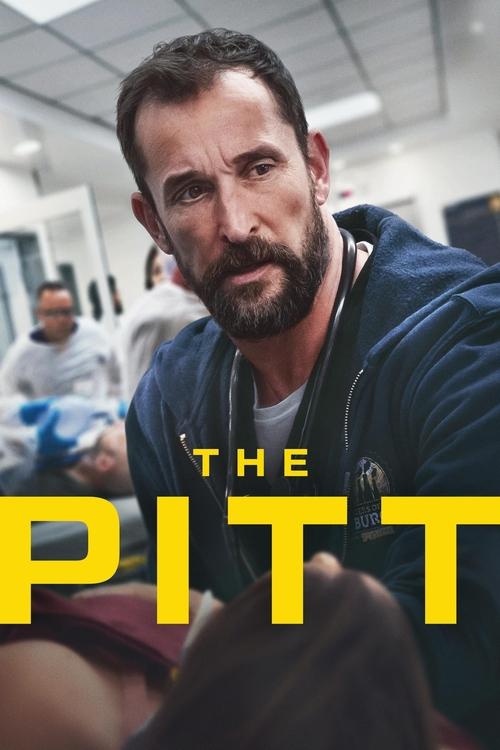
The Pitt
"15 episodes. 15 hours. 1 shift."
Overview
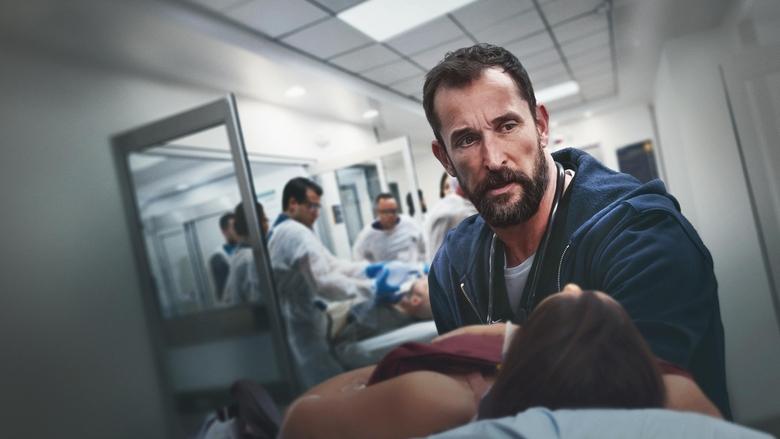
"The Pitt" offers a visceral, real-time depiction of the immense pressures faced by frontline healthcare workers in a contemporary American hospital. The first season unfolds over a single, grueling 15-hour shift at the fictional Pittsburgh Trauma Medical Center, with each of the 15 episodes representing one hour. The series is anchored by Dr. Michael "Robby" Robinavitch (Noah Wyle), a veteran attending physician haunted by the trauma of the COVID-19 pandemic, particularly the anniversary of his mentor's death which falls on this day.
As Robby guides a team of residents, interns, and new medical students through a relentless barrage of critical cases, the series explores the systemic failures of the healthcare system, including chronic underfunding, staff shortages, and the immense emotional and psychological toll it takes on its practitioners. The narrative masterfully weaves together the high-stakes medical procedures with the personal struggles and interpersonal dynamics of the staff, from addiction and burnout to financial hardship and the conflict between professional duty and personal well-being. The season culminates in a mass casualty event that pushes the already strained department, and its leader, to the breaking point.

Core Meaning
The core meaning of "The Pitt" is an unflinching examination of the profound human cost of a broken healthcare system. The creators sought to shine a light on the post-pandemic reality for medical professionals, moving beyond the idealized hero narrative to reveal their vulnerability, burnout, and the mental health crises they face. The series argues that the fragility of the healthcare system is directly proportional to the fragility of its practitioners' mental health. It's a tribute to the resilience and compassion of these individuals, while simultaneously serving as a powerful critique of a system that asks them to perform miracles in an environment of scarcity and overwhelming pressure, ultimately questioning how much trauma the healers can endure before they break themselves.
Thematic DNA
Systemic Failure in Healthcare
This is the central theme, constantly reinforced by the visual of an overcrowded waiting room, gurneys lining the hallways, and frequent discussions of staff shortages and underfunding. Hospital administrator Gloria (Michael Hyatt) repeatedly confronts Dr. Robinavitch about efficiency and patient satisfaction scores, highlighting the conflict between the business of healthcare and the practice of medicine. The narrative demonstrates how these systemic issues directly impact patient care and place an unsustainable burden on the staff, leading to burnout and moral injury.
The Mental and Emotional Toll on Healers
The series delves deep into the psychological trauma carried by its characters. Dr. Robby's journey is a season-long arc of a hero's deconstruction, as he battles PTSD from the COVID-19 pandemic, culminating in a severe breakdown and a near-suicide attempt in the finale. Other characters also grapple with their own demons: Dr. Langdon's secret drug addiction, Charge Nurse Dana Evans' burnout after being physically assaulted, and Dr. Mohan's struggle with work-life balance all illustrate the immense personal cost of their profession.
Human Fallibility and Resilience
Despite their expertise, the characters are portrayed as deeply human and fallible. They make mistakes, have personal biases, and struggle with their emotions. Dr. Langdon's addiction compromises his judgment, and even the heroic Dr. Robby makes questionable decisions as his mental state deteriorates. Yet, the series also showcases their incredible resilience. They continue to save lives under impossible circumstances, find moments of compassion (like Dr. Santos offering a homeless colleague a place to live), and support each other through profound trauma, highlighting the strength of their shared humanity.
Realism and Authenticity in Medicine
A defining theme is the show's commitment to medical accuracy, which has been widely praised by real-life medical professionals. The series avoids overly dramatized or stylized medical events, instead focusing on the meticulous, chaotic, and often gory process of emergency care. From the use of complex medical jargon to the realistic depiction of procedures and injuries (like a "degloved" foot in the first episode), the show grounds its drama in a palpable sense of reality, which heightens the stakes and the audience's immersion.
Character Analysis
Dr. Michael 'Robby' Robinavitch
Noah Wyle
Motivation
His primary motivation is to save lives and mentor the next generation of doctors, driven by a profound sense of duty. However, as the season progresses, his motivation becomes intertwined with a desperate attempt to outrun his own trauma and grief. He throws himself into his work to avoid confronting the memories of the pandemic and the loss of his mentor, a struggle that ultimately proves unsustainable.
Character Arc
Robby begins the series as the competent, empathetic, and heroic leader of the ER, but is privately crumbling under the weight of PTSD from the COVID-19 pandemic, triggered by the anniversary of his mentor's death. Throughout the 15-hour shift, his composure slowly erodes. The relentless trauma, culminating in a mass shooting where his surrogate son's girlfriend dies, leads to a complete mental breakdown in Episode 13. His arc is a powerful deconstruction of the infallible doctor trope, ending with him on the hospital rooftop, suicidal, having to be saved by a colleague. It's a journey from perceived strength to acknowledged vulnerability, highlighting the critical need for mental health support for healthcare workers.
Dana Evans
Katherine LaNasa
Motivation
Dana is motivated by a deep-seated commitment to her patients and her colleagues. She is the fierce protector of the nurses and the one who keeps the department running. Her motivation erodes as the personal cost becomes too high, and the daily abuse and systemic failures extinguish her passion for the job.
Character Arc
Dana is the highly experienced, tough-as-nails charge nurse who acts as the ER's logistical and emotional backbone. Her arc traces the path to burnout. Initially, she is the unshakable veteran, managing the chaos with authority. A turning point occurs when she is violently punched by a patient, leaving her physically and emotionally shaken. This event, compounded by the overwhelming stress of the mass shooting, pushes her past her breaking point. By the end of the season, she confesses her desire to quit, and is seen quietly removing her personal photos from her desk, signaling the end of her long career in a department she can no longer endure.
Dr. Frank Langdon
Patrick Ball
Motivation
Langdon is motivated by ambition and a genuine, if arrogant, confidence in his medical skills. He wants to be the best. However, this is secretly undermined by his addiction, which becomes his primary, hidden motivator. He is driven to maintain his high-functioning facade to protect his career and his access to drugs.
Character Arc
Langdon is presented as a cocky, highly skilled senior resident and Robby's mentee. His arc is a descent into crisis as his secret opioid addiction is revealed. He is caught stealing medication from the ER by Dr. Santos and subsequently confronted by Robby, who suspends him. Despite being sent home, he returns to help during the mass casualty event, demonstrating his capability as a doctor even while impaired. His season ends in a heated confrontation with Robby, where he exposes Robby's own breakdown while deflecting from his addiction. His arc ends not with resolution but with his career in jeopardy, setting up a potential road to recovery or ruin for Season 2.
Dr. Trinity Santos
Isa Briones
Motivation
Her primary motivation is to prove herself and excel as a doctor. She is fiercely ambitious and driven to be the best, which sometimes manifests as arrogance. However, she is also motivated by a strong, if not always visible, moral compass, which compels her to do the right thing, even when it's difficult or unpopular.
Character Arc
Santos starts the season as a brash, overly confident, and often abrasive intern who clashes with her colleagues, particularly the less confident Dr. Whitaker. She is a controversial figure, seen by some as a risk-taker whose bravado could be dangerous. Her arc involves the gradual revealing of a more compassionate and principled character beneath the tough exterior. This is first shown when she rightly reports Dr. Langdon's drug theft, and culminates in the finale when she discovers Whitaker is homeless and, in a surprising act of kindness, offers him a place to live. Her arc is about challenging first impressions and revealing hidden depth and empathy.
Symbols & Motifs
The Hospital Rooftop
The rooftop of the Pittsburgh Trauma Medical Center symbolizes a place of ultimate crisis, contemplation, and fragile connection. It represents the precipice—both literally and metaphorically—where the characters confront the overwhelming weight of their job and their own mortality.
The rooftop bookends the first season. In the premiere, "7:00 A.M.", Dr. Robby finds his night-shift counterpart, Dr. Abbott, on the ledge, contemplating suicide after a brutal shift. In the finale, "9:00 P.M.", the roles are reversed. After his own complete breakdown, a traumatized Robby finds himself on the same ledge, only to be found and talked down by Dr. Abbott, bringing their shared experience of trauma and support full circle.
The Overflowing Waiting Room
The waiting room, constantly shown to be packed with patients waiting for hours or even days, is a persistent visual motif that symbolizes the brokenness and inadequacy of the healthcare system. It's a physical manifestation of the staff shortages and lack of resources that plague the hospital.
From the very first scene of the series, the waiting room is depicted as chaotic and overflowing. It is a constant source of stress for the characters, who are painfully aware of the people suffering just outside the ER doors. Dr. Robby explicitly tells the new interns to keep an eye on the waiting room to ensure no one dies out there, highlighting it as a zone of constant, unmanageable risk.
Memorable Quotes
A hundred and fifty thousand people die every day in the world. Today, you got one of them. And we're going to get more of them before the shift is over.
— Dr. Michael 'Robby' Robinavitch
Context:
Said in the first episode, "7:00 A.M.", as Robby briefs the new medical students and interns at the start of their harrowing 15-hour shift.
Meaning:
This quote, delivered to the new recruits, encapsulates the grim, relentless reality of emergency medicine. It's a stark introduction to the daily confrontation with death that defines their work and serves as a brutal check on any romantic notions of the job.
Tears are just grief leaving our body.
— Dr. Michael 'Robby' Robinavitch
Context:
Spoken to a colleague during a moment of reflection in the first season, it becomes a key piece of his characterization, highlighting his role as a mentor despite his own internal struggles.
Meaning:
This line reveals Robby's underlying empathy and his philosophy for processing trauma. It's a moment of gentle wisdom amidst the chaos, acknowledging the necessity and normality of expressing emotional pain, something he himself struggles to do.
You're a sensitive person, and this is a tough place for sensitive people. But we need them badly.
— Dr. Frank Langdon
Context:
Spoken to Dr. King in the latter half of the season, this moment stands in stark contrast to Langdon's usual arrogance and his aggressive defensiveness about his addiction.
Meaning:
In a surprising moment of insight and empathy, Langdon says this to the gentle Dr. Mel King. It's a significant quote because it acknowledges that sensitivity, often seen as a weakness in such a high-pressure environment, is actually a vital and necessary quality for a good doctor. It also shows a flicker of the better man within the troubled Langdon.
Welcome to the Pitt. Let's go save some lives.
— Dr. Michael 'Robby' Robinavitch
Context:
Said in the pilot episode, "7:00 A.M.", as Robby officially begins the shift with the new students and interns, plunging them directly into the chaos.
Meaning:
This is the call to action that defines the series. It's both an informal greeting and a mission statement, acknowledging the grim nickname of their workplace while immediately focusing on their core purpose. It captures the blend of cynicism and idealism required to work there.
Episode Highlights
7:00 A.M.
The premiere establishes the series' unique real-time format and relentless tone. It introduces the key characters, the hospital's dire state of overcrowding, and the central emotional conflict for Dr. Robby: the anniversary of his mentor's death. The episode ends with the harrowing rooftop scene where Robby must talk down a suicidal Dr. Abbott, setting the stakes for the season's exploration of physician burnout.
This episode masterfully sets the stage, defining the show's visual style, thematic concerns, and the immense pressure the characters are under from the very first minute of their 15-hour day.
4:00 P.M.
This is a pivotal episode for Dr. Langdon's arc. Dr. Santos, after witnessing suspicious behavior, informs Robby that she believes Langdon is stealing medication. Robby investigates and finds proof in Langdon's locker, leading to a tense confrontation where he sends his mentee home.
This episode marks a major turning point in the series, confirming a main character's drug addiction and shattering the trust between Robby and Langdon. It creates a significant ethical and personal crisis that reverberates through the rest of the season.
6:00 P.M.
Widely regarded as one of the best episodes, "6:00 P.M." depicts the immediate aftermath of a mass shooting at a local music festival, "PittFest." The ER is inundated with victims, and the episode becomes a masterclass in controlled chaos. All interpersonal drama is sidelined as the team works in horrifyingly beautiful unison to save as many lives as possible. The camera work is tight and relentless, immersing the viewer in the visceral reality of a mass casualty event.
This episode is the dramatic apex of the season, showcasing the cast's medical training and the show's unflinching realism. It's the event that directly leads to Dr. Robby's final breakdown and pushes every character to their absolute limit.
7:00 P.M.
Continuing the mass shooting aftermath, this episode focuses on the emotional toll. The tragedy becomes personal for Robby when his surrogate son, Jake, arrives with his girlfriend, Leah, who is mortally wounded. Robby's desperate attempts to save her fail, and having to tell Jake she died triggers his complete psychological collapse in a raw and powerful scene.
This episode is the emotional climax of Dr. Robby's season-long arc. It's the point where the 'Wounded Healer' finally succumbs to his wounds, shattering the heroic facade and revealing the broken man beneath. Noah Wyle's performance in this episode was widely cited as award-worthy.
9:00 P.M.
The season finale is a quiet, melancholic look at the immediate aftermath of the traumatic shift. Key plotlines are resolved: Dr. McKay avoids arrest, Dana Evans silently decides to quit, and Dr. Santos offers a homeless Dr. Whitaker a place to live. The episode culminates with the emotional rooftop scene where a broken Robby contemplates suicide and is saved by Dr. Abbott, the same man he saved in the premiere.
The finale provides a poignant and emotionally resonant conclusion to the 15-hour ordeal. It forgoes a dramatic cliffhanger for character-focused resolution, solidifying the show's core themes of trauma, burnout, and the fragile bonds that help the characters survive.
Philosophical Questions
What is the true cost of empathy in professions defined by trauma?
The series explores this by showing how the doctors' compassion is both their greatest strength and their greatest vulnerability. Dr. Robby's deep empathy makes him an excellent mentor and physician, but it also leads to his profound psychological breakdown as he absorbs the endless suffering around him. The show questions whether it's possible to remain empathetic and effective without eventually being consumed by the immense grief inherent in the work.
Where is the line between professional duty and personal survival?
This question is central to the arcs of several characters. Dana Evans reaches her limit and seemingly chooses survival by quitting. Dr. Langdon's addiction is a twisted form of survival that jeopardizes his duty. Dr. McKay removes her ankle monitor—a legal violation—to fulfill her medical duty during a crisis. The series constantly places characters in situations where their oath to 'do no harm' conflicts with their own well-being, forcing them to make impossible choices.
In a broken system, what does it mean to be a 'good' doctor?
"The Pitt" challenges the traditional definition of a good doctor. Is it Dr. Mohan, who takes time with patients but is criticized for being slow? Is it Dr. Santos, who is brilliant and efficient but often lacks bedside manner? Or is it Dr. Robby, the ideal physician who is privately falling apart? The series suggests that in an underfunded, understaffed system, the metrics for success are warped, and simply surviving a shift can be its own form of victory.
Cultural Impact
"The Pitt" premiered in January 2025 to widespread critical acclaim, quickly becoming one of the most talked-about and best-reviewed shows of the year. Its success was largely driven by word-of-mouth, especially within the medical community, which lauded the series for its unprecedented realism and its raw, honest portrayal of the challenges facing the profession post-COVID. The show's real-time, 15-hour-shift format was hailed as an innovative and immersive storytelling device that set it apart from other medical dramas.
The series sparked national conversations about physician burnout, hospital staffing crises, and the mental health of frontline workers. Its unflinching look at topics like gun violence, the opioid crisis, and the systemic failures of the American healthcare system resonated deeply with audiences. The show's impact was solidified at the 77th Primetime Emmy Awards, where it won five awards, including the coveted prize for Outstanding Drama Series, and acting awards for Noah Wyle and guest star Shawn Hatosy, cementing its status as a cultural phenomenon and a new benchmark for the medical drama genre.
Audience Reception
"The Pitt" received an overwhelmingly positive reception from audiences, becoming a word-of-mouth hit that saw its viewership grow consecutively for 13 weeks. The first season averaged 10 million viewers globally across all platforms, with the premiere episode eventually surpassing 16 million viewers. Audiences praised the show's intense realism, gripping storytelling, and powerful performances, particularly Noah Wyle's portrayal of Dr. Robinavitch. The real-time format was a frequent point of praise for creating a uniquely stressful and immersive experience. The series resonated particularly strongly with healthcare professionals, who flooded social media with reactions, calling it the most accurate medical drama they had ever seen. While some critics found the relentless bleakness and occasional melodrama to be overwhelming, the general consensus from viewers was that the show's unflinching honesty was its greatest strength, making it compelling and essential viewing.
Interesting Facts
- The series was filmed chronologically, with the actors shooting the scenes for each hour-long episode in sequential order to help them realistically portray the escalating fatigue and stress of a 15-hour shift.
- Production designer Nina Ruscio built a complete, 360-degree ER set, allowing the handheld cameras to move freely through the space in long, uninterrupted takes, enhancing the show's documentary-like feel.
- To ensure authenticity, the main cast underwent a two-week medical boot camp before filming to learn the basics of procedures and how to handle medical equipment correctly.
- During filming, the crew members wore scrubs on set, just like the actors. This was done partly so they wouldn't be noticeable in reflections, but it also helped foster a collaborative atmosphere where everyone felt like part of the same team.
- The show's creators, R. Scott Gemmill and John Wells, along with star Noah Wyle, are all veterans of the iconic medical drama "ER". The idea for "The Pitt" originated from Wyle sharing letters he received from frontline workers during the COVID-19 pandemic with his former colleagues.
- While most of the series was filmed on a soundstage in Burbank, California, the production spent three days shooting exteriors in Pittsburgh at the real Allegheny General Hospital, which stood in for the fictional Pittsburgh Trauma Medical Center.
⚠️ Spoiler Analysis
Click to reveal detailed analysis with spoilers
Frequently Asked Questions
Explore More About This Movie
Dive deeper into specific aspects of the movie with our detailed analysis pages
Comments (0)
No comments yet. Be the first to share your thoughts!