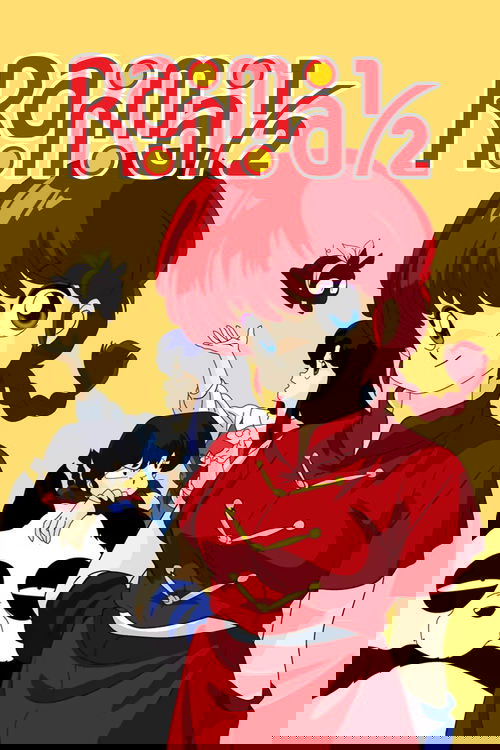
Ranma ½
A chaotic ballet of martial arts and romance, where a splash of cold water pirouettes a boy into a girl, painting a vibrant, hilarious canvas of identity.
Ranma ½

Ranma ½

らんま1/2

15 April 1989 — 25 September 1992 Japan 1 season 161 episode Ended ⭐ 8.6 (1,469)
Cast: Kappei Yamaguchi, Megumi Hayashibara, Noriko Hidaka, Kenichi Ogata, Kikuko Inoue
Animation Sci-Fi & Fantasy Action & Adventure Comedy
Gender Identity and Fluidity Love and Relationships Martial Arts and Honor Acceptance and Self-Discovery

Overview

Ranma ½, created by the renowned Rumiko Takahashi, revolves around Ranma Saotome, a prodigious teenage martial artist with a unique problem. During a training trip in China with his father, Genma, they fall into the cursed springs of Jusenkyo. Ranma emerges from the 'Spring of Drowned Girl' and is now cursed to turn into a red-headed girl when splashed with cold water, only reverting to his male form with hot water. His father suffers a similar fate, turning into a giant panda.

Their lives become even more complicated upon arriving at the Tendo Dojo in Nerima, Tokyo. Genma has a long-standing agreement with his friend Soun Tendo to unite their families, betrothing Ranma to one of Soun's three daughters. The engagement falls to the youngest, Akane Tendo, a formidable martial artist in her own right who happens to despise boys. The series follows their tumultuous love-hate relationship, as they navigate high school, constant battles with a bizarre array of rivals and additional fiancées, and the endless search for a cure to their curses. The narrative is a whirlwind of slapstick comedy, intricately choreographed martial arts, and evolving romantic entanglements.
Core Meaning

At its heart, Ranma ½ is a progressive exploration of identity, love, and acceptance, wrapped in the guise of a martial arts romantic comedy. The creator, Rumiko Takahashi, intended it as a 'simple, fun idea' rather than a vehicle for a social agenda. However, the series profoundly delves into themes of gender fluidity and the arbitrary nature of societal gender roles long before such topics were mainstream. Ranma's curse forces him to literally walk in another's shoes, challenging traditional notions of masculinity and femininity. The core message is that one's identity is not defined by physical form but by character, actions, and heart. It champions the idea of accepting oneself and others, with all their eccentricities and curses, suggesting that true strength lies in embracing the entirety of who you are.

Thematic DNA

Gender Identity and Fluidity 35%
Love and Relationships 30%
Martial Arts and Honor 25%
Acceptance and Self-Discovery 10%

Gender Identity and Fluidity

The central theme of the series is the exploration of gender. Ranma's curse is the primary vehicle for this, forcing him to live as both a man and a woman. This was groundbreaking for its time, presenting themes of gender fluidity in a humorous and accessible way. The series often subverts gender stereotypes; Akane is a powerful martial artist who is considered 'tomboyish,' while many male characters display vulnerability and emotional depth. Ranma often uses his female form to his advantage, demonstrating that strength and capability are not tied to a specific gender. The show challenges the audience's perceptions of traditional gender roles and highlights the social constructs surrounding them.

Love and Relationships

Ranma ½ is fundamentally a romantic comedy, exploring the complexities of young love through the bickering, tsundere-style relationship of Ranma and Akane. Their engagement is arranged, and both initially reject it, but they slowly develop deep-seated feelings for each other, which they are too proud or awkward to admit. The central romance is complicated by a vast array of suitors for both Ranma (in both forms) and Akane, including Shampoo, Kodachi Kuno, and Ukyo Kuonji. This 'harem' setup, which the series helped popularize, is used to create comedic chaos and to test the central couple's bond, ultimately reinforcing their connection through shared trials.

Martial Arts and Honor

The world of Ranma ½ is built on a foundation of martial arts, but it's a wildly imaginative and often absurd interpretation of them. The 'Anything-Goes School of Martial Arts' is a central concept, leading to fantastical styles like Martial Arts Rhythmic Gymnastics, Martial Arts Tea Ceremony, and Martial Arts Takeout Delivery. These exaggerated forms serve as a backdrop for both comedy and action. Beneath the silliness, however, are themes of discipline, rivalry, and honor. Characters are constantly challenging each other to prove their strength and defend their pride. Ranma's primary motivation, beyond finding a cure, is to be the best martial artist he can be, and his rivalry with characters like Ryoga is a driving force of the narrative.

Acceptance and Self-Discovery

Throughout the series, the characters grapple with their own flaws, curses, and insecurities. Ranma initially finds his curse humiliating but gradually learns to live with it and even use it strategically. Akane struggles with her perceived lack of femininity and her violent temper. The journey of the characters is one of gradual self-acceptance. They learn to navigate their bizarre circumstances and complex relationships. The core message is that true growth comes not from changing one's essential nature (or finding a magical cure) but from understanding and accepting oneself and the people one cares about, imperfections and all.

Character Analysis

Ranma Saotome

Kappei Yamaguchi (Male), Megumi Hayashibara (Female)

Archetype: The Reluctant Hero
Key Trait: Prideful but Good-Hearted

Motivation

Initially, his sole motivation is to find a cure for his Jusenkyo curse and become the 'manliest man.' This goal often drives him into absurd situations. As the series progresses, his motivation expands to include protecting Akane and his friends from the chaos that constantly surrounds them. He is driven by a deep-seated desire to be the best martial artist and will never back down from a challenge, but his connections to others, particularly Akane, become an equally powerful motivator.

Character Arc

Ranma begins the series as an arrogant, cocky, and somewhat tactless martial artist, solely focused on his training and finding a cure for his curse. His arranged engagement to Akane is a major annoyance to him. Over the course of 161 episodes, he undergoes significant, albeit slow, emotional growth. While he never fully loses his arrogance, he becomes more considerate and protective of others, especially Akane. He learns to use his female form strategically and becomes less ashamed of it. His arc is about maturing beyond his pride, learning to be vulnerable, and admitting his true feelings, even if he can only do so through actions rather than words.

Akane Tendo

Noriko Hidaka

Archetype: The Tsundere
Key Trait: Short-tempered but Compassionate

Motivation

Akane's primary motivation is to be seen as more than just a 'tomboy' or a prize to be won. She wants to be respected for her strength and her own choices. While she often finds herself in the role of a damsel in distress, she actively fights against it. Her feelings for Ranma become a central motivation, compelling her to become stronger, face danger to help him, and navigate the emotional turmoil of their relationship.

Character Arc

Akane starts as a strong-willed, independent, and notoriously short-tempered girl who claims to hate all boys due to constant unwanted attention. Her engagement to Ranma infuriates her, leading to violent, comedic clashes. Throughout the series, her tough exterior is frequently broken down, revealing a deeply sensitive and caring person who dreams of romance. Her relationship with Ranma forces her to confront her own insecurities about her femininity and her temper. Her arc involves learning to trust Ranma, accepting his bizarre situation, and becoming more honest with her own feelings, moving from constant hostility to a complex, love-hate dynamic that leans more towards love.

Ryoga Hibiki

Koichi Yamadera

Archetype: The Rival / The Lost Boy
Key Trait: Eternally Lost and Vengeful

Motivation

Ryoga is driven by two powerful forces: his intense desire for revenge against Ranma and his deep, secret love for Akane. His entire life revolves around these two conflicting goals. As P-Chan, he gets to be close to Akane, but in his human form, he is Ranma's sworn enemy. This duality traps him in a cycle of comedic tragedy and furious combat.

Character Arc

Ryoga is introduced as Ranma's primary rival, holding a grudge for being made late to a duel, which indirectly led to him falling into the 'Spring of Drowned Piglet.' Cursed to turn into a small black pig (whom Akane names P-Chan), he possesses a comically terrible sense of direction. His arc is one of perpetual rivalry and unrequited love for Akane. While his goal of defeating Ranma never wavers, he occasionally becomes a reluctant ally. He remains largely a static character, defined by his eternal quest for victory over Ranma and his inability to confess his feelings to Akane, but his presence continually challenges Ranma and complicates the central romance.

Genma Saotome

Cho (as Kenichi Ogata)

Archetype: The Irresponsible Mentor
Key Trait: Selfish and Scheming

Motivation

Genma's motivations are simple and selfish: personal comfort, food, and avoiding responsibility. When in his panda form, he communicates via wooden signs, often offering cynical or unhelpful advice. He pushes the engagement with Akane primarily to secure a home and the future of the Tendo dojo for his own benefit.

Character Arc

Genma is Ranma's father and a master of the Anything-Goes School of Martial Arts. He is cursed to become a giant panda. Genma is largely a static character who serves as a source of conflict and comic relief. His character arc is non-existent; he remains selfish, scheming, and a terrible father throughout the series. He is responsible for most of Ranma's problems, having arranged multiple engagements for his son in exchange for food or training tools. His actions, driven by greed and cowardice, consistently create new obstacles for Ranma to overcome.

Symbols & Motifs

The Cursed Springs of Jusenkyo

Meaning:

The springs symbolize transformation, fate, and the inescapable, often comical, consequences of one's actions. Each spring holds a tragic history, imposing the form of whatever drowned there onto its victims. This represents how the past can physically manifest and alter one's present identity. The curse is not just a physical change; it's a constant challenge to the characters' sense of self and forces them to adapt to new perspectives.

Context:

Jusenkyo is the inciting incident of the entire series, cursing Ranma, Genma, Ryoga, Shampoo, and Mousse. The search for a cure, specifically for the 'Spring of Drowned Man' (Nanniichuan), becomes a recurring goal for Ranma and others, driving many of the plot's adventures and wild-goose chases. The springs are a constant presence, as the transformations can be triggered by a simple splash of cold water, leading to endless comedic and dramatic situations.

Water (Hot and Cold)

Meaning:

Water is the direct catalyst for transformation and symbolizes the duality of identity and the thin line between different states of being. Cold water represents the activation of the curse, a change often brought about by accident or chaos. Hot water symbolizes a return to the 'original' self, a temporary restoration of normalcy. This constant back-and-forth illustrates the fluid and unstable nature of the characters' lives and identities.

Context:

Used in virtually every episode, the hot/cold water mechanic is the series' primary comedic and plot device. A rainstorm, a spilled drink, or a fall into a pond can instantly change the entire dynamic of a scene, turning a serious fight into a farce or vice versa. Kettles of hot water are a staple of the Tendo household, always on hand to reverse an unwanted transformation.

Akane's Cooking

Meaning:

Akane's notoriously terrible cooking symbolizes her struggles with traditional femininity and her fierce, sometimes destructive, personality. Despite being a powerful martial artist, she fails spectacularly at this traditional domestic skill. It's a source of great comedy but also a point of genuine insecurity for her. It represents the idea that no one is perfect and that strength in one area can be balanced by weakness in another.

Context:

A recurring gag throughout the series. Her cooking is often described as lethal, capable of incapacitating even the strongest characters. Quotes about the deadliness of her food are common. Ranma's reluctant endurance of her cooking becomes a strange form of affection and a testament to their bond, as he is often the only one brave (or foolish) enough to eat it.

Memorable Quotes

らんま、あんたって本当に可愛くないっ!

— Akane Tendo

Context:

This line is used countless times throughout the series, usually shouted by Akane in response to Ranma teasing her, calling her a tomboy, or generally being insensitive. It is a cornerstone of their daily bickering from the very first episodes.

Meaning:

Translating to 'Ranma, you are so uncute!', this is one of Akane's most frequent and iconic lines. It perfectly encapsulates their tsundere relationship. While she's ostensibly insulting him, the frequency and passion with which she says it becomes a unique term of endearment, masking her deeper feelings of affection and frustration.

If Kasumi isn't back by dinnertime, we're gonna have to eat Akane's cooking.

— Ranma Saotome

Context:

This line or variations of it are spoken whenever Kasumi, the Tendo family's gentle and skilled homemaker, is absent, and the dread of an Akane-cooked meal looms over the household.

Meaning:

This quote is a humorous testament to the legendary awfulness of Akane's cooking. It highlights a key running gag in the series and shows how the entire household lives in fear of her culinary creations. It's a line that bonds the characters through shared comical suffering.

Where the heck am I now?

— Ryoga Hibiki

Context:

Ryoga utters this line whenever he appears in a new location, having been on a journey to find Ranma or return to the Tendo dojo. He might be trying to cross the street and end up in a different prefecture, underscoring the comedic tragedy of his character.

Meaning:

This is Ryoga's catchphrase, perfectly summarizing his defining characteristic: a complete and utter lack of a sense of direction. No matter how simple the journey, Ryoga will inevitably become hopelessly lost, often ending up in different countries. The quote signifies his role as the 'eternal lost boy.'

Episode Highlights

Here's Ranma

S1E1

The pilot episode introduces the core premise and characters. It establishes the Jusenkyo curse, showing Ranma and his father Genma's transformations. It also sets up the central conflict of the arranged marriage between Ranma and Akane Tendo, beginning their iconic love-hate dynamic from the moment Akane discovers Ranma's secret in the bathtub.

Significance:

This episode lays the entire foundation for the 161-episode series. It masterfully blends exposition with comedy and introduces the central conceit—the gender-swapping curse—that drives the entire narrative.

Enter Ryoga! The Eternal 'Lost Boy'

S1E7

This episode introduces Ranma's main rival, Ryoga Hibiki. It explains his backstory, his own Jusenkyo curse (turning into a piglet), and his burning desire for revenge against Ranma. Their first major battle at Furinkan High School showcases their power and sets the tone for their long-running rivalry.

Significance:

The introduction of Ryoga is a pivotal moment. He becomes a cornerstone of the series, serving as a persistent rival to Ranma and a tragic romantic competitor for Akane's affections (as his pig form, P-Chan, becomes her beloved pet).

Enter Shampoo, the Gung-Ho Girl! I Put My Life in Your Hands

S1E15

The arrival of Shampoo, a formidable Chinese Amazon warrior, adds another layer of chaos. Having been defeated by female Ranma, she hunts him to Japan to kill him. However, after being defeated by male Ranma, tribal law dictates she must marry him, making her the first of Ranma's multiple fiancées.

Significance:

Shampoo's introduction expands the cast and the romantic complications exponentially. She solidifies the 'harem' aspect of the show and becomes a major, often aggressive, rival to Akane for Ranma's affection.

A Woman's Love Is War! The Martial Arts Rhythmic Gymnastics Challenge!

S1E12

This episode introduces another key rival, Kodachi Kuno, the 'Black Rose.' When Akane is injured before an 'anything-goes' martial arts rhythmic gymnastics match against her, Ranma (in his female form) must take her place. The episode is a perfect example of the series' bizarre and hilarious take on martial arts.

Significance:

It establishes the show's formula of adapting any activity into a form of combat. It also adds Kodachi to Ranma's ever-growing list of admirers and demonstrates Ranma's willingness to help Akane, even if he complains about it the entire time.

Akane Goes to the Hospital!

S6E127

A rare episode that focuses more on romance than comedy. After Akane sprains her ankle, Ranma finds himself too embarrassed and flustered to visit her properly. The episode explores his genuine feelings for her, as he daydreams about confessing his love. It's a significant step forward in their relationship, filled with moments of vulnerability.

Significance:

This episode is a fan favorite because it provides one of the clearest confirmations of Ranma's deep feelings for Akane, moving their relationship beyond simple slapstick and into genuine romantic development.

Philosophical Questions

What defines a person's true identity: their physical body or their consciousness?

The series constantly plays with this question. Ranma always maintains his male consciousness, personality, and memories, regardless of his physical form. He insists, 'I am a man!' even when in a girl's body. However, society reacts to him based on his appearance, and he is often forced to navigate situations from a female perspective. This raises questions about whether identity is an internal state of being or a social construct defined by how others perceive you. The show suggests that the 'true self' is the consistent mind within, but it also acknowledges that the physical body profoundly shapes one's experiences and interactions with the world.

Is love based on who a person is, or what they are?

This question is explored through the various romantic entanglements. Akane falls for Ranma, the boy, and is often jealous or confused by his female form. Tatewaki Kuno, on the other hand, loves Akane and despises male Ranma, but is madly in love with female Ranma (the 'Pigtailed Girl'), refusing to believe they are the same person. Shampoo loves male Ranma but wants to kill female Ranma. The series probes whether love can transcend physical form. The slow-burning romance between Ranma and Akane suggests that true love involves accepting every part of a person, curse and all.

Alternative Interpretations

While presented as a heterosexual romantic comedy, Ranma ½ has been widely embraced and interpreted through an LGBTQ+ lens. Ranma's ability to exist as both male and female makes him an icon for discussions of gender fluidity, transgender identity, and non-binary experiences. Some interpretations view Ranma's journey not as a quest to 'cure' himself and restore a male-only identity, but as a journey toward accepting his dual nature. His female form is not just a disguise but a genuine part of who he is, possessing its own strengths and perspectives.

Another interpretation focuses on the series as a critique of toxic masculinity. Many of Ranma's problems stem from his father Genma's selfish and irresponsible actions, which are often framed as misguided attempts to make Ranma 'a man among men.' Ranma's own struggles with pride, his inability to express emotion, and his constant need to prove his strength can be seen as a deconstruction of traditional, restrictive masculine ideals, which are constantly being challenged by his physical transformation into a woman.

Cultural Impact

Ranma ½ had a profound and lasting impact on the anime and manga landscape, both in Japan and internationally. It was one of the first major anime and manga series to achieve mainstream popularity in the United States in the 1990s, paving the way for the larger anime boom that followed.

Its most significant influence was its pioneering exploration of gender-bending and gender fluidity. Long before these themes were common, Ranma ½ used its central premise to humorously deconstruct gender roles and stereotypes, influencing countless series in the romantic comedy, 'harem,' and gender-bender genres that came after it. The series' blend of slapstick comedy, romance, and martial arts created a unique formula that has been often imitated.

The character archetypes, particularly the 'tsundere' personality of Akane, were refined and popularized by the series. The dynamic of a large cast of characters with complicated, intersecting relationships became a staple of the genre. Despite being a product of the late 80s and early 90s, its themes of identity and acceptance continue to resonate with modern audiences, cementing its legacy as a timeless classic. The announcement of a full remake in 2024, more than three decades after the original's debut, is a testament to its enduring popularity and cultural significance.

Audience Reception

The reception of Ranma ½ was initially mixed. The first anime series, which ran for 18 episodes in 1989, suffered from low ratings and was canceled. However, the show was quickly retooled, given a new time slot, and rebranded as Ranma ½ Nettōhen. This second iteration became a massive success in Japan and ran for another 143 episodes. Internationally, it became a gateway anime for many viewers in North America and Europe during the 1990s, where it was lauded for its unique blend of comedy, action, and romance.

Audiences have overwhelmingly praised the series' humor, memorable and eccentric cast of characters, and its lighthearted-yet-groundbreaking take on gender. The dynamic between Ranma and Akane is often cited as a highlight. Criticisms are generally directed at the repetitive nature of the plot in later parts of the series, where a 'new rival of the week' formula becomes more prominent. Another point of contention is that the anime adaptation ended abruptly, covering only about half of the manga's story and leaving many plotlines unresolved.

Interesting Facts

  • The creator, Rumiko Takahashi, decided to make the main character male after her previous series, Urusei Yatsura, featured a female protagonist. Worried about writing a male lead, she made him half-female to make it more interesting.
  • The idea for the water-based transformation reportedly came to Takahashi from the vision of a traditional Japanese bathhouse's cloth entrance sign.
  • The setting of Nerima, Tokyo, is based on the actual district where Rumiko Takahashi lives.
  • The initial 18-episode run of the anime in 1989 received low ratings and was canceled. It was then reworked by the same staff into a new time slot as 'Ranma ½ Nettōhen,' which became immensely popular and ran for another 143 episodes.
  • The manga has sold over 55 million copies, making it one of the best-selling manga series of all time.
  • Many of the original Japanese voice actors reprised their roles for the new 2024 remake, over 30 years after the original series ended.

⚠️ Spoiler Analysis

Click to reveal detailed analysis with spoilers

Frequently Asked Questions

Explore More About This Movie

Dive deeper into specific aspects of the movie with our detailed analysis pages

Comments (0)

Leave a comment

No comments yet. Be the first to share your thoughts!